


Freight Shipping between Thailand and Czechia | Rates – Transit times – Duties and Taxes
The first mistake you can make with shipping between Thailand and Czechia is treating it like a simple port-to-port move, when in reality you are coordinating Southeast Asian export procedures with EU import compliance in a landlocked country. You are dealing with departures from hubs like Laem Chabang, European gateway ports, inland rail or road transfers, and customs rules that can shift your budget if you overlook one document. If you want clarity on transit times, realistic freight costs, customs duties, and the smartest way to structure your Thailand to Czech Republic logistics flow, this Destination guide will walk you through the operational facts you actually need to plan with confidence.
Which are the different modes of transportation between Thailand and Czechia?
If you prioritize speed and high-value cargo, you will choose air freight from Bangkok to Prague, accepting higher costs for tighter lead times. If your goods are heavier or less urgent, you will move them by sea from Laem Chabang to a major EU port like Hamburg, then continue by rail or truck into Czechia to control your landed cost.
You will notice fast that Czechia being landlocked changes the equation, because your ocean freight always includes a European inland leg. From experience, this is where planning makes the difference, so you can contact our team anytime and we will help you compare real-time capacity, pricing, and routing options before you commit, and we will break each mode down in more detail below.
Need help with your shipment?
Need assistance with your shipment? Dont hesitate to contact us even for a simple question. Choose the option that suits you
Live chat with an expert Chat on WhatsApp Free Quote 24hHow can Siam Shipping help you
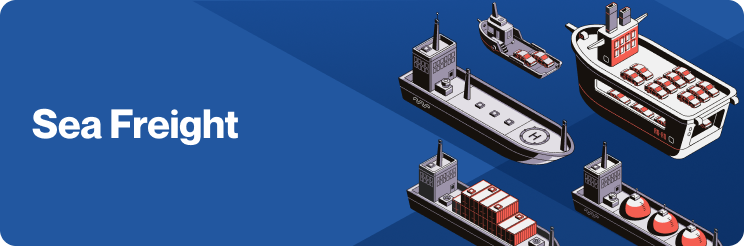
Sea freight between Thailand and Czechia
If you are planning sea freight from Thailand to Czechia, the first thing you need to decide is simple, does ocean freight actually fit your timeline and cash flow? For most shipments above 8 to 10 CBM, regular container shipping Thailand to Czech Republic quickly becomes more cost-effective than air. You trade speed for stability and lower unit cost. If your cargo is bulky, palletized, or production-based with predictable lead times, ocean freight shipping between Thailand and Czechia usually makes sense.
Here is what many first-time importers miss. Czechia is landlocked. Your container will not arrive directly in Prague. It will move through a European gateway port and then continue by rail or truck as part of an intermodal sea freight to inland Europe chain. That inland leg affects your transit time, cost structure, and Incoterm choice more than most people expect.
Sea freight is not ideal if you need goods in less than three weeks, if your production schedule changes constantly, or if your supplier cannot manage export documentation properly. This route involves a feeder vessel and mother vessel connection in most cases, plus inland handling in Europe. Small documentation mistakes can easily add days and storage costs.
If you approach this route as structured international sea logistics Southeast Asia to Central Europe, with the right Incoterm, correct port of loading and port of discharge, and realistic transit planning, you will gain cost control and predictable lead times. If you treat it like a simple port-to-port move, you will probably underestimate the real operational flow.
Main ports to know in Thailand and Czechia
When you organize sea freight from Thailand to Czechia, you choose more than a departure and arrival point. You choose how your container integrates into the global carrier network and inland Europe.
Main Thai seaports for export cargo
- Laem Chabang: This is the primary container hub for exports to Europe. You will find the widest carrier choice, more frequent sailings, and better reliability for FCL container shipping service and LCL consolidation service.
- Bangkok Port: Suitable for smaller volumes and certain regional trades. You may face draft limitations, so many Europe-bound shipments still move via Laem Chabang.
- Map Ta Phut: Relevant if you ship petrochemical or industrial cargo. Not a mainstream container hub for general cargo to Europe, but useful for specific industries.
European gateway ports serving Czechia
- Hamburg: One of the most common gateways for Czech-bound cargo. Strong rail links into Prague and industrial zones. Good option if you want stable inland rail solutions.
- Bremerhaven: Often competitive for container shipping into Central Europe, with solid rail and truck corridors.
- Rotterdam: Major hub with high frequency. You may get competitive ocean rates, but inland trucking to Czechia must be calculated carefully.
- Koper: Sometimes used for Central Europe. Shorter sea leg via the Mediterranean, then rail or truck northbound.
Czech river ports such as Prague or Děčín are inland terminals, not ocean ports. Your container first discharges at a seaport, then continues inland. The port of loading and port of discharge you select will directly affect inland cost, transit reliability, and customs clearance planning.
Choosing between Hamburg, Rotterdam, Bremerhaven, or Koper is not just about ocean freight price. It is about rail slots, truck availability, and how close the final terminal is to your warehouse. If you plan a full door-to-door ocean freight service, you should always compare total inland cost, not only the sea leg.
Should I choose FCL or LCL when shipping between Thailand and Czechia?
Choosing between Full Container Load (FCL) and Less than Container Load (LCL), commonly known as consolidation, is a strategic decision. This choice directly influences your shipping costs, delivery timing and overall success when shipping from Thailand to Czechia. Let’s dive into understanding these two sea freight options, their benefits, and drawbacks. By the end, you’ll be equipped to make the best decision for your unique shipping needs. Shall we lay the course for smooth sailing?
Full container load (FCL)
Definition: FCL (Full Container Load) shipping is a method in which an entire container is exclusively allocated for a single consignment. It's aptly specified in 'FCL container'—the 20'ft container and 40'ft container being the standard sizes in international shipping.
When to Use: If you're shipping a high volume of goods—from Thailand to Czechia, for instance—above 13 to 15 CBM (Cubic Meters), FCL offers a cost-effective solution. Plus, as the container is sealed from origin to destination, it reduces potential damage, ensuring the safety of the goods.
Example: Suppose you're in the furniture business and need to transport 25 CBM of teak dining tables from Thailand to Czechia. Choosing the FCL shipping option will ensure safe delivery while being more economical due to the high volume of goods.
Cost Implications: With an FCL shipping quote, the costs are fixed regardless of how full your container is. That's why it will be cheaper per CBM if your goods fill up most of the container. Nonetheless, neutrality on weight or the number of goods in the container lets FCL be a predictable, cost-efficient option.
Less container load (LCL)
Definition: LCL, or Less than Container Load shipment, is a mode of shipping where multiple shippers share space in a single container. This method is commonly referred to as 'consolidation'. When to Use: LCL freight is an optimal choice when you don't have enough cargo to fill a container (typically under 13-15 CBM). Its flexibility and cost-efficiency make it an excellent option for businesses with smaller shipments. Example: Imagine you're an artisan furniture manufacturer in Thailand shipping 10 CBM of goods to a boutique store in Czechia. Instead of paying for a full container, you'll only pay for the space your goods occupy, sharing the rest of the container with other businesses. Cost Implications: As an lcl shipment only charges you for your cargo’s space, it can significantly reduce your shipping costs, especially for lower-volume shipments. However, individual handling charges applied for each LCL load can add up, so careful budgeting is advised. Also, bear in mind that although the LCL shipping quote might be lower initially compared to a full container, the overall cost could outweigh the benefits if your cargo volume increases.
Hassle-free shipping
Choosing between consolidation and full container shipments between Thailand and Czechia? Let DocShipper take the guesswork out. Our expert team analyzes factors like volume of goods, delivery deadlines, and budget. Based on this, they’ll recommend the most suitable and cost-effective Ocean Freight option for your enterprise. Unravel the complexities of cargo shipping with DocShipper. Reach out for a no-obligation, free cost estimation today!
Transit times: how long does it take to ship from Thailand to Czechia?
| Route | Service Type | Estimated Port-to-Port Transit Time |
|---|---|---|
| Laem Chabang to Hamburg | FCL | 25 to 35 days |
| Laem Chabang to Rotterdam | FCL | 27 to 37 days |
| Laem Chabang to Bremerhaven | FCL | 26 to 36 days |
| Laem Chabang to Hamburg | LCL | 30 to 40 days |
The average sea transit time Thailand to Czechia, including inland transfer, is usually around 30 to 40 days door-to-door. Pure port-to-port transit time is shorter, but you must add European discharge, customs clearance, and rail or truck to final destination.
You will notice three factors that change everything. First, whether your container moves on a direct mother vessel service or via transshipment. A feeder vessel and mother vessel connection can add several days. Second, port congestion in major European gateways, especially during peak season. Third, seasonal pressure before European holidays or during strong Asia to Europe export cycles. Always build a safety buffer into your planning. Sea freight works best when you accept that schedules are estimates, not guarantees.
Shipping rates: how much does a sea freight shipment cost from Thailand to Czechia?
| Shipment Type | Estimated Rate | Notes |
|---|---|---|
| LCL, 1 to 5 CBM | USD 80 to 150 per CBM | Excluding destination charges and inland transport |
| 20ft FCL | USD 1,200 to 2,500 per container | Main port to main European gateway |
| 40ft FCL | USD 1,800 to 3,800 per container | Main port to main European gateway |
In practical terms, container shipping rates Thailand to Czechia depend on container size, season, carrier capacity, and your chosen European gateway. The freight rate per container is only one part of your ocean freight quote breakdown. You must add origin charges in Thailand, European port handling charges, inland trucking or rail, customs clearance fees at destination port, and freight surcharges and additional charges such as bunker adjustment factor or peak season surcharge. Ocean freight often looks cheap at first glance, but your real focus should be total landed cost in Czechia.
Special sea freight solutions
Standard full container load shipment and less than container load shipment cover most cargo flows between Thailand and Czechia. But some industries require more tailored solutions.
Out of gauge cargo
If your machinery exceeds standard container dimensions, you will use flat racks or open top containers. This is common for industrial equipment moving from Thai factories to Central Europe.
Project cargo by sea
For large industrial projects, multiple oversized units move under a coordinated shipping plan. You will need detailed lifting plans, port surveys, and tight schedule control.
Reefer container shipping
If you export food products or temperature-sensitive goods, reefer container shipping ensures stable temperature from Thailand to the European gateway, with monitored settings throughout the voyage.
Ro-Ro and breakbulk
Vehicles or heavy rolling units can move via Ro-Ro vessels, while non-containerized heavy cargo may ship as breakbulk.
No matter the format, you should always consider cargo insurance for international shipping. Sea freight involves long transit, multiple handling points, and inland movement across Europe. At DocShipper, we structure your step-by-step ocean freight process, manage export documentation for sea freight in Thailand, coordinate import handling in Czechia, and help you compare FCL vs LCL for shipping between Thailand and Czechia based on your real volume and risk profile. If you want a tailored freight cost estimation before booking, we can provide a detailed quote within 24 hours.
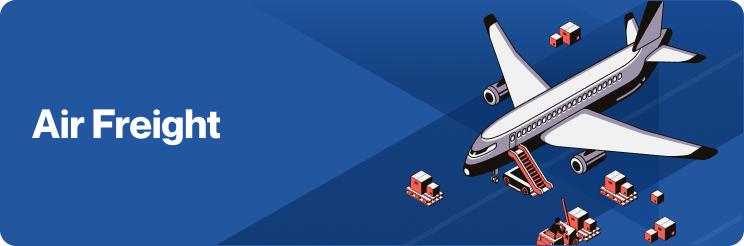
Air freight between Thailand and Czechia
If you are considering air freight from Thailand to Czechia, you usually care about speed, product value, or production delays you cannot afford. On this Southeast Asia to Europe lane, air is the fastest way to ship between Thailand and Czechia, but it is also stricter than most expect. Cut-off times, cargo screening procedures, and chargeable weight rules will shape your timeline more than the flight itself.
Many importers assume it is always 3 days, always too expensive, or priced only on real weight. In reality, delays often come from export customs for air freight, late supplier handover, or a misunderstanding between airport-to-airport air shipment and door-to-door air freight service. If you underestimate volumetric weight or forget airport handling charges at destination, your budget can shift quickly.
Air cargo vs express: how should you ship on this route?
When you compare air cargo vs express courier service between Thailand and the Czech Republic, you are really choosing between control and simplicity. Standard air freight service moves your goods as consolidated or palletized air cargo under an Air Waybill (AWB), usually airport-to-airport or door-to-door through a forwarder. Express air freight Thailand to Czechia moves through an integrator network with one tracking number and simplified handling.
The first thing we always tell you is this, your volume and internal organization matter more than the plane type. If you ship regularly, need cost optimization per chargeable weight, or manage specific Incoterms, air cargo shipping Thailand to Czech Republic gives you more flexibility. If you ship small urgent parcels and want minimal coordination, express may fit better.
Should you choose air cargo from Thailand to Czechia?
You should usually consider standard air cargo once your shipment exceeds 1 CBM or 100 to 150 kg. Above that threshold, air freight rates per chargeable weight often become more competitive than express. This is especially true for B2B flows, repeat orders, palletized air cargo, temperature-controlled air freight, dangerous goods by air, or high-value cargo air transport that requires structured documentation.
Before you request an air cargo quote request, you need exact dimensions, gross weight, nature of goods, Incoterm, preferred departure airport in Thailand, arrival airport in Czechia, and confirmed ready date. Without these, any air freight cost estimation will be approximate at best.
Where do most mistakes happen? You book airport-to-airport air shipment but expect door delivery. You ignore cut-off times and your supplier misses the flight. You forget minimum charges, fuel surcharge in air freight, security surcharge for air cargo, or destination airport handling charges. On this lane, those details make the difference between a smooth move and an expensive surprise.
Should you choose express air freight from Thailand to Czechia?
Express makes sense if you ship small parcels under 1 CBM, prototypes, samples, or urgent spare parts with no in-house logistics team. You get one tracking number, faster internal processing, and simplified export customs for air freight. For many first shipments, it feels easier.
But you trade simplicity for less control. Reweigh and remeasure adjustments based on volumetric weight calculation are common. Duties and import clearance at destination airport are not always included depending on the Incoterm. If you misunderstand who pays what, costs can escalate quickly.
Express is a good fit if you value speed and low coordination. It becomes risky if your cargo is bulky but light, poorly packed, or if you assume everything is included without checking the service level in detail.
Main airports to know in Thailand and Czechia
Thailand
Suvarnabhumi Airport, Bangkok is the main cargo gateway and one of the main cargo airports in Thailand for international air logistics Southeast Asia to Europe. You will find the widest flight connection and cargo routing options here, which reduces the risk of long transshipment delays.
Don Mueang International Airport handles a mix of low-cost passenger flights and some cargo flows. You may use it for specific routings, but capacity and connections are generally more limited for Europe-bound freight.
U-Tapao Rayong Pattaya can be relevant if your factory is in the Eastern Economic Corridor. You may save on inland trucking, but you should verify international frequency and connection options carefully.
Czechia
Václav Havel Airport Prague is the primary Czech international cargo airport. Most air cargo shipping Thailand to Czech Republic will route here, either direct or via a European hub, before final distribution.
Brno-Tuřany Airport and Ostrava Airport can handle cargo, including some charter or industrial flows. You may use them for specific projects, but you should always compare total cost including pre-carriage, last mile, and customs setup.
Transit times: how long does air freight take from Thailand to Czechia?
| Service | Estimated transit time | Notes |
|---|---|---|
| Standard air cargo | Approximately 3 to 7 days | Depends on direct flight vs transshipment and cargo consolidation |
| Express air freight | Approximately 2 to 5 days | Priority network with faster internal handling |
Your real air transit time Thailand to Czechia depends less on flight duration and more on coordination. You need to factor in supplier readiness, export customs for air freight, cargo screening procedures, and connection time in case of transshipment. Peak seasons can also reduce available capacity.
If you want a realistic schedule, you should confirm the exact departure airport, final delivery address, nature of goods, and chosen Incoterm. That is what determines whether you land closer to 3 days or closer to a full week.
Shipping rates: how much does air freight cost from Thailand to Czechia?
| Service | Indicative range | Cost driver |
|---|---|---|
| Standard air cargo | Often quoted per kg of chargeable weight | Volume, density, season, airport pair |
| Express air freight | Higher per kg, small shipment focus | Speed, network fees, reweigh policies |
Your air freight rates per chargeable weight will first depend on gross weight vs chargeable weight. If your shipment is bulky, volumetric weight calculation will increase your billing weight. Then come dimensions, packaging type, urgency, available capacity, and whether you ship from Bangkok or a secondary airport.
You should also account for fuel surcharge in air freight, security surcharge for air cargo, airport handling charges, and final delivery in Czechia. A precise air freight cost estimation always starts with full shipment data, not just a rough kilogram figure.
Step-by-step: how an air shipment usually works on this route
If you understand the step-by-step air shipping process, you will control your timeline instead of reacting to it. Between Thailand and Czechia, most delays appear before takeoff or right after landing, not in the air itself.
- You confirm dimensions, weight, HS code, Incoterm, and ready date so we can plan capacity and routing.
- We book space with the airline and issue a house air waybill and master air waybill under the main Air Waybill (AWB).
- Your supplier delivers cargo to the terminal before cut-off, where cargo screening procedures and document checks take place.
- Export customs for air freight is completed in Thailand, and the cargo is palletized or consolidated.
- The shipment flies, sometimes direct, sometimes via a European hub depending on flight connection and cargo routing.
- On arrival at the Czech international cargo airport, import clearance at destination airport is processed.
- After customs release, we arrange final delivery or keep it as airport-to-airport air shipment if agreed.
What is the difference between volumetric and gross weight?
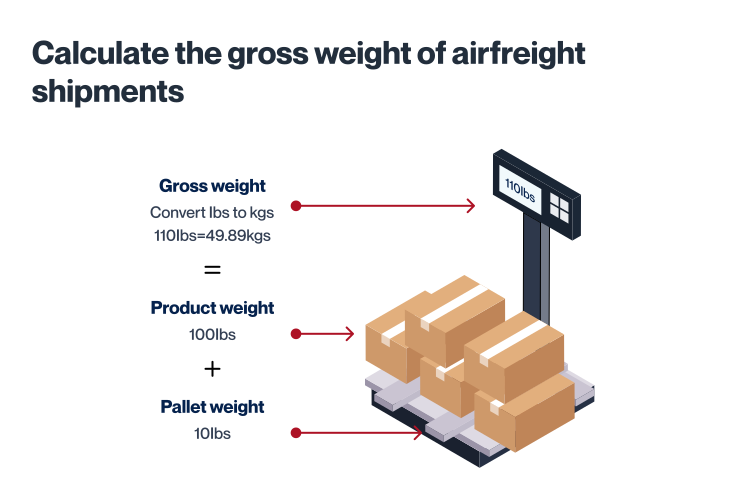
In air freight, you are not charged only on what your cargo weighs, but also on the space it occupies. This is where gross weight vs chargeable weight becomes critical. Airlines apply IATA cargo regulations terminology to determine which weight to use for billing, and they always select the higher value.
- Gross weight, the real physical weight of your cargo including packaging and pallets.
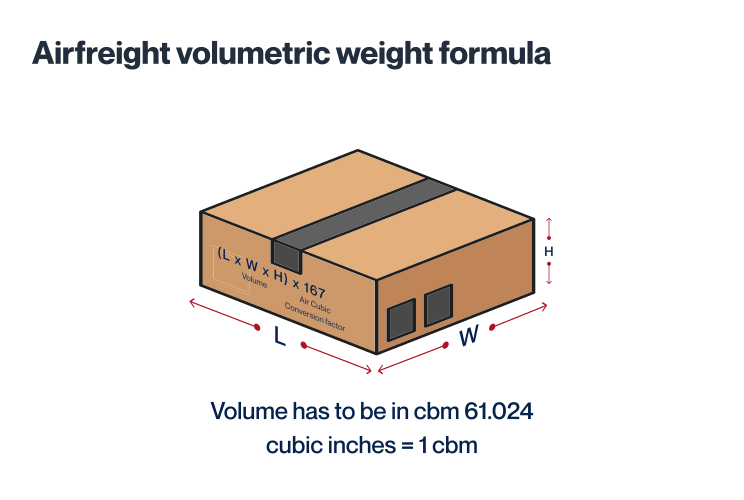
- Volumetric weight, a calculated weight based on dimensions.
- Chargeable weight, the higher of gross or volumetric weight.
How to calculate: For air cargo, multiply length x width x height in centimeters and divide by 6000. For example, 120 x 100 x 110 cm / 6000 = 220 kg volumetric weight. If your gross weight is 150 kg, you will be charged on 220 kg.
| Service | Conversion rule |
|---|---|
| Air cargo | 1 m3 = 167 kg, divisor 6000 |
| Express | 1 m3 = 200 kg, divisor 5000 |
Common mistakes include measuring cartons without pallets, rounding dimensions down, or ignoring remeasurement at the terminal. If you validate your data before booking, you avoid unexpected billing adjustments and protect your margin.
Door to door between Thailand and Czechia
Door to Door shipping is your turnkey solution for transporting goods all the way from bustling Thailand to enchanting Czechia. This international shipping method strips away the usual logistic hurdles, offering you unparalleled convenience, cost-effectiveness, and a hassle-free experience. Let’s dive in to uncover how this can transform your shipping journey!
Overview – Door to Door
If shipping goods between Thailand and Czechia seems daunting, consider our most popular solution: Door to Door shipping. It eases the process by handling transportation, customs, and paperwork from pickup to delivery. However, it could incur higher costs compared to self-managed alternatives.
But don’t fret: the convenience, safety, and stress-free nature, makes it a go-to for our clients. Knowledge of customs regulations and handling paperwork can be tricky, but Door to Door shipping can be your hassle-free way forward. Learn how you can benefit from this service in our detailed guide! With our expertise, your cargo will get to the destination smoothly and affordably!
Why should I use a Door to Door service between Thailand and Czechia?
Hopping between Thailand and Czechia with hefty packages? Never fear, Door to Door service is here! This service is your magic carpet ride when it comes to freight forwarding. Here’s why:
1. Simplicity and Alleviated Stress: Door to Door service is your go-to solution for a hassle-free experience. You’ve got enough on your plate – like making sure your business thrives. Leave logistics to the experts who will pick your goods right from your doorstep in Thailand and deliver them to the final destination in Czechia. Goodbye logistics stress!
2. Timely Delivery: Urgency is our second name. With flights even at odd hours, we ensure your goods reach without any minute to waste. Especially beneficial for fast-moving consumer goods (FMCG), perishables, and any other high-need consignments.
3. Specialized Care for Complex Cargo: Fragile? Valuable? Oversized? Each type of cargo gets personalized attention and care. We clad your special cargo in cushy safety, whether it’s an intricate decoration piece or sensitive scientific equipment.
4. Efficient Trucking and Delivery: No more endless phone calls with trucking companies. We handle it all – from pickup trucks to delivery vehicles. Just sit back and watch as your goods fluidly roam from Thailand’s bustling streets to the quaint lanes of Czechia.
5. Convenience is King: Instead of juggling between different freight companies and customs clearance processes, Door to Door service makes your life easier. We are your one-stop-shop for all international shipments.
Choose Door to Door service: because you’ve got enough grey hairs as it is.
DocShipper – Door to Door specialist between Thailand and Czechia
Unsure where to begin with shipping your goods from Thailand to Czechia? Entrust your items with DocShipper. We manage every step: packing, transportation, customs clearance, across all transport modes, to ensure a seamless journey. You can sit back and track your shipment, as a dedicated Account Executive takes charge. Quick, efficient, and stress-free, we offer free estimates within 24 hours or immediate assistance via a call. Step into hassle-free international shipping with DocShipper.
Customs clearance in Czechia for goods imported from Thailand
When you handle customs clearance in Czechia for goods from Thailand, you are deciding three things at once: your final landed cost, how fast your cargo gets released, and who is legally responsible as Importer of Record. One wrong detail on the declaration can freeze your goods at the port or airport. We coordinate the full process for our clients, from document check to customs release procedure, so you avoid last-minute surprises.
You will quickly notice that most delays on this route come from incorrect HS code classification, missing proof of origin documents, or inconsistencies between the commercial invoice and packing list. Underestimating VAT impact or misreading the Incoterms impact on customs value is another classic trap. Let us walk you through the exact logic so you can plan properly and avoid common customs clearance mistakes.
How to calculate duties & taxes when importing from Thailand to Czechia?
To understand duties and taxes on imports from Thailand, you need four core inputs: the country of origin declaration, the HS code classification, the customs value calculation method, and the applicable import tariff in Czechia. From there, you add VAT and any other import taxes and charges.
The amount you estimate before shipping can differ from what customs finally assess because of valuation adjustments, exchange rates, or a customs risk assessment that challenges your HS code. This is why very cheap freight quotes that ignore tax structure can be misleading. If you want to know how to calculate import duties in Czechia correctly, you need to follow a strict order, which we break down below.
Step 0 – Quick checks before you calculate
- Who is the Importer of Record? You or your Czech customer must hold a valid EORI number for EU imports.
- Which Incoterm applies? The agreed term defines who controls the import customs process in Czech Republic and who pays the duties.
- Is your shipment eligible for a simplified or low-value clearance? Some small consignments follow a lighter customs declaration process, but you must confirm before shipping.
Step 1 – Identify the Country of Origin
Your country of origin declaration determines whether you qualify for any preferential origin claim and what customs duty rate by HS code applies. Customs will expect consistent proof of origin documents, sometimes including a certificate of origin issued in Thailand.
If your paperwork is weak or inconsistent, Czech customs can challenge your claim during their customs risk assessment. The most common mistake we see is confusing the shipping country with the manufacturing origin. If goods transit through another country, origin does not automatically change.
Step 2 – Find the HS Code of your product
Your HS code classification drives everything: duty rate, VAT treatment, possible restrictions, and even whether your cargo faces inspection. One digit wrong can mean overpaying duty or triggering a cargo inspection by customs.
You can start with your supplier, but you should always validate the code yourself using a harmonized system code lookup tool. For EU imports, you can consult the official TARIC database here: EU TARIC database. Compare the product description, materials, and function, not just the product name.
If your HS code is incorrect, customs may reclassify it, reassess the import tariff in Czechia, and apply retroactive duties. That can mean extra duty plus penalties.
Here’s an infographic showing you how to read an HS code.
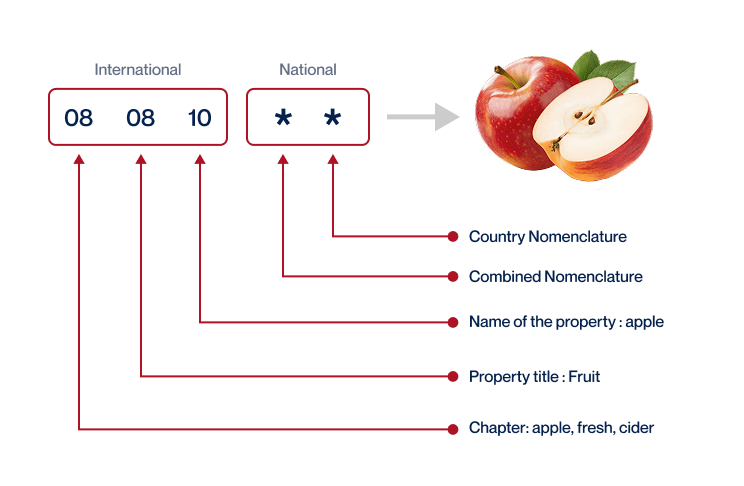
Step 3 – Calculate the Customs Value
Czech customs generally rely on the transaction value for customs, meaning the price you actually paid or will pay, adjusted under the official customs value calculation method. This is not always just your invoice total.
You must factor in the Incoterms impact on customs value. Under FOB terms, you add freight and insurance up to the EU entry point. Under CIF, those costs are already included. You also need to include assists, certain commissions, royalties, and packing if they are not already reflected.
Example: if you buy goods for 10,000 USD under FOB and pay 1,500 USD for freight and insurance to Prague, your customs value becomes 11,500 USD. Duties and value added tax on imports will be calculated on that adjusted base.
Step 4 – Figure out the applicable Import Tariff in Czechia
The import tariff in Czechia is the customs duty rate applied to your product based on its HS code and origin.
Here is the method we use in practice:
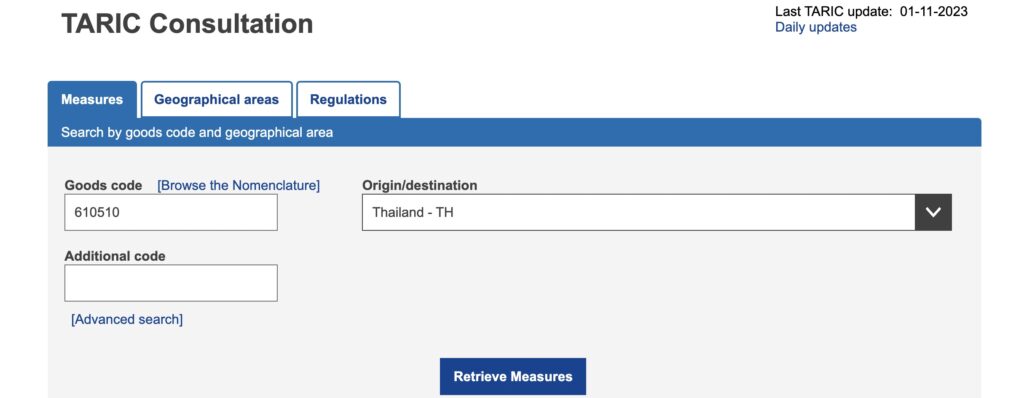
- Open the official EU TARIC tool.
- Enter your full HS code.
- Check the customs duty rate by HS code for goods originating in Thailand.
When you read the result, verify:
- If the rate is ad valorem or specific.
- If a preferential origin claim could reduce it.
- If anti-dumping or other trade measures apply.
- If additional documentation is required.
If your customs value is 11,500 USD and the duty rate is 5%, your customs duty would be 575 USD. That figure then feeds into your VAT base.
On this route, differences in classification can significantly change your landed cost. If you are unsure, we can review your HS code and tariff exposure before you ship.
Step 5 – Consider other Import Duties and Taxes
Beyond customs duty, you must account for value added tax on imports. In Czechia, VAT is calculated on the customs value plus duty and certain additional charges.
Example: if your customs value is 11,500 USD and duty is 575 USD, VAT is calculated on 12,075 USD. Apply the relevant VAT rate to that total to estimate what you will pay at import.
You should also check for other import taxes and charges. Some products are subject to excise duty, and others may face trade defence measures such as anti-dumping duties. These are product specific and linked directly to your HS code.
- Confirm the VAT rate applicable to your product category.
- Check for excise or anti-dumping measures in TARIC.
- Review your customs documentation requirements for consistency.
- Validate whether a temporary import procedure or bonded warehouse storage would optimize cash flow.
Step 6 – Calculate the Customs Duties
The core formulas are simple:
Customs duty = customs value × duty rate.
VAT = (customs value + duty + applicable charges) × VAT rate.
If your customs value is 11,500 USD and the duty rate is 5%, duty equals 575 USD. If VAT applies to 12,075 USD, you multiply that base by the VAT rate to get your import VAT.
What happens next? The Importer of Record pays these amounts before or at release, depending on your setup with your customs broker in Czechia. If payment is delayed, your cargo can sit in bonded warehouse storage and storage fees start to accumulate. This is often where clearance costs escalate.
Does DocShipper charge customs fees?
Understand that while DocShipper, as a customs broker in both Thailand and Czechia, does facilitate your customs clearance, we do not impose your customs duties. These are government charges, distinct from our clearance fees. Picture it as shopping at a grocery store: you pay for groceries plus sales tax. Here, your goods are the groceries, the sales tax represents customs duty, and our charges are like a service fee for carrying your groceries to your car! We provide authentic customs documentation to assure you that what you’re paying is solely the government’s claim on your shipment.
Contact Details for Customs Authorities
Thailand Customs

Czechia Customs

Official name: General Directorate of Customs, Czech Republic
Official website: www.celnisprava.cz
Required documents for customs clearance in Czechia
When you import from Thailand into Czechia, you will quickly notice that customs issues rarely come from “the border” itself. They come from inconsistencies between documents. Your shipper, consignee, product description, values, and Incoterm must match everywhere. Even small gaps can trigger a hold. Here’s the checklist we always walk you through before your cargo lands.
Commercial Invoice
The commercial invoice is the document that shows what you sold, to whom, and at what price.
Czech customs use it to determine the customs value, calculate duties and VAT, and verify product classification.
Example: 1,200 rubber components, HS code declared, unit price and total value in EUR, Incoterm CIF Hamburg, seller in Bangkok, buyer in Prague.
Common mistake: Declaring a value on the invoice that does not match the payment proof or contract.
Packing List
The packing list details how your goods are physically packed, carton by carton or pallet by pallet.
Your broker uses it to cross-check weights, dimensions, and package count against the transport document.
Example: 24 pallets, each with 50 cartons, gross and net weight clearly separated.
Common mistake: Total gross weight on the packing list does not match the Bill of Lading.
Bill of Lading or Air Waybill
This is the transport document issued by the carrier for sea or air freight.
Czech customs use it to confirm the route, consignor, consignee, and shipment reference.
Example: Port of loading Laem Chabang, port of discharge Hamburg, final delivery Prague under a through Bill of Lading.
Common mistake: Consignee name differs slightly from the one on the commercial invoice.
Import Declaration and EORI Number
The import declaration is the formal customs filing submitted electronically in the EU system.
You must have a valid EORI number to import into Czechia, otherwise your goods cannot be cleared.
Example: Czech-registered company acting as importer of record with its CZ EORI provided to the broker before arrival.
Common mistake: Waiting until the cargo arrives to apply for an EORI number.
Certificate of Origin
The certificate of origin states where your goods were manufactured.
Czech customs use it to determine whether preferential duty treatment applies under any EU trade arrangement.
Example: Thai Chamber of Commerce-issued certificate confirming Thai origin for processed food products.
Common mistake: Confusing country of export with country of manufacture.
Conformity and Compliance Documents (CE and Product-Specific Certificates)
These documents prove that your products comply with EU technical, safety, or health regulations.
If you import electronics, machinery, toys, or certain consumer goods, you must show CE conformity or other required certifications.
Example: CE Declaration of Conformity for electrical equipment, aligned with the product model listed on the invoice.
Common mistake: Shipping goods before verifying that labeling and documentation meet EU standards.
Step-by-step: how customs clearance usually works on this route
If you want to understand the import customs clearance step by step between Thailand and Czechia, you need to see the operational flow, not just the theory. The exact sequence can differ depending on the port of entry, airport, shipment type, and Incoterm, but the backbone of the customs declaration process remains similar.
- We start with a pre-clearance document check, reviewing your commercial invoice for customs, packing list for import clearance, transport document, and EORI number.
- We validate your HS code classification and origin details to reduce customs risk assessment flags.
- Your goods arrive at the Czech port or airport and are registered in the customs system.
- We submit the electronic customs declaration process through a licensed customs broker in Czechia, often under indirect customs representation if you are a non-EU company.
- Customs may release the goods directly or select them for cargo inspection by customs, this is one of the main moments of truth where inconsistencies create delays.
- If inspection is required, authorities verify quantity, classification, or origin against your documents.
- Once duties and VAT are secured or paid, customs issues the customs release procedure.
- Your cargo is delivered or transferred to a bonded warehouse storage facility if you choose deferred release or special procedures.
From experience, most delays happen at document validation and during inspection requests. If your paperwork is clean and your valuation logic is solid, how long does customs clearance take in Czechia becomes much more predictable. This is where structured customs compliance for international trade makes the difference.
Get Started with Siam Shipping
Prohibited and Restricted items when importing into Czechia
Before shipping, you should verify whether your goods are subject to restrictions, licensing, or special controls. Certain agricultural products, chemicals, dual-use goods, and protected species items can require additional permits.
If you ignore this step, your shipment can be blocked during customs risk assessment or physical inspection. Always review official EU and Czech guidelines and align your customs documentation requirements accordingly.
Prohibited and restricted items when importing into Czechia
Before you ship from Thailand, you need to understand one key difference. Restricted products can enter Czechia, but only if you meet specific conditions such as licenses, health certificates, or inspections. Prohibited products should not enter at all and can be seized, returned, or destroyed. This is where many first-time importers get caught off guard.
Restricted products
- Food and agricultural products, sanitary and phytosanitary controls required.
- Animal-origin goods, veterinary certificates and EU-approved facilities needed.
- Electronics and machinery, CE marking and technical documentation required.
- Cosmetics, ingredient compliance and EU product notification obligations.
- Chemicals, potential REACH registration or safety data sheet requirements.
- Medical devices, EU conformity assessment and labeling obligations.
- Textiles with animal components, possible CITES or material origin checks.
Prohibited products
- Counterfeit goods infringing intellectual property rights.
- Illicit drugs and narcotics under EU control regulations.
- Weapons and certain military equipment without proper authorization.
- Hazardous waste banned under EU environmental rules.
If you are unsure about your product category, you should confirm the correct HS code and check EU import conditions before shipment. From experience, a five-minute classification check before departure can save you weeks of storage and inspection costs in Europe.
Trade agreements and preferential duties for imports from Thailand to Czechia
Czechia applies the European Union’s common external tariff because it is an EU Member State. As of 2025 to 2026, there is no EU Thailand free trade agreement in force. This means your goods from Thailand are generally subject to the standard EU Most Favoured Nation duty rates, depending on their HS code.
You should also know that Thailand is not currently benefiting from the EU Generalised Scheme of Preferences for most industrial products. In practical terms, you will usually pay the full EU customs duty applicable to your product category, plus Czech VAT at import.
This is why classification matters so much. A small difference in HS code can significantly change your duty exposure. Before you confirm your purchase order, you should ask your supplier for the exact HS code used in previous EU shipments and have your broker validate it.
On the economic side, trade between Thailand and Czechia has been active for decades, with total bilateral trade reaching 334 million USD in 2019 according to publicly available figures. Key sectors include automotive components, machinery, electronics, food products, and rubber-based goods. If you operate in one of these sectors, you will notice established supply chains and recurring flows, which can make customs handling more predictable when your documentation is consistent.
The first thing we always tell importers on this route is simple. Do not assume there is a preferential tariff just because both countries have strong trade ties. You should verify the applicable EU duty rate for your exact product before calculating your landed cost. That is where your margin is really decided.
Your first steps with Siam Shipping
If you want clarity on customs clearance cost components, tax exposure, or representation options before you ship from Thailand to Czechia, we can review your documents and structure the process with you. We handle classification checks, indirect customs representation, and coordination with your customs broker in Czechia.
You do not need to guess how your import will be treated. Share your product details, origin, and Incoterm with us, and we will map out the exact clearance scenario before your cargo even departs.
Additional logistics services
Warehousing
Finding the right warehousing for your goods, especially when they need specific conditions like temperature control, can be a head-scratcher. But don't fret - our robust solutions offer a worry-free experience. Need to store Thai spices or Czech glassworks? Get the perfect conditions every time. Soak up more nuggets of wisdom on our dedicated Warehousing page.
Packing
Proper packaging becomes crucial when shipping between Thailand and Czechia, ensuring your precious freight remains intact. Whether it's fragile ceramics or sturdy automotive parts, a reliable agent can cater to diverse packaging needs. Take, for instance, bespoke wooden crates for valuable artefacts. More info on our dedicated page: Freight packaging.
Transport Insurance
For every shipping venture, Cargo Insurance acts as your trusted safeguard. Contrary to Fire Insurance—which covers losses from fires—Cargo Insurance takes it a step further. It shields your goods both from unforeseen accidents and transport conditions that could potentially harm them. Picture your product's unfortunate exposure to rain or damaging sea-air - an insurance policy ensures those risks are mitigated.
Household goods shipping
Relocating from Thailand to Czechia or vice versa? Your personal belongings - appliances, souvenirs, keepsakes - deserve top-tier care, especially when they're fragile or large. Lean on our high-flexibility solution for moving these special items, just like Mr. Somchai who safely shipped his vintage Buddha statue collection to Prague. More info on our dedicated page: Shipping Personal Belongings.
Procurement in Thailand
If you're looking to source or manufacture in Asia, East Europe, and more, DocShipper streamlines the task with efficient supplier management. Our expert team negates language hurdles while guiding you through the entire procurement journey. For instance, if you have your eyes on Czech glass manufacturers, think of us as your reliable touchpoint to great products and services. Delve into the details on our dedicated page: Sourcing services.
Quality Control
Ensuring quality is crucial when shipping from Thailand to Czechia. Picture this: you're manufacturing beautiful wooden furniture in Chiang Mai, but upon arrival in Prague, your client finds blemishes and defects. Ouch! With our Quality Control service, these nightmares are averted. Our experts scrutinize every detail of your goods, ensuring they're up to standard, leaving no room for nasty surprises. Keep your clients smiling.
Conformité des produits aux normes
Meeting product compliance regulations is crucial when importing or exporting. Mistakes can lead to costly fines, or worse, barred entry for your goods. Our Product Compliance Services offer laboratory testing and certification to ensure products align with destination regulations. Avoid complications and keep operations smooth.More info on our dedicated page: Product Compliance Services.