


Freight Shipping between Thailand and Switzerland | Rates – Transit times – Duties and Taxes
The first thing you need to know about shipping between Thailand and Switzerland is that distance is only half the story, the real challenge sits in transit planning, customs coordination, and choosing the wrong mode too early. You are moving cargo between Southeast Asia and a landlocked European market, often via Laem Chabang Port and major EU gateways before final delivery into Switzerland, which means every decision you make affects cost, lead time, and customs exposure. If you misjudge volume, Incoterms, or documentation, you will feel it in delays and unexpected charges. In this Destination guide we will cover transport options, realistic transit logic, customs clearance, duties and taxes, and the operational checkpoints you should validate before you book.
Which are the different modes of transportation between Thailand and Switzerland?
If you need speed or you are shipping high value or time sensitive goods, you should choose air freight from Suvarnabhumi Airport to Zurich Airport, even if you pay more. If your cargo is heavy, non urgent, or containerized, you will usually move by sea freight via Laem Chabang Port to a major European hub before trucking or railing into Switzerland.
Rail can make sense in specific intermodal setups when you balance cost and transit time, but you need to check schedules and capacity carefully. If you are unsure, you can contact our team and we will help you decide based on real time rates, space availability, and your exact cargo profile, then we will break each option down in more detail below.
Need help with your shipment?
Need assistance with your shipment? Dont hesitate to contact us even for a simple question. Choose the option that suits you
Live chat with an expert Chat on WhatsApp Free Quote 24hHow can Siam Shipping help you
Sea freight between Thailand and Switzerland
If you’re planning sea freight Thailand to Switzerland, the first question isn’t “how does it work?” but “does it fit your timeline and cargo profile?” For heavy, high-volume, or non-urgent goods, ocean freight Thailand Switzerland route is usually the most cost-efficient option. If you’re shipping 10+ CBM, full pallets, or a full container load, sea freight quickly becomes more economical than air.
Here’s the trade-off. You save on freight cost, but you add lead time and coordination. Switzerland is landlocked, so your container will discharge in a European seaport and then move by rail or truck into Switzerland. That means you are not just buying ocean transport, you are managing multimodal transport sea and road to Switzerland.
The most common mistake we see when shipping between Thailand and Switzerland by sea is underestimating total transit time and destination charges. Another one is choosing the wrong Incoterm and losing control of inland delivery or customs timing. If you understand these two points early, sea freight becomes predictable and scalable. If you ignore them, costs creep in fast.
The good news is that once you understand the operational logic, international sea logistics Thailand Switzerland is actually straightforward. Let us break it down the way we manage it for our clients every week.
Which Incoterms should you use?
When you organize sea freight on this route, your Incoterm determines who controls the risk, the cost, and the paperwork. In theory, every Incoterm looks simple. In real operations, some are clearly safer than others.
FOB Thailand to Switzerland is often the most balanced option. Your supplier delivers the cargo to the port of loading in Thailand, clears export customs, and you control the ocean freight with your own freight forwarder Thailand to Switzerland. You see the real freight cost, you choose the schedule, and you avoid inflated local charges.
CIF Switzerland from Thailand looks convenient, but you lose visibility. Your supplier chooses the carrier and often selects the cheapest ocean solution. You then pay destination charges in Europe that you did not negotiate. This is where many importers get surprised.
EXW vs DAP for international sea freight is another common dilemma. With EXW, you control everything from factory pickup, but you also take responsibility earlier than most buyers realize. With DAP Switzerland, your supplier or forwarder manages transport to your door, but you must confirm who handles Swiss import customs and duties.
No matter the Incoterm, always clarify who issues the Bill of Lading B/L and whether you will use an original B/L or a telex release bill of lading. A simple documentation misunderstanding can delay cargo release in Europe. We always recommend choosing the Incoterm that gives you operational control, not just a lower invoice price.
Main ports to know in Thailand and Switzerland
Switzerland does not have a seaport connected directly to the ocean. Your container will discharge in a major European hub and then move inland. Port choice affects transit time, congestion risk, and inland trucking cost.
In Thailand, the key ports are:
- Laem Chabang, the main container gateway for exports to Europe. You will find the widest carrier coverage and more stable container shipping schedule Thailand to Switzerland options.
- Bangkok Port, suitable for smaller vessels and certain LCL shipping Thailand to Switzerland flows, but draft limitations can reduce direct service options.
- Map Ta Phut, mainly relevant if you handle industrial or chemical cargo.
For Switzerland-bound cargo, discharge usually happens in:
- Rotterdam or Antwerp, major hubs often used as a transshipment hub Europe for Swiss cargo, with strong rail connections to Basel and Zurich.
- Hamburg, frequently used for rail corridors into Switzerland.
- Port of Basel, which is a river port connected via the Rhine after transshipment from a North Sea port.
Your choice of port of discharge for Switzerland shipments directly affects inland haulage cost and delivery time. If your final destination is near Basel, rail from Rotterdam may be efficient. If you are delivering to eastern Switzerland, another routing may reduce trucking distance. This is where multimodal planning makes a real difference.
Transit times: How long does it take to ship from Thailand to Switzerland?
Your sea transit time Thailand to Switzerland depends on whether the service is direct to a North Sea hub or involves transshipment.
| Port of loading in Thailand | European discharge hub | Estimated ocean transit time | Estimated total lead time to Switzerland |
|---|---|---|---|
| Laem Chabang | Rotterdam / Antwerp | 25 to 35 days | 30 to 40 days |
| Bangkok | Rotterdam / Hamburg | 27 to 38 days | 32 to 42 days |
| Laem Chabang | Via transshipment hub | 30 to 40 days | 35 to 45 days |
In practice, you should plan around 30 to 45 days door to door for ocean shipping lead time Thailand Switzerland. The ocean leg might look short on paper, but inland rail to Switzerland and customs clearance add days.
You should also factor in port congestion in peak season, especially before European holidays or during high export cycles from Asia. Direct services are faster but not always available weekly. If your container moves via a transshipment hub Europe for Swiss cargo, add buffer time. The safest approach is to build your planning around a range, not a single date.
Should I choose FCL or LCL when shipping between Thailand and Switzerland?
Deciding between Full Container Load (FCL) and Less than Container Load (consolidation or LCL) for shipping from Thailand to Switzerland can be daunting, yet vital! It’s a high-stakes decision that directly affects your bottom line and delivery timelines. This section is your compass to navigate these waters, breaking down crucial factors like cost, time, and efficiency, enabling you to make a savvy choice that’s a perfect fit for your specific business needs. Onwards to mastering maritime freight choices!
Full container load (FCL)
Definition: FCL (Full Container Load) shipping involves hiring an entire container for transporting your goods. In this case, all the cargo in the 20'ft or 40'ft container is owned by one shipper, offering greater control and security as the container is sealed from origin to destination. When to Use: FCL shipping is typically the more cost-effective option when you've got a high volume of cargo - approximately 13 to 15 CBM or more. It’s a strong choice when safety is a priority, as the shipment remains undisturbed until it's unsealed at the destination. Example: Let's consider a Thailand-based furniture manufacturer looking to ship a bulk order to a retailer in Switzerland. As the cargo volume exceeds 14 CBM, they decide to opt for a FCL shipping arrangement to ensure the safety of their valuable items and potentially save on shipping cost. Cost Implications: FCL shipping quotes generally offer advantageous unit prices for larger volumes, especially compared with LCL (Less Container Load) alternatives. However, remember that while the per unit cost might be lower, the overall cost is invariably higher due to the bulk nature of the exchange. Remember, with FCL, you pay for the whole container, regardless of whether you fill it completely or not.
Less container load (LCL)
Definition: Less-than-container load (LCL) is a term used to describe the shipping of cargo that is not enough to fill a standard shipping container. It is a cost-effective strategy for low-volume shipping needs. When to Use: LCL is best used when your freight is less than 13 to 15 cubic meters. This could be perfect for startups, small businesses, or larger businesses with lightweight products. Example: A Thai handicraft business wanting to export eclectic home decor accessories to Switzerland may only need to ship about 10 cubic meters. LCL would be the ideal shipping option. Cost Implications: With LCL, businesses pay only for the container space they utilize. This provides a significant cost advantage for smaller volumes. However, be aware there could be additional handling charges as your shipment will be consolidated with others, loading and unloading at different ports. Overall, LCL has a dynamic pricing model. Your lcl shipping quote or lcl freight charge can vary, but generally, it's significantly less than booking a full-container load (FCL) shipment.
Hassle-free shipping
Streamlining cargo shipping from Thailand to Switzerland is what DocShipper does best. Our team of ocean freight experts will guide you, whether you opt for consolidation or full container loads. Factors like your shipment size, budget, and timelines dominate the decision-making. We personalize shipping options, ensuring a hassle-free experience for your business. Don't stay in the dark about your shipping choices. Reach out to us now for a free estimation!
Shipping rates: how much does a sea freight shipment cost from Thailand to Switzerland?
| Mode | Indicative rate | What it typically covers |
|---|---|---|
| LCL shipping Thailand to Switzerland | USD 80 to 150 per CBM | Port to port ocean freight, excluding destination charges |
| FCL 20ft | USD 1,500 to 3,000 per container | Main ocean freight only |
| FCL 40ft / High Cube | USD 2,500 to 4,500 per container | Main ocean freight only |
Sea freight rates Thailand to Switzerland fluctuate depending on season, carrier capacity, fuel prices, and whether you ship FCL shipping Thailand to Switzerland or use less than container load consolidation services. The ocean freight quotation Thailand Switzerland you receive usually covers only the port to port leg. You still need to add inland transport to Switzerland, customs clearance, insurance, and destination handling. This is why the cheapest ocean number rarely reflects your final landed cost.
How to estimate your sea freight cost before requesting a quote
If you want to estimate your freight cost calculator sea Thailand Switzerland logic, start with four elements: total volume in CBM, total weight, chosen Incoterm, and final delivery address in Switzerland.
For LCL, you pay per cubic meter or per ton, whichever is higher. Example: if you ship 8 CBM weighing 4 tons, your chargeable volume is 8 CBM. If the rate is USD 100 per CBM, your base ocean freight is about USD 800, before destination charges.
For FCL, you compare container types dry high cube reefer. If you have 18 CBM of dense cargo, LCL may be fine. If you reach 25 to 28 CBM, a 20ft container could be more cost-efficient and gives you full container load advantages for long distance trade, including lower handling risk.
Always add estimated inland trucking in Switzerland, customs documentation for sea shipments, cargo insurance for ocean freight Thailand Switzerland, and terminal fees. A quote that looks cheap but excludes local charges can end up costing more. If you send us your packing list and delivery address, we provide a clear, route-specific estimate within 24 hours.
Surcharges and hidden cost drivers to watch for
The first surprise usually comes from destination charges. Terminal handling charges THC, documentation fees, and inland rail costs from the European port to Switzerland are often payable locally and not included in the ocean freight.
Second, time-related charges. If your container is not collected quickly, you may face demurrage at the port and detention on the container. These costs increase daily and are often triggered by delays in customs clearance or missing documents.
Third, market surcharges. Carriers may apply a bunker adjustment factor BAF linked to fuel prices or a peak season surcharge PSS during high demand periods. These are not penalties, but they can change your budget quickly. Always confirm what is included before you validate a booking.
Step-by-step: how a sea freight shipment usually works on this route
When you look at sea freight process step by step Thailand Switzerland, it seems linear. In reality, several actors interact at once. This route requires patience because you combine export in Asia, ocean transport, European port operations, and Swiss inland delivery. Most surprises happen at documentation and destination handling stage.
- We confirm your volume, weight, Incoterm, and choose between FCL or groupage cargo Thailand to Switzerland.
- We arrange pickup at your supplier if you ship EXW or coordinate with them for FOB delivery at the Thai port.
- Your cargo is packed according to export packing for sea transport standards and delivered to the port of loading in Thailand.
- Thai export customs clearance is completed and the container is loaded on the vessel.
- The carrier issues the Bill of Lading B/L, and we arrange original documents or telex release bill of lading.
- The vessel sails to a European hub, sometimes via transshipment.
- At the port of discharge for Switzerland shipments, the container is unloaded and prepared for rail or truck transfer.
- We manage Swiss import customs clearance using your commercial invoice and packing list.
- The cargo moves by multimodal transport sea and road to Switzerland to your final warehouse.
Special sea freight solutions
If your cargo does not fit standard containers, you still have options. For out of gauge OOG cargo by sea or project cargo Thailand to Switzerland, we use flat racks or open top containers. For temperature-sensitive goods, a reefer container Thailand to Switzerland keeps your products within controlled ranges. If you ship vehicles or heavy machinery, RoRo solutions may apply.
The key is to match your cargo profile with the right equipment and routing from the start. Once you align those elements, sea freight becomes predictable and scalable for long-distance trade between Thailand and Switzerland.
Special transportation services
Out of Gauge (OOG) Container
Definition: An OOG container is designed for items that can’t fit in a normal container due to their size or shape. It includes flat racks and open top containers.
Suitable for: Larger, oversize items that won’t fit into a standard container.
Examples: Industrial equipment, machinery, large vehicles, or pre-assembled goods like prefab homes.
Why it might be the best choice for you: If you need to ship unusually large or shaped items from Thailand to Switzerland, an Out of gauge cargo option can be a lifesaver.
Break Bulk
Definition: Break bulk involves shipping cargo items separately rather than in containers, essentially designed for goods that can’t be containerized.
Suitable for: Varied, non-standardized cargo that’s bulky and heavy.
Examples: Things like construction equipment, timbers, or metal beams. These items are typically shipped as they are, without any container.
Why it might be the best choice for you: For non-containerizable cargo, break bulk is an optimized method that provides greater flexibility in handling and loading.
Dry Bulk
Definition: Dry bulk is a shipping method where cargo typically in the form of loose cargo load is shipped in large quantities within a ship’s cargo space without containment.
Suitable for: Goods that are uniformly shaped and can be easily grabbed or scooped, typically in granular form.
Examples: Raw materials such as coal, grains, or sand.
Why it might be the best choice for you: If you’re shipping a large amount of granular items, like raw commodities, Dry bulk is the most efficient.
Roll-on/Roll-off (Ro-Ro)
Definition: With the Roll-on/Roll-off method, the cargo directly rolls onto the ro-ro vessel under its own power or with the help of a working machine.
Suitable for: Vehicles and heavy machinery which can be driven on and off the ship.
Examples: Cars, trucks, trailers, cranes, or any other wheeled machinery.
Why it might be the best choice for you: Going RoRo can be a fast and efficient way of shipping larger autos or machinery from Thailand to Switzerland.
Reefer Containers
Definition: Reefer containers are refrigerated containers used to ship goods that need temperature control during transportation.
Suitable for: Perishable goods such as fruits, vegetables, dairy products, pharmaceuticals, or other such temperature-controlled goods.
Examples: Thailand’s exotic fruits or Swiss cheeses require temperature control to maintain their quality during the long journey.
Why it might be the best choice for you: If you’re shipping goods that need a temperature-controlled environment, investing in Reefer containers can retain the quality of your goods.
For detailed advice tailored to your specific shipping needs, contact DocShipper. We’ll provide you a free shipping quote in less than 24 hours.
Air freight between Thailand and Switzerland
If you are considering air freight Thailand to Switzerland, you usually need speed, predictability, or extra security. This route works well for high-value cargo, urgent replenishment, pharma air cargo Thailand to Switzerland, electronics, and time-sensitive B2B orders. But you should know upfront that air is fast on paper, yet operationally demanding with cut-off times, cargo screening process air transport, and strict IATA cargo standards.
You have probably heard that air always takes 3 days, that it is always too expensive, or that you only pay based on real weight. None of that is universally true. On this air cargo Thailand Switzerland route, most costly mistakes come from ignoring chargeable weight, weak air cargo packaging requirements, or missing export declaration for air shipment. That is where budgets and timelines slip.
Air Cargo vs Express Air Freight: How should I ship?
When you compare air freight vs express courier Thailand Switzerland, you are really choosing between control and simplicity. Standard air cargo service Thailand to Switzerland uses commercial airlines with airport handling charges air freight, security surcharge air freight, and fuel surcharge air cargo applied separately. Express air freight Thailand to Switzerland is handled end-to-end by an integrator, usually door to door, with fewer steps visible to you.
The first thing we always tell clients is simple. If you ship regularly, in B2B flows, and you want control over Incoterms, customs, and costs, classic air cargo is often the smarter structure. If you ship small parcels, urgent samples, or you do not have a logistics team, express may save you time internally. The right answer depends on your volume, urgency, and how much visibility you want.
Should I choose Air Cargo between Thailand and Switzerland?
You should generally look at standard air cargo once you ship above 1 CBM or 100 to 150 kg. At that level, an airport to airport air cargo service or even door to door air freight Thailand Switzerland often becomes more cost-efficient than express.
This option fits you if you move B2B cargo, palletized air freight, industrial parts, high value cargo air transport, or temperature controlled air freight. It is also better if you plan regular flows and want access to an air freight consolidation service to optimize cost per kilo.
Before booking air freight space Thailand Switzerland, you should have exact dimensions, gross weight, HS code, Incoterm, chosen airport, ready date, and product type, for example dangerous goods by air DGR or perishable cargo air freight. Missing one of these slows down your air cargo quote Thailand Switzerland.
From experience, you must be clear about airport to airport versus door to door scope. Many importers underestimate airport handling charges air freight in Switzerland, or forget that cargo screening and cut-off times can push your shipment to the next flight. That is usually where delays and unexpected costs appear.
Should I choose Express Air Freight between Thailand and Switzerland?
You should consider express air freight Thailand to Switzerland if you ship small parcels, typically under 1 CBM or below 100 kg, and you need a time critical air shipment Thailand Switzerland with minimal coordination. Express is also logical if you want one single provider to manage pickup, flight, customs, and delivery.
The trade-off is simple. You gain simplicity, but you give up part of the cost control and flexibility. Reweigh and remeasure adjustments, limited negotiation on fuel surcharge air cargo equivalents, and predefined customs structures can increase your final invoice if your data was not precise.
Common mistakes are underestimating volumetric weight vs gross weight air cargo, assuming everything is included in the first quote, and using packaging that does not meet air cargo packaging requirements. Express is a strong tool if your shipment is small and urgent. It becomes risky if your cargo is bulky, repetitive, or if you need tight cost engineering.

Main airports to know in Thailand and Switzerland
- Suvarnabhumi Airport, Bangkok – The main airport in Thailand for international cargo and the primary hub for shipping between Thailand and Switzerland by air. You get the widest flight options, better consolidation opportunities, and smoother handling for pharma, perishable, and high-value cargo.
- Don Mueang International Airport, Bangkok – More focused on regional and low-cost operations. You may use it for specific routings, but long-haul cargo capacity to Europe is more limited compared to Suvarnabhumi.
- Zurich Airport – The largest Swiss international cargo airport and the main gateway for general cargo into Switzerland. You benefit from strong European connectivity, reliable customs, and advanced facilities for temperature controlled air freight.
- Geneva Airport – Useful if your final delivery is in Western Switzerland or for high-value and diplomatic-related flows. Capacity is smaller than Zurich, so flight options can be more limited.
- Basel-Mulhouse EuroAirport – Strategically positioned for tri-border distribution. You may choose it if you plan onward trucking into France or Germany, especially for pharma air cargo Thailand to Switzerland.
Your airport choice directly affects inland trucking cost, available direct flight vs transshipment air cargo options, and real air shipping lead time Thailand Switzerland. That is why we always align airport selection with your final delivery address, not just the flight schedule.
How long does air freight take between Thailand and Switzerland?
On average, the air transit time Thailand to Switzerland ranges between 3 and 7 days airport to airport. Express services can be shorter, often 2 to 4 days door to door, depending on origin city and customs clearance speed.
| Service Type | Estimated Transit Time |
|---|---|
| Standard air cargo | Approximately 3 to 7 days |
| Express air freight | Approximately 2 to 4 days |
You should treat these as operational ranges, not guarantees. Your real air shipping lead time Thailand Switzerland depends on the exact airport pair, whether you use direct flight vs transshipment air cargo, and your cargo ready date.
The main variation drivers are pre-flight cut-off and warehouse handling, cargo screening process air transport, and seasonal congestion when capacity to Europe tightens. If your supplier misses the cut-off by a few hours, you often lose a full day. That is the detail most first-time shippers underestimate.
How much does it cost to ship a parcel between Thailand and Switzerland with air freight?
For standard air cargo, air freight rates Thailand to Switzerland are typically quoted per kilogram based on chargeable weight. In many market conditions, you will see indicative ranges between 3 and 8 USD per kg for general cargo, while express services are usually higher per kg due to the integrated model.
| Service Type | Indicative Cost Structure |
|---|---|
| Standard air cargo | Per kg, based on chargeable weight, plus handling and surcharges |
| Express air freight | All-in per kg pricing, adjusted after reweigh and remeasure |
Your final air cargo quote Thailand Switzerland will depend first on chargeable weight calculation air freight, then on dimensions and density, urgency, season, and selected airport. Fuel surcharge air cargo, security surcharge air freight, and airport handling charges air freight also impact the total. This is why two shipments with the same gross weight can generate very different invoices.
What is the difference between volumetric and gross weight?
If you want to control your air budget, you must understand volumetric weight vs gross weight air cargo. Airlines do not charge you only on what your cargo weighs, but also on how much space it occupies in the aircraft. They always bill you on the higher value between the two, which becomes your chargeable weight.
Definitions
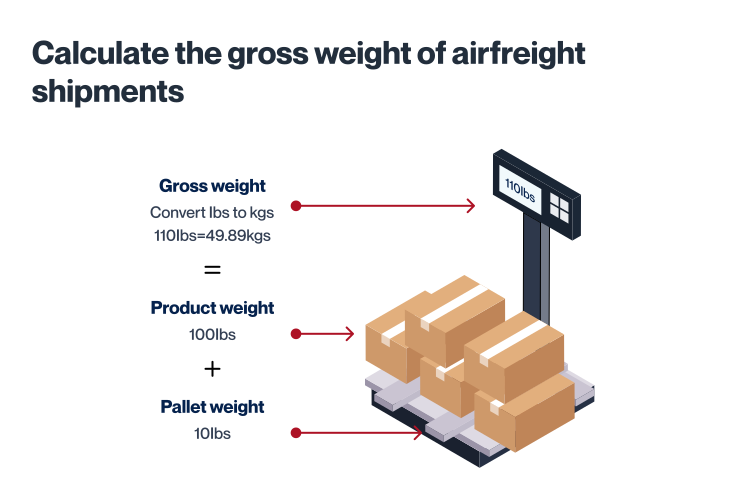
- Gross weight: the real weight of your goods including packaging.
- Volumetric weight: a theoretical weight based on volume.
- Chargeable weight: the higher value between gross and volumetric weight.
- Air waybill AWB: the transport document, issued as MAWB and possibly HAWB in consolidation.
How to calculate
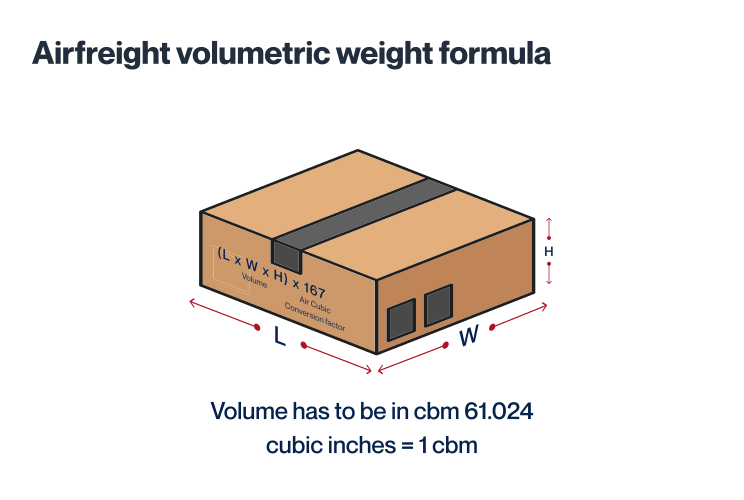
For air cargo, you multiply length × width × height in cm, then divide by 6000. For express, you divide by 5000.
| Service | Volume Conversion |
|---|---|
| Standard air cargo | 1 m³ = 167 kg, divisor 6000 |
| Express air freight | 1 m³ = 200 kg, divisor 5000 |
Example. If your cargo measures 100 × 80 × 60 cm, the volumetric weight in standard air cargo is 100 × 80 × 60 / 6000 = 80 kg. If your gross weight is 65 kg, you will be charged on 80 kg.
Common mistakes
You underestimate dimensions before palletizing, you ignore outer packaging, or you forget that palletized air freight increases volume. That is usually where the gap between expected and invoiced cost appears. Once you understand this logic, you control your air freight step by step process much better.
Door to door between Thailand and Switzerland
Navigating the journey from vibrant Thailand to picturesque Switzerland is a breeze with Door to Door shipping—comprehensive service all about speed and convenience. Expect seamless delivery right from the supplier’s doorstep in Thailand, straight to your preferred location in Switzerland. This option is fantastic for stress-free, reliable transit. So, roll up those sleeves, let’s dive into the world of Door to Door shipping!
Overview – Door to Door
Taking care of international shipping between Thailand and Switzerland can be a mind-boggling task. That’s where Door-to-Door shipping steps in, providing a seamless, stress-free solution. It simplifies the process, handling everything from pickup in Thailand to delivery in Switzerland – all customs duties and headaches included. However, it can be pricier and longer.
Despite these trade-offs, it’s the hot favorite among the DocShipper community, proving to be a handy tool in the complex world of logistics. With Door-to-Door shipping, no destination is out of reach. Comprehend its in’s and out’s to save you time, effort, and unwanted surprises!
Why should I use a Door to Door service between Thailand and Switzerland?
Ever wondered why elephants don’t travel by airplane? Well, it might not have anything to do with shipping your goods from Thailand to Switzerland, but let’s dive right into why Door to Door services might be the best choice for your business.
1. Sweat-Free Logistics: Leave the fear of muddled documentation, custom clearances, and tangled paperwork behind. Door to Door services handle everything, ensuring stress-free logistics. Just like skipping that dreadful airport security line!
2. Timeliness: If you’ve got a Swiss watch manufacturer eagerly waiting for your Thai silk shipment, time is of the essence. Door to Door services ensure prompt collection and delivery, so you can meet even the most pressing deadlines.
3. Special Care for Complex Cargo: Door to Door isn’t just about simplicity, but equally about expertise. Fragile, unusual, or precious cargo? No worries! Your goods get the specialized care they deserve, right from pickup to delivery. Our professionals handle them as delicately as the elephant handles its calf.
4. Convenience: Imagine hosting a Swiss fondue night with ingredients sourced directly from Thailand without leaving your home. That’s how convenient Door to Door services are – they take the goods straight from the pickup point to the destination, including all trucking requirements. Why lift a finger when you don’t have to?
5. Precision: Door to Door services are meticulously planned. They eliminate unpredictable factors like delayed transfers or lost goods. It’s the shipping equivalent of a sharpened Swiss army knife – precision at its finest!
So why not opt for a Door to Door service and make your shipping journey as comfortable and smooth as if you were taking a first-class flight. After all, even though elephants might not fly, your goods definitely can!
DocShipper – Door to Door specialist between Thailand and Switzerland
Navigating the complexities of international shipping? At DocShipper, we’ve got you covered! Streamlined, comprehensive solutions for your freight forwarding needs from Thailand to Switzerland. No need for you to worry about a thing; we expertly manage everything from packing to customs clearance, regardless of the shipping method. You even get a dedicated Account Executive to provide personalized assistance.
Reach out to us for a quick, free estimate within 24 hours or consult with our experts at no charge. Let us simplify your shipping process while you focus on your business.
Customs clearance in Switzerland for goods imported from Thailand
When you handle customs clearance in Switzerland for Thai goods, you are deciding three things at once: your final landed cost, how fast your cargo is released, and who is legally liable if something is wrong. A small classification error or missing document can shift your margin overnight. We coordinate customs clearance in Switzerland daily and align your documents, Incoterm, and declaration before your cargo even lands.
You will usually run into trouble for three reasons on this route: incorrect HS code classification for imported goods, weak country of origin declaration, or inconsistent values between invoice and freight documents. These are the moments where delays and inspections start. Let us break down the logic step by step so you can control the process instead of reacting to it.
How to calculate duties & taxes when importing from Thailand to Switzerland?
If you want a reliable estimate, you need five inputs: confirmed origin, correct HS code, Incoterm, transport cost, and invoice value. Without these, any quote you receive is just a guess. This is the backbone of the importing from Thailand to Switzerland customs process.
You should also expect the assessed amount to differ slightly from your estimate if customs adjusts the value or classification. That usually happens when the commercial invoice requirements for customs are not fully respected or when freight is declared differently from what appears on the transport document. Cheap shipping quotes often ignore duty, VAT, or clearance fees. You should always ask what is included and what is not before you confirm your booking.
Step 0 – Quick checks before you calculate
- Confirm who acts as the Importer of Record in Switzerland and whether you need an EORI number for Swiss importer registration.
- Check your Incoterm. It determines who controls the export customs clearance Thailand to Switzerland and who files the Swiss import declaration.
- Verify whether your shipment qualifies for a low-value or simplified clearance procedure in Switzerland.
Step 1 – Identify the Country of Origin
Your origin determines your import tariff Switzerland for Thai products and whether you can make a preferential origin claim. If your goods genuinely qualify under the rules of origin Thailand to Switzerland, you may benefit from preferential treatment under the free trade agreement Thailand Switzerland, if applicable to your product.
You must support this with a proper certificate of origin Thailand or equivalent proof. Swiss customs may challenge the claim during a document compliance check customs or even later in a post clearance audit Switzerland. The common mistake is confusing country of shipment with country of manufacture. They are not the same in the eyes of customs.
Step 2 – Find the HS Code of your product
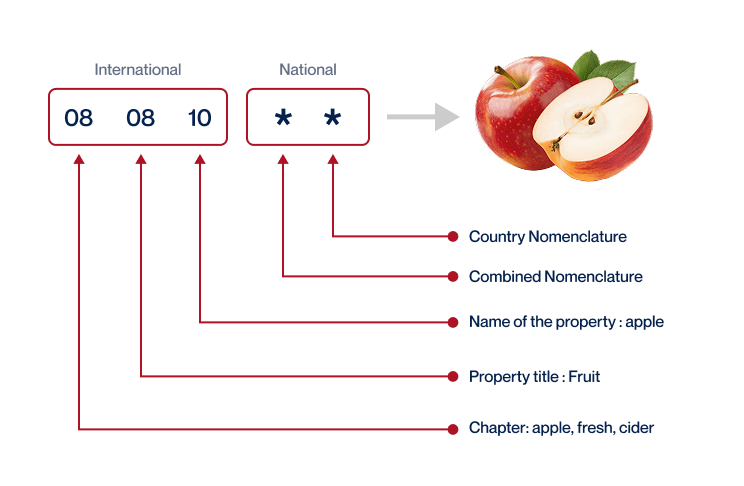
Your HS code drives your duty rate, VAT treatment, and whether your goods fall under restricted and prohibited goods Switzerland rules or special import license requirements Switzerland. In short, classification decides your risk level.
You can start with your supplier, but you should always validate through an official harmonized system code lookup. For Switzerland, you can consult the Federal Customs Administration resources at Swiss Customs Tares and compare the technical description with your product specs.
If you misclassify, you risk reassessment, retroactive duties, or fines. Wrong HS codes are one of the most common customs clearance mistakes importers make, and they often trigger inspection.
Here’s an infographic showing you how to read an HS code.
Step 3 – Calculate the Customs Value
Switzerland generally bases duties and VAT on the customs value calculation method aligned with transaction value principles. In practice, you usually work with the CIF value for customs purposes, meaning cost of goods plus international freight and insurance up to the Swiss border.
You must also add certain elements if they are not already included, such as packing, commissions, assists, or royalties linked to the goods. For example, if your goods cost 20,000 USD, freight is 2,000 USD, and insurance 200 USD, your indicative customs value becomes 22,200 USD before applying duties.
Your Incoterm matters here. Under EXW or FOB, you must add main freight and insurance. Under CIF, they are normally already embedded in the price. This is where many estimates go wrong.
Step 4 – Figure out the applicable Import Tariff
An import tariff is the customs duty rate Switzerland applies to a specific HS code at the time of import.
To determine your import tariff Switzerland for Thai products:
- Open the official Swiss Tares tool.
- Enter your confirmed HS code.
- Review the duty rate and any additional notes linked to origin or special regimes.
When you read the result, check:
- Whether the rate changes depending on origin.
- Whether a preferential column appears.
- Whether additional agricultural or weight-based duties apply.
- Whether specific authorizations are required.
If your customs value is 22,200 USD and the applicable duty rate is 4%, your indicative customs duty would be 888 USD before VAT. That gives you a working budget figure.
You will notice that some Swiss duties are weight-based rather than percentage-based, which can significantly change your math. If you are unsure how to interpret the result, we review the tariff output with you before you ship.
Step 5 – Consider other Import Duties and Taxes
Beyond customs duty, you must account for customs duties and import taxes Switzerland, especially VAT on imports Switzerland. VAT is generally calculated on the customs value plus duty and certain additional costs up to the first destination in Switzerland.
If your customs value is 22,200 USD and duty is 888 USD, your VAT base becomes 23,088 USD. VAT is then applied to that amount according to the applicable Swiss rate at the time of import.
You should also verify whether your goods fall under excise, agricultural measures, or require special authorization. If your product is regulated, Swiss customs may initiate a customs inspection process Switzerland before release.
- Confirm whether your product needs an import license.
- Check if your origin allows preferential treatment.
- Validate your valuation and freight allocation.
- Prepare for potential inspection if your product is sensitive.
Step 6 – Calculate the Customs Duties
Your core formulas are straightforward. Duty = customs value × duty rate. VAT = taxable base × VAT rate.
Using our example, duty = 22,200 × 4% = 888 USD. If the VAT base is 23,088 USD, VAT is calculated on that amount at the applicable Swiss rate. This gives you your total payable amount before release.
You, or your appointed customs broker Switzerland, will submit the customs declaration form Switzerland, often aligned with the single administrative document SAD format used in European trade flows. If you appoint a broker, you will usually sign a power of attorney for customs broker so they can declare on your behalf.
Payment timing depends on your setup. If you have a deferment account, duties may be settled periodically. Otherwise, customs will request payment before release. Extra costs are triggered if documents are inconsistent, if inspection is ordered, or if storage accumulates while waiting for clearance.
Does DocShipper charge customs fees?
Don’t fret over customs fees when shipping with DocShipper. We operate as a customs broker in Thailand and Switzerland and only charge for customs clearance, not the actual customs duties or taxes – those go straight to the government.
We maintain transparency by providing you with official documents that confirm you’re only paying what’s required by the customs office. Remember, customs clearance fees and customs duties aren’t the same thing. Think of it like paying a fee to a tax preparer but then still owing the actual taxes to the government.
Contact Details for Customs Authorities
Thailand Customs

Official name: The Customs Department, Ministry of Finance, Thailand
Official website: https://www.customs.go.th/
Switzerland Customs

Official name: Swiss Federal Customs Administration
Official website: https://www.ezv.admin.ch/ezv/en/home
Required documents for customs clearance in Switzerland
When you import from Thailand into Switzerland, customs issues rarely come from the border itself. They come from inconsistent paperwork. You need every document to match, same shipper and consignee, same values, same product descriptions. If one detail conflicts, Swiss Customs will pause the file and ask questions. Here is the checklist we use with our clients on this route.
Commercial Invoice
The commercial invoice is the official document issued by your Thai supplier that states what you are buying and at what price.
Swiss Customs uses it to determine the customs value, calculate VAT, and confirm the nature of the goods.
Example: 1,200 stainless steel kitchen utensils, HS code declared, unit price and total FOB Bangkok value clearly shown in CHF or EUR equivalent.
Common mistake: Declaring a vague description like “household items” instead of precise product names.
Packing List
The packing list details how your goods are physically packed, cartons, pallets, net and gross weight, and dimensions.
Customs and your broker use it to verify quantities and to select cartons if an inspection is required.
Example: 24 cartons on 2 pallets, each carton numbered, 500 kg gross weight total.
Common mistake: Weight or carton count does not match the transport document.
Bill of Lading or Air Waybill
This is the transport document issued by the carrier for sea freight or air freight.
It proves shipment, identifies the consignee in Switzerland, and links the cargo to the customs declaration.
Example: Port of loading Laem Chabang, port of discharge Rotterdam, final delivery Basel under a through Bill of Lading.
Common mistake: Consignee name differs slightly from the Swiss company’s registered legal name.
Certificate of Origin
The certificate of origin states that your goods are manufactured in Thailand.
Swiss Customs may require it to determine the correct duty rate and check eligibility for any preferential treatment once applicable agreements are in force.
Example: Thai Chamber of Commerce issued certificate confirming Thai origin for processed food products.
Common mistake: Assuming “Made in Thailand” on the invoice replaces an official certificate when one is required.
Swiss Customs Declaration
This is the electronic import declaration submitted to the Swiss Federal Office for Customs and Border Security.
Your customs broker uses your shipment data to classify goods under the correct Swiss tariff code and calculate duties and VAT.
Example: HS code aligned with the Swiss tariff, customs value based on CIF entry into Switzerland.
Common mistake: Using the wrong HS code, which can trigger reassessment or post-clearance audits.
Product Compliance Documents
These are certificates or test reports proving your goods comply with Swiss technical, safety, or health standards.
They are especially relevant for electronics, medical devices, food products, and cosmetics entering the Swiss market.
Example: CE conformity documents for electrical equipment or sanitary certificates for food items.
Common mistake: Shipping regulated goods before verifying Swiss labeling and language requirements.
Step-by-step: how customs clearance usually works on this route
If you follow a clear step by step customs clearance Thailand Switzerland plan, you reduce uncertainty and control your customs clearance timeline Thailand to Switzerland. The sequence varies slightly depending on airport or inland terminal, shipment type, and Incoterm, but the operational logic stays the same.
- You prepare export documents in Thailand and complete export customs formalities before departure.
- Your carrier issues the transport document, and you align invoice, packing list for customs clearance, and origin proof.
- Before arrival, we pre-check classification, value, and origin to avoid customs delays Switzerland.
- On arrival, the import declaration is lodged electronically by your broker.
- Swiss customs performs a risk analysis. This is the first moment of truth where data inconsistencies trigger inspection.
- If selected, goods undergo document control or physical inspection. Clearance pauses until resolved.
- Once duties and VAT are secured or guaranteed, customs releases the goods.
- If you use a customs bonded warehouse Switzerland, goods can move under suspension until final release.
- If goods transit onward within Switzerland or to another country, a transit procedure to Switzerland such as a T1 transit document may apply until final discharge with proof of delivery for customs closure.
If you plan temporary import procedure Switzerland or inward processing relief, the flow changes and requires prior authorization. From experience, delays usually happen at classification, origin validation, or missing data in the invoice. When you control those three points, you control most of the risk.
Get Started with Siam Shipping
Prohibited and Restricted items when importing into Switzerland
You should always verify whether your goods fall under restricted and prohibited goods Switzerland categories before shipping. Certain products require prior authorization, health certificates, or technical conformity documents. If you ignore this step, your cargo can be blocked at the border.
We always recommend checking import license requirements Switzerland early in the sourcing stage, not once the container is already on the water. Prevention is far cheaper than storage and re-export.
Prohibited and restricted items when importing into Switzerland
Before you ship from Thailand, you need to understand one key distinction. Restricted products are allowed into Switzerland, but only if you meet specific conditions such as permits, health certificates, or labeling rules. Prohibited products should not enter at all. If you ignore that difference, you risk seizure, fines, or forced re-export.
Restricted products
- Food and agricultural products, require sanitary or phytosanitary certificates.
- Meat, dairy, and animal products, subject to veterinary controls.
- Plants and seeds, need phytosanitary documentation.
- Pharmaceuticals and medical devices, require Swiss market authorization.
- Cosmetics, must comply with Swiss ingredient and labeling rules.
- Electrical and electronic equipment, must meet Swiss safety standards.
- Chemicals, subject to registration and safety data requirements.
Prohibited products
- Counterfeit goods, immediate seizure and legal consequences.
- Illicit drugs and narcotics, strictly forbidden.
- Weapons and certain military equipment, banned without special authorization.
- Products made from protected species, restricted under international conventions.
- Hazardous waste, prohibited without specific cross-border authorization.
If you are unsure about your product category, you should confirm the Swiss tariff classification and any permit requirements before booking freight. From experience, this is where most first-time importers get surprised, not by duties, but by compliance.
Trade agreements and preferential duties for imports from Thailand to Switzerland
If you are importing regularly from Thailand, you should pay attention to the trade framework between Thailand and the European Free Trade Association, which includes Switzerland. An EFTA-Thailand Free Trade Agreement was signed in 2024. However, preferential duty treatment only applies once the agreement officially enters into force in Switzerland and Thailand.
Until full implementation, you should verify with your customs broker whether your specific product line qualifies for reduced or zero customs duties. Even when an agreement is signed, you will only benefit if you provide the correct proof of origin and your goods meet the agreement’s rules of origin.
You should also check whether your product is subject to specific measures such as agricultural quotas, excise duties, or sector-specific controls. Switzerland applies VAT on imports in addition to customs duties, and VAT is calculated on the customs value plus transport and insurance to the Swiss border.
The first thing we always tell importers on this route is simple. Do not assume you have preferential rates just because an agreement exists. Confirm the entry into force status, confirm the applicable tariff line, and make sure your Thai supplier can issue compliant origin documents. That is how you actually turn a trade agreement into real savings.
Your first steps with Siam Shipping
If you want full control over your Thailand to Switzerland flow, you should align freight, documentation, and customs from day one. We coordinate export clearance in Thailand, import declaration in Switzerland, and work with licensed brokers so you avoid the common customs clearance mistakes importers make.
You tell us your product, value, and timeline. We review classification, origin, and tax exposure before you ship. Get in touch and we will map out your route with you, step by step.
Additional logistics services
Warehousing
Storing goods overseas can feel like a game of chance. But, it's no gamble when temperature control is a priority, especially for shipments like Swiss chocolate or medical supplies. Partnering with a reliable warehousing service drops those risks significantly. Discover how our solutions can simplify your Thailand-Switzerland shipping worries. More info on our dedicated page: Warehousing.
Packing
Packaging your goods for shipment from Thailand to Switzerland is a crucial step, requiring an expert's touch. Our agency ensures right boxing, crating or palletization matching your product type to withstand transit stress. Transporting fragile antiques? Imagine custom-crates with internal shock-absorbers. Bulk goods? We manage shrink-wrap stacking for maximum container use. Visit our dedicated Freight packaging .
Transport Insurance
When it comes to moving goods, transport insurance extends far beyond coverage offered by typical fire insurance. It's like having an additional safety net for your freight's journey, catching mishaps like damage, theft, or in extreme cases, total loss. Imagine you're shipping delicate glassware; with cargo insurance, even a small accident won't shatter your profit margin. This peace of mind comes standard with our service.
Household goods shipping
Shipping personal effects from Thailand to Switzerland doesn't have to be stressful. Trust us to handle even your most delicate possessions with care, from grandma's antique table to that bulky artwork you can't leave behind. With us, shipping these objects becomes hassle-free, affordable, and flexible. Visit our dedicated page Shipping Personal Belongings to learn more.
Procurement in Thailand
Expanding your business from Thailand to Switzerland? DocShipper provides tailored supplier management assistance, making sourcing and manufacturing in Asia and Eastern Europe hassle-free. Our experts manage the entire procurement process, overcome language hurdles, and guide you every step of the way. Seeking reliable suppliers has never been this easy! For further insight, visit our dedicated page: Sourcing services.
Quality Control
Quality control is non-negotiable when shipping from Thailand to Switzerland. It guarantees your product meets both Swiss standards and customer expectations. Imagine a Thai supplier delivering damaged handicrafts – a quality inspection would catch this before leaving the country. Shield your business from potential losses by ensuring quality compliance. More info on our dedicated page: Quality Inspection.
Conformité des produits aux normes
Shipping internationally? Regulatory compliance is crucial. We get it, the task can be daunting. That's why we offer Product Compliance Services, taking the weight off your shoulders. From advising on regulations to conducting lab tests and securing certification, we ensure your goods meet all standards.