In short ⚡
Shipping process is the end-to-end workflow that moves goods from the supplier to the final consignee, covering planning, booking, export and import customs clearance, main transport, cargo handling, last‑mile delivery, and post‑shipment invoicing checks to control costs, lead times, and compliance and prevent delays, demurrage, and inventory disruptions.In this article, you will find the core stages of the shipping process, the roles of each logistics partner, key execution steps from export coordination to last‑mile delivery, essential shipping documents to control, and how to choose the right mode between sea, air, and multimodal freight.
We hope you’ll find this article genuinely useful, but remember, if you ever feel lost at any step, whether it’s finding a supplier, validating quality, managing international shipping or customs, DocShipper can handle it all for you!
What is the shipping process and why does it matter for your business?

The shipping process is the end-to-end workflow that moves your goods from supplier to final consignee, including freight forwarding, customs clearance, cargo handling, and delivery appointments.
If you’ve ever had a supplier swear “it shipped yesterday” while your warehouse stays empty, you already know why process discipline matters.
At DocShipper, we treat the shipping process like a supply chain system, not a one-off booking, because lead time optimization, cost control, and import/export compliance live or die in the details.
Here’s what a solid international shipping process protects you from:
- Unexpected freight rates due to poor load planning, wrong mode, or last-minute tendering freight.
- Customs delays from incorrect tariff classification, missing HS code logic, or weak shipping documents.
- Cost leakage from demurrage, detention, drayage surprises, and unmanaged port operations.
- Inventory shocks when shipment tracking is vague and your inbound plan collapses.
Mini workflow (how we frame it in real operations):
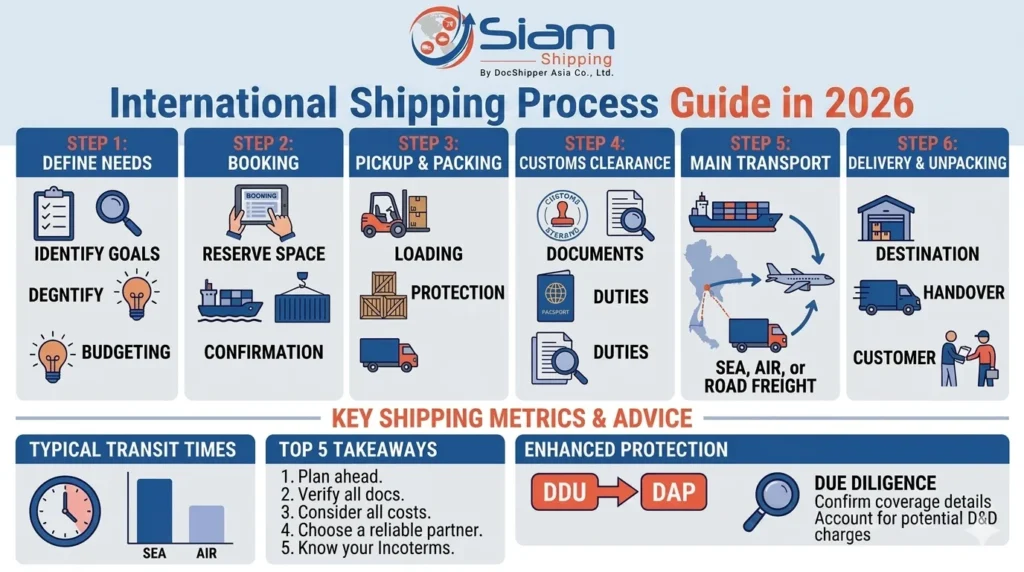
Plan, book, prepare documents, export clear, move, import clear, deliver, reconcile freight invoicing.
Checklist, before you ship anything:
- Confirm Incoterms and the exact “named place” (port, terminal, or address).
- Validate HS codes and import requirements for the destination country.
- Lock shipping instructions with your supplier, including labeling and packing rules.
- Choose your freight forwarder and agree on what’s included in the quote.
- Align timeline with warehousing, cross-docking, and receiving capacity planning.

Siam Shipping Info
Let DocShipper structure your end-to-end shipping flow, from planning to delivery, so nothing slips between booking, customs, and final mile.
Siam Shipping Advice
Appoint one logistics conductor to align forwarders, brokers, carriers, and 3PLs, and eliminate costly role gaps before storage fees appear.
From order to delivery: core stages of the shipping process
The shipping process starts earlier than most people think, right at procurement and vendor management, when you set expectations on packing, readiness dates, and documentation.
We’ve seen a “simple” cargo shipping process turn into a week of chaos because the purchase order didn’t specify pallet height, then containerization failed at pickup.
Core stages you’ll notice in any shipping guide:
- Pre-shipment planning: route optimization, mode choice, freight insurance, and quote comparison.
- Booking and cargo readiness: load planning, carton counts, weights, and pickup scheduling.
- Origin handling: warehousing, freight consolidation, export packing checks, and port/airport receiving.
- Main transport: sea, air, or multimodal transport with milestone-based shipment tracking.
- Customs clearance: export then import, with duties, taxes, and compliance checks.
- Final delivery: drayage to rail ramp or terminal, then FTL or less-than-truckload (LTL), then last-mile delivery.
- After-delivery: claims, reverse logistics (if needed), and freight invoicing validation.
Quick comparison table (what changes most by stage):
| Stage | What you control | What usually breaks |
| Planning | Incoterms, freight rates, lead time, service level | Hidden surcharges, wrong responsibilities |
| Origin handling | Pickup timing, packing, consolidation, bonded warehouse option | No-show truck, wrong labels, missing shipping instructions |
| Main transport | Carrier negotiation, routing, container type, flight selection | Rolled bookings, transshipment delays |
| Customs | HS code, valuation, permits, shipping documents quality | Holds, exams, duty re-assessments |
| Delivery | Appointment, dock constraints, FTL vs LTL, cross-docking plan | Storage fees, missed slots, damages |
And yes, “shipping processing” is a real thing internally, it’s the operational choreography that keeps each handoff clean so your goods don’t sit idle.
Key players: shipper, freight forwarder, carrier, customs broker and 3PL
In the shipping process, confusion rarely comes from transport itself, it comes from unclear roles between the shipper, freight forwarder, carrier, customs broker, and your 3PL provider.
One importer told us their forwarder “handled everything”, then customs asked for a missing certificate and everyone pointed fingers while storage charges grew.
Who does what in a typical international shipping process:
- Shipper: the party tendering cargo, setting shipping instructions, and ensuring export readiness.
- Freight forwarder / freight brokerage: designs the routing, books carriers, manages documents flow, and coordinates cargo handling end-to-end.
- Carrier: physically moves the cargo, ocean line, airline, trucking carrier, rail operator.
- Customs broker: files customs entries, handles tariff classification, customs duties, and import/export compliance.
- 3PL provider: warehousing, inventory management, cross-docking, fulfillment, and sometimes last-mile delivery.
- 4PL provider: orchestrates multiple 3PLs and forwarders, often for complex multimodal networks.
From experience, you’ll move faster when you appoint one “conductor” for the sea freight forwarding process or air chain, especially when shipments split across suppliers and need freight consolidation.
That’s where we step in at DocShipper, we run the freight forwarding and coordination, align brokers and carriers, and keep your shipping documents consistent with what customs will actually accept.
Checklist, to avoid role gaps:
- Confirm who issues the bill of lading or airway bill, and who approves drafts.
- Decide who owns customs clearance and who pays duties and taxes under your Incoterms.
- Clarify who books drayage and who manages detention and demurrage risk.
- Assign one contact for shipment tracking and exception management.
Operational workflow (who touches what):
Shipper confirms cargo ready, forwarder tenders freight, carrier picks up, broker clears, 3PL receives, forwarder closes files and audits freight invoicing.
Looking for a Reliable Shipping & Sourcing Partner?
Step‑by‑step shipping process: from purchase order to final delivery
This is the shipping process the way it runs in real logistics, with decision points you can’t “fix later” once the container gates in or the flight departs.
You’ve probably felt that moment when the supplier says “ready”, but nobody can answer the simplest question, “ready with which documents?”
We’ll walk you through a practical international shipping process that connects quotations, Incoterms, customs clearance, and final delivery, without the usual blind spots.
End-to-end workflow (high level):
Purchase order, quotations and Incoterms, booking, export docs, origin handling, main transport, import clearance, delivery, post-shipment audit.
Checklist, before the PO becomes a shipment:
- Lock product specs, packing method, and carton/pallet configuration for load planning.
- Define the Incoterm and payment terms, so responsibilities match reality.
- Validate HS codes and destination import requirements before cargo is produced.
- Choose a forwarder that can control documents and execution, not just quote.
Siam Shipping Info
We map your purchase order to final delivery, aligning Incoterms, routing, and compliance before cargo moves.
Pre‑shipment planning: quotations, incoterms, shipping instructions and payment
Your shipping process either stays predictable or falls apart right here, when you request quotes, negotiate Incoterms, and issue shipping instructions to the supplier.
We once saw a buyer accept an ultra-low quote, then discover it excluded origin charges, export paperwork, and even terminal handling, the “cheap” deal ended up as the most expensive lane that month.
What you should lock in during planning:
- Quote structure: ask for a full cost breakdown, including origin handling, THC, documentation, drayage, delivery, and fuel/security surcharges.
- Incoterms: confirm not only the rule (EXW, FOB, CIF, DAP, DDP) but also the named place and who controls main transport.
- Freight rates strategy: spot vs contract, capacity planning for peak season, carrier negotiation approach.
- Shipping instructions: marks, labels, carton count, pallet specs, gross and net weights, and document names exactly as customs expects.
- Payment and risk: align payment release with document readiness, inspection, and freight insurance coverage.
Practical tip: treat shipping instructions like a mini contract. If the supplier “forgets”, you’ll pay for it at customs or at the warehouse dock.
For credibility and alignment, many forwarders follow common documentation and liability principles used across the industry, including frameworks referenced by FIATA.
Mini workflow (planning to booking):
Request quote, compare inclusions, set Incoterm, confirm HS codes, issue shipping instructions, confirm cargo ready date, book space.
Quick table, Incoterms impact on control:
| Incoterm | Who controls main transport | Where mistakes happen fast |
| EXW | You (or your forwarder) | Export clearance and pickup coordination at origin |
| FOB | You (from port of loading) | Misunderstood origin charges and cut-off dates |
| CIF | Supplier chooses carrier | Poor visibility, weak service level, destination fees surprise |
| DAP/DDP | Supplier (to your door) | Customs compliance, duty payment proof, delays with broker authority |
Siam Shipping Alert
Ask for a full cost breakdown and validate Incoterms, inclusions, and responsibilities before you confirm booking.
Export coordination, main transport, import clearance and last‑mile delivery
This part of the shipping process is execution mode, export coordination, carrier handoffs, customs clearance, and the last-mile delivery slot that your warehouse actually has to receive.
A classic scenario we handle, the cargo arrives, but the importer can’t provide the broker with the right consignee details, the container sits, demurrage starts, and everyone suddenly becomes “urgent”.
Execution steps in the cargo shipping process:
- Export coordination: pickup, origin warehouse staging, VGM where applicable, export declaration, and port operations check-in.
- Main transport: containerization for ocean, ULD build-up for air, or multimodal transport when routing demands it.
- Import clearance: entry filing, HS code verification, customs duties and taxes, and any inspection holds.
- Final delivery: terminal release, drayage, then FTL or LTL to your dock, sometimes via cross-docking to protect inventory management flow.
Documents and tracking that drive decisions:
- Bill of lading for ocean shipments, airway bill for air shipments.
- Arrival notice, delivery order, and broker entry status for customs clearance.
- Milestones for shipment tracking, gate-in, departure, arrival, customs released, out for delivery.
Mini workflow (execution):
Pick up cargo, origin handling, export cleared, depart, arrive, import cleared, release, drayage, schedule delivery, POD and close.
Checklist, to prevent last-minute fire drills:
- Confirm consignee and notify party details match across all shipping documents.
- Pre-alert the customs broker with invoice, packing list, and transport document drafts.
- Plan terminal release and drayage early, especially during port congestion.
- Book delivery appointments with your 3PL or warehouse, align dock hours and unloading method.
- Audit charges after delivery, detention, demurrage, and accessorials, before paying freight invoicing.
If you want this to run smoothly, we coordinate your sea freight forwarding process or air chain end-to-end, align customs brokerage, and keep your shipping guide, shipping instructions, and shipping documents consistent so clearance and delivery don’t turn into a guessing game.
When you’re ready, you can start by requesting a quote with DocShipper, we’ll challenge assumptions, confirm Incoterms, and build a realistic routing plan around your lead time and budget.
Siam Shipping Advice
Pre-alert brokers, validate consignee details, and plan drayage early to avoid demurrage and missed delivery slots.
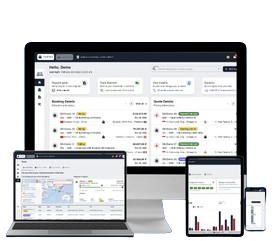
DocShipper Platform
One platform. Your entire supply chain
Sourcing, freight, customs & documents, all centralised, all visible, 24/7.
Choosing the right mode: sea freight, air freight and multimodal shipping
You cannot optimize cost and lead time without choosing the right transport mode. The mode you select reshapes your entire cost structure and delivery reliability.
Sea freight is cost-efficient for high volumes but slower. Air freight is fast but expensive, and multimodal solutions combine flexibility and optimization.
| Mode | Best For | Transit Time | Cost Level | Key Advantage |
| Sea Freight FCL | Full containers | 20 to 45 days | Low per unit | Scalable for large volumes |
| Sea Freight LCL | Small to medium loads | 25 to 50 days | Medium | No need to fill a container |
| Air Freight | Urgent or high-value goods | 3 to 10 days | High | Speed and reliability |
| Multimodal | Complex routes | Variable | Optimized | Flexible routing |
You should evaluate mode selection based on these operational criteria:
- Product value versus freight cost ratio.
- Inventory holding cost and stock-out risk.
- Seasonality and sales forecast volatility.
- Destination infrastructure constraints.
- Carbon footprint objectives.
We often design hybrid solutions, such as sea freight for the bulk and air freight for urgent SKUs. This approach secures your supply chain while protecting margins.
If you are sourcing from Asia, you can explore our dedicated solutions here: Sea Freight Services and Air Freight Services.
Essential shipping documents you must control to avoid delays
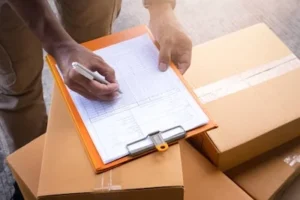
If you lose control of your paperwork, you lose control of your cargo. In the shipping process, documents move faster than containers, and customs will block you at the slightest inconsistency.
You need to understand what each document does and who is responsible for issuing it. At DocShipper, we review every file before departure to prevent costly holds and demurrage.
| Document | Issued by | Main Purpose | Risk if Incorrect |
| Commercial Invoice | Supplier | Declares value and terms of sale | Customs reassessment, penalties |
| Packing List | Supplier | Details cartons, weight, volume | Inspection delays |
| Bill of Lading or Air Waybill | Carrier or Forwarder | Transport contract and title of goods | Release blocked at destination |
| Certificate of Origin | Chamber of Commerce | Determines applicable duties | Loss of preferential tariffs |
| Import or Export License | Authorities | Authorizes controlled goods movement | Cargo seizure |
You must cross-check data consistency across all documents. Even a mismatch in HS code or Incoterm can trigger inspections and storage fees.
Use this checklist before shipment departure to stay compliant:
- Verify HS code classification with a customs specialist.
- Ensure Incoterm is identical on invoice and Bill of Lading.
- Confirm weights and dimensions match booking confirmation.
- Check consignee and notify party details.
- Validate required certificates for regulated products.
When we manage your operations, we centralize documentation flow between supplier, carrier and broker. You gain full document visibility before cargo even reaches the port.

Siam Shipping Alert
Centralize document control and cross-check every data point before departure to avoid inspections, penalties, and storage fees.
Siam Shipping Info
We design sea, air, or hybrid solutions that balance inventory pressure, margins, and lead time reliability.
Conclusion
You now understand that mastering the shipping process is not about moving boxes. It is about controlling information, risks and responsibilities at every step.
- Plan your shipment before production is finished.
- Choose Incoterms strategically, not by habit.
- Secure accurate and consistent shipping documents.
- Select the transport mode aligned with your cash flow and deadlines.
- Work with a freight forwarder who oversees the entire chain.
When you partner with us, you do not just book freight. You gain a single operational partner who coordinates sourcing, shipping, customs and final delivery from origin to destination.
FAQ | The shipping process explained: how to move cargo efficiently from seller to buyer
Most customs blocks come from mismatches between documents, not from the goods themselves. To reduce the risk, use a single “source of truth” (usually the commercial invoice) and align every other document to it. Double‑check that HS codes, Incoterms, values, quantities, and consignee details are identical across invoice, packing list, and bill of lading/air waybill. If anything changes after booking (price, cartons, weight), have your forwarder re‑issue updated drafts before departure instead of “fixing it at destination”.
You can accept their Incoterm on paper but still regain control by negotiating who selects the forwarder and how visibility works. For CIF, ask your supplier to use your nominated forwarder and require full pre-alerts and tracking milestones shared directly with you. For DAP/DDP, clarify in writing who handles customs, who pays duties, and which documents you must receive before cargo leaves. If the supplier refuses transparency or flexibility, it is often safer to renegotiate to FOB and put your own forwarder in charge.
LCL makes sense when the financial and operational cost of waiting for a full container is higher than the LCL premium. If delaying shipment would create stock‑outs, missed launches, or air freight emergencies later, LCL is usually the better call. It’s also useful for testing new products or suppliers, where you want to limit inventory exposure. The key is to compare the extra LCL cost with your margin loss or air freight cost if you run out of stock.
These charges appear when containers sit too long at the terminal or with the trucker. You can reduce them by aligning customs clearance, terminal release, and truck booking before the vessel arrives. Share ETA and document drafts with your customs broker early, so they can pre‑file the entry and clear as soon as possible. Then confirm truck capacity and delivery slot in advance, especially during peak seasons. Make sure your Incoterms and contract clearly state who pays these storage-related fees.
You need to calculate landed cost per unit and compare it to your selling price and margin. Add product cost, all freight and local charges, duties, taxes, and last‑mile delivery, then divide by sellable units to get a true unit cost. If freight is a big share of that number, consider changing mode (e.g. sea instead of air), adjusting packaging to fit more units per cubic meter, or consolidating shipments. If you still cannot hit a sustainable margin, the product or route may not be viable as designed.
With multi-supplier flows, you mainly fight fragmentation. Nominate one lead forwarder and agree that all suppliers follow the same routing, cut‑off dates, labeling rules, and document templates. Ask the forwarder to consolidate cargo where possible, and to provide a single shipment dashboard instead of separate updates. Internally, assign one person as shipment owner, responsible for collecting packing lists and invoices on time, approving bill of lading drafts, and making sure every supplier respects the same shipping instructions.
The most damaging issues are those that break either safety rules or data consistency. Overloaded pallets, unstable stacking, or missing dangerous goods markings can trigger inspections, re‑packing, or even cargo refusal. At the same time, labels that don’t match the packing list or shipping marks in the instructions can cause mis‑picks, mis‑loads, and customs confusion. Before pickup, ask your supplier for photos of packed pallets and labels, and compare them to your agreed specifications and documentation.
Need Help with
Logistics or Sourcing ?
First, we secure the right products from the right suppliers at the right price by managing the sourcing process from start to finish. Then, we simplify your shipping experience - from pickup to final delivery - ensuring any product, anywhere, is delivered at highly competitive prices.
Fill the Form
Prefer email? Send us your inquiry, and we’ll get back to you as soon as possible.
Contact Us