


Freight Shipping between Thailand and Greece | Rates – Transit times – Duties and Taxes
The first mistake you can make with shipping between thailand and greece is assuming it is just another Asia to Europe lane, when in reality you are dealing with long sea routes via the Suez Canal, tight transshipment schedules, and EU customs rules that will directly affect your budget and timeline. You quickly realize that freight from Thailand to Greece is less about theory and more about choosing the right balance between cost, speed, and compliance from day one.
You are probably here because you want clear numbers, realistic transit expectations, and a solid understanding of duties and taxes before you commit, and that is exactly what you will get. In this Destination guide, we will cover transport options, transit logic, customs clearance in Greece, and the key cost drivers you need to factor into your plan.
Which are the different modes of transportation between Thailand and Greece?
If you ship full containers or heavy cargo, you will usually choose sea freight via Laem Chabang and Piraeus, because it keeps costs under control even if transit is longer. If you move high-value or urgent goods, you will prefer air freight from Suvarnabhumi Airport to Athens, where speed clearly outweighs price.
The first thing we always tell you is simple, you match the mode to your cash flow, your delivery deadline, and your cargo profile. If you are unsure, you can contact our team and we will guide you based on real-time capacity and market conditions, and then we will break each option down in detail below.
Need help with your shipment?
Need assistance with your shipment? Dont hesitate to contact us even for a simple question. Choose the option that suits you
Live chat with an expert Chat on WhatsApp Free Quote 24hHow can Siam Shipping help you
Sea freight between Thailand and Greece
If you are planning sea freight from Thailand to Greece, the first thing we always tell you is simple. Choose ocean transport when you care more about cost per unit than speed. For regular commercial goods, industrial equipment, consumer products, or palletized cargo, ocean freight Thailand to Greece is usually the most economical option. If you are under tight deadlines or shipping small urgent batches, air freight will make more sense.
On this corridor, you should expect long ocean shipping lead time and at least one transshipment in the Middle East or at a Mediterranean transshipment hub. This is not a fast lane route. It is a cost optimization route. When you plan correctly, shipping between Thailand and Greece by sea works very well. When you underestimate timing, you create stock pressure in Greece.
The most common mistakes we see are linked to Incoterms and unrealistic timelines. You agree on FOB without understanding local export handling in Thailand. You buy CIF and realize too late that destination charges in Piraeus are higher than expected. You assume port to port transit time equals delivery time to your warehouse. It does not. If you want a smooth international container shipping Thailand Greece flow, you need to think door to port vs door to door sea freight from day one.
Sea freight makes sense here if your cargo is heavy, bulky, or container-sized, and if you can plan 5 to 7 weeks ahead including customs and inland transport. If that matches your situation, this route can be extremely competitive.
Which Incoterms should you use?
When you organize how to ship commercial goods from Thailand to Greece, your choice of Incoterms FOB CIF EXW DAP DDP will define who controls the shipment and who absorbs surprises. This is really about freight terms allocation of risk and cost, not about memorizing definitions.
If you buy EXW in Thailand, you take responsibility very early. That means you handle export customs clearance Thailand, local trucking, and port formalities. Many importers underestimate this and end up depending on their supplier anyway. From experience, EXW only works well if you already have a reliable freight forwarder coordination in place.
FOB Laem Chabang is often a balanced option. Your supplier clears the goods for export and delivers them to the port, and you control the main ocean freight. This gives you transparency on sea freight rates Thailand to Greece and better visibility on the bill of lading B/L conditions.
CIF can look convenient, but here is the catch. You do not control the carrier, and destination charges in Greece are not always clear upfront. This is where many importers feel trapped.
If you sell onward in Greece and want full control, DAP can make sense. If you consider DDP, you must be sure someone handles import customs clearance Greece correctly, including VAT and duties. Otherwise, you face delays and storage costs.
Before you confirm any contract, you should also clarify cargo insurance for sea freight and marine insurance coverage. Basic carrier liability is limited. If your cargo value is high, you need proper coverage.
Main ports to know in Thailand and Greece
When you plan sea freight from Thailand to Greece, port selection impacts inland costs, transit time, and reliability. You should focus on the ports that actually handle containerized international flows.
- Port of Laem Chabang, Thailand. This is the main deep sea container gateway. Most FCL and LCL exports leave from here. If your supplier is in the Eastern Economic Corridor, this is usually the most efficient choice.
- Port of Bangkok, Thailand. Located inland on the Chao Phraya River. Suitable for smaller volumes and certain regional flows, but vessel size limitations can mean feeder services to larger hubs.
- Port of Piraeus, Greece. The primary entry point and a major Mediterranean transshipment hub. If your cargo arrives here, you benefit from strong feeder and rail connections into Greece and the Balkans.
- Port of Thessaloniki, Greece. Strategic for Northern Greece and Balkan distribution. You may choose it if your final delivery point is closer to this region, but services from Thailand are less frequent than to Piraeus.
Your choice influences inland trucking cost and delivery time. If your warehouse is near Athens, Piraeus is logical. If you distribute in Northern Greece, Thessaloniki can reduce domestic transport legs.
Transit times: How long does it take to ship from Thailand to Greece?
Below you can see indicative sea transit time Thailand to Greece based on common port pairs. These figures represent port to port transit time and exclude customs and inland delivery.
| Origin Port | Destination Port | Estimated Transit Time |
|---|---|---|
| Laem Chabang | Piraeus | 28 to 35 days |
| Laem Chabang | Thessaloniki | 30 to 38 days |
| Bangkok | Piraeus | 30 to 37 days |
In practice, you should plan around 5 to 6 weeks total door to port. Direct services are rare, so most shipments transship through hubs in Asia or the Middle East before reaching the Mediterranean. Each transshipment adds handling time and potential delay.
Port congestion surcharge situations, peak season before European summer, and year end export rush in Asia can extend schedules. So when you read 30 days, you should treat it as sailing time, not warehouse delivery time.
Should I choose FCL or LCL when shipping between Thailand and Greece?
Shipping goods between Thailand and Greece? The choice between Full Container Load (FCL) and Less than Container Load (LCL), also known as consolidation, can be a strategic decision. It’s more than just cargo; it shapes your cost, delivery timeline, and overall shipping success. Picking the right option is like fine-tuning an instrument – it needs careful consideration and understanding. Ready to dive in? This section empowers you to weigh up FCL and LCL, unearthing the complexities of each and ultimately, helping you to chart your optimal course through the intriguing world of sea freight. Let’s get started!
Full container load (FCL)
Definition: FCL (Full Container Load) shipping implies that you're buying all the space inside a shipping container, typically a 20'ft or 40'ft container, from Thailand to Greece. When to Use: FCL is a wise move when your cargo volume exceeds 13/14/15 cubic meters (CBM), otherwise known as the break-bulk point. High-volume shipments make FCL cost-effective and offer an additional layer of security as the container seals remain intact from source to destination. Example: For instance, a furniture exporter from Thailand with a shipment of 20 CBM would opt for FCL. Their goods can safely occupy a whole 20'ft container, significantly reducing the risk of damage during transit and providing a sense of security about the cargo's safe arrival in Greece. Cost Implications: While FCL might appear more pricey at first, especially when getting an FCL shipping quote, it becomes financially feasible with larger volumes. Why? It's simply because the price per unit decreases; so, in essence, the more you ship, the less you pay per unit, making FCL an economical choice for bigger consignments.
Less container load (LCL)
Definition: Less than Container Load (LCL) shipping, also known as consolidation, refers to shipments that do not fill a whole container. Various shippers' cargoes are combined into one container. When to Use: LCL shipment becomes a feasible choice when the cargo volume is small—typically less than 13, 14, or 15 cubic meters (CBM). It offers flexibility and cost-effectiveness for smaller volumes. Example: Suppose a Thailand-based furniture manufacturer is exporting only a small number of tables to Greece. Instead of booking a whole container, they can choose LCL freight, which can be shared with other businesses' goods. Cost Implications: Since you only pay for the space you use, it's generally cheaper for smaller volumes. However, remember that there could be additional fees for consolidation and de-consolidation activities. Moreover, as more handling is involved, there's slightly higher risk of damage or delay compared to Full Container Load (FCL) shipping.
Hassle-free shipping
Make your Thailand-to-Greece cargo shipping effortless with DocShipper. Our ocean freight experts will assist you in choosing between consolidation and full container shipments, gauging factors such as your budget, shipment size, and delivery timeline. Why navigate the murky waters of freight forwarding alone? Let DocShipper be your compass. Contact us today for a free, no-obligation cost estimation. Let's sail to success together!
Shipping rates: how much does a sea freight shipment cost from Thailand to Greece?
Indicative sea freight rates Thailand to Greece fluctuate depending on season, fuel, and carrier capacity. Below you have planning ranges for standard cargo.
| Mode | Type | Estimated Cost Range (USD) |
|---|---|---|
| LCL | Per CBM | 80 to 150 USD per CBM |
| FCL | 20ft container | 1,800 to 3,000 USD |
| FCL | 40ft container | 2,800 to 4,500 USD |
If you want a quick container shipping cost estimate, you should know that price depends on volume, container type, carrier space availability, bunker adjustment factor, and peak season surcharge. Ocean freight alone is only part of your budget. Terminal handling charges, documentation, inland trucking, and customs clearance can significantly change your total landed cost.
How to estimate your sea freight cost before requesting a quote
Before starting your freight quote request process, you should prepare four key elements. Total volume in CBM, total gross weight, chosen Incoterm, and exact origin and destination addresses.
For LCL, carriers charge per cubic meter or per ton, whichever is higher. For example, if you ship 8 CBM weighing 6 tons, the chargeable volume is 8 CBM because 1 CBM is usually compared to 1 ton. If you ship 5 CBM weighing 9 tons, the chargeable volume becomes 9 freight tons. This is the logic behind Less than Container Load consolidation pricing.
For FCL, you pay for a Full Container Load dedicated container, whether you fill it completely or not. So you should compare the LCL total with the flat FCL rate. Around 12 to 15 CBM, FCL often becomes competitive.
Be careful with cheap looking offers that only show ocean freight. You need clarity on destination charges in Piraeus or Thessaloniki, customs brokerage, and delivery. The best way to reduce sea freight costs between Thailand and Greece is to look at the total door to door scenario, not only the sea leg.
At DocShipper, we can review your shipment details and provide a clear, route specific quotation within 24 hours.
Surcharges and hidden cost drivers to watch for
The first surprise usually comes from destination charges. Even if you buy CIF, you will still pay terminal handling charges, documentation fees, and delivery order fees in Greece.
Then come time related costs. Demurrage and detention apply if you do not return the container on time. Storage applies if customs or paperwork delay the release. A missing document in your shipping documentation checklist can quickly turn into real money.
Finally, operational surcharges can appear. Bunker adjustment factor reflects fuel changes. Peak season surcharge applies during high demand periods. In some cases, a port congestion surcharge is added when terminals are saturated. These are market driven and outside your direct control.
Step-by-step: how a sea freight shipment usually works on this route
When you book ocean freight between Thailand and Greece, you are setting in motion a multi stage process that requires coordination and patience. Most delays do not happen at sea. They happen during documentation, customs, or port handling. If you understand the sequence, you avoid most surprises.
- We confirm volume, weight, cargo type, and Incoterm with you and your supplier.
- We arrange pickup at origin and manage export customs clearance Thailand.
- Your cargo is delivered to the port, consolidated if LCL, or loaded into your container if FCL vs LCL shipping decision favors FCL.
- The carrier issues the bill of lading B/L, and we validate details before vessel departure.
- The vessel sails, usually with one transshipment before reaching Greece.
- Before arrival, we prepare import customs clearance Greece and verify documents, including possible telex release.
- Once cleared, we arrange container release, inland trucking, and final delivery to your warehouse.
If you anticipate documentation early and align with your supplier, this flow becomes predictable. If you wait until the vessel arrives to check paperwork, this is where costs start increasing.
Special sea freight solutions
Out of Gauge and special containers
If your cargo does not fit in a standard dry container, you can use specific container types dry container reefer open top flat rack. For out of gauge cargo, open top or flat rack units allow height or width overflow. This is common for industrial machinery and project components.
Project cargo and breakbulk shipping
For very large pieces, you may consider project cargo by sea or breakbulk shipping. Instead of containerization, cargo is loaded individually onto the vessel. This requires detailed planning, lifting studies, and precise port coordination.
Reefer containers
If you transport food or temperature sensitive goods, reefer containers maintain controlled conditions during the entire voyage. You should define temperature range and monitoring requirements clearly before departure.
Ro-Ro solutions
If you ship vehicles or rolling equipment, Ro-Ro vessels allow units to be driven on and off the ship. This can be efficient for cars, trucks, and certain construction machines.
Each of these solutions requires early technical validation. If you share dimensions, weight, and cargo value with us, we will advise you on the safest and most cost effective setup for your shipment between Thailand and Greece.
Air freight from Thailand to Greece
If you need speed, tight inventory control, or you are moving high value goods, air freight from Thailand to Greece makes sense. You can move cargo from Bangkok to Athens in a few days, but you need to respect cut-off times, cargo security screening, and strict packaging rules. Air is fast, but it is also unforgiving if you prepare late or document poorly.
You have probably heard that air freight always takes 2 or 3 days, that it is always too expensive, or that you only pay for real weight. None of that is consistently true. Your cost depends on chargeable weight calculation, not just kilos. Your timing depends on space allocation and possible transit via a transit hub in the Middle East or Europe. On this route, the most expensive mistakes usually come from wrong dimensions, weak packaging, or incomplete export documentation for air cargo.
Air cargo vs express: how should you ship on this route?
When you organize shipping between Thailand and Greece by air, you basically choose between standard air cargo and courier style express. This is the classic air cargo vs courier service decision. Air cargo moves your goods under an airline contract with an air waybill AWB, often using consolidated space. Express runs through an integrator network with its own aircraft and sorting hubs.
The first thing we always tell you is this, the right option depends on your volume, urgency, and how much control you want over customs and destination charges. Let us break it down clearly below.
Should you choose air cargo from Thailand to Greece?
If your shipment is above 1 CBM or roughly 100 to 150 kg, air cargo Thailand to Greece is usually the logical choice. This is especially true for B2B flows, regular replenishment, oversized cargo air transport, or when you need temperature controlled air cargo, dangerous goods by air, or high value cargo handling under IATA cargo standards.
Before booking, you should have ready your exact dimensions, gross weight, Incoterm, pickup city, destination airport, ready date, and precise commodity description. If you ship lithium batteries, perishables, or controlled products, you must declare it clearly from day one. Airlines apply strict rules for lithium batteries shipping by air and perishable goods shipping by air.
Most problems on this route come from confusion between airport to airport shipping and door to door air freight service. You also need to factor in airport handling charges, screening time, and minimum charges. If you miss the airline cut-off at origin, your cargo simply rolls to the next flight. That is where your lead time can suddenly stretch.
Should you choose express air freight from Thailand to Greece?
Express air freight Thailand to Greece works well if you ship small parcels, samples, spare parts, or urgent documents. If you need the fastest shipping option between Thailand and Greece for a box under 1 CBM and you do not have a logistics team managing customs daily, express keeps it simple.
The trade-off is control. You gain simplicity, but you have less flexibility on billing structure, reweigh or remeasure decisions, and destination charges under certain Incoterms. Many shippers underestimate volumetric weight, assume everything is included, or ignore specific packaging requirements for air freight. That is how invoices increase after dispatch.
Express is a good fit if your cargo is compact, urgent, and standard. It becomes risky if your cargo is bulky but light, sensitive, or subject to special compliance. In those cases, standard air cargo with a forwarder often gives you better visibility and structured air freight customs clearance support.

Main airports to know in Thailand and Greece
- Suvarnabhumi Airport Bangkok, Thailand. This is the primary international cargo hub and the backbone of most air freight from Thailand to Greece flows. You get the widest airline capacity and better options between direct flight vs transshipment flight. If your supplier is near Bangkok, this is usually your most efficient origin.
- Don Mueang Airport, Thailand. Mainly used for regional and low cost traffic, with limited long haul cargo capacity. You may use it for specific routings, but most Europe bound cargo consolidates via Suvarnabhumi.
- Athens International Airport, Greece. This is the main entry point for air cargo into Greece and the logical choice for most imports. You benefit from structured import process at destination airport and strong road connectivity to mainland Greece.
Your airport choice affects inland trucking cost, total air freight lead time, and exposure to congestion. If your cargo connects through a Middle Eastern or European hub, you must also consider transfer time and space availability during peak seasons.
Transit times: how long does air freight take from Thailand to Greece?
| Service | Typical transit time | Notes |
|---|---|---|
| Standard air cargo | Approximately 3 to 7 days | Often via a transit hub in the Middle East or Europe, depending on airline capacity and space allocation |
| Express courier | Approximately 2 to 5 days | Integrated network with fixed schedules and central sorting hubs |
Your real air transit time Thailand to Greece depends on the exact origin airport, final delivery point, and when your cargo is ready. The clock does not start when you request a quote. It starts when your shipment is screened, accepted, and loaded.
The main variables are pre-flight handling and cut-off times, possible cargo security screening delays, and congestion during peak seasons. If you ship dangerous goods or oversized cargo, you should add extra validation time before departure.
Shipping rates: how much does air freight cost from Thailand to Greece?
There is no single air freight cost per kg estimate that fits all shipments. Your air freight rates Thailand to Greece depend first on chargeable weight, then on dimensions and density, urgency, season, and the airports involved.
| Cost driver | What you should check |
|---|---|
| Chargeable weight | Compare volumetric weight vs gross weight before requesting a quote |
| Dimensions and packaging | Verify stackability and compliance with airline pallet formats |
| Urgency and season | Peak season and tight capacity increase spot rates |
| Airport and inland legs | Include pickup, delivery, and airport handling charges in your budget |
If you want a reliable estimate, you should prepare exact dimensions, total weight, commodity type, and Incoterm. Without that, any rate you receive is just a rough indication and may change once the cargo is measured at origin.
Step-by-step: how an air shipment usually works on this route
When you ship air cargo from Thailand to Greece, the process looks simple on paper. In reality, timing and documentation make all the difference. Here is how it typically works when we manage it end to end.
- You confirm booking details, including dimensions, weight, commodity, Incoterm, and ready date.
- We organize pickup at your supplier and move the cargo to the origin warehouse near the departure airport.
- Your goods go through cargo security screening and document validation under IATA cargo standards.
- We issue the air waybill AWB, either a house AWB and master AWB in consolidated air freight, or a direct airline AWB.
- The cargo is loaded on a direct flight or routed via a transit hub in the Middle East or Europe.
- Upon arrival at Athens International Airport, the import process at destination airport begins, including customs clearance and duty assessment.
- After release, we arrange final delivery if you booked door to door air freight service, and you can follow progress through an air cargo tracking system.
Most delays happen at three points, late cargo arrival at origin warehouse, documentation errors, or customs queries at destination. That is where costs and storage fees can increase quickly if you are not prepared.
What is the difference between volumetric and gross weight?
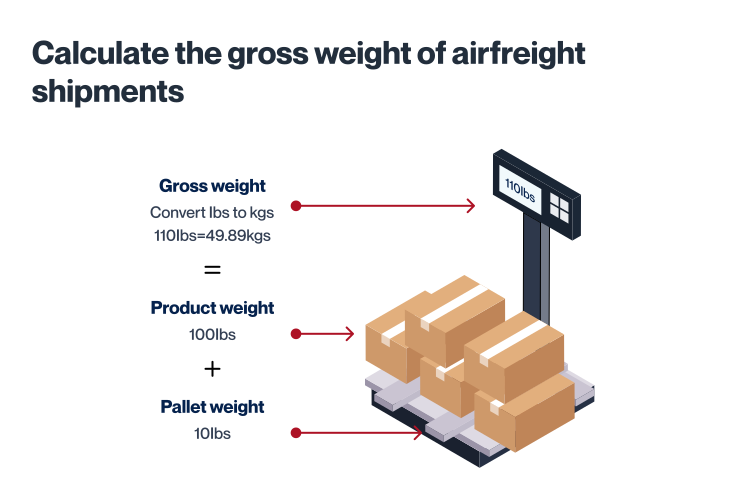
When you calculate your air freight budget, you must understand volumetric weight vs gross weight. Airlines do not charge you only on what your cargo weighs physically. They charge you on the space it occupies in the aircraft. The higher value between gross and volumetric becomes your chargeable weight.
- Gross weight, the real weight of your cargo including packaging.
- Volumetric weight, the theoretical weight based on volume.
- Chargeable weight, the higher of the two, used for invoicing.
- Chargeable weight calculation, the method used to determine what you actually pay.
How to calculate
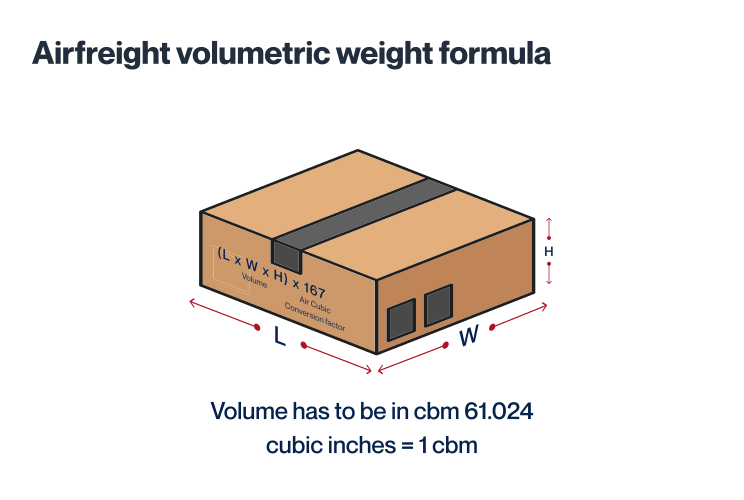
For standard air cargo, you use: Length cm × Width cm × Height cm / 6000. For express, you use: Length cm × Width cm × Height cm / 5000.
| Service | Conversion rule |
|---|---|
| Air cargo | 1 m³ = 167 kg, divisor 6000 |
| Express | 1 m³ = 200 kg, divisor 5000 |
If you ship a package measuring 200 × 50 × 50 cm and weighing 70 kg, your volumetric weight in air cargo is 83.33 kg. You will be billed on 83.33 kg, not 70 kg.
The most common mistake is sending estimated dimensions instead of final packed dimensions. Even a few extra centimeters can change your pricing bracket. Always measure after final packaging, not before.

Door to door between Thailand and Greece
Shipping made smoother! Let’s talk about International Door-to-Door shipping – a time-saving option that takes care of everything, from pickup at the origin to delivery at the doorstep in the destination country. For Thailand-Greece routes, it’s a headache-free choice, optimizing shipping logistics. Super efficient, right? So, ready to dive deeper into the world of Door-to-Door shipping? Let’s dive in!
Overview – Door to Door
Shipping products from Thailand to Greece can feel like maneuvering a labyrinth. That’s where Door to Door service steps in, offering a no-fret alternative to traditional logistics. By handling everything from pick-up, transport to customs clearance and final delivery, it takes the burden of complex shipping procedures off your shoulders. While it may incur a slightly higher cost, the peace of mind and time-conservation it brings is why businesses, similar to yours, find it worth it. Door to Door helps sidestep obstacles, making it the favored option by many of DocShipper’s clients for a hassle-free and efficient shipping process.
Why should I use a Door to Door service between Thailand and Greece?
Don’t you just crave a tzatziki even when you’re chilling in Bangkok? What if you could get it from Greece straight to your doorstep, effortlessly? That’s what Door to Door service between Thailand and Greece offers. It sounds like a dream come true, and honestly, it might be. Here are the five reasons why you might just choose this service:
1. COMPLETE PEACE OF MIND: Say goodbye to stress! Door to Door service shoulders the entire logistics load. From goods pickup at the origin to deliver at the destination, your only job is to sit back and relax.
2. SPEEDY GONZALEZ: Urgency? No problem! Priority is given to timely delivery. So, if your goods need to get there, like, yesterday, Door to Door is your savour.
3. CARE YOU CAN COUNT ON: Have complex cargo? Door to Door is your logistics superhero! Specialized care and attention are part of the package, so you can rest assured your precious cargo is in safe hands.
4. ROAD RALLY: Trucking frights? Not here! Door to Door takes care of it all! All the road heavy lifting from pick-up to final delivery point is under its belt, making your journey as smooth as a baby’s bottom.
5. EASY BREEZY: Life’s too short for procedures and paperwork, right? This service takes care of all the tedious logistics, leaving you free to focus on what truly matters – like, savouring that tzatziki.
So, why wouldn’t you choose a Door to Door service? Taste the Greek cuisine from your Thai recliner, hassle-free and without any logistics nightmares. Isn’t that a win-win?
DocShipper – Door to Door specialist between Thailand and Greece
With DocShipper, experience stress-free door-to-door shipping from Thailand to Greece. We manage all aspects of your freight-forwarding needs – from packing your goods, organizing transportation, handling customs, to using all shipping methods efficiently. Our skilled team ensures smooth operations while you can relax and focus on other aspects of your business. Get a dedicated account executive for personalized service and detailed consultations. Reach out for a free estimate in less than 24 hours or call our consultants – we’re here to simplify logistics for you.
Customs clearance in Greece for goods imported from Thailand
When you handle customs clearance in Greece for goods from Thailand, you are deciding three things in real life: your final landed cost, how fast your cargo gets released, and who is legally responsible as Importer of Record. A small classification or valuation error can change your margin overnight. We coordinate the full process, from customs declaration submission to release, so you stay in control of timing and cost.
On this route, you will typically see delays linked to incorrect HS code classification, missing product compliance documentation such as CE marking for the European market, or inconsistent commercial invoice details. You may also face additional scrutiny if customs questions the declared value. Let us break down how you calculate duties and how the import procedures in Greece actually work step by step.
How to calculate duties & taxes when importing from Thailand to Greece?
To understand how to calculate import duties from Thailand to Greece, you need five inputs: country of origin, HS code classification, customs value, applicable EU tariff, and VAT on imports. If one of these is wrong, your import duty assessment will be wrong.
You should also know that the amount you estimate before shipment and the amount assessed by Greek customs can differ. Why? Because customs may adjust your declared value, reject your tariff classification process, or request additional documents.
If a quote looks unusually low, check what it excludes. Some offers ignore freight and insurance inclusion in customs value or assume a preferential origin claim without proof. That is where extra costs usually appear.
Step 0 – Quick checks before you calculate
Before you start any calculation, you should confirm three operational points:
- Who is the Importer of Record in Greece, and do you have a valid EORI registration?
- Which Incoterm applies, and therefore who controls customs broker representation, direct vs indirect representation, and payment of duties?
- Does your shipment qualify for a low-value or simplified clearance path, or will it require a full single administrative document and standard customs declaration submission?
Step 1 – Identify the Country of Origin
You need to identify the real country of origin, meaning where the product was manufactured or last substantially transformed, not just where it was shipped from.
This determines your tariff outcome, your eligibility for any preferential origin claim, and whether customs will perform rules of origin verification. If your documents are weak, you increase the risk of inspection by customs authorities.
The common mistake we see is confusing shipping country with origin. That error alone can cancel a preferential rate or trigger a customs challenge.
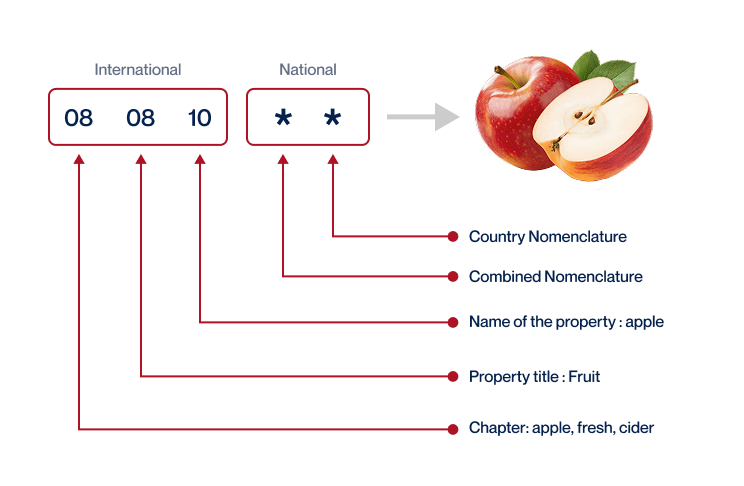
Step 2 – Find the HS Code of your product
Your HS code classification drives everything: duty rate, VAT base, possible import license requirements, and whether your goods fall under restricted and prohibited goods rules or sanitary and phytosanitary controls.
The first thing we always tell clients is this: start with your supplier’s code, but never stop there. You should cross-check the description against the EU tariff database and your product specifications. A defensible tariff classification process means matching materials, function, and technical characteristics.
You can consult the EU TARIC database here: EU TARIC consultation tool. Compare several headings and read the explanatory notes carefully.
If your HS code is wrong, you risk duty reassessment, penalties, customs hold and release process delays, or even post clearance audit exposure later.
Here’s an infographic showing you how to read an HS code.
Step 3 – Calculate the Customs Value
Greek customs apply a standard customs value calculation method based primarily on the transaction value. In practice, you calculate the CIF value for customs purposes, meaning cost of goods plus freight and insurance up to the EU entry point.
You must check what your Incoterm includes. If you buy FOB Bangkok, you will add international freight and insurance. If you buy CIF Piraeus, those costs are already included. You also need to consider customs valuation adjustments such as assists, specific packing costs, commissions, or royalties when applicable.
Example: if your goods cost 8,000 USD, freight is 1,000 USD, and insurance is 200 USD, your customs value becomes 9,200 USD. Duties and VAT on imports will be calculated on that base, not only on the product price.
Step 4 – Figure out the applicable Import Tariff
An import tariff is the customs duty rate applied to your product when it enters Greece under the EU Common Customs Tariff.
You can determine it in three steps:
- Open the official EU TARIC tool.
- Enter your HS code and select Thailand as country of origin.
- Review the duty rate and any additional measures listed.
When you check the result, look for:
- Standard third-country duty rate.
- Any preferential origin claim possibility.
- Additional measures such as anti-dumping or surveillance.
- Import license requirements or product compliance documentation.
If your customs value is 9,200 USD and the duty rate shown is 5%, your import duty assessment would be 9,200 × 5% = 460 USD.
On Thailand to Greece shipments, you should pay close attention to product category specific measures. If you are unsure whether your classification or origin supports the rate you see, we can double-check it before you ship.
Step 5 – Consider other Import Duties and Taxes
After customs duty, you calculate VAT on imports. In Greece, VAT is generally applied to the customs value plus import duty and certain additional costs.
Using the previous example, if your customs value is 9,200 USD and duty is 460 USD, VAT will be calculated on 9,660 USD. You then apply the applicable VAT rate to that total.
Depending on your product, you may also face excise duty, anti-dumping measures, or specific sanitary and phytosanitary controls. Some goods require prior authorizations, CE marking for the European market, or other product compliance documentation before release.
Before shipping, you should:
- Confirm required documents for importing into Greece, including commercial invoice details and packing list requirements.
- Check if a certificate of origin is needed to support origin claims.
- Verify if your goods fall under restricted and prohibited goods categories.
- Budget for possible customs broker fees and services.
Step 6 – Calculate the Customs Duties
The basic formulas are straightforward:
Customs duty = customs value × duty rate.
VAT on imports = (customs value + customs duty + applicable additions) × VAT rate.
Example: customs value 9,200 USD, duty rate 5%. Duty = 460 USD. If VAT applies on 9,660 USD, you multiply that amount by the VAT rate to get the VAT payable.
What happens next is operational. The Importer of Record pays duties either before release or via a deferred payment account, depending on setup. If documents are incomplete or values are challenged, you enter the customs hold and release process, which can add storage, bonded warehouse storage, or inspection costs. That is why getting the numbers right before departure is part of a solid import compliance checklist Thailand to Greece.
Does DocShipper charge customs fees?
At DocShipper, we’re upfront about our fees. While we charge for customs clearance in our roles as customs brokers in Thailand and Greece, we don’t bill you for actual customs duties and taxes – these payments go directly to the government. We hand over all customs documents to ensure complete transparency. So, if you’re shipping a crate of olive oil from Athens to Bangkok, only government-imposed duties and taxes will be your responsibility, while we take care of the technicalities for a separate fee.Contact Details for Customs Authorities
Thailand Customs

Official name: Customs Department – Ministry of Finance, Thailand Official website: www.customs.go.th
Greece Customs

Required documents for customs clearance in Greece
The first thing we always tell you is simple. Your documents must match each other perfectly. Same shipper and consignee, same values, same product descriptions. In Greece, most customs holds happen because of inconsistencies or missing proof, not because “the border is strict.” If you prepare a clean file from the start, you avoid storage fees and unnecessary inspections.
Commercial Invoice
This is the official sales document issued by your Thai supplier to you.
Greek customs uses it to determine the customs value, calculate duties and VAT, and verify what you are actually importing.
Example: 5,000 LED light units, HS code 9405, unit price 4.20 USD, total 21,000 USD, Incoterm FOB Laem Chabang.
Common mistake: Descriptions like “electronic goods” instead of a precise product name and HS code.
Bill of Lading or Air Waybill
This is the transport document issued by the carrier as proof that your cargo has been shipped.
Your broker in Greece needs it to claim the cargo and match shipment details with the customs declaration.
Example: Original Bill of Lading showing Bangkok as port of loading and Piraeus as port of discharge, with you listed as consignee.
Common mistake: Different consignee name on the Bill of Lading and the commercial invoice.
Packing List
This document details how your goods are physically packed.
Customs officers use it during inspections to quickly verify quantities, weights, and carton references.
Example: 200 cartons, each containing 25 units, total gross weight 3,200 kg, palletized on 10 EUR pallets.
Common mistake: Total weight on the packing list not matching the transport document.
Import Declaration (Single Administrative Document)
This is the formal customs declaration submitted electronically in Greece by your customs broker.
It classifies your goods under the correct HS code and applies the appropriate EU duty rate and VAT.
Example: Declaration filed before vessel arrival in Piraeus, referencing your EORI number and customs procedure code for free circulation.
Common mistake: Using the wrong HS code, which can trigger reassessment or inspection.
EORI Number
Your Economic Operators Registration and Identification number is your unique ID for customs operations in the European Union.
Without it, you cannot legally import goods into Greece.
Example: Your Greek company provides its EORI to the broker before shipment departure from Thailand.
Common mistake: Waiting until cargo arrival to apply for an EORI, which causes immediate delays.
Certificates of Conformity or Product Compliance (if applicable)
These are documents proving that your products comply with EU standards.
Greek customs may request them for regulated goods such as electronics, machinery, medical devices, or toys.
Example: CE Declaration of Conformity for electrical equipment, supported by test reports.
Common mistake: Assuming your supplier “has CE” without having the signed declaration and technical file available if requested.
Step-by-step: how customs clearance usually works on this route
When you move cargo from Thailand to Greece, the clearance flow follows a structured path, but the timing depends on the port or airport of entry, the Incoterm, and whether you ship by sea or air. Here is how the steps to clear goods through customs in Greece usually unfold when we coordinate them.
- You confirm the Importer of Record in Greece and verify EORI registration before cargo departure.
- You prepare required documents for importing into Greece, including commercial invoice details, packing list requirements, certificate of origin if needed, and transport documents.
- Before arrival, we review HS code classification, customs value calculation method, and check for import license requirements or compliance gaps.
- Upon arrival at Piraeus port or the relevant airport, the carrier files the arrival notice and the goods are presented to customs.
- We submit the customs declaration submission electronically using the single administrative document.
- Customs performs document review and risk assessment. This is one of the real moments of truth where classification or value inconsistencies trigger inspection by customs authorities.
- If selected for control, your cargo may undergo physical inspection, sanitary and phytosanitary controls, or technical compliance checks.
- Once duties and VAT on imports are assessed and paid or secured, customs issues release.
- You arrange final delivery, or if needed, temporary admission procedure, inward processing relief, or bonded warehouse storage depending on your business model.
Most delays on this route come from incomplete documentation, weak origin support, or product compliance gaps. When you anticipate those points early, your customs clearance timeline becomes predictable instead of reactive.
Packing List
Your packing list is not just an internal document. Greek customs use it to cross-check quantities, weights, and packaging against your declaration. You should clearly state item-by-item descriptions, number of packages, net and gross weight, and marks and numbers.
If your packing list requirements are not respected, you increase the risk of inspection or document queries. From experience, mismatched weights between the packing list and the Bill of Lading are one of the most common customs mistakes to avoid.
Commercial Invoice
Your commercial invoice is the backbone of your import duty assessment. You must include full seller and buyer details, EORI number when applicable, detailed product description, HS code, unit price, total price, currency, and Incoterm.
If your commercial invoice details are vague, for example “machine parts” instead of a precise description, you invite document review and risk assessment. Make sure values align with your contract and payment proof, especially if customs questions your declared value.
Certificate of Origin
The certificate of origin supports your declared country of origin and any preferential origin claim you make. If you claim a reduced rate, Greek customs can request rules of origin verification.
You should ensure the document is correctly issued and matches your invoice and packing list. Inconsistent origin data is a common trigger for delays and possible reassessment.
Certificate of Conformity (CE standard)
If your goods fall under EU harmonized regulations, you must demonstrate compliance before release. That usually means proper CE marking for the European market and supporting technical documentation.
Customs may block your shipment if product compliance documentation is missing or incomplete. You should confirm requirements before shipment, not after arrival in Greece.
Your EORI number (Economic Operator Registration Identification)
You cannot complete customs declaration submission in Greece without a valid EORI registration. This number identifies you to EU customs systems and links all your import activities.
If you act as Importer of Record, secure your EORI in advance. Without it, your cargo will remain on hold regardless of how perfect your other documents are.
Get Started with Siam Shipping
Prohibited and Restricted items when importing into Greece
Before you ship from Thailand, you should verify whether your products fall under restricted and prohibited goods categories. This includes certain food products subject to sanitary and phytosanitary controls, dual-use items, counterfeit goods, and regulated chemicals.
If your goods require prior authorization or an import license, secure it before departure. Discovering this requirement after arrival usually means storage costs and a disrupted customs clearance timeline.
Prohibited and restricted items when importing into Greece
Before you ship from Thailand, you need to understand one key difference. Restricted means your goods are allowed, but only if you meet specific conditions such as licenses, certifications, or inspections. Prohibited means they should not enter Greece at all and you risk seizure, return, or fines.
Here is what you should double check before loading your container.
Restricted products
- Food and agricultural products, subject to sanitary and phytosanitary controls.
- Seafood and animal products, requiring health certificates and EU approval.
- Cosmetics and chemicals, compliance with EU safety and labeling rules.
- Electrical and electronic equipment, CE marking and technical documentation required.
- Medical devices, strict EU conformity assessment procedures.
- Textiles and footwear, labeling requirements and possible market surveillance checks.
- Wood packaging materials, ISPM 15 treatment and proper marking.
Prohibited products
- Counterfeit or pirated goods, seized under EU intellectual property rules.
- Certain hazardous chemicals, banned under EU regulations.
- Illicit drugs and narcotics, strictly forbidden.
- Weapons and ammunition, prohibited without special state authorization.
- Products infringing EU sanctions regimes, depending on origin and ownership.
If you are unsure about your product category, you should confirm the HS code and check the applicable EU restrictions before shipping. A quick verification with your broker before departure is far cheaper than dealing with a customs seizure in Piraeus.
Trade agreements and preferential duties for imports from Thailand to Greece
When you import from Thailand into Greece, you are importing into the European Union customs territory. That means EU common external tariff rules apply to your shipment, not a bilateral Greece specific system.
As of 2025, there is no free trade agreement in force between Thailand and the European Union. You therefore cannot automatically claim zero duty under an FTA. Your duties will generally be based on the standard EU tariff rate linked to your HS code.
However, you should still check whether your products qualify under any EU preferential scheme that may apply to Thailand, depending on the product category and current eligibility status. These schemes can change, and product specific conditions often apply.
You should also verify whether your goods are subject to anti dumping duties or additional trade defense measures at EU level. This is especially relevant for certain steel products, aluminum items, or specific manufactured goods.
The practical approach we recommend is simple. Before confirming your purchase order, ask your broker to simulate the import declaration with the correct HS code in the EU tariff database. That gives you visibility on customs duty, import VAT in Greece, and any additional measures. Once you see the full landed cost, you can negotiate with your Thai supplier with real numbers in hand.
Your first steps with Siam Shipping
If you want a clear import compliance checklist Thailand to Greece, we can review your HS code classification, customs value calculation method, and documentation set before you ship. You will know your realistic duty exposure and clearance path in advance.
Reach out with your product details, origin, and Incoterm. We will coordinate transport, customs broker representation, and clearance so you avoid the common customs mistakes to avoid and keep your margins protected.
Additional logistics services
Warehousing
Storing your stock in between Thailand and Greece can be a puzzle, with variables like consistent temperature control for sensitive goods. A strong partner is key to protect your merchandise from humidity, heat, or cold. Overcome these hurdles with us - we have just the right warehousing solutions for you. To learn more, visit our Warehousing. Let's make your inventory management hassle-free.
Packing
Safeguarding your valued merchandise for that Thailand to Greece journey is crucial. Quality packaging and repackaging can be a game-changer, especially with reliable agents by your side. Whether it's delicate ceramics or bulk metal tools, the right approach prevents damage and eases customs clearance. A wrongly packed Buddha statue or a spilled olive oil jar – costly nightmares you want to avoid. Dive deeper into Freight Packaging.
Transport Insurance
Cargo Insurance is more than just a safety net. While fire insurance covers perils like blazes; here we're talking about transport disturbances, sinking, capsizing, and more. Consider it your shield against untoward incidents in transit. It's an investment in peace of mind, especially handy when goods sail through tumultuous waters or fly through rough weather. Don't leave your risks to chance, let us help you protect your assets.
Household goods shipping
Planning a move from Thailand to Greece? So, you've got delicate or bulky items, right? No stress, we perfectly understand your predicament. Imagine a fragile, porcelain vase, expertly wrapped and delivered with zero scratches—that's our personal effects shipping service. From cozy armchairs to beloved instruments—we handle it all.
Procurement in Thailand
Searching for suppliers and handling procurement in foreign regions can be a daunting process. DocShipper steps in to make it easier. We'll find suppliers in Asia, East Europe, and beyond, handling every step of procurement, while mitigating language barriers. Your manufacturing fears will be calmed as we guide you through every step. Explore how we simplify international sourcing on our dedicated page: Sourcing services.
Quality Control
For a flawless shipment from Thailand to Greece, early quality checks in manufacturing or customization are crucial. They help you sidestep costly hold-ups and breaches of Greek standards. Imagine realizing your teak furniture shipment, crafted in Chiang Mai, doesn't meet Greek import regulations—after it's already on the ship! Avoid these predicaments with our Quality Inspection service. More info on our dedicated page: Quality Inspection
Conformité des produits aux normes
Meeting global safety standards is key when shipping goods. Our Product Compliance Services ensure your items pass muster, with rigorous in-laboratory testing for crucial certification. Sidestepping those legal headaches has never been easier, and you'll never have to compromise on your product's quality. Want a smoother journey for your freight? More info on our dedicated page: Product Compliance Services