In Short ⚡
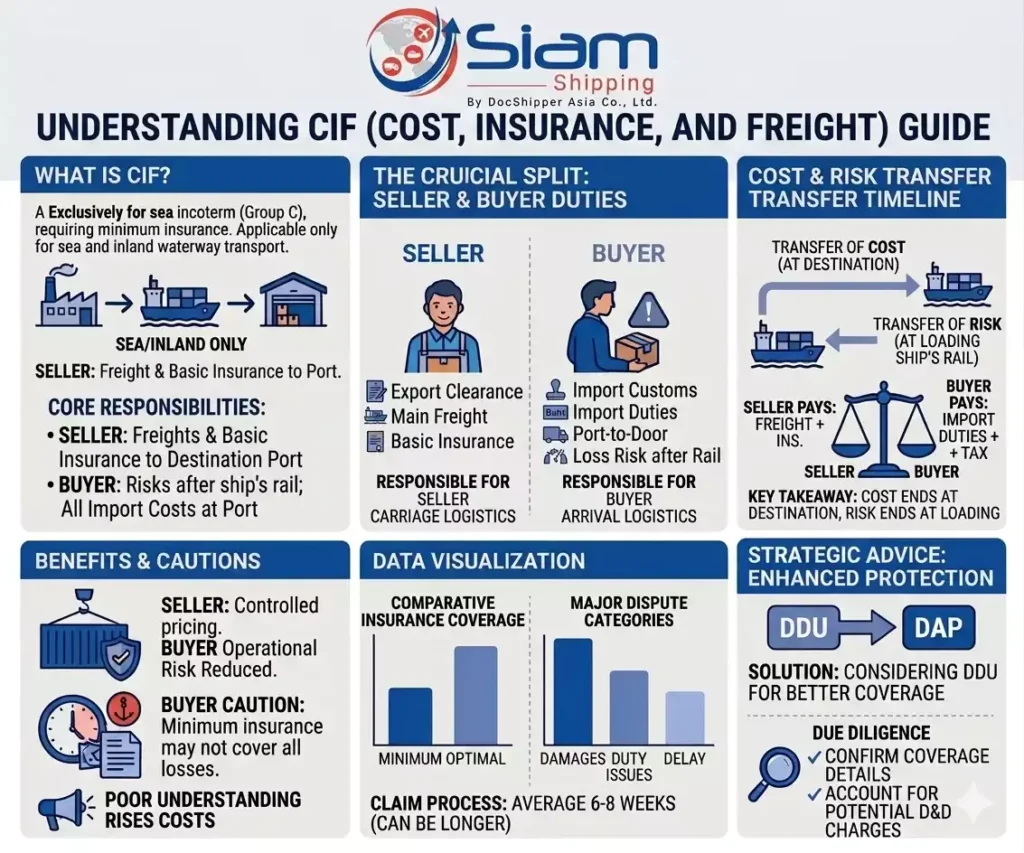
CIF Incoterms (Cost, Insurance and Freight) are international trade rules under which the seller pays transport and insurance costs to deliver goods to the destination port, while the risk transfers to the buyer once the cargo is loaded on board the ship at the exporting port. It applies only to sea and inland waterway transport.In this article, you will find a breakdown of CIF responsibilities for buyers and sellers, export and import clearance obligations, and the situations where a CIF agreement is most appropriate.
International commercial terms, or Incoterms represent a series of laws and regulations related to import and export activities. Being the fundamentals of international trade and business, incoterms are used by almost all governments, and it is essential to know them.
There are a variety of incoterms, but we will focus on CIF (Cost, Insurance & Freight) in this article. CIF incoterms simplify the shipping process by offering multiple advantages to buyers. It can also be a good and cost-efficient option for sellers, especially if they have a significant network. What exactly are CIF incoterms, what do they entail, and when do you use them? Let’s find out!
What does CIF mean?
Incoterms are published by the International Chamber of Commerce (ICC), which revises and updates them every ten years.
CIF stands for Cost, Insurance and Freight. This incoterm is commonly used for maritime transportation and inland waterway transport.
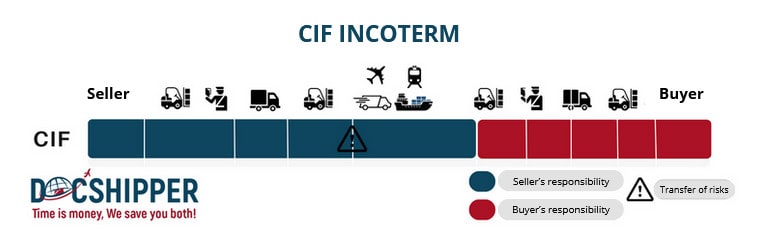
When using CIF, the seller bears all costs for the transportation of the goods from the origin point to the destination port. He also has to provide insurance coverage for the items.
On the other hand, the risks of loss and damages to goods transfer from the seller to the buyer once the cargo is onboard the ship at the exporting port. The buyer is then responsible for the rest of the process.
All in all, CIF incoterm defines a clear framework for both the seller and the buyer, making it an attractive option for the shipping process.
Siam Shipping Alert
SIAM Shipping Alert : SIAM Shipping offers expertise in production outsourcing from Thailand and beyond. Our experienced team handles it all – from sourcing to shipping – so you can focus on growing your business. Don’t hesitate to contact us via Whatsapp, or request a free shipping quote.
What are the buyer’s and the seller’s responsibilities with CIF?

Let’s take a closer look at the responsibilities of both parties.
Seller’s obligations under CIF:
- Complete the packaging and labeling of goods;
- Load goods onto a local carrier (truck, van, etc.) and pay the fees associated with this process;
- Transport and deliver goods to the shipping terminal;
- Handle the export clearance, which includes export duties, taxes, and customs clearance;
- Remove goods from the local carrier and load them onto the cargo transport, then pay the Origin Terminal Handling Charges (OTHC);
- Pay freight charges and freight insurance related to the import activity.
Buyer’s obligations under CIF:
- Transfer items to local transportation once they arrive at the destination port and pay the Destination Terminal Handling Charges (DTHC);
- Deliver and unload goods at the final destination;
- Handle the import clearance, which includes import duties, taxes, and customs clearance.
Siam Shipping Info
SIAM Shipping info: SIAM Shipping helps with document preparation and offers a customs clearance service. To ensure the project’s feasibility, we carefully review the entire bundle of documents for every shipment we handle. Contact us via WhatsApp, and receive a free quote in less than 24 hours.
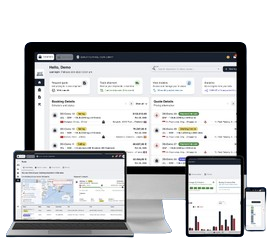
DocShipper Platform
One platform. Your entire supply chain
Sourcing, freight, customs & documents — all centralised, all visible, 24/7.
When to use CIF Agreement?

CIF Agreement can only be used for sea and inland waterway transport. It’s often employed for a Full Container Load.
Using CIF incoterm is interesting for importers who are not used to working with a specific export country, or for new importers since the process is easier for them. There are also fewer risks, as they are equally shared with the other party. For the seller, using CIF means better control over the logistics process.
You should opt for CIF Agreement in the following scenarios:
- The seller is certain to make higher margin profits despite all the costs related to the transportation of goods and the insurance;
- The seller has a good network and enough experience to have access to competitive freight rates and make the process cost-efficient for both him and the buyer;
- The trade relationship can be trusted, especially for the seller’s sake, as there are risks that the buyer might back out of the agreement or engage in deceitful behavior.

FAQ | CIF incoterms: Meaning, terms and conditions
The main difference lies in who pays for what — and when the risk transfers. Under CIF (Cost, Insurance & Freight):
- The seller pays for ocean freight and minimum insurance coverage
- The seller handles export clearance and origin charges
- Risk transfers to the buyer once the goods are loaded on board at the port of origin
Under FOB (Free On Board):
- The seller only covers costs until the goods are loaded on the vessel
- The buyer pays for freight and insurance
- Risk also transfers once goods are on board
In short: CIF = seller organizes main transport and insurance. FOB = buyer takes control earlier and manages the shipment from the port of departure. ---
The key differences are transport mode and insurance level. CIF:
- Used only for sea or inland waterway transport
- Seller provides minimum insurance coverage (Institute Cargo Clauses C unless agreed otherwise)
- Risk transfers when goods are loaded on the vessel
CIP (Carriage and Insurance Paid To):
- Can be used for multimodal transport (air, road, rail, sea)
- Seller must provide higher insurance coverage (Institute Cargo Clauses A under Incoterms 2020 unless agreed differently)
- Risk transfers when goods are handed to the first carrier
If you're shipping by air or containerized multimodal freight, CIP is usually more appropriate. ---
Technically yes — but it’s not always ideal. CIF can apply to:
- FCL (Full Container Load)
- LCL (Less than Container Load)
- Small sea freight shipments
However, for small parcel shipments (especially courier or air freight), CIF is not recommended because:
- It is strictly for maritime transport
- Risk transfers at vessel loading, which can create practical complications in consolidated shipments
For small or multimodal shipments, CIP or DAP is often more suitable. ---
The seller arranges and pays for the insurance under CIF. By default, this insurance usually covers minimum protection. That means:
- Limited coverage against major risks
- No automatic coverage for all types of damage
If you're the buyer and want broader protection:
- You can negotiate higher insurance coverage in the sales contract
- You can request specific insurance clauses
- You can also purchase supplementary insurance independently
Always clarify the insurance level in writing before shipment. ---
Many importers assume CIF covers everything — it doesn’t. CIF does NOT include:
- Destination Terminal Handling Charges (DTHC)
- Import customs duties and taxes
- Customs broker fees at destination
- Inland transport from port to warehouse
- Storage or demurrage fees
Before agreeing to CIF, ask your freight forwarder for a full landed cost breakdown to avoid unpleasant surprises. ---
This is where many misunderstand CIF. Risk transfers once the goods are loaded onto the vessel at the port of origin — not at destination. If damage occurs during ocean transport:
- The buyer must claim against the insurance arranged by the seller
- Proper documentation (Bill of Lading, survey report, photos) is essential
If damage occurs after unloading at destination:
- It becomes entirely the buyer’s responsibility
To protect yourself: inspect cargo immediately upon arrival and document any issue before leaving the port. ---
Yes — in many cases, it simplifies the process. CIF can be beneficial if:
- You are new to international trade
- You don’t have established freight partners
- You want the seller to manage the main shipping leg
However, keep in mind:
- You have less control over freight rates
- You may pay hidden destination charges
- Insurance coverage may be minimal
For strategic or high-volume imports, many experienced buyers eventually shift to FOB to gain more control and optimize costs.
Read more
Looking for more? These articles might interest you:
SIAM Shipping info: Do you like our article today? For your business interest, you may like the following useful articles :
Need Help with Logistics or Sourcing ?
First, we secure the right products from the right suppliers at the right price by managing the sourcing process from start to finish. Then, we simplify your shipping experience - from pickup to final delivery - ensuring any product, anywhere, is delivered at highly competitive prices.
Fill the Form
Prefer email? Send us your inquiry, and we’ll get back to you as soon as possible.
Contact Us