


Freight Shipping between Thailand and Ireland | Rates – Transit times – Duties and Taxes

The first thing we always tell people about shipping between Thailand and Ireland is this: the distance is not the real challenge, the coordination is. You are dealing with long sea legs from Southeast Asia to Northern Europe, tight airline capacity out of Bangkok, EU customs compliance on arrival, and inland delivery across Ireland, and if one link is misjudged your timeline and budget shift fast.
Whether you are comparing sea freight from Laem Chabang, air freight from Suvarnabhumi, or evaluating duties and VAT exposure in Ireland, you need clear numbers, realistic transit expectations, and zero surprises at clearance. In this Destination guide, we will cover transport options, transit logic, customs procedures, duties and taxes, and the practical decisions you need to make your Thailand–Ireland freight flow predictable and cost controlled.

Which are the different modes of transportation between Thailand and Ireland?

If you prioritize cost and ship larger volumes, you will usually choose sea freight from Laem Chabang Port to Dublin Port, especially for full containers or heavy cargo. If you prioritize speed or move high value goods, you will lean toward air freight from Bangkok Suvarnabhumi to Dublin, accepting higher rates for shorter lead times.

Here is the logic we use with you: volume and cost sensitivity point to ocean, urgency and product value point to air, and hybrid solutions sometimes make sense when you balance both. You can always contact our team because we monitor capacity and rate shifts in real time, and we will break down the details of each option in the sections below.

How can Siam Shipping help you

Looking to ship goods between Thailand and Ireland? Trust in DocShipper’s expertise. We handle the complexities of international shipping – from planning, customs clearance to quick delivery. Got a query about your cargo’s journey? Reach out to our consultants for free. Click here for a no-obligation estimate in less than 24 hours.

Sea freight between Thailand and Ireland

If you’re considering sea freight from Thailand to Ireland, the first question is simple. Does your cargo justify the time in exchange for lower unit costs? For most regular commercial flows, container shipping between Thailand and Ireland makes sense when you ship more than a few cubic meters, when your margins are tight, or when you replenish stock rather than respond to urgent demand.

This maritime transport route Thailand Ireland is reliable but not fast. You are typically looking at 4 to 6 weeks port to port, sometimes longer if transshipment is involved. If you need speed or have fragile production deadlines, air freight may protect you better. If you plan properly and build lead time into your supply chain, ocean freight Thailand to Ireland gives you cost control and predictable capacity.

Where most importers get caught off guard is not at sea. It is in the details. Choosing the wrong Incoterm, assuming your supplier handles export clearance correctly, underestimating destination port charges in Ireland, or confusing door-to-port vs door-to-door transit time. From experience, these are the points that create friction, not the vessel itself. The goal here is to help you treat sea freight as a controlled process, not a gamble.

Which Incoterms should you use?

When you organize sea freight from Thailand to Ireland, your Incoterm determines who controls the shipment and who absorbs risk when something goes wrong. In practice, this matters far more than most first-time importers expect.

If your supplier offers FOB Thailand export terms, you usually gain better visibility and cost control. Your supplier handles export clearance and delivers the cargo to the port of loading in Thailand, and you take control from that point. This setup gives you the freedom to appoint your own forwarder and avoid inflated freight margins hidden in the product price.

With CIF Ireland port delivery, your supplier arranges the freight and insurance up to the port of discharge in Ireland. It looks simple, but you often lose transparency on the ocean rate and face higher destination charges. You also depend on a forwarder you did not choose. That is where many importers feel stuck.

If you are comparing EXW vs DAP for international shipping, be careful. EXW in Thailand means you are responsible from the factory gate, including export formalities. That can create delays if you do not have a local partner. DAP Ireland gives you door delivery but usually at a premium. The first thing we always tell clients is this. Choose the Incoterm that gives you operational control, not just the lowest invoice price.

Also clarify documentation. Will you receive a Bill of Lading B/L, a telex release, or a sea waybill? That detail affects how quickly you can collect your cargo in Ireland and whether original documents are required. Small paperwork choices can add days of delay.

Main ports to know in Thailand and Ireland

Port choice shapes your inland trucking costs, schedule reliability, and even customs handling. You do not need every port. You need the right one for your cargo and destination.

Main Thai seaports for export cargo

  • Laem Chabang, Thailand’s primary deep-sea container hub. If you are booking FCL full container load service or LCL consolidation service to Europe, this is usually your default option because of better carrier coverage and more stable sailings.
  • Bangkok Port, closer to central factories but with draft limitations. It can work for smaller volumes, yet many Europe-bound shipments still route via Laem Chabang for mainline services.
  • Map Ta Phut, mainly industrial and bulk oriented. Relevant if you ship chemicals, petrochemicals, or specialized project cargo.

Irish container ports for imports

  • Dublin Port, the main container gateway. If your final customers are in or around Dublin, this reduces inland trucking and speeds up customs clearance.
  • Port of Cork, useful for southern Ireland and sometimes for specific feeder connections from continental Europe.
  • Shannon Foynes, more bulk focused, relevant if you move breakbulk or heavy industrial cargo rather than standard containers.

You will notice that the combination of Laem Chabang to Dublin is the most common for standard containerized flows. Changing ports can slightly reduce ocean cost but increase inland or handling charges, so you should always assess the full logistics chain, not just the sea leg.

Should I choose FCL or LCL when shipping between Thailand and Ireland?

Deciding between Full Container Load (FCL) and Less than Container Load (LCL), or consolidation, can be a real game changer when shipping goods from Thailand to Ireland. It’s not just about getting your freight to its destination, but how efficiently, affordably and smoothly it gets there. Your choice can significantly impact your bottom line, delivery speed, and the overall success of your shipment.

Let’s break down these two sea freight options, deciphering the ins and outs so that you can make an informed, strategic decision that aligns perfectly with your shipping needs.

Full container load (FCL)


Definition: FCL (Full Container Load) shipping is a freight transport option where the entire container is exclusively dedicated to one shipper's goods. When to Use: FCL shipping is ideal when your cargo exceeds 15 cubic meters (CBM). It’s not only cost-effective for high volume shipments, but it also offers added security as your goods are sealed within the container from origin to destination. Example: For instance, a home-furnishing business that needs to ship a bulk order of 200 armchairs from Bangkok to Dublin could effectively utilize a 40'ft FCL container. This enables them to cut costs, secure the items and minimize the risk of damage during transit. Cost Implications: Despite the higher initial FCL shipping quote, choosing an FCL container, be it a 20'ft or 40'ft container, reduces the cost per unit, particularly for large shipments. This is because you are paying for the whole container and not per CBM, as you would with LCL. Hence, with volume comes savings. Remember, an essential aspect of FCL shipping is to avoid being put off by the initial quote; instead, consider the overall cost-effectiveness.

Less container load (LCL)

Definition: LCL (Less than Container Load) shipping is a method of transporting goods that are not enough to fill a standard container. This means your shipment will be consolidated with others to make up a full container load. When to Use: LCL is a more cost-effective and flexible solution for smaller amounts of cargo. This method is ideal when shipments are between 13 to 15 CBM (Cubic Meters). Example: For instance, a business trading handcrafted goods from Thailand to Ireland would benefit from LCL shipping. Since their cargo isn't high in volume, sharing a container with other shippers can offer cost savings. Cost Implications: When using LCL, you pay for the exact volume you send, rather than a whole container. This allows you to control your costs effectively. But remember, costs can vary due to factors like the nature of your goods, routing, and fluctuations in global freight rates. Hence, it's advisable to get an LCL shipping quote to have an accurate understanding of the total cost.

Hassle-free shipping

Choosing between consolidation and a full container? Let DocShipper simplify the shipping maze for you. Our ocean freight experts facilitate hassle-free cargo shipping, assessing your business needs in line with size, weight, destination, and budget. In the complex world of international trade, our team is committed to finding the best shipping solution for your Thailand-Ireland route. Reach out now for a free estimation, and start your seamless shipping journey today!

Transit times: How long does it take to ship from Thailand to Ireland?

Below are indicative sea transit time Thailand to Ireland ranges for standard container services. These reflect port-to-port ocean shipping lead time to Ireland and do not include pre-carriage or final delivery.

Port of Loading (Thailand) Port of Discharge (Ireland) Estimated Transit Time (Days) Service Type
Laem Chabang Dublin 35 to 45 FCL / LCL
Laem Chabang Cork 38 to 48 FCL / LCL
Bangkok Dublin 38 to 50 FCL / LCL via transshipment

In practice, you should plan on around 5 to 7 weeks port to port. If you require door-to-port vs door-to-door transit time, you must add factory pickup in Thailand, export handling, customs clearance in Ireland, and inland trucking. That can easily add another week depending on coordination.

Direct services to Ireland are rare. Most containers move via a major European hub such as Rotterdam or Antwerp before feedering to Dublin or Cork. That means transshipment risk. During peak season or when vessels are full, you may see rollovers. Port congestion in Europe can also extend your schedule by several days. The key is to build buffer time into your planning rather than relying on the shortest advertised transit.

Shipping rates: how much does a sea freight shipment cost from Thailand to Ireland?

Sea freight rates Thailand to Ireland fluctuate depending on season, fuel prices, and space availability. The figures below are indicative planning ranges for standard dry containers.

Service Type Route Indicative Rate (USD)
LCL consolidation service Laem Chabang to Dublin Approx. 80 to 150 USD per CBM
FCL 20ft Laem Chabang to Dublin Approx. 1,800 to 3,000 USD per container
FCL 40ft Laem Chabang to Dublin Approx. 2,800 to 4,500 USD per container

If you are asking about the cost of shipping a container from Thailand to Ireland, you should think beyond the ocean leg. Your final invoice will also include origin charges in Thailand, port handling charges, customs clearance fees at destination port, inland trucking, and possible freight surcharges and additional charges. The ocean rate is only one part of the total landed cost.

How to estimate your sea freight cost before requesting a quote

If you want to understand the ocean freight quotation process before speaking to a forwarder, you need four elements. Exact pickup location in Thailand, final delivery point in Ireland, Incoterm, and precise cargo details including weight and volume in cubic meters.

For LCL, you are usually charged per CBM, sometimes with a minimum billing volume. If you ship 8 CBM at 120 USD per CBM, your base ocean freight is 960 USD. For FCL, you pay a flat freight rate per container, whether you fill it completely or not. That is why volume planning matters.

Now add origin handling in Thailand, documentation, export booking and container loading costs, and destination charges in Ireland. This is where cheap-looking offers become misleading. A low ocean rate combined with high local charges can increase your total cost significantly. Always calculate your total landed cost, not just the sea leg.

If you send us your packing list and target Incoterm, we can review your setup and provide a clear, route-specific quotation in less than 24 hours.

Surcharges and hidden cost drivers to watch for

The first surprise usually comes at destination. Terminal handling, documentation, and customs clearance fees at destination port are payable before you can collect your cargo. If you shipped under CIF, you often discover these only after arrival.

Second, time-related charges. Demurrage, detention, and storage apply if you do not collect or return the container within the free time allowed. In Ireland, space at terminals is limited, so delays in customs paperwork can quickly become expensive. This is often triggered by missing documents or late payment.

Third, carrier surcharges. You may see bunker adjustment factor, peak season surcharge, or congestion-related fees depending on market conditions. These are not arbitrary, but they can change quickly. The important thing is to clarify in writing what is included and what is not. A single misunderstood line item can affect your margin.

Step-by-step: how a sea freight shipment usually works on this route

When you book sea freight from Thailand to Ireland, you are not just reserving space on a vessel. You are coordinating factories, truckers, port terminals, customs authorities, and shipping lines across two continents. This route requires patience and accurate paperwork. Most delays come from documentation gaps or missed cargo cut-off and documentation deadline, not from the vessel itself.

  1. We confirm your cargo details, Incoterm, and preferred schedule, then secure space with the carrier.
  2. We organize pickup at your supplier and manage export booking and container loading at the agreed Thai port.
  3. We submit export customs clearance and ensure documents match the commercial invoice and packing list.
  4. The container is loaded on the vessel, often with transshipment in a European hub before reaching Ireland.
  5. Before arrival, we prepare import documentation and coordinate customs clearance in Ireland.
  6. Once cleared, we arrange delivery to your warehouse or notify you for collection, depending on your chosen service.

Special sea freight solutions

If standard FCL vs LCL shipping between Thailand and Ireland does not fit your cargo, you still have options.

Oversized cargo by sea freight can move in out of gauge containers or through breakbulk and project cargo services if dimensions exceed container limits.

If you ship vehicles or rolling machinery, Ro-Ro may be suitable depending on available sailings.

For perishable goods, temperature-controlled sea freight reefer container solutions maintain strict temperature ranges from Thailand to Ireland.

The right mode depends on your cargo profile, budget, and risk tolerance. When you share your specifications with us, we assess which setup protects your goods and your margin at the same time.

Air freight between Thailand and Ireland

If you’re considering air freight from Thailand to Ireland, you usually need speed, reliability, or tight inventory control. You’ll get fast uplift compared to sea freight, but you’ll also deal with cut-off times, cargo screening and strict documentation. It’s efficient, but only if you prepare it properly.

You’ve probably heard that air freight always takes 3 days, is always too expensive, or is priced on real weight only. None of that is fully true. On this lane, the most expensive mistakes usually come from wrong chargeable weight, poor packaging, or missing export documents before departure. If you want predictable air cargo Thailand to Ireland, you need to control those points first.

Air cargo vs express: how should you ship on this route?

If you’re hesitating between standard air cargo and an express air freight service to Ireland, the choice depends on your volume, urgency and how much control you want. You’re basically comparing airline-based freight, often consolidated with other shipments, versus courier networks that manage everything door to door.

The real air cargo vs express courier difference shows up in pricing logic, documentation, and flexibility. Let’s break it down so you can decide based on facts, not assumptions.

Should you choose air cargo from Thailand to Ireland?

You should usually choose standard air cargo if your shipment is above 1 CBM or 100 to 150 kg. That’s where standard air freight consolidation or direct airline bookings become more cost-efficient than courier services.

This option works well if you ship B2B, pallets, industrial parts, electronics, temperature-controlled air cargo, or even dangerous goods by air under IATA cargo regulations. You can choose between airport-to-airport air shipping and a door-to-door air freight service, depending on how much of the chain you want us to handle.

Before requesting an air freight quotation process, you should have ready: exact dimensions, gross weight, commodity type, Incoterm, pickup location, destination airport in Ireland, and confirmed cargo ready date. Without that, your quote will shift later.

The mistakes we see most often are confusing airport-to-airport with door-to-door, ignoring cargo cut-off times, underestimating screening delays, and forgetting minimum airline charges. On this route, export customs clearance before air freight in Thailand must also be completed properly or your cargo simply will not fly.

Extracted Image

Should you choose express air freight from Thailand to Ireland?

You should consider express if you’re shipping small parcels under 1 CBM, samples, spare parts, or an urgent shipment by air from Thailand. It’s ideal if you don’t have a logistics team and you want simplicity, fast pickup, and integrated customs clearance.

The trade-off is control. With express, you accept carrier-controlled routing, automated reweigh and remeasure, and limited negotiation on surcharges. If your commercial invoice is unclear or your Incoterm is wrong, you may face unexpected destination charges in Ireland.

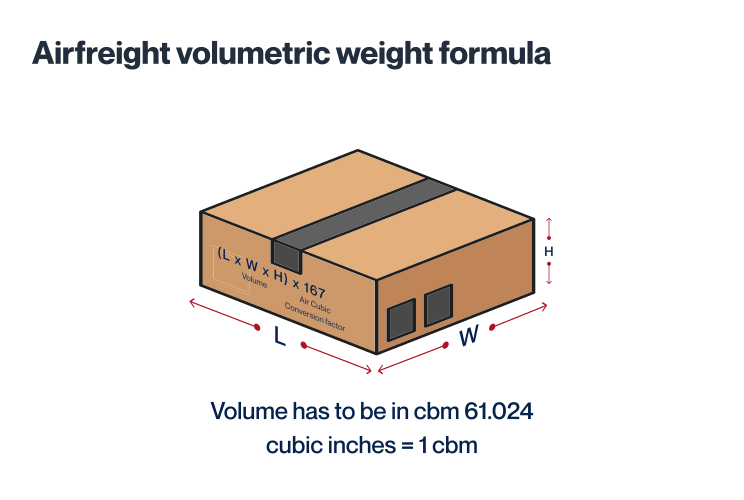
Common issues include underestimating volumetric weight calculation air freight, assuming all duties are prepaid, and using packaging that does not meet courier standards. Express works well if your shipment is compact, urgent and low complexity. It becomes risky if your cargo is bulky, high value, or sensitive to cost fluctuations.

Extracted Image

Main airports to know in Thailand and Ireland

  • Suvarnabhumi Airport, Bangkok – Thailand’s primary international cargo hub and the most reliable option for long-haul routes to Europe. You’ll find the widest airline capacity and specialized facilities for high-value cargo air transport and controlled temperature shipments.
  • Don Mueang International Airport – Mainly regional and low-cost focused. You may use it for specific routings, but most Europe-bound cargo consolidates through Suvarnabhumi.
  • Dublin Airport – Ireland’s main cargo gateway and the first choice for most imports. You’ll clear customs here in most cases, and cargo terminal handling in Ireland is centralized around this hub.
  • Shannon Airport – Useful if your final delivery is on the west coast or if you’re structuring specific distribution flows. It can reduce inland trucking time depending on your consignee location.

Your airport choice affects inland trucking cost, airline availability, and real air freight lead time to Ireland. If your supplier is far from Bangkok, pre-carriage timing in Thailand can add a full day before uplift.

Transit times: how long does air freight take from Thailand to Ireland?

Service Type Estimated Transit Time
Standard air cargo (direct or 1 transshipment) Approximately 3 to 6 working days
Express courier service Approximately 2 to 4 working days

Your real air transit time Thailand to Ireland depends on flight availability, whether you use a direct flight or transshipment air cargo, and how early your cargo reaches the terminal before cut-off. Pre-flight handling and cargo screening and security checks in Thailand usually add at least one day.

Delays typically come from three areas. First, you miss the airline cut-off and your cargo rolls to the next flight. Second, security or documentation issues trigger inspections. Third, seasonal congestion reduces available capacity. If your shipment is urgent, you should always check uplift confirmation, not just the estimated departure date.

Shipping rates: how much does air freight cost from Thailand to Ireland?

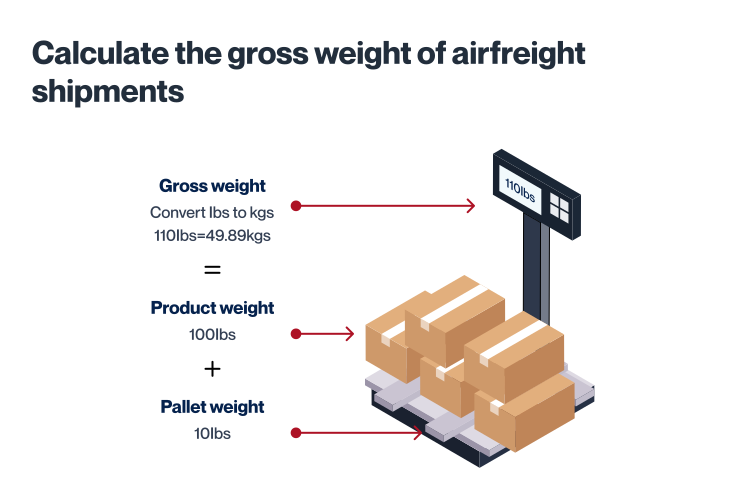
If you’re asking how much does air freight cost from Thailand to Ireland, the honest answer is that rates fluctuate constantly. Your final price depends first on chargeable weight vs gross weight, then on dimensions, urgency, season and airport pair.

Cost Driver What You Should Check
Chargeable weight Compare gross weight with volumetric weight, airlines charge the higher value
Dimensions and density Low-density cargo increases your air cargo cost per chargeable weight
Surcharges Fuel surcharge air cargo and security surcharge air freight vary monthly
Routing and service level Priority air freight service costs more than standard consolidation

On this route, rates can shift quickly during peak export seasons in Thailand or when capacity to Europe tightens. If you ship e-commerce air freight to Ireland or high-value goods, you should also factor in insurance and handling fees. The only reliable way to budget is to request a detailed quotation with full shipment specifications.

Step-by-step: how an air shipment usually works on this route

If you’ve never managed a step-by-step air shipment process Thailand to Ireland, it’s more procedural than it looks. Timing, documentation and coordination between supplier, forwarder and airline determine whether your cargo flies on schedule or sits in a warehouse.

  1. You confirm shipment details, dimensions, weight, commodity and Incoterm so we can structure the booking correctly.
  2. We issue the booking with the airline and align the cargo ready date with the flight schedule.
  3. Your supplier prepares export documents and we complete export customs clearance before air freight in Thailand.
  4. Cargo is delivered to the terminal, labeled and screened under security regulations.
  5. The airline issues a master air waybill MAWB, and if consolidated, a house air waybill HAWB is created under the main air waybill AWB.
  6. The shipment flies to Ireland, either direct or via transshipment.
  7. Upon arrival, import customs clearance is completed and terminal handling charges are settled.
  8. Final delivery is arranged to your warehouse if you selected door service.

Most delays happen at documentation stage, missed cut-offs, or when cargo dimensions differ from the initial booking. That’s when costs and timelines suddenly increase.

Door to door between Thailand and Ireland

Navigating international trade can seem like a maze, but Door to Door shipping is like having a personal guide escorting your valuable goods from the vibrant coasts of Thailand to the emerald landscapes of Ireland. It’s a full-service freight option that takes the mystery out of customs and relieves logistical headaches. With so many benefits in your corner, let’s dive right in!

Overview – Door to Door

Embarking on Thailand-Ireland shipping? Confront complex logistics with DocShipper’s most sought-after service: door-to-door shipping. Benefit from a hassle-free delivery, from collection to customs clearance, to arrival at the destination. Yet, bear in mind potential drawbacks like extended delivery times. You may question its suitability, especially dealing with bulky, delicate, or high-value goods.

Let our expert team guide you, ensuring a streamlined process while tackling your specific shipping nuances. Trust our door-to-door shipping — it’s your stress-free ticket in the intricate world of cross-country logistics.

Why should I use a Door to Door service between Thailand and Ireland?

Ever had a Thai curry at an Irish pub? We bet not! But with Door to Door shipping, a container of Thai spices could be making its way from the bustling streets of Bangkok straight to a Irish establishment’s kitchen before you know it!

1. Relieves logistics stress: Door to Door service takes the weight off your shoulders. No need to fret about transfers or customs; all handling and documentation is handled professionally from pick-up at origin to the final destination.

2. Speedy delivery: It’s not called Thai ‘express’ for nothing. U Time-sensitive shipments are managed with strict scheduling to ensure your goods arrive on the Emerald Isle precisely when they are expected.

3. Special care for complex cargo: Have delicate or valuable items to ship? Door to Door services are specialized to ensure your exotic fruit or fragile crockery always get the VIP treatment they deserve.

4. Full trucking service to final destination: Traffic, road works, parking — who needs them? With Door to Door, your goods are chauffeured smoothly all the way to their final Irish location.

5. Extra convenience: Door to door service means exactly that. There’s no need to arrange pickup or delivery, it’s all included, making life just a tad simpler for busy business owners.

So why not sit back, order a pint, and let Door to Door shipping between Thailand and Ireland take care of the rest?

DocShipper – Door to Door specialist between Thailand and Ireland

At DocShipper, we promise stress-free door-to-door shipping from Thailand to Ireland. You can sit back while we expertly manage everything – packing, transport, customs clearance across all shipping methods – ensuring your goods arrive swiftly and safely. A dedicated Account Executive is always ready to guide you. Get in touch for a free estimate within 24 hours or speak to our consultants, available at your convenience. Experience our hassle-free and proficient shipping services today.

Customs clearance in Ireland for goods imported from Thailand

When you handle customs clearance in Ireland for goods from Thailand, you are deciding your final landed cost, your release timing, and who carries the legal responsibility as Importer of Record. If your paperwork or valuation is off, your container waits at Dublin Port or your air freight sits at the airport. We coordinate the full import customs process in Ireland for you, from document review to customs declaration submission.

You will notice fast that most delays on this route come from three issues: wrong HS code classification, undervalued invoices, or missing origin proof from Thailand. Add to that a missing EORI number for importing into Ireland and your file simply cannot move. Let us break down exactly how you calculate your duties and how the clearance actually unfolds in real life.

How to calculate duties & taxes when importing from Thailand to Ireland?

If you want to know how to calculate import duties from Thailand to Ireland, you need three core inputs: the country of origin, the correct HS code classification, and the customs value calculation method used by Irish Customs. You also need to know your Incoterm because freight and insurance in customs value are not treated the same way under every contract.

Your final assessed amount can differ from your estimate because Customs can challenge your HS code, adjust your declared value, or deny a preferential origin claim. Cheap quotes often ignore these adjustments. The first thing we always tell you is this: calculate like Customs will verify everything, because they often do.

Step 0 – Quick checks before you calculate

  • Confirm who acts as Importer of Record and holds the EORI number for importing into Ireland.
  • Check your Incoterm to see who controls the import customs process in Ireland and who pays duties.
  • Verify whether your shipment qualifies for a low-value or simplified clearance path before starting a full calculation.

Step 1 – Identify the Country of Origin

You must distinguish between the shipping country and the country of origin. If your goods are manufactured in Thailand, that origin drives your tariff rate and any eligibility for duty relief and exemptions.

Ireland, as part of the EU customs territory, may grant preferential treatment only if you provide proper rules of origin documentation, such as a certificate of origin Thailand issued under the relevant framework. If your origin claim is weak or inconsistent, Customs can reject it and reassess duties. This is where many importers get surprised.

Step 2 – Find the HS Code of your product

Your HS code classification determines your customs tariff Ireland import rate, whether additional measures apply, and even whether your goods are flagged for inspection. A small classification error can completely change your duty exposure.

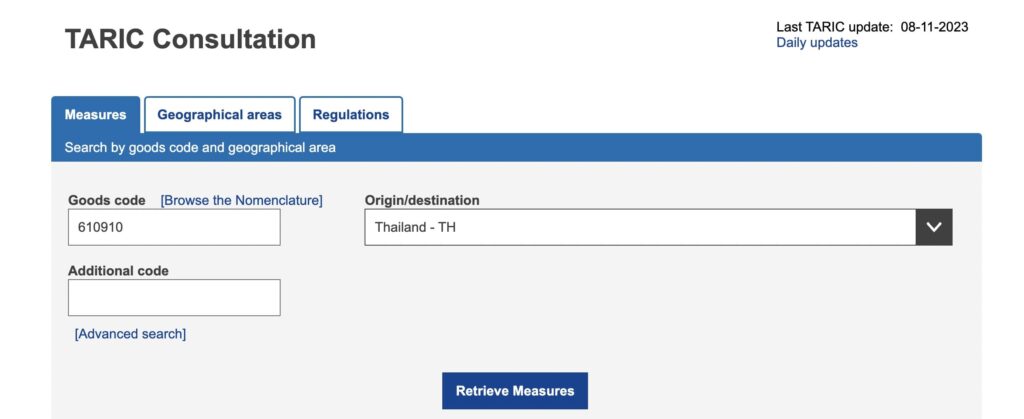
You can start with a harmonized system code lookup using the EU TARIC database here: EU TARIC search tool. You search by product description, compare legal notes, and match the technical characteristics of your product, not just its commercial name.

If your HS code is wrong, you risk reassessment, penalties, and delays during the customs inspection procedure. From experience, this is one of the main triggers of post-clearance audit customs reviews.

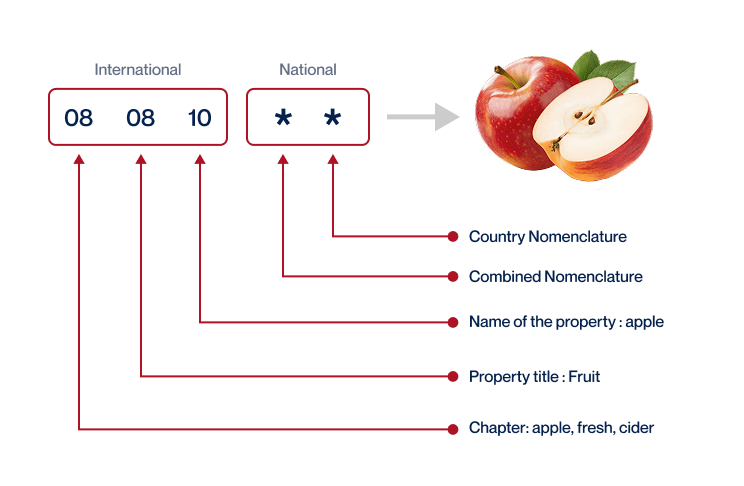
Here’s an infographic showing you how to read an HS code.

Step 3 – Calculate the Customs Value

Ireland generally uses the transaction value method, meaning the price you actually paid, adjusted where required. For most shipments from Thailand, Customs works with the CIF value for customs purposes, which includes cost, freight, and insurance up to the EU entry point.

You must also consider customs valuation adjustments such as assists, tooling provided free of charge, commissions, royalties, packing costs, and freight and insurance in customs value depending on your Incoterm. For example, if you buy goods for 10,000 USD under FOB Bangkok and you pay 1,000 USD freight and 100 USD insurance, your customs value becomes 11,100 USD. That is the base on which duties are calculated.

Extracted Image

Step 4 – Figure out the applicable Import Tariff in Ireland

The import tariff is the percentage of duty applied to your customs value based on your HS code and origin.

You can follow this simple method:

  1. Open the official EU TARIC tool.
  2. Enter your HS code and confirm the product description.
  3. Check the duty rate shown for goods of Thai origin.

What you should look for:

  • Standard third-country duty rate.
  • Eligibility for preferential origin claim.
  • Anti-dumping or additional measures.
  • Any tariff quota limitations.

If your customs value is 11,100 USD and the duty rate is 8 percent, your duty would be 888 USD. You then carry that amount forward into your VAT base. On this Thailand to Ireland route, textile and agricultural categories often require extra attention, so double-check before you lock your pricing. If you want, we can review your classification before filing.

Step 5 – Consider other Import Duties and Taxes in Ireland

Beyond customs duty, you must account for import VAT Ireland. VAT is usually calculated on the customs value plus duty and certain additional costs. If your customs value is 11,100 USD and your duty is 888 USD, VAT applies to the combined base of 11,988 USD at the applicable Irish rate.

Depending on your product, you may also face excise duties or trade defense measures. For example, specific categories can trigger anti-dumping duties. This is where a careful review of your customs tariff Ireland import record becomes essential.

  • Confirm the VAT treatment and whether postponed accounting applies.
  • Check if your product qualifies for duty relief and exemptions.
  • Verify if a temporary import procedure or bonded warehouse Ireland setup fits your cash flow strategy.

Step 6 – Calculate the Customs Duties

The core formulas are straightforward:
Duty = customs value × duty rate.
VAT = VAT base × VAT rate.

If your customs value is 11,100 USD and the duty rate is 8 percent, duty equals 888 USD. If VAT is applied on 11,988 USD, you multiply that base by the Irish VAT rate to obtain the VAT due.

What happens next? Your customs broker in Ireland submits the customs declaration submission electronically, often using the single administrative document SAD format. Duties and VAT are secured before or at release, depending on your deferment setup. If documents such as the commercial invoice requirements, packing list for customs clearance, or exporting from Thailand to Ireland documentation are inconsistent, your file can move from green channel vs red channel customs, and that is where time and storage costs start adding up.

Does DocShipper charge customs fees?

Don’t confuse customs clearance fees with duties. As a customs broker, DocShipper in Thailand and Ireland will bill for clearance services, but the customs duties themselves, those go directly to the government. To maintain transparency, you’ll be handed official customs office documents, verifying that what you’ve paid is only what the government charged, nothing more. This principle ensures your shipping endeavor remains as cost-efficient as possible.

Contact Details for Customs Authorities

Thailand Customs

Thai Customs Department logo

Official name: Thai Customs Department.

Official website: www.customs.go.th/

Ireland Customs

Revenue Commissioners, Ireland logo

Official name: Revenue Commissioners, Ireland

Official website: www.revenue.ie/

Required documents for customs clearance in Ireland

When you import from Thailand into Ireland, you will notice quickly that customs issues rarely come from “the border” itself. They come from inconsistent paperwork. Your invoice, transport document, and declarations must match line by line, same shipper, same consignee, same values, same product descriptions. If one document says “plastic components” and another says “automotive spare parts,” you are inviting questions. The first thing we always tell you is simple, make your documents tell the exact same story.

Commercial Invoice

The commercial invoice is the seller’s official bill for the goods you are importing.

Irish customs uses it to calculate customs duties and VAT, verify product classification, and confirm the transaction value under EU rules.

Example: Your Thai supplier issues an invoice showing HS code, unit price, total value in EUR or USD, Incoterm such as FOB Laem Chabang, and full buyer details in Ireland.

Common mistake: Declaring a value on the customs entry that does not exactly match the invoice total.

Bill of Lading or Air Waybill

This is the transport document issued by the carrier as proof that the goods were shipped.

Customs and your broker use it to confirm shipment details, routing, container numbers, and the official importer of record.

Example: An ocean Bill of Lading showing Bangkok or Laem Chabang as port of loading and Dublin or Cork as port of discharge, with you listed as consignee.

Common mistake: Using a different consignee name than the one registered for EORI in Ireland.

Packing List

The packing list details how your goods are physically packed, cartons, pallets, weights, and dimensions.

Irish customs may use it for inspections, and your broker relies on it to check consistency with the invoice and transport document.

Example: 10 pallets, 240 cartons, gross weight 3,200 kg, net weight 2,950 kg, with clear product breakdown per carton.

Common mistake: Gross weight on the packing list not matching the weight declared on the Bill of Lading.

EORI Number Registration

The EORI number is your EU importer identification number.

Without a valid Irish or EU EORI, you cannot legally clear goods into Ireland.

Example: Your customs declaration is submitted under your Irish EORI, linked to your company’s VAT registration.

Common mistake: Trying to use a supplier’s or freight forwarder’s number instead of being properly registered yourself.

Import Declaration and HS Classification

The import declaration is the electronic customs filing submitted to Irish Revenue.

It determines the duty rate, VAT treatment, and whether additional controls apply based on the HS code.

Example: Your broker declares HS code for electrical appliances, triggering standard EU duty and 23% Irish VAT.

Common mistake: Using an incorrect HS code that results in underpaid duties, which can lead to post-clearance audits.

Certificates of Origin or Conformity

These documents confirm where your goods were manufactured and whether they comply with EU standards.

Depending on your product, Irish authorities may require proof of origin or EU conformity such as CE marking documentation.

Example: For electronics from Thailand, you provide a supplier declaration and technical file supporting CE compliance.

Common mistake: Assuming CE marking is optional. For regulated goods, missing compliance proof can lead to clearance suspension.

Step-by-step: how customs clearance usually works on this route

If you want a clear view of customs clearance step-by-step Thailand to Ireland, this is how it usually unfolds. The exact sequence depends on the port or airport of entry, your Incoterm, and whether you appoint a customs broker in Ireland under direct or indirect representation customs. Still, the operational logic stays similar.

  1. You prepare exporting from Thailand to Ireland documentation, including commercial invoice, packing list for customs clearance, transport document, and certificate of origin Thailand if applicable.
  2. Before arrival, we organize pre-arrival customs filing when possible, so Irish Customs can risk-assess your shipment in advance.
  3. Your goods arrive at Dublin Port or the relevant airport and are presented to Customs electronically.
  4. We submit the customs declaration submission through the Irish system using the correct HS code classification and valuation data.
  5. Customs performs risk analysis and assigns green channel vs red channel customs status.
  6. If selected for control, a customs inspection procedure takes place, which can include document checks or physical examination.
  7. Once duties and import VAT Ireland are accounted for, the shipment is released for delivery.
  8. After release, you must keep records in case of post-clearance audit customs review.

The moments of truth are always the same: classification, valuation, and origin proof. If those three are solid, your customs clearance timeline Ireland stays predictable. If not, delays, storage, and rework costs follow quickly.

Packing List

Your packing list for customs clearance must describe exactly what is inside each carton or pallet, with quantities, gross and net weight, and packaging type. Irish Customs compares it directly with your commercial invoice requirements and your customs declaration submission.

If your packing list says 100 units but your invoice says 90, you trigger questions immediately. On shipments from Thailand, this mismatch is one of the fastest ways to move from green channel to red channel. You should treat this document as operational evidence, not a formality.

Commercial Invoice

Your commercial invoice is the backbone of the customs value calculation method. It must clearly state seller and buyer details, full product description, HS code where possible, unit price, total price, currency, and Incoterm.

If you want your file processed smoothly, your invoice must align with transport documents and origin documents. Irish Customs relies heavily on invoice consistency when reviewing customs compliance for Thailand exports. If values look artificially low, expect questions and possible valuation adjustments.

Certificate of Origin

The certificate of origin Thailand supports your preferential origin claim when applicable. It proves where your goods were manufactured and under which rules of origin documentation they qualify.

If you claim a reduced tariff but cannot provide valid origin proof, Customs can deny the preference and reassess duties at the standard rate. You should always verify that the origin statement matches your production reality before shipment leaves Thailand.

Certificate of Conformity (CE standard)

If your products fall under EU regulatory requirements, you must ensure CE conformity before arrival in Ireland. This is separate from customs duty, but without it, your goods can be blocked from free circulation even after duty payment.

You should confirm that your Thai manufacturer holds the correct test reports and technical documentation. Customs and market surveillance authorities can request proof at any time, especially for electronics, machinery, and consumer products.

Your EORI number (Economic Operator Registration Identification)

You cannot complete the import customs process in Ireland without an EORI number for importing into Ireland. This number identifies you in all EU customs systems.

If you act as Importer of Record, you must obtain your own EORI before shipping. Without it, no customs declaration submission can be validated, and your goods will not be released. This is one of the first checks we perform before cargo even departs Thailand.

Get Started with Siam Shipping

Navigating through customs can be tough and time-consuming. Don’t let complex procedures cloud your shipping experience. With DocShipper, we put your mind at ease by handling every step of the customs clearance process. Eager to get started? Reach out to us and receive a free quotation within 24 hours. Let’s simplify your international shipping experience.

Prohibited and Restricted items when importing into Ireland

Before you ship, you should verify whether your goods fall under restricted regimes such as dual-use items, agricultural controls, health certifications, or specific licensing requirements. Thailand exports in food, plants, or animal products often require additional sanitary or phytosanitary documentation.

If you ignore these checks, your shipment can be stopped during the customs inspection procedure and held until you provide missing authorizations. Always confirm regulatory requirements before booking transport, not after arrival.

Prohibited and restricted items when importing into Ireland

Before you ship from Thailand, you need to understand one key difference. Restricted means your goods are allowed into Ireland, but only if you meet specific conditions, licenses, or certifications. Prohibited means the goods should not enter at all, and you risk seizure, return shipment, or fines. This is where many first-time importers get caught off guard.

Restricted products

  • Food and agricultural products, subject to EU sanitary and phytosanitary controls.
  • Animal products and seafood, veterinary checks and health certificates required.
  • Cosmetics, must comply with EU Cosmetics Regulation and ingredient rules.
  • Electrical and electronic equipment, CE marking and technical documentation required.
  • Medical devices, EU conformity assessment and proper labeling mandatory.
  • Chemicals, may require REACH registration or safety data sheets.
  • Wood packaging materials, ISPM 15 treatment and marking required.

Prohibited products

  • Counterfeit or pirated goods, intellectual property infringement.
  • Illicit drugs and controlled narcotics, strictly banned.
  • Certain weapons and offensive weapons, without proper authorization.
  • Products made from endangered species, restricted under CITES rules.
  • Unsafe consumer goods that fail EU safety standards.

If you are unsure about your product category, you should confirm classification and regulatory status before shipment. The cost of checking in advance is small compared to dealing with seizure or destruction after arrival in Ireland.

Trade agreements and preferential duties for imports from Thailand to Ireland

As of 2025 and 2026, there is no bilateral Free Trade Agreement in force between Thailand and Ireland. Since Ireland is part of the European Union, your imports from Thailand follow standard EU common external tariff rules. That means you will generally pay the normal EU duty rate based on your HS code, plus Irish VAT at import.

You should, however, keep an eye on the ongoing EU Thailand FTA negotiations. Discussions have been relaunched in recent years, and if an agreement enters into force, you could benefit from reduced or zero customs duties on qualifying products. But until such an agreement is officially implemented, you should plan your landed cost using standard EU duty rates.

From experience, this is where you gain an edge. If your product falls under categories sometimes subject to EU trade defense measures, such as anti-dumping duties, you must verify whether additional duties apply to Thai-origin goods. These measures are product-specific and can significantly increase your total cost.

The practical approach is simple. You confirm your HS code, check the EU duty rate applicable to Thailand as country of origin, and verify whether any trade defense measures apply. That is how you avoid underestimating your landed cost in Ireland and protect your margin before you place the order.

Your first steps with Siam Shipping

If you are planning regular flows or a first shipment, the smartest move is to validate your HS code classification, customs value structure, and documentation set before departure. We review your documents needed for customs clearance in Ireland, confirm your representation model, and align everything with Irish Customs requirements.

Whether you need indirect representation customs, support with a bonded warehouse Ireland solution, or guidance on a re-export process from Ireland, we coordinate the full chain. You stay focused on your supply and sales, and we make sure your Thailand to Ireland shipments clear without surprises.

More than shipping

Additional logistics services

1 Warehousing
1

Warehousing

Finding the right warehouse in Thailand or Ireland can feel like hunting for a needle in a haystack, especially when you've got commodities that need specific conditions like temperature control. Our strategic solutions could be the answer, offering secure spaces with state-of-the-art amenities. Why spin your wheels when you can rely on us? For the full rundown, take a peek at our Warehousing page.
img
2 Packing
2

Packing

Ensuring your goods reach Ireland safe and intact from Thailand is no small feat. That's where proper packaging and repackaging become essential! It can cater to anything, from delicate ceramics to solid car engines. Imagine wrapping your fine Thai silk in robust packages resistant to weather conditions on its journey. Or repackaging machinery using an advanced case crating system. Trusting a reliable agent ensures your shipment's secure journey.

3 Transport Insurance
3

Transport Insurance

Transporting goods, unlike sitting still like property covered by fire insurance, comes with its own unique risks. Picture unexpected typhoons at sea or turbulence in the air, situations where cargo insurance can be a life-saver. Imagine shipping high-end electronics - without adequate cover, a lost container could mean hefty losses. But, taking out a transport insurance policy could help you sleep better knowing you're covered for such unforeseen incidents.

4 Household goods shipping
4

Household goods shipping

Shipping personal items from Thailand to Ireland? From your heirloom china to that bulky vintage dresser, we've got you covered. We handle your fragile or bulky treasures with utmost professional care and flexibility, ensuring safe transit. Take the example of Mrs. O'Reilly, who trusted us with her grandfather's antique writing desk - it arrived on her Irish doorstep, as pristine as it left Bangkok.

5 Procurement in Thailand
5

Procurement in Thailand

Looking to manufacture in Asia or East Europe? DocShipper can bridge the language gaps and spearhead the procurement journey for your business. We find suitable suppliers and oversee the entire sourcing process to ensure a seamless production experience. Check out real-world examples and in-depth insights on our dedicated page: Sourcing services.

6 Quality Control
6

Quality Control

Quality control is vital when shipping goods from Thailand to Ireland. It guarantees your merchandise meets international standards before embarking on its journey. For instance, intricate Thai crafts screened for quality assurance evade rejection at Irish customs, saving you time and costs. Don't risk sending sub-par products. More info on our dedicated page: Quality Inspection.

7 Conformité des produits aux normes
7

Conformité des produits aux normes

Shipping goods globally? Complying with respective regulations boosts your business reputation. Our Product Compliance Services offer comprehensive lab tests and certification solutions. Rest easy knowing your product meets all requirements at the target destination.