Freight shipping between Thailand and Qatar | Rates – Transit time – Duties & Taxes
You will quickly realize that shipping between Thailand and Qatar is not just about booking space, it is about aligning supplier timelines in Bangkok or Laem Chabang with capacity into Doha and anticipating customs requirements on both sides before your cargo even moves.
If you misjudge transit times, documentation, or duties, you risk storage fees, delayed deliveries, or cash flow surprises, especially on Thailand to Qatar freight where sea and air options follow very different cost and speed logic. In this Destination guide we will cover rates, transit times, customs clearance, and transport options so you can plan your shipment with clarity and avoid the mistakes we see too often on this route.
What is the best method of transport between Thailand and Qatar?
You should choose sea freight when your cargo moves through Laem Chabang Port to Hamad Port and cost control matters more than speed, especially for full containers or heavy goods. You should choose air freight via Suvarnabhumi Airport to Hamad International Airport when your cargo is urgent, high value, or time sensitive.
From experience, you will see that capacity, seasonal demand, and cargo type can quickly shift the equation. You can always contact our team, we monitor real-time space and rate conditions and help you decide, and we will break down each option in more detail below.
Docshipper Note:
Besoin d'aide pour votre expédition ? N'hésitez pas à nous contacter, même pour une simple question. Choisissez l'option qui vous convient.
Chat en direct avec un expert Discutez-nous sur WhatsApp Remplissez le formulaire
Sea freight from Thailand to Qatar
Which Incoterms should you use?
When you organize sea freight shipping between Thailand and Qatar, the Incoterm you choose will directly impact your control over costs, documents, and delays. On this corridor, the first thing we tell you is simple, avoid giving up control too early.
If you buy under FOB Thailand to Qatar shipment, you control the main leg and choose your own freight forwarder Thailand to Qatar. That usually gives you better visibility on sea freight rates Thailand to Qatar, container allocation, and schedule changes. You also control the bill of lading B/L requirements and avoid surprises at destination.
If you buy under CIF Qatar import from Thailand, your supplier selects the carrier. It looks convenient, but you often discover higher destination charges, limited schedule flexibility, and little leverage if the vessel rolls. This is where many first-time importers lose cost control.
When you compare EXW vs DAP for international sea freight, be careful. EXW means you handle export customs clearance in Thailand, which can be operationally heavy if your supplier is inexperienced. DAP gives you door-to-door sea freight control, but you must clearly define who handles import customs coordination in Qatar.
From experience, FOB or FCA at origin combined with a forwarder you trust gives you the most operational stability on the maritime transport Thailand–Qatar route.
Main ports to know in Thailand and in Qatar
Port choice affects more than vessel arrival. It impacts trucking cost, customs flow, and sometimes transit time reliability.
- Laem Chabang Port, the main seaports in Thailand for export. This is where most container shipping Thailand to Qatar moves from. You get better carrier options and more frequent sailings.
- Bangkok Port, closer to central factories but with draft limitations. You often face feeder connections instead of direct deep sea services.
- Map Ta Phut, specialized in petrochemical cargo. Relevant if you ship hazardous cargo IMO cargo by sea.
- Hamad Port, the main seaports in Qatar for import. Almost all containerized ocean freight from Thailand to Qatar arrives here. Modern infrastructure, efficient customs flow.
- Mesaieed Port, more industrial focused. Less common for standard container traffic.
- Al Ruwais Port, regional and secondary traffic. Not typically used for large scale port-to-port shipping Thailand Qatar.
You will notice fast that choosing Laem Chabang to Hamad is the most stable combination for containerized cargo.
Transit times: How long does it take to ship from Thailand to Qatar?
| Route | FCL Transit Time | LCL Transit Time |
|---|---|---|
| Laem Chabang to Hamad | 20 to 25 days | 23 to 30 days |
| Bangkok to Hamad | 22 to 28 days | 25 to 32 days |
| Map Ta Phut to Hamad | 21 to 27 days | 24 to 31 days |
If you ask, how long does sea freight take between Thailand and Qatar? You should plan around 3 to 4 weeks port-to-port under normal conditions.
However, sea transit time Thailand to Qatar depends heavily on transshipment hubs, often in Singapore or the Middle East. Direct services are limited, so you must factor potential delays. Port congestion impact on transit time becomes visible during peak season, especially before Ramadan or year-end cycles. Always treat shipping lead time by sea freight as a planning window, not a fixed promise.
Shipping rates: how much does a sea freight shipment cost from Thailand to Qatar?
| Shipment Type | Estimated Range |
|---|---|
| LCL, per CBM | USD 70 to 130 per CBM |
| 20ft FCL | USD 1,200 to 2,200 |
| 40ft FCL | USD 1,800 to 3,200 |
If you ask what is the cheapest way to ship containers from Thailand to Qatar, FCL becomes more competitive above 13 to 15 CBM. Below that, less than container load LCL consolidation is usually more economical. These figures reflect base ocean freight only. Your real container shipping cost breakdown must include terminal handling charges THC, documentation fees for sea freight, bunker adjustment factor BAF, and destination handling in Qatar.
How to estimate your sea freight cost before requesting a quote
Before sending a freight quote request Thailand to Qatar, prepare four things, total CBM, total gross weight, chosen Incoterm, and origin and destination details.
For LCL, carriers apply the rule 1 CBM equals 1 metric ton, whichever is higher. If you ship 8 CBM weighing 4 tons, you pay 8 revenue tons. If you ship 8 CBM weighing 12 tons, you pay 12 revenue tons.
For example, if the LCL rate is USD 100 per CBM and your chargeable volume is 10 CBM, base ocean freight equals USD 1,000. Then you add origin THC, BAF, documentation, and destination charges. That is how to estimate ocean freight costs realistically.
The mistake most importers make is comparing only the ocean line on two quotes. The cheapest ocean rate can hide high destination fees. Always think in terms of total landed cost, including customs and delivery in Qatar. We can calculate this for you and provide a free, route-specific quote in under 24 hours.
Surcharges and hidden cost drivers to watch for
On this route, surprises usually appear at destination.
First, destination charges in Qatar. These include terminal handling charges THC, documentation release fees, and sometimes container cleaning or inspection. If you buy under CIF, this is where you may face unexpected local charges.
Second, time-related costs. Demurrage and detention apply if you exceed free time at Hamad Port. Storage applies if customs clearance is delayed. A missing document, incorrect HS code, or late bill of lading release can quickly trigger these fees.
Third, operational surcharges. Bunker adjustment factor BAF fluctuates with fuel prices. Peak season surcharge PSS may apply during high-demand periods. Congestion surcharges can appear if transshipment hubs face delays.
Most of these costs are avoidable if paperwork, bill of lading B/L requirements, and telex release vs original bill of lading decisions are handled correctly from the start.
Step-by-step: how a sea freight shipment usually works on this route
The step-by-step sea freight process Thailand to Qatar is predictable, but you need patience. The maritime transport Thailand–Qatar route often involves transshipment, so small documentation issues can create disproportionate delays. This is where you will see why preparation matters more than speed.
- We confirm cargo details, Incoterm, and select the most reliable sailing from Thailand.
- We coordinate pickup at your supplier and arrange export customs clearance in Thailand.
- The container is delivered to Laem Chabang or another agreed port and loaded on board.
- The vessel sails, usually via a transshipment hub before heading to Qatar.
- We manage document flow, including bill of lading issuance and telex release if agreed.
- The container arrives at Hamad Port and we start import customs coordination in Qatar.
- After customs clearance, we arrange final delivery if you selected door-to-port and door-to-door sea freight.
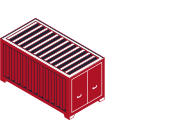
Full Container Load
For this type of shipment, one person will use the entire capacity of the container. This minimizes the risk of damage to the goods.
This method would still be advantageous even if you did not fill the container completely. However, it is the most cost-effective for shipments over 15 m³.
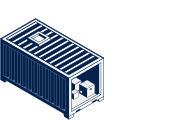
Less than Container Load
This type of shipment, allows several people, who do not have enough goods to fill an entire container, to use the same container. The goods of various people are thus combined to fill an entire container.
This is the most cost-effective choice for small shipments of less than 15 m³.
Advantages of LCL
- The advantageous rate for small volumes.
- Allows for fewer but more frequent shipments, reducing storage expenses.
Disadvantages of LCL
- Often longer delivery times due to loading and unloading of goods from all customers.
- Increased risk of loss and damage from multiple loading and unloading.
Advantages of FCL
- The advantageous rate for large shipments of goods.
- Reduced risk of damage or loss of goods because containers are not opened during transit.
Disadvantages of FCL
- A minimum volume of at least 15 m³ to be profitable.
Special sea freight solutions
If your cargo does not fit standard container shipping Thailand to Qatar, you still have options.
Reefer container
You use reefer container shipping Thailand to Qatar when you move temperature-sensitive goods. This applies to food products, pharmaceuticals, or certain chemicals. Temperature settings, power availability during transshipment, and monitoring are critical. You should also review cargo insurance for maritime shipments carefully for these goods.
Roro
RORO vessels are relevant when you move vehicles or rolling equipment. Instead of containerizing, the cargo is driven on and off the vessel. This can reduce handling risk for oversized vehicles.
Bulk
Bulk shipping solutions apply to raw materials transported unpackaged. This is less common for general trade between Thailand and Qatar but remains relevant for industrial flows.
OOG
Out of gauge OOG cargo by sea applies when your cargo exceeds standard container dimensions. You can use open top or flat rack equipment. For large industrial units, breakbulk shipping solutions or full project cargo Thailand to Qatar coordination may be more suitable. In those cases, planning and port handling compatibility become decisive factors.
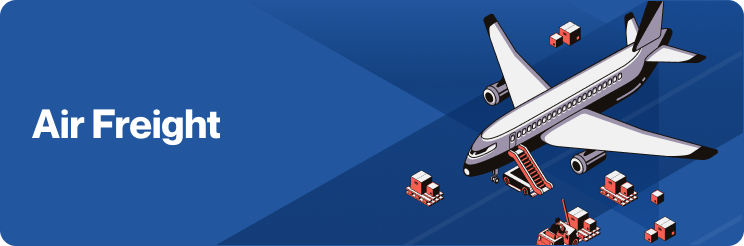
Air freight from Thailand to Qatar
If you are considering air freight shipping between Thailand and Qatar, you are usually dealing with tight timelines, high-value goods, or supply chain pressure. Air is often the fastest way to ship from Thailand to Qatar, but it is also less forgiving. Cut-off times, cargo security screening procedures, and chargeable weight rules can change your cost and timeline overnight.
You have probably heard that air freight always takes 3 days, that it is always too expensive, or that you pay based on real weight only. On this route, none of that is automatically true. Most costly mistakes we see involve wrong chargeable weight calculation, weak packaging that fails screening, and export documentation for air cargo Thailand that is not aligned with import clearance preparation in Qatar.
Air cargo vs express: how should you ship on this route?
There are two types of air freight:
- Classic air freight: This option uses the space available on board commercial flights of airlines such as Thai Airways, China Southern Airlines, or even Qatar Airways, and exploits the empty spaces.
- Express airfreight: This option uses aircraft dedicated solely to airfreight. This solution is offered by courier companies, such as FedEx, DHL, UPS, or even TNT, which offers door-to-door solutions.
Should you choose air cargo from Thailand to Qatar?
You should look at standard air cargo Thailand to Qatar if your shipment is above roughly 1 CBM or 100 to 150 kg. At that point, airport-to-airport air freight or a tailored door-to-door air freight service is usually more cost-efficient than express.
This option fits you if you ship B2B, move regular volumes, or need more control over customs and documentation. Before booking space with airlines, you need exact dimensions, gross weight, Incoterm, chosen airport, ready date, and product details including whether you fall under IATA cargo regulations or dangerous goods by air (DGR cargo).
Common mistakes on this lane include confusing airport-to-airport with door-to-door responsibilities, missing the cargo cut-off time for air freight, underestimating airport handling charges, and ignoring minimum charges on low-density cargo. This is where costs quietly increase.
Should you choose express air freight from Thailand to Qatar?
Express is logical if you have small parcels, urgent shipment by air from Thailand to Qatar, or no internal logistics team. You get a simplified process and a single tracking number, which is why many first-time shippers prefer it.
The trade-off is control. With express, you have less flexibility on customs strategy, limited negotiation on air freight rates Thailand to Qatar, and strict reweigh and remeasure policies. If your invoice value or Incoterm is wrong, corrections can delay clearance in Doha.
Express works well if your shipment is compact, properly packed, and documentation is clean. It becomes risky if you underestimate volumetric weight vs gross weight, assume all duties are included, or use packaging that fails screening standards.
Main airports to know in Thailand and Qatar
- Suvarnabhumi Airport (BKK), Bangkok – The main international cargo hub and one of the main international airports in Thailand for cargo. You will find the widest flight options and better capacity for consolidated air freight services and temperature-controlled air freight.
- Don Mueang Airport (DMK), Bangkok – Often used for regional and low-cost operations. You may route specific cargo here, but long-haul capacity is more limited than BKK.
- Chiang Mai Airport (CNX) – Useful if your supplier is in northern Thailand. You reduce inland trucking, but you may rely on feeder flights via Bangkok.
- Hamad International Airport (DOH), Doha – The main international airport in Qatar for cargo and the core hub for Qatar Airways. Most direct flight cargo Thailand to Qatar solutions connect here, which helps reduce transit uncertainty.
Your airport choice affects inland trucking cost in Thailand, total transit time, and exposure to congestion. From experience, choosing the wrong departure airport can add one or two days before the cargo even leaves the country.
Transit times: how long does air freight take from Thailand to Qatar?
| Service type | Estimated transit time |
|---|---|
| Standard air cargo (airport-to-airport) | Approximately 2 to 5 days depending on flight availability and connection |
| Express courier | Approximately 2 to 4 days door-to-door under normal conditions |
If you are asking, how long does air cargo take between Thailand and Qatar?, the short answer is that flight time is only part of the equation. Pre-flight handling, cargo security screening procedures, and customs coordination on both sides shape the real timeline.
The main variables are your cargo ready date versus the airline cut-off, whether your shipment requires special checks under IATA cargo regulations, and seasonal capacity pressure. During peak periods, even one missed document can push your cargo to the next flight.
Shipping rates: how much does air freight cost from Thailand to Qatar?
| Cost component | What impacts your price |
|---|---|
| Air freight rate per kg | Based on chargeable weight and airline capacity |
| Fuel surcharge in air freight | Varies with market conditions |
| Airport handling charges | Origin and destination terminal fees |
| Pre-carriage and last mile | Trucking to and from airports |
If you are wondering how much does air freight cost from Thailand to Qatar?, you need to start with the air cargo cost per kilogram, calculated on the higher of gross or volumetric weight. Then you add fuel surcharge, handling, and any special service such as high-value cargo by air or temperature-controlled air freight.
From experience, the biggest cost driver is density. Low-density cargo increases your chargeable weight. Urgency, limited capacity on a specific week, and airport choice also influence the final quotation.
Step-by-step: how an air shipment usually works on this route
If you have never handled a step-by-step air shipment process between Thailand and Qatar, it is simpler than it looks once you see the logic. The key is to control documents, timing, and weight assumptions from day one.
- We collect shipment details including dimensions, weight, Incoterm, product type, and confirm compliance with IATA cargo regulations.
- We coordinate export documentation for air cargo Thailand and prepare the air waybill (AWB) documentation, clarifying house AWB vs master AWB if consolidation is used.
- We book space with airlines and confirm the cargo cut-off time for air freight at the chosen airport.
- Your cargo is picked up or delivered to the terminal, screened under cargo security screening procedures, and weighed to confirm the final chargeable weight.
- The flight departs, ideally on a direct flight cargo Thailand to Qatar routing, or via a transit hub if needed.
- On arrival at Hamad International Airport, we handle air freight customs coordination and import clearance preparation in Qatar before final delivery.
Most delays occur at two moments, before departure if documents or packing are not compliant, and after arrival if invoice values or HS codes do not match customs expectations.
What is the difference between volumetric and gross weight?
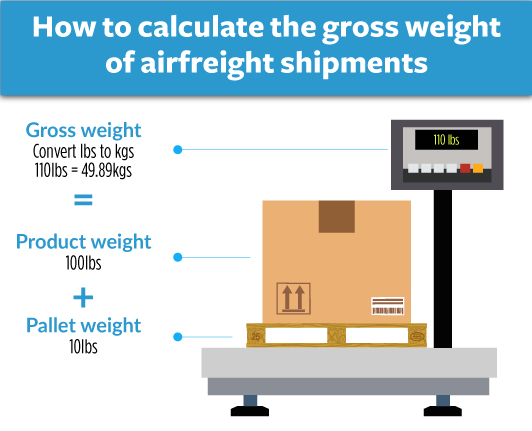
When you ship by air, airlines charge you based on the higher of gross weight and volumetric weight. This is the foundation of any chargeable weight calculation. If your cargo is light but bulky, you pay for the space it occupies, not just what it weighs on a scale.
- Gross weight: the real weight of your cargo measured on a scale.
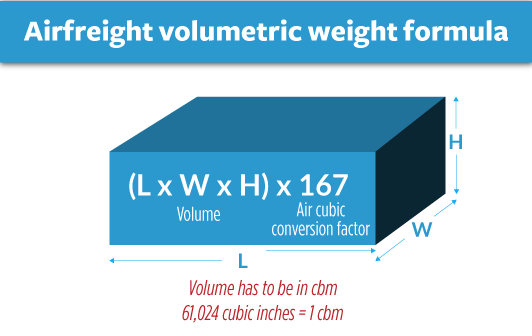
- Volumetric weight: a calculated weight based on dimensions.
- Chargeable weight: the higher of gross or volumetric weight.
- Divisor: the factor used to convert volume into weight.
How to calculate:
Volumetric weight = (Length x Width x Height in cm) / 6000 for standard air cargo.
Example: 100 x 80 x 60 cm / 6000 = 80 kg volumetric weight.
| Service | Conversion rule |
|---|---|
| Standard air cargo | 1 m³ = 167 kg, divisor 6000 |
| Express courier | 1 m³ = 200 kg, divisor 5000 |
Common mistakes include measuring cartons before final palletizing, forgetting that express uses a different divisor, and assuming airlines will ignore small dimension differences. They will not. A few extra centimeters can change your entire pricing structure.
Door-to-door delivery between Thailand and Qatar
If you don’t have time to devote to transportation, door-to-door delivery is for you. This method is simple, your goods will be picked up directly at your home, and then delivered to the desired destination. You will not need to take care of anything and your goods will be safe with professionals.
What are the advantages of door-to-door services?
- Quick delivery: As everything is completed in a 24-hour period, you can send it if your delivery time is during the day.
- Door-to-door delivery is always available, so your package will come even late at night or on a holiday.
- Convenience: Receiving the package at your location rather than having it delivered to you is better for you.
- Your cargo can be qualified for courier delivery if it is a manageable size.
What are the disadvantages of door-to-door services?
- High cost: The cost increases with the urgency of the cargo, as well as with the package’s size and weight, which also affect the cost.
Customs clearance in Qatar for goods imported from Thailand
If you are handling customs clearance in Qatar for goods from Thailand, you are deciding more than paperwork. You are deciding your final landed cost, your cash flow timing, and whether your cargo is released in days or sits under customs inspection. The declared value, HS code classification, and importer setup in Qatar will directly affect your import duties and taxes in Qatar. We coordinate the full customs entry for our clients, including document review and electronic filing, so you are not guessing at the last minute.
On this route, the costly mistakes are predictable. You confuse country of origin with shipping country, you underestimate the CIF value for customs purposes, or you submit incomplete documents and trigger a delay. You will also notice fast that customs compliance for Thailand to Qatar shipments depends heavily on documentation accuracy. Let us walk you through how to calculate correctly and how the import process Qatar from Thailand actually works in practice.
How to calculate duties & taxes when importing from Thailand to Qatar?
If you are asking how to calculate import duties from Thailand to Qatar?, you need three inputs: the correct HS code, the customs value, and the applicable tariff and tax rates. Your estimate before shipping is only as accurate as those three elements. The amount customs finally assesses can differ if your value declaration or classification is challenged. That is why you should always do a proper duty and tax estimation before shipping instead of relying on a freight quote that ignores taxes.
Step 0 – Quick checks before you calculate
- Confirm who is the Importer of Record in Qatar. That entity is legally responsible for the declaration and payment.
- Check your Incoterm. Your Incoterms impact on customs value and determine who controls the clearance.
- Verify whether your shipment qualifies for any low-value or simplified clearance procedure before running full calculations.
Step 1 – Identify the Country of Origin
Your country of origin determination affects duty eligibility, possible preferential origin vs non-preferential origin treatment, and how customs reviews your file. If your goods are manufactured in Thailand, you may need a certificate of origin Thailand to support the declaration. Customs can challenge origin if documents are inconsistent with your commercial invoice or export declaration Thailand. The common mistake is declaring Thailand as origin just because the goods ship from Bangkok, even if they were produced elsewhere.
Step 2 – Find the HS Code of your product
Your HS code classification Thailand exports determines the duty rate, possible restrictions, and whether your goods fall under restricted and prohibited goods Qatar rules. You should start with your supplier’s HS code, then verify it using an official harmonized system code lookup and compare the product description carefully. Make sure your commercial invoice requirements and product specs match the classification.
If your HS code is wrong, you risk tariff classification disputes, reassessment of duties, and delays during customs inspection procedures. Misclassification is one of the most common customs clearance mistakes to avoid. Here’s an infographic showing you how to read an HS code.
Step 3 – Calculate the Customs Value
Qatar generally applies the customs value calculation method based on transaction value. In simple terms, you start from the price you actually pay your Thai supplier, then adjust it depending on your Incoterm. For many shipments, the CIF value for customs purposes becomes the taxable base, meaning cost of goods plus freight and insurance up to Qatar.
Example: if your goods cost 8,000 USD and freight and insurance to Doha total 2,000 USD, your customs value may be 10,000 USD. You must also consider assists, commissions, packing costs, or royalties if they are not already included. Customs can review this later during valuation methods for imported goods checks or post-clearance audits.
Step 4 – Figure out the applicable Import Tariff in Qatar
The import tariff is the percentage or specific rate applied to your customs value to calculate duty.
To find it, you should:
1. Open the official customs tariff lookup Qatar tool.
2. Enter your verified HS code.
3. Read the corresponding duty rate and any notes attached to that code.
- Check if the rate is ad valorem or specific.
- Look for exemptions or conditional notes.
- Confirm whether origin affects the rate.
If your customs value is 10,000 USD and the duty rate is 5 percent, your customs duty would be 500 USD. On Thailand to Qatar shipments, you should double check that the HS description exactly matches your product, not just the code. If you are unsure, we can review the classification with you before filing.
Step 5 – Consider other Import Duties and Taxes in Qatar
After customs duty, you calculate VAT. VAT is usually applied on the customs value plus duty. For example, if your customs value is 10,000 USD and duty is 500 USD, VAT would apply on 10,500 USD. This is where your real landed cost increases.
You should also check for excise or other measures depending on your product category. Certain goods may fall under restricted and prohibited goods Qatar controls or require additional approvals under import license requirements Qatar.
- Verify whether your product requires prior approval.
- Confirm VAT registration status of the importer.
- Prepare a full customs documentation checklist before arrival.
Step 6 – Calculate the Customs Duties
The basic formulas are straightforward:
Customs duty = customs value × duty rate.
VAT = tax base × VAT rate.
Using our earlier example, 10,000 USD customs value × 5 percent duty = 500 USD duty. If VAT applies on 10,500 USD, you calculate VAT on that amount.
What happens next depends on who is acting as your customs broker in Qatar. The importer of record in Qatar or their appointed broker, under a valid power of attorney for customs clearance, submits the customs declaration form submission through the electronic customs filing system Qatar. Duties must generally be settled before the cargo release process after customs clearance is completed. If documents are inconsistent, you can face inspection fees, storage, or valuation queries.
Step-by-step: how customs clearance usually works on this route
If you want a clear view of the step-by-step customs clearance process Qatar for a Thailand shipment, here is how it usually unfolds. The operational flow changes slightly depending on airport or port of entry, shipment type, and Incoterm, but the logic remains the same. From experience, delays rarely come from transport itself. They come from documentation gaps or last-minute corrections.
- You prepare documents before departure, including commercial invoice requirements, packing list for customs clearance, and export declaration Thailand.
- You verify the bill of lading for customs submission or air waybill for customs entry matches the invoice details exactly.
- We conduct pre-shipment document verification to catch inconsistencies before arrival.
- Upon arrival in Qatar, the customs declaration form submission is filed electronically by the appointed broker.
- Customs reviews the file and may select it for customs inspection procedures based on risk profiling.
- If selected, your cargo is inspected. This is a key moment where HS code, value, and origin consistency are checked.
- Duties and taxes are assessed and paid by the importer of record in Qatar.
- After payment and clearance approval, the cargo release process after customs clearance is authorized and goods can exit the port or airport.
If you are planning temporary import procedures Qatar or re-export documentation from Qatar, the sequence changes slightly and requires advance planning. The first thing we always tell you is this: treat customs as part of your logistics timeline, not an afterthought. That is how you keep your customs clearance timeline Thailand to Qatar shipment under control and avoid preventable surprises.
The customs services
When you structure your import process Qatar from Thailand properly, customs becomes a controlled step, not a gamble. We can act as your coordinating partner with a licensed customs broker in Qatar, review your HS classification, check your customs value calculation method, and prepare the full customs documentation checklist before the vessel or aircraft lands.
You can also rely on us for support with tariff classification disputes, customs audit preparation, temporary import procedures Qatar, or re-export documentation from Qatar. The goal is simple. You stay compliant, you understand your numbers, and you avoid the common customs clearance mistakes to avoid that cost time and money.
Qatari Customs
Official name: General authority of customs
Official website:https://www.customs.gov.qa/english/pages/default.aspx
Thai Customs

Official name: Customs Department of Thailand
Official website: http://www.customs.go.th/index.php?lang=en&left_menu=menu_homepage
Required documents for customs clearance in Qatar
When you import from Thailand into Qatar, your documents must tell the exact same story. The shipper name, consignee, product description, HS code, quantities, and values must match across every file. Most customs holds in Doha happen because of inconsistencies or missing supporting proof, not because the goods are “stuck at the border”. If you align your paperwork before the cargo lands, you avoid 80 percent of delays.
Commercial Invoice
The commercial invoice is the document that shows what you are selling, to whom, and for how much.
Qatar Customs uses it to calculate duties and taxes, verify HS codes, and assess the declared transaction value.
Example: 1,200 units of plastic kitchenware, FOB Laem Chabang, total value USD 18,000, seller in Bangkok, buyer in Doha.
Common mistake: You use vague descriptions like “household items” instead of precise product names and HS-aligned descriptions.
Packing List
The packing list details how your goods are physically packed, carton by carton or pallet by pallet.
Customs and your broker use it to cross-check quantities, weights, and packaging details during inspection or risk assessment.
Example: 240 cartons, 5 units per carton, gross weight 3,200 kg, 10 pallets.
Common mistake: Your packing list quantities do not match the commercial invoice exactly.
Bill of Lading or Air Waybill
This is the transport contract issued by the carrier for sea or air shipments.
Qatar Customs uses it to confirm shipment routing, port of loading in Thailand, and consignee details in Qatar.
Example: Port of loading Laem Chabang, port of discharge Hamad Port, consignee company registered in Doha.
Common mistake: The consignee on the Bill of Lading is different from the entity listed on the commercial invoice.
Certificate of Origin
The certificate of origin confirms that your goods are manufactured or sufficiently processed in Thailand.
You need it if you want to support origin claims or if Qatari authorities request proof of manufacturing country.
Example: Certificate issued by the Thai Chamber of Commerce stating Thai origin for food products.
Common mistake: You declare Thailand as origin on the invoice but cannot provide an official certificate when requested.
Import License or Product-Specific Permit
An import license or special permit authorizes you to import regulated goods into Qatar.
You will need this for products such as food, cosmetics, medical items, chemicals, or telecommunications equipment.
Example: Prior approval from the relevant Qatari authority before shipping cosmetics or dietary supplements.
Common mistake: You ship regulated goods first and apply for approval after arrival, which can lead to storage costs and clearance delays.
Customs Declaration and Supporting Valuation Documents
The customs declaration is the formal submission of shipment data to Qatar Customs through your broker.
It summarizes the HS code, value, origin, and duty calculation, supported by your invoice and transport documents.
Example: Electronic declaration filed before vessel arrival at Hamad Port, including CIF value and duty computation.
Common mistake: You underestimate the declared value without proper justification, which can trigger inspection or reassessment.
Prohibited and restricted items when importing into Qatar
Before you ship from Thailand, you need to understand the difference. Restricted products are allowed into Qatar but only if you meet specific conditions, approvals, or labeling rules. Prohibited products should not enter the country at all, and you can face seizure, fines, or mandatory re-export if you ignore this.
Restricted products
- Food and beverages, subject to health registration and labeling rules.
- Pharmaceuticals and medical devices, prior approval and product registration required.
- Cosmetics and personal care products, ingredient review and compliance checks.
- Chemicals and industrial substances, safety documentation and possible permits.
- Telecommunication equipment, conformity approval before commercial use.
- Alcohol and pork-related products, strictly controlled distribution channels.
Prohibited products
- Narcotics and controlled drugs without authorization.
- Weapons and ammunition without special governmental approval.
- Pornographic materials and content offensive to public morals.
- Counterfeit goods or items infringing intellectual property rights.
- Products containing banned substances under Qatari law.
If you are unsure about your product category, you should confirm the HS code classification and check current import conditions with your broker before booking freight. It is always easier to adjust documentation before departure than to deal with storage at Hamad Port.
Trade agreements and preferential duties for imports from Thailand to Qatar
When you import into Qatar, you generally deal with the GCC Common Customs Law framework. Qatar applies a standard customs duty of 5 percent on most imported goods, calculated on the CIF value, unless a specific exemption or higher rate applies. Certain categories such as tobacco can be subject to significantly higher duties under GCC rules.
As of 2025 to 2026, there is no bilateral free trade agreement in force between Thailand and Qatar that grants automatic preferential tariff reductions. This means you should plan your cost structure around the standard GCC external tariff unless your product qualifies for a specific exemption under Qatari regulations.
You will not benefit from preferential duty simply by presenting a Thai certificate of origin unless a specific scheme applies to your product category. The certificate still matters for origin verification, but not for automatic tariff reduction on this route.
The first thing we always tell importers on this lane is simple. You should confirm three points before you quote your client or sign a sales contract: the correct HS code, the applicable GCC duty rate, and whether your product falls under any excise or special tax regime. Once you lock these three elements, your landed cost calculation becomes predictable and you avoid unpleasant surprises at clearance.
Prohibited & Restricted Items
Prohibited & Restricted Items
Before you ship from Thailand, you should always confirm whether your goods fall under restricted and prohibited goods Qatar rules. Some items are strictly banned, while others require prior authorization, special permits, or additional inspections. If you ignore this step, customs inspection procedures can stop your cargo even if your documents look correct.
You should also check import license requirements Qatar for controlled categories and make sure your documents clearly describe the product to avoid suspicion of misdeclaration.
Drugs
Explosives
Biohazard
Chemicals
Corrosive
Counterfeit
Ivory
Batteries
Flammable
Firearms
Prescription Drugs
Counterfeit Notes
Poison
Pornography
Knife
Tobacco
Gambling
Hazardous
Additional logistics services
Venture beyond shipping and customs with SIAM Shipping! Explore our wide array of additional logistics services, ensuring your supply chain operation runs smoothly from start to finish. Let's take care of everything, together.
Warehousing and storage
Finding the right warehouse for your goods can feel like a treasure hunt—a steady temperature for your delicate items is a must. Storing chocolates? You wouldn’t want a meltdown! For a stress-free solution that considers all conditions, explore our warehousing services, designed to keep your goods in prime condition.
Packaging and repackaging
Inherent challenges in shipping from China to France make quality packaging vital. Having a reliable agent can help ensure your wine barrels or electronics are suitably packed and repacked, reducing the risk of damages. Whether it's ceramics securely cushioned or machinery components assembly-segregated, great packaging caters to every product. Find out more about securing your cargo on our dedicated page: Freight packaging.
Cargo insurance
Contrary to fire insurance limited to premises, transport insurance is your flotation device over rough trade seas. Imagine sending a pricey, custom-built machinery and it gets damaged in transit. Ouch! But, with cargo insurance, you're covered and can breeze through such setbacks. It's the booster dose of prevention to keep your trade immunity sky-high.
Personal effects shipping
Moving precious belongings from China to France? No worries, we manage fragile or bulky items with extra care, ensuring they reach your new French home intact. Like Aunt Mei's porcelain vase, we pack, transport, and deliver with professionalism. Save time and energy for croissants and vin rouge!