In short ⚡
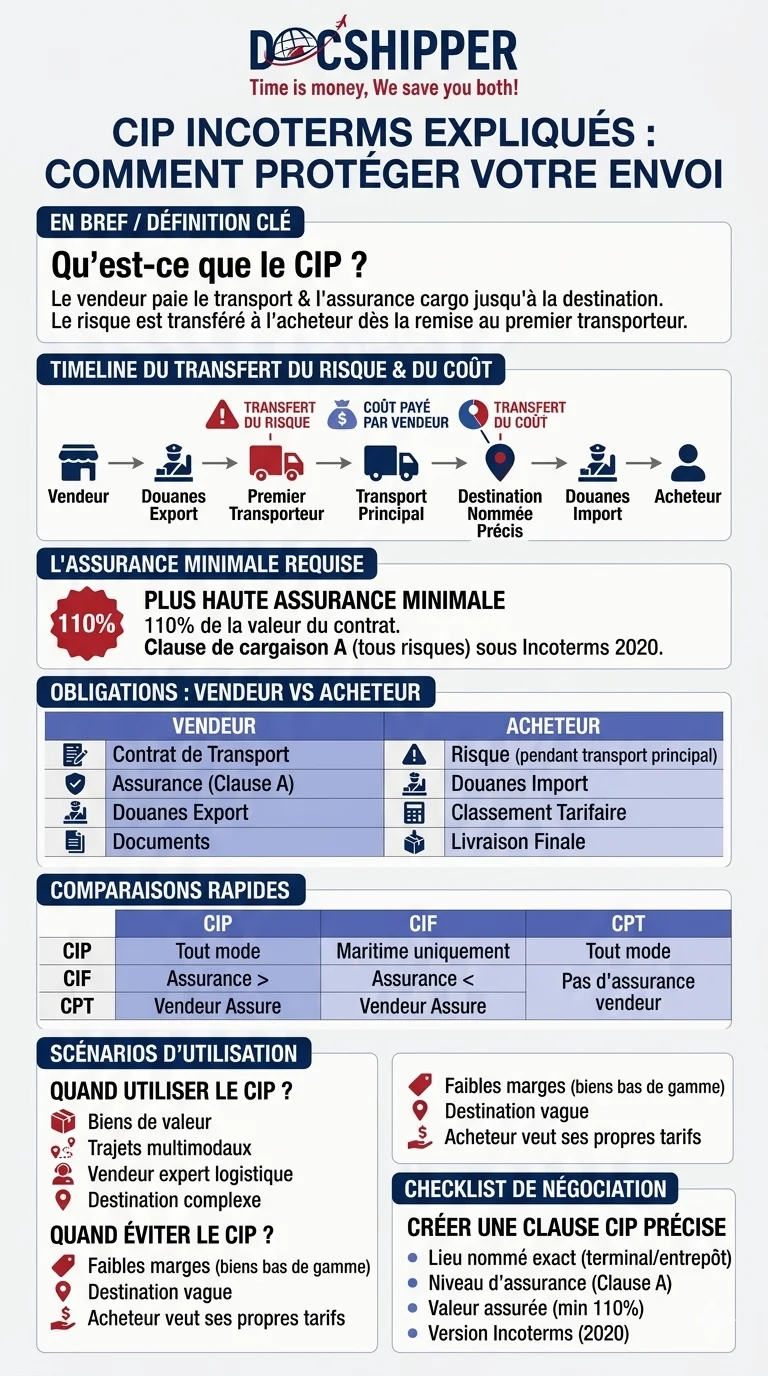
CIP Incoterms mean the seller pays for carriage and cargo insurance to a named place of destination, but risk transfers to the buyer as soon as the goods are handed over to the first carrier. Under Incoterms 2020, CIP applies to any mode of transport, requires higher minimum insurance (typically 110% of contract value), and demands precise definition of the delivery location for smooth operations.In this article, you will find a breakdown of CIP risk transfer and insurance, step‑by‑step seller and buyer obligations, comparisons with CIF, CPT, DAP and DDP, plus negotiation tips and checklists to draft precise CIP clauses and avoid disputes.
We hope you’ll find this article genuinely useful, but remember, if you ever feel lost at any step, whether it’s finding a supplier, validating quality, managing international shipping or customs, DocShipper can handle it all for you!
What CIP Incoterms mean in international trade

With CIP Incoterms, you’re buying a deal where the seller pays carriage and insurance, but you start carrying the risk earlier than most importers expect.
Here’s the thing, the cip incoterms meaning is simple on paper and tricky in real logistics, because cost, risk, and insurance don’t shift at the same place.
CIP Incoterms meaning and how they fit within Incoterms 2020
Last year, we saw a buyer assume “insured to destination” meant “risk until destination”, then a pallet got crushed during cross docking and the dispute started within hours.
Under Incoterms 2020 from the ICC, the cip incoterm (Carriage and Insurance Paid To) means the seller contracts and pays for transport to the named place of destination, and also buys cargo insurance for you.
But the risk transfers when the goods are handed to the first carrier, not when the truck or container arrives at your warehouse.
To make that easier to visualize, here’s a quick comparison of what changes hands, and when.
| CIP element | What the seller does | What it means for you |
| Transport contract | Books and pays carriage to the named destination (air freight, ocean freight, road freight, rail, multimodal transport) | You don’t manage freight procurement up front, but you still need shipment tracking and delivery coordination |
| Insurance | Buys insurance with higher minimum coverage under CIP | You must confirm coverage scope, exclusions, and claims process before shipping |
| Risk transfer | Hands goods to the first carrier | You carry risk during the main transport leg even though the seller is paying |
| Export formalities | Handles export customs and typical export documents | You’ll focus on import customs clearance, tariff classification, and last mile delivery planning |
If you’re running tight lead times or just in time inventory management, that “risk early, cost later” split is exactly where CIP can either protect you or surprise you.
Siam Shipping Info
Our logistics experts break down cost, insurance, and liability in practical terms.
Talk to a specialist before your next contract negotiation.
CIP condition vs. delivery terms: cost, risk and insurance in one clause
Tip: when you negotiate a cip condition, write the named place like you mean it, for example “CIP, Frankfurt Airport cargo terminal” or “CIP, Buyer’s 3PL distribution center dock”.
In cip delivery terms, the seller’s cost responsibility runs to the named destination, but your risk flips once the first carrier takes custody.
That’s why a sloppy named place creates real supply chain management headaches, storage fees at a bonded warehouse, missed delivery slots, and fights over who pays demurrage or handling.
Before you sign, use this quick checklist to pressure-test the clause the way a freight forwarder or customs brokerage team would.
- Named place precision: exact facility, terminal, Incoterms location, and whether it includes unloading
- Insurance coverage: risks covered, deductible, insured value basis, and who can file a claim
- Documents: commercial invoice, packing list, bill of lading or airway bill, insurance certificate, compliance docs
- Import side: who manages customs clearance, duty/tax payer, and required licenses
- Operational handoffs: who books last mile delivery, delivery appointment rules, and warehouse management system receiving requirements
If you want to align CIP with your actual operations, we usually recommend you map it to your warehousing and fulfillment services flow, not just your purchase order wording.
Siam Shipping Advice
A small wording gap can trigger storage or demurrage fees.
Request a contract review with our team.
CIP delivery terms step by step: who does what and when
The most common frustration with CIP Incoterms is that you feel “covered”, then something goes wrong in cargo handling and everyone points at the other party.
Let us explain it in a practical workflow, so you can plug it straight into your logistics outsourcing or 3PL playbook.
Here’s the step-by-step cip shipping terms workflow you can follow for almost any multimodal shipment.
- Step 1: You agree the named place of destination and required documents in the sales contract
- Step 2: Seller prepares goods, packaging, palletization, and export-ready labeling
- Step 3: Seller clears export customs and hands goods to the first carrier (risk transfers here)
- Step 4: Seller pays main carriage to the named destination and provides shipment tracking details
- Step 5: Seller provides insurance certificate, you verify coverage and claim procedure
- Step 6: You handle import customs clearance, duty and tax payment, and any inspections
- Step 7: You organize final delivery, unloading, and receiving into your inventory management system
Siam Shipping Info
We map each handover, document flow, and risk point to your 3PL setup.
Optimize your shipment workflow with us.
Seller’s obligations under CIP Incoterms

A client once told us their supplier “handled everything under CIP”, yet the cargo sat two days because the export carton markings didn’t match the packing list.
Under CIP Incoterms, the seller must deliver the goods to the first carrier, clear export formalities, pay carriage to the named destination, and provide cargo insurance for your benefit.
Operationally, you’ll want the seller aligned on containerization or air cargo requirements, correct shipping marks, and document accuracy, because a tiny mismatch can snowball into delays at a distribution center.
To keep it tangible, here’s what you should expect from the seller side in cip delivery terms.
- Export side: export customs declaration, permits if required, and compliant commercial paperwork
- Transport booking: carrier contract via a freight forwarder or direct carrier, plus routing and lead time confirmation
- Cargo handover: delivery to first carrier with proof of handoff and clean documents
- Insurance: insurance certificate issued to cover the buyer’s interest per CIP expectations
Buyer’s obligations under CIP Incoterms
Want a practical rule that saves money, set up your import file before the goods even leave origin.
With cip incoterm deals, you still handle import customs clearance, duties and taxes, and the last mile delivery from the named place if the contract doesn’t include unloading or final positioning.
This is also where you control tariff classification, customs brokerage instructions, and whether you route to a bonded warehouse or straight to your facility for cross docking.
If you need help on the import side, you can align your process with our customs clearance service.
Transfer of risk vs. place of delivery under CIP
Bottom line: in CIP Incoterms, the place where the seller pays to is not the place where the seller carries risk to.
We’ve seen this bite importers when goods move from truck to rail, then rail to ocean freight, because each handoff increases damage exposure, while the buyer already holds the risk after the first carrier.
So in cip shipping terms, you manage risk through insurance verification, packaging standards, and clear carrier handover records, not by assuming the seller “owns” the transit problems.
To make disputes less likely, always match three items: the named destination, the handover point to the first carrier, and the insurance certificate wording.
CIP shipping terms vs other Incoterms: CIF, CPT and more
You’ll hear suppliers casually propose CIP as if it’s a universal solution, but CIP shipping terms fit some routes better than others.
Once you compare CIP to CIF and CPT, you’ll see why the mode of transport and insurance level are the real decision drivers, not the acronym itself.
CIP vs CIF: mode of transport, insurance level and risk
One buyer switched from CIF to CIP Incoterms for an air freight shipment, then realized too late that CIF wasn’t even designed for that mode.
The clean difference is this, CIP works for any mode including multimodal, while CIF is for sea and inland waterway only and ties delivery to an onboard concept.
Insurance is another separator, CIP requires a higher minimum insurance level than CIF under Incoterms 2020, which matters for high-value cargo and electronics that don’t forgive rough cargo handling.
If you want a refresher on the sea-focused alternative, you can compare it with the CIF Agreement.
For extra precision on clause naming conventions, many logistics teams reference the Lloyd’s Market Association (LMA) cargo clauses when reviewing what “insurance” actually covers.
CIP vs CPT and other alternatives when you should not use CIP
Are you shipping low-margin goods where the seller’s insurance cost just inflates your unit price?
In cip delivery terms, the seller must insure, while under CPT the seller pays carriage but doesn’t have to provide insurance, which can be better if you already run a global cargo policy through your freight brokerage setup.
In practice, you should avoid CIP when you can’t verify the insurance scope, when the named destination is operationally vague, or when you need the seller to keep risk longer for fragile goods.
Here’s a quick comparison table to help you pick the right tool for your transportation plan and supply chain risk profile.
| Incoterm | Best fit | Why you’d choose it over CIP |
| CIP | Multimodal routes, higher-value shipments, buyers wanting seller-arranged freight plus insurance | You want built-in insurance and a seller-managed main carriage to a named place |
| CPT | Buyers with their own cargo insurance program and strong logistics procurement | You avoid paying for the seller’s insurance markup and keep coverage consistent across lanes |
| CIF | Ocean freight, port-to-port trades for bulk or containerized sea cargo | You need a sea-specific term and accept the CIF insurance baseline |
| DAP/DDP | Buyer wanting delivery closer to the final point, sometimes including import side | You want fewer handoffs to manage, but you must watch customs and tax obligations closely |
If you’re ever unsure, ask one question, who can actually control the risk at each handover, and who has the paperwork to prove it when something breaks.
Siam Shipping Alert
Mode of transport and insurance level must match your cargo profile.
Get a comparative assessment before deciding.
When you should use CIP Incoterms (and when you should avoid them)

If you’re considering cip incoterms, you’re probably dealing with an international shipment where insurance, risk transfer, and multimodal transport are on the table.
Here’s the thing, CIP delivery terms are powerful, but only when you apply them in the right context. Used correctly, they protect your shipment. Used blindly, they create confusion and unexpected exposure.
The International Chamber of Commerce, through the ICC Incoterms Committee, clearly positions CIP as a rule suitable for any mode of transport, which already gives you a clue about when it makes sense.

Looking for a Reliable Shipping & Sourcing Partner?
DocShipper Platform
One platform. Your entire supply chain
Sourcing, freight, customs & documents, all centralised, all visible, 24/7.
Best use cases for CIP: high‑value goods, multimodal routes and complex logistics
We once supported a client shipping medical devices from Germany to Chile under cip incoterms, involving truck, ocean freight, and inland delivery. The multimodal route made CIF unsuitable, and the high cargo value required robust insurance.
That’s exactly where CIP shines.
You should seriously consider CIP when:
- Your goods are high value and require broader insurance coverage, typically Institute Cargo Clauses A under Incoterms 2020.
- Your transport is multimodal, combining road, rail, air, and sea.
- You want the seller to handle carriage and insurance up to a named destination.
- You’re importing into a country where freight booking is complex and you prefer the exporter to manage it.
Under cip shipping terms, the seller must arrange carriage to the agreed destination and procure insurance with at least 110 percent of the contract value, unless you agree otherwise. For high‑value cargo, that extra 10 percent often covers anticipated profit or additional costs.
You’ll also find CIP useful when:
- You buy from a supplier with strong logistics expertise.
- You lack freight forwarding capacity in the export country.
- You want cost predictability up to your inland terminal.
However, avoid CIP if you want full control over the main carriage, or if you can negotiate better freight rates yourself. In those cases, CPT or FCA may be more strategic.
Before choosing CIP, run through this quick checklist.
- Is the route multimodal?
- Are the goods sensitive or expensive?
- Do you trust the seller’s choice of insurer?
- Have you clearly defined the named place of destination?
- Are you comfortable with risk transferring at first carrier?
If you hesitate on the last point, that’s your warning sign.
Siam Shipping Advice
We evaluate cargo value, multimodal exposure, and insurance scope against your risk appetite.
Schedule a quick feasibility check with our team.
Advantages and disadvantages of CIP for buyers and sellers
Let’s be direct, cip incoterms are not “better” or “worse”, they’re strategic tools.
You need to understand the trade-offs before inserting CIP into your contract.
Here’s a simplified comparison.
| Aspect | For the Seller | For the Buyer |
| Control of main carriage | High control over carrier selection | Limited control |
| Insurance obligation | Must procure broad coverage | Beneficiary of coverage |
| Risk transfer | Transfers at first carrier | Bears risk earlier than delivery point |
| Cost visibility | Can include margin in freight | Predictable landed transport cost |
From experience, buyers often misunderstand the risk transfer. You might assume that because the seller pays transport to your warehouse city, they also carry the risk until arrival. That’s incorrect under CIP delivery terms.
The risk transfers once the goods are handed to the first carrier. If damage occurs mid-transit, you claim under the insurance policy, not against the seller, unless there’s a breach of contract.
On the plus side, you benefit from enhanced insurance coverage compared to CIF. On the downside, you sacrifice some operational control.
If you’re a seller, CIP lets you manage the freight process and potentially optimize transport costs. But you also carry the administrative burden of arranging compliant insurance documentation.
How to negotiate and implement CIP conditions in your contracts
Choosing cip incoterms is only half the job. The real protection comes from how precisely you draft and negotiate the clause.
You’ve probably seen contracts that simply state “CIP Shanghai” with no further detail. That’s where disputes begin.
According to guidance from organizations like UNCTAD on trade facilitation, clarity in contractual terms significantly reduces cross-border disputes, and CIP is no exception.
Key points to define in a CIP clause (destination, insurance, documents)
Picture this, a shipment arrives damaged, and you discover the insurance only covers minimal risks. That usually means the CIP clause was poorly defined.
When using cip incoterms, you must clearly specify the named place of destination. Not just the city, but the exact terminal, warehouse, or logistics hub.
Here’s what you should explicitly include in your CIP clause.
- Named place of destination, precise address or terminal code.
- Insurance level, confirm Institute Cargo Clauses A unless agreed otherwise.
- Insured value, typically 110 percent of contract value.
- Currency of insurance.
- Required documents, insurance certificate, transport document, commercial invoice, packing list.
- Reference to Incoterms 2020, always specify the version.
Let us outline a simple negotiation workflow you can follow.
Step 1: Agree on the exact destination point. Step 2: Define insurance coverage and insurer rating. Step 3: Confirm risk transfer moment in writing. Step 4: Align on documentation format and deadlines. Step 5: Insert “CIP [Place] Incoterms 2020” in the contract.
When we assist clients at DocShipper, we systematically validate each of these elements before shipment booking, because one vague sentence can cost thousands later.
Practical tips to reduce disputes under CIP shipping terms
Want to avoid the most common cip shipping terms disputes? Start by thinking beyond the Incoterms rule itself.
Most conflicts don’t come from the rule, they come from assumptions.
Here are practical safeguards you can implement immediately.
- Request a copy of the insurance policy wording, not just the certificate.
- Verify that you are listed as the beneficiary.
- Confirm the first carrier’s identity and handover point.
- Align Incoterm with payment terms, especially if using a letter of credit.
- Document packaging standards in the sales contract.
We once saw a case where goods were damaged during inland trucking before export. The buyer assumed the seller still bore the risk, but under cip incoterms, risk had already transferred at first carrier pickup. The insurance covered the loss, but only after weeks of clarification.
You can avoid that delay by clearly documenting the handover moment and keeping timestamped transport receipts.
Finally, always coordinate CIP with your customs strategy. Import clearance, duties, and local compliance remain your responsibility as the buyer, even if freight and insurance are prepaid.
Siam Shipping Info
We draft precise destinations, insurance terms, and documentation lists aligned with Incoterms 2020.
Secure your contracts before shipment booking.
Conclusion
By now, you should see that cip incoterms are neither complicated nor risky, provided you understand where cost ends and risk begins.
CIP delivery terms work best when you consciously align them with your logistics model and risk appetite.
Here are the key takeaways you should remember.
- CIP works for any transport mode, especially multimodal routes.
- Risk transfers at first carrier, not at final destination.
- Seller must provide broad insurance, typically Clause A, for at least 110 percent of value.
- Precise drafting is essential, always name the exact destination and Incoterms version.
- CIP favors buyers seeking simplicity, but reduces their transport control.
If you approach CIP strategically, define every detail in writing, and align insurance with your real exposure, you’ll turn this Incoterm into a genuine protection tool rather than a source of confusion.
FAQ | CIP Incoterms explained: how CIP delivery terms protect your shipment
CIP in shipping stands for “Carriage and Insurance Paid To.” In practice it means:
So: the seller pays more (freight + insurance) and organizes transport, but the buyer carries the transport risk once the first carrier takes custody.
- The seller arranges and pays for the **main transport** to a clearly named place (airport, port, DC, etc.).
- The seller also buys **cargo insurance** for the benefit of the buyer, usually with broad coverage (Incoterms 2020 expects higher coverage than CIF).
- However, the **risk of loss or damage transfers early**: as soon as the goods are handed to the first carrier (for example, the first truck that picks up at the factory).
Under Incoterms 2020, CIP is supposed to come with “higher” minimum coverage, but in real life suppliers sometimes buy the cheapest policy they can. To protect yourself, you should:
If the seller refuses to upgrade insurance, either negotiate a price reduction and use **your own policy**, or switch to a term like CPT and fully control insurance yourself.
- **Ask for the insurance wording**, not just the certificate (e.g. confirm Institute Cargo Clauses A, or equivalent).
- **Check the insured value**: usually 110% of invoice value; insist on this if it’s not stated.
- **Confirm who is insured**: make sure you (or your company) are named as beneficiary or co‑insured.
- **Review exclusions**:
- common exclusions: poor packaging, inherent vice, delays, war/strikes without add-ons
- if your goods are fragile or high‑tech, make sure they’re not excluded
- **Align on claims handling**: who files the claim, which documents are needed, and in what deadline.
Most CIP disputes come from confusing “who pays freight” with “who bears risk.” To avoid this:
With this paper trail, if cargo is damaged at sea or in air transit, you can immediately open a claim with clear proof of when risk switched.
- **Write the risk transfer point explicitly** in the contract: “Risk transfers when goods are handed over to [carrier name] at [location] on [Incoterms reference].”
- **Match three elements**:
- the named destination in the CIP clause,
- the actual first carrier pickup point,
- the wording on the insurance certificate.
- **Collect handover evidence**: CMR, AWB, B/L, or carrier receipt with date/time, condition remarks, and seal numbers if any.
- **Document packaging standards**: so the insurer can’t reject claims for “insufficient packing.”
- **Explain internally** (to finance, sales, logistics) that:
- you claim against **the insurer**,
- not against the seller, once risk has passed.
The same errors come up again and again, and they’re all avoidable:
To fix this, use one compact but precise line, then an annex with details:
- **Vague named place**: “CIP Paris” instead of “CIP, Paris CDG Cargo Terminal 2, Incoterms 2020”.
- **No Incoterms version**: just “CIP Hamburg” with no “Incoterms 2020”, creating ambiguity.
- **Silence on unloading**: not saying if the price includes unloading at the terminal/warehouse.
- **No insurance details**: assuming “insurance included” means full coverage.
- **Ignoring payment terms**: CIP clause not aligned with letter of credit or bank requirements.
- **No agreement on documents**: missing commitments on which transport/insurance docs will be provided and when.
- “CIP, [exact place], Incoterms 2020 – seller to provide insurance under ICC(A) for 110% of contract value and deliver [list of documents] no later than [X] days after shipment.”
CIP can be dangerous in some operational contexts, even if it seems convenient. Be cautious when:
In these cases, consider instead:
- **You can’t verify the insurance scope** or the seller refuses to share policy wording.
- **The route has many handovers** (truck → rail → port → feeder vessel → main vessel → inland truck) and your goods are fragile or high value.
- **The named place is operationally vague**, causing extra storage/handling that nobody clearly owns.
- **You already run a global cargo insurance program**: you’ll pay twice for insurance you don’t need.
- **You need tight control of carrier choice and routing** for service level or compliance reasons.
- **CPT** if you want the seller to pay freight but keep insurance and risk management under your own umbrella.
- **FCA** if you want full control over the main transport and insurance from origin.
Treat CIP as a joint project, not “supplier will handle everything.” Before departure, you should:
Doing this before loading means that when the goods hit the named place, you’re ready to clear customs, route the cargo, and react fast if anything goes wrong during the leg where you already bear the risk.
- **Lock the clause details**: exact CIP place, Incoterms 2020 reference, insurance requirements.
- **Set up your import file early**: broker instructions, HS codes, licenses, and duty/tax setup.
- **Collect pre‑shipment documents**: draft commercial invoice, packing list, HS classification, and any compliance certificates (CE, FDA, etc.).
- **Confirm operational contacts**:
- seller’s logistics contact
- first carrier or forwarder contact
- your warehouse / 3PL receiving contact
- **Test data flows**: how you’ll receive tracking, ETA updates, and pre‑alert copies of documents.
Need Help with
Logistics or Sourcing ?
First, we secure the right products from the right suppliers at the right price by managing the sourcing process from start to finish. Then, we simplify your shipping experience - from pickup to final delivery - ensuring any product, anywhere, is delivered at highly competitive prices.
Fill the Form
Prefer email? Send us your inquiry, and we’ll get back to you as soon as possible.
Contact Us