In short ⚡
Custom clearance Thailand refers to the end‑to‑end process of getting import or export goods legally approved by Thai Customs, from HS code classification, valuation, duties/VAT calculation and risk screening to final cargo release at port or airport. It hinges on accurate documents, correct permits for regulated goods, and often support from a licensed customs broker to avoid holds, fines, and audits.In this article, you will find how Thai customs clearance works, duties and taxes, required documents, step‑by‑step import and export procedures, the role of customs brokers, and the main compliance risks, penalties, and audits under Thai customs law.
We hope you’ll find this article genuinely useful, but remember, if you ever feel lost at any step, whether it’s finding a supplier, validating quality, managing international shipping or customs, DocShipper can handle it all for you!
How customs clearance works in Thailand for import and export
If custom clearance Thailand feels like a black box, you’re not imagining it.
You’re juggling documents, HS codes, freight forwarders, and Thai port procedures, and one mismatch can turn a simple consignment into a week of calls.
Here’s the thing, once you understand the customs clearance process and who controls each step, you’ll stop guessing and start planning your lead time.
Key authorities, systems, and customs laws you must know
Last year, we saw a container cleared fast until the importer used an old consignee name on the Bill of Lading, and custom clearance Thailand stopped cold at the authority check.
That’s because Thai Customs is strict on data consistency, and the system flags even “small” differences.
The core institution you’ll deal with is Thai customs, which controls import, export, duties, risk screening, and post-entry checks.
In practice, your clearance interacts with port/terminal operators, airlines, and sometimes other ministries for controlled goods, but Customs remains the gatekeeper.
To make the mechanics easy to picture, here’s how we explain the workflow inside a typical freight forwarding setup.
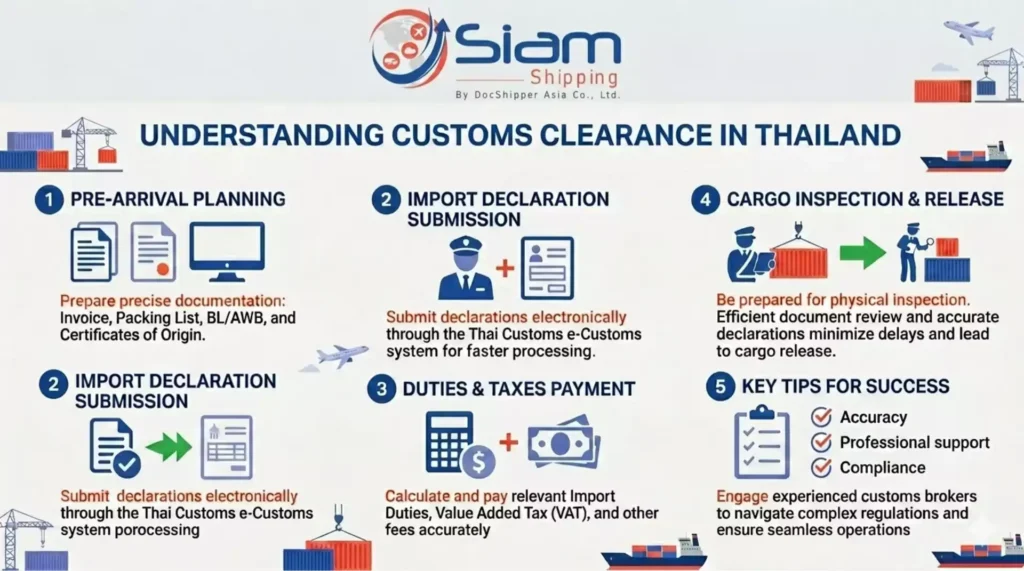
Customs clearance process workflow (import or export):
- Pre-alert from your supplier or origin agent, plus shipping docs (draft first).
- Classification using HS code, check thailand customs rules that apply to your product.
- Declaration filing by you or your broker, with invoice values and shipment details.
- Risk channel assigned (document check, scan, physical inspection, or straight release).
- Duties and taxes assessed and paid, then release authorization issued.
- Cargo release at terminal/warehouse, then trucking or last-mile delivery to your distribution center.
You’ll notice fast that Customs doesn’t “clear cargo”, they clear data tied to a shipment, then the terminal releases the physical goods.
That’s why document discipline matters as much as freight rates or transit time.
Siam Shipping Info
Our brokers align data, documents, and declarations so your cargo moves without guesswork.
Plan your lead time with confidence.
When formal customs clearance is required for your shipment
Direct tip: assume formal customs clearance required whenever you’re moving commercial cargo into or out of Thailand, especially if you’re shipping under your company name and not as a traveler.
Even small shipments can trigger formalities depending on commodity type, value, and whether a license is involved, so you want to decide early if you’ll self-file or use a custom clearance agent in thailand.
To keep you out of trouble, use this quick rule-of-thumb list before you book ocean freight or air freight.
Formal customs clearance is typically required when:
- You’re importing for resale or business use (not personal effects).
- Your goods are regulated (food, cosmetics, chemicals, telecom, medical items, etc.).
- You need to claim a specific tariff treatment or origin preference.
- Your shipment moves as commercial cargo with invoice, packing list, and transport document (AWB or Bill of Lading).
- The declaration must match your Incoterms allocation (who pays what, and who appears as importer of record).
From experience, the moment most importers get stuck is when they treat clearance like a “shipping add-on”, then discover their commodity needs extra permits after the cargo arrives.
That’s the expensive version of learning, storage, demurrage, and rework on the paperwork.
Siam Shipping Advice
We review commodity, value, and permits before booking.
Avoid storage and demurrage surprises.
Typical timeline and steps from arrival to cargo release
Are you expecting next-day delivery from the port once your vessel berths?
With custom clearance Thailand, the timeline depends less on how fast your container lands and more on whether your declaration is clean and whether you hit inspection.
We once handled a palletized air freight shipment where the importer’s invoice listed “spare parts” with no material breakdown, Customs requested clarification, and the warehouse clock started ticking immediately.
To set realistic expectations, here’s the operational timeline you should plan for, including the hidden waiting points.
Typical arrival-to-release steps (high level):
- Arrival notice and manifest availability, carrier and terminal acknowledge the consignment.
- Document finalization, you confirm invoice, packing list, HS code, and consignee details.
- Entry filing, broker or importer submits the declaration into the customs system.
- Risk assessment, green lane release or red lane inspection/scan request.
- Payment of duty and taxes, then clearance decision.
- Release and pickup, terminal gate-out and trucking to your warehouse or cross-docking point.
As a planning baseline, you can often clear fast if everything is aligned, but inspections, licensing, or valuation questions can stretch lead time.
That’s why you should build buffer into inventory management, especially for time-sensitive SKUs.
Siam Shipping Info
We pre-check documents and manage inspection risk under custom clearance Thailand.
Build buffer with real operational insight.
Duties, taxes, and customs rules in Thailand you must follow
Custom clearance Thailand gets expensive when you underestimate duties and taxes or treat “value” as a negotiable line item.
You’ve probably dealt with suppliers who offer to “reduce the invoice”, but that shortcut can backfire during valuation checks.
The clean way is to understand thailand customs rules, calculate costs early, and align invoices, payments, and Incoterms so the story matches.
Import duties, VAT, excise and how they are calculated
One shipment of consumer goods we supported looked “cheap” on paper, until the importer realized VAT applied on top of duty and freight, and the landed cost jumped overnight.
That’s a classic custom clearance Thailand surprise, and it hits your pricing and replenishment plan immediately.
At a practical level, you’re usually dealing with three layers: import duty, VAT, and sometimes excise for specific product categories.
To help you estimate landed cost before you confirm a quotation with your freight forwarder, use this simplified comparison.
| Charge | What triggers it | What it’s commonly based on | Why you care operationally |
| Import duty | HS code tariff rate | Customs value (often CIF-style basis) | Drives landed cost and can change with classification |
| VAT | Most imports | Value plus duty and certain costs | Affects cash flow, especially if you’re not set up to reclaim |
| Excise | Selected goods (category dependent) | Specific excise methods by product | Can dwarf duty, requires compliance documentation |
You don’t want to discover tax exposure when the cargo is already in the bonded area.
We recommend you run a landed-cost estimate before booking, including freight insurance and local handling, so your margin is real.
For trade and taxation definitions, it helps to align your internal assumptions with frameworks often referenced by the WCO in customs valuation and classification guidance.
Siam Shipping Alert
We calculate landed cost upfront, duty, VAT, excise, before you ship.
Protect cash flow and pricing.
HS code, customs valuation, and tariff classification basics
Direct tip: lock your HS code before you negotiate price, because the HS code often decides whether your product is “cheap to import” or “punishing”.
In custom clearance Thailand, misclassification is one of the fastest ways to trigger queries, reassessment, and inspections.
Valuation also matters more than most importers think.
Customs doesn’t just look at the invoice total, they look for a valuation that matches your commercial reality, payments, Incoterms, and freight costs.
To keep your tariff classification consistent across suppliers and shipments, use this checklist before your first import, and revisit it when specs change.
HS code and valuation checklist to reduce disputes:
- Confirm the product composition (materials, function, tech specs), not just marketing names.
- Collect datasheets and photos that prove what the item is.
- Align the commercial invoice description with the HS logic.
- Make sure freight and insurance align with your Incoterms and payment trail.
- Document any assists (molds, tooling, free parts) that may affect valuation.
You’ll save time if you treat HS classification like a controlled master data field in your supply chain.
That’s how you keep clearance repeatable when you scale SKUs and add consolidation.
Siam Shipping Advice
Our experts validate classification and valuation to prevent reassessments.
Keep clearance repeatable as you grow.
Restricted and prohibited goods, licenses, and permits
What happens when your goods arrive, but the permit doesn’t?
In custom clearance Thailand, that’s when storage fees start piling up and you lose control of lead time.
We’ve seen importers order “simple” electronics, then discover radio or battery compliance requirements, and the shipment sat while paperwork caught up.
The fix is to screen restricted goods before procurement, not after booking.
Here are the most common red flags that suggest you’ll need extra review under thailand customs rules.
- Food, supplements, cosmetics, often require health-related approvals and labeling checks.
- Chemicals, paints, and industrial fluids, may involve hazardous classifications and controlled lists.
- Telecom and wireless products, can trigger radio compliance requirements.
- Medical devices and related parts, frequently require additional documentation.
- Used goods, may face stricter scrutiny on condition, value, and permissibility.
If you’re unsure, build a pre-check step into your sourcing and freight forwarding workflow, and don’t wait for the port to tell you.
This is also where a good broker or 3PL partner can save you money by spotting restrictions early.
Siam Shipping Alert
We screen restricted goods early under Thailand customs rules.
Stop storage fees before they start.
Essential documents for customs clearance in Thailand

Custom clearance Thailand succeeds or fails on document quality, not on good intentions.
You can have perfect packaging and fast ocean freight, but if the invoice, HS code, and consignee details don’t line up, clearance slows down.
We like to think of paperwork as your shipment’s “digital twin”, Customs releases the twin first.
Core paperwork for import customs clearance
One importer sent us two versions of the packing list, and the carton counts didn’t match, Customs didn’t love that.
The cargo wasn’t “illegal”, but the inconsistency invited questions, and custom clearance Thailand turned from routine to manual review.
To help you standardize imports across suppliers, here’s the document set you should prepare before arrival.
- Commercial invoice, with accurate descriptions, currency, unit price, and Incoterms.
- Packing list, matching weights, dimensions, carton counts, palletization details.
- Bill of Lading for ocean freight or Air Waybill for air freight.
- Import permits or licenses where applicable.
- Certificate of origin when needed for origin claims or customer requirements.
- Insurance certificate if insured separately from freight.
You’ll move faster when your warehouse receiving plan matches the packing list, down to carton labels and weights.
That reduces inspection friction and speeds up distribution center put-away.
Siam Shipping Info
We audit your commercial invoice, packing list, and B/L before filing.
Reduce inspection friction at warehouse intake.
Core paperwork for export customs clearance
Direct tip: for export customs clearance, your documents must match the outbound booking and the importer’s requirements, otherwise the shipment bounces back as “problem cargo”.
We’ve seen exporters focus on the ocean bill of lading, then forget destination compliance documents, and the buyer refused the release at destination.
Even though this is Thailand export, your paperwork still needs to tell a clean story from factory gate to foreign customs.
Use this baseline export pack to keep export declarations smooth.
- Commercial invoice and packing list, consistent with the booking and containerization plan.
- Transport document, booking confirmation, draft B/L or AWB details verified.
- Export declaration data aligned with HS code and origin statements.
- Certificate of origin if requested by the buyer or needed for tariff benefits.
- Any product-specific certificates required by the destination market.
This is where coordination with your freight forwarder matters, they’ll connect the export filing, terminal cut-off, and loading sequence.
If you miss the cut-off, the next sailing becomes your new transit time.
Siam Shipping Advice
We coordinate export customs clearance and freight cut-offs.
Avoid missing the next sailing.
How to avoid errors that cause inspections, fines, or seizure
Bold truth: most clearance issues come from “almost correct” documents.
In custom clearance Thailand, the tiny gaps, inconsistent weights, vague descriptions, mismatched Incoterms, are exactly what triggers risk controls.
We’ve watched a shipment get pulled for inspection because the invoice said “samples”, but the quantities looked commercial, and Customs treated it like undervaluation risk.
To reduce your odds of inspection and penalties, run this pre-filing quality check every time, especially if you’re switching suppliers.
Pre-filing document QA checklist:
- Descriptions are specific, include model, material, and use, not generic terms like “parts”.
- Invoice, packing list, and B/L or AWB match on consignee name, pieces, gross weight, and HS code.
- Declared values align with your payment records and any tooling or assists.
- Incoterms match who pays freight and insurance, and match the customs value basis you’re declaring.
- Permits are issued before arrival for controlled goods.
If you keep seeing holds, that’s often a sign you need a tighter compliance process or help from a broker.
We can also step in through our partner network to help you stabilize the data flow, but the key is consistency.
Siam Shipping Alert
Our pre-filing QA catches mismatches in values, weights, and Incoterms.
Stabilize your compliance process.
Import customs clearance in Thailand step by step
Custom clearance Thailand for imports gets smooth when you treat it like a repeatable operations process, not a one-off event.
You’re balancing supplier documents, freight booking, terminal handling, and inventory needs, all under time pressure.
Below is the step-by-step approach we use to keep import clearance predictable across air, ocean, and multimodal transport.
Preparing product data, Incoterms, and declarations
One of our clients changed from FOB to CIF mid-negotiation, and nobody updated the declaration notes, Customs questioned the freight component and delayed release.
That kind of misalignment is avoidable, but only if you prepare product master data before you ship.
To start your custom clearance Thailand import correctly, you need clean inputs for classification, valuation, and declaration.
Here’s a simple preparation workflow you can copy into your SOP.
Import preparation workflow:
- Confirm product master data, HS code, composition, specs, and compliance requirements.
- Set Incoterms and map who pays freight, insurance, and local charges.
- Validate documents, invoice, packing list, B/L or AWB drafts checked for consistency.
- Pre-calculate landed cost, duties, VAT, and local handling, then confirm budget.
- File declaration as early as your data allows, especially for tight lead time shipments.
If you want a deeper overview of local handling and brokerage, you can review Customs clearance in Thailand and compare service scopes.
This is often where choosing the right customs brokerage model saves you the most time.
Siam Shipping Info
We structure your product data, Incoterms, and declarations into a clear SOP.
Choose the right brokerage model.
Customs inspection, risk control, and resolving holds
Direct tip: when Customs asks for clarification, answer with evidence, not opinions.
In custom clearance Thailand, a clean pack of supporting docs, photos, datasheets, purchase orders, can resolve holds faster than back-and-forth emails.
Risk control can include document review, scanning, or physical inspection, and the outcome shapes your port storage and trucking schedule.
To help you manage a hold without losing your mind, use this response sequence.
- Identify the hold reason, valuation, HS code, permit, or mismatch in quantities.
- Freeze changes, don’t issue “new” invoices unless Customs requests corrections.
- Submit a clear evidence pack, technical docs, payment proof, catalogs, permits.
- Align stakeholders, broker, carrier, warehouse, and trucking so pickup timing stays realistic.
- Update your inventory plan, prioritize SKUs if partial release becomes possible.
You’ll reduce downtime when you plan inspection risk into your transit time, especially for first-time SKUs.
And if your shipment is urgent, air freight doesn’t protect you from a documentation hold.
Siam Shipping Advice
Facing a customs hold?
We prepare a documented response pack for custom clearance Thailand inspections.
Reduce downtime and storage risk.
Common mistakes importers make with Thailand customs rules
Bold statement: the fastest way to pay more is to “save time” by skipping compliance checks.
With custom clearance Thailand, the common mistakes are predictable, and that’s good news because you can avoid them.
We’ve seen importers accept vague supplier invoices, then scramble when Customs requests model-level detail and proof of valuation.
To keep your imports compliant with thailand customs rules, watch for these recurring pitfalls.
- Wrong HS code chosen from guesswork, not from specs and classification logic.
- Undervaluation attempts that don’t match banking records or purchase orders.
- Mismatched weights between packing list and actual cargo, often from last-minute repacking.
- Incoterms confusion leading to inconsistent freight and insurance reporting.
- No permit readiness for controlled goods, discovered only after arrival.
If you’re scaling imports, treat clearance like a supply chain control point, with checklists and master data.
That’s how you keep your clearance predictable across consolidation, deconsolidation, and warehouse receiving.
Siam Shipping Alert
We audit your process against Thailand customs rules.
Keep clearance predictable across warehouses.
Export customs clearance from Thailand: what exporters must prepare
When it comes to custom clearance Thailand for exports, you might think it is simpler than imports because duties are often lower or zero. In reality, export customs clearance in Thailand requires just as much preparation, especially if you want to avoid shipment holds at port or airport.
If you have ever had a container blocked 24 hours before vessel departure, you already know how stressful this stage can be. Let us break down what you must prepare before your goods leave Thailand.
Siam Shipping Info
We validate HS codes, origin, and e-Customs declarations before submission.
Avoid last-minute port blocks.
Classifying goods, origin, and export declarations
We once handled a shipment of processed food where the exporter used the wrong HS code for export customs clearance in Thailand. The container was flagged during risk screening, and the vessel sailed without it.
That single classification mistake cost a full week and additional storage fees.
For custom clearance Thailand on exports, you must ensure three critical elements are correct:
- HS code classification aligned with Thai Customs tariff
- Country of origin properly declared and supported
- Export declaration submitted electronically via the e-Customs system
Thailand follows the Harmonized System under the World Customs Organization framework, and misclassification can trigger inspections or retroactive reviews. You should never rely solely on your supplier’s description, always verify the tariff line and product specifications.
Here is a quick checklist you can use before lodging your export declaration:
- Product description matches commercial invoice and packing list
- HS code verified against Thai Customs database
- Origin documents ready if claiming preferential treatment
- FOB value clearly calculated and supported
- Exporter registration active in customs system
When we support exporters, we systematically cross-check these points before submission to reduce risk exposure.
Looking for a Reliable Shipping & Sourcing Partner?


DocShipper Platform
One platform. Your entire supply chain
Sourcing, freight, customs & documents, all centralised, all visible, 24/7.
Tax refunds, bonded zones, and export-related incentives
Here is a practical tip for your custom clearance Thailand export strategy. If you are manufacturing locally and exporting, you might be eligible for VAT refunds or duty drawbacks.
Thailand generally applies 0% VAT on exports, but you must properly document the transaction to benefit from it. Missing proof of export often leads to rejected refund claims.
You may also consider operating within:
- Free Zones
- Bonded warehouses
- BOI-promoted projects
These schemes allow you to defer or exempt import duties on raw materials that will be re-exported. We have seen manufacturers reduce significant cash flow pressure by structuring operations inside bonded facilities.
Before choosing this route, compare the options carefully:
| Scheme | Main Benefit | Key Constraint |
| Free Zone | Duty exemption for re-exported goods | Strict inventory control |
| Bonded Warehouse | Deferred duties | Customs supervision required |
| BOI Incentives | Tax holidays and exemptions | Approval process and compliance audits |
You should assess your production flow and export volume before committing, because compliance obligations are real.
Siam Shipping Advice
We assess Free Zone, bonded, and BOI options to improve cash flow.
Structure compliance before you commit.
Coordinating export customs with your freight forwarder
Are you aligning your Incoterms and export declaration before booking space with your carrier?
Many delays in custom clearance Thailand exports happen because documentation and freight booking are handled separately. That disconnect creates errors in weights, values, or shipping terms.
To keep things smooth, follow this simple workflow:
Step 1: Confirm Incoterm and responsibilities. Step 2: Finalize invoice, packing list, and HS code. Step 3: Submit export declaration. Step 4: Coordinate cargo delivery to port or airport. Step 5: Obtain customs clearance and load confirmation.
At DocShipper, we coordinate documentation and freight under one roof, so you avoid mismatches between what customs sees and what the carrier files.
Siam Shipping Info
We align Incoterms, booking, and export filings under one coordination flow.
Eliminate carrier and customs mismatches.
How a customs clearance agent in Thailand can help your business

If you are dealing with custom clearance Thailand regularly, you have probably wondered whether to handle declarations internally or appoint a licensed customs broker. The right partner can save you time, money, and compliance headaches.
This is especially true when your cargo value increases or your product range becomes more complex.
What a licensed customs broker actually does for you
We once took over a case where an exporter tried to manage export customs clearance in Thailand alone. After two minor declaration errors, customs flagged the company for deeper scrutiny.
From that moment, every shipment was inspected.
A licensed broker in custom clearance Thailand does far more than submit forms:
- Prepare and validate customs declarations
- Classify goods accurately
- Calculate duties and taxes
- Represent you during inspections
- Advise on compliance strategy
Thai Customs requires brokers to hold official licenses, and their activities are regulated under national customs law. According to WTO trade facilitation principles, professional intermediaries play a key role in reducing border friction.
When we act on your behalf, we also monitor regulatory updates so you do not miss policy changes.
Siam Shipping Info
We manage classification, duties, and inspections on your behalf.
Stay ahead of regulatory updates.
When you should hire a customs clearance agent instead of self-filing
Let us be direct. If your shipments are occasional and low value, self-filing may seem cost-effective.
But once complexity increases, risk multiplies.
You should seriously consider professional support for custom clearance Thailand when:
- You import or export regulated products
- You operate under BOI or bonded schemes
- You face repeated inspections
- Your team lacks in-house tariff expertise
We have seen businesses lose preferential duty benefits simply because origin documentation was incorrectly declared. The broker fee would have been a fraction of that loss.
Siam Shipping Advice
Consider expert support for custom clearance Thailand before mistakes cost you.
Broker fees are cheaper than lost benefits.
Criteria to choose the right partner and avoid compliance risks
The wrong broker can expose you to serious compliance risk.
You should evaluate potential partners carefully before granting them power of attorney for custom clearance Thailand.
Use this checklist before making your decision:
- Valid Thai customs broker license
- Experience with your product category
- Transparent fee structure
- Strong coordination with freight operations
- Clear liability and compliance procedures
Ask direct questions about how they handle post-clearance audits or disputes. A reliable partner will answer confidently and with examples.
Siam Shipping Alert
We operate with licensed experts and transparent procedures.
Protect your power of attorney.
Compliance, penalties, and audits under Thai customs law
Even with proper custom clearance Thailand procedures, compliance does not end once cargo is released. Thai Customs has authority to review past declarations and apply penalties if irregularities are found.
You should treat every declaration as if it could be audited later.
Typical customs violations and how they are penalized
We once assisted an exporter who undervalued goods to reduce statistical exposure. Customs detected inconsistencies during a routine review.
The company faced penalties and reputational damage.
Common violations in custom clearance Thailand include:
- Incorrect HS classification
- Under-valuation of goods
- False origin declarations
- Exporting restricted items without permit
Penalties may include fines, seizure of goods, and in severe cases, criminal prosecution. Thai Customs applies structured penalty frameworks based on the severity and intent of the violation.
Siam Shipping Alert
We review your HS codes, valuation, and origin to reduce penalty risk.
Stay compliant under Thai law.
Post-clearance audits, disputes, and appeal options
Did you know customs can audit your export customs clearance in Thailand months after shipment?
Post-clearance audits focus on documentation accuracy, valuation, and origin claims.
If discrepancies arise, you typically receive a notification requesting clarification or additional documents. You can respond with supporting evidence or file a formal appeal if you disagree with the assessment.
We usually advise clients to maintain organized digital archives for at least five years, including invoices, contracts, freight documents, and proof of payment.
Proper recordkeeping is your strongest defense during a customs dispute.
Siam Shipping Info
We help structure digital archives and dispute responses.
Strengthen your defense before issues arise.
Conclusion
Custom clearance Thailand for exports is not just about filing a declaration and waiting for release. It involves classification accuracy, incentive management, coordinated logistics, and strict compliance under Thai law.
If you prepare correctly, you reduce risk and protect your margins.
Here are the key takeaways you should remember:
- Verify HS codes and origin before submitting export declarations
- Use bonded or incentive schemes strategically to improve cash flow
- Align Incoterms, freight booking, and customs documentation
- Consider a licensed broker when complexity increases
- Keep complete records to handle audits confidently
When you treat export customs clearance in Thailand as a strategic process instead of an administrative formality, you gain control, predictability, and long-term compliance.
FAQ | Customs clearance in Thailand: how to move goods smoothly and avoid delays
Think in “landed cost”, not just freight + supplier price. Before you confirm the PO, quickly map out:
- Duty exposure:
- Identify the HS code and look up the Thai duty rate (or ask your broker for a ruling/estimate).
- Check if any FTA/preferential origin could reduce that rate.
- Tax and fee exposure:
- Estimate VAT on: customs value + duty + certain local charges.
- Check if any excise tax might apply (alcohol, sugary drinks, some electronics, etc.).
- Logistics and local charges:
- Inland trucking, terminal handling, documentation fees, and broker fees.
- Practical workflow:
- Prepare a mock invoice and packing list.
- Share them with your broker/freight forwarder and request a landed-cost estimate scenario.
- Stress-test your margin by adding a buffer (e.g. +5–10%) in case of duty reclassification or extra charges.
At that point, time is working against you, but you still have options. Act in this order:
- Freeze unnecessary moves:
- Don’t change documents or issue new invoices unless Customs or your broker advises it.
- Stop any attempt to “push” clearance without a permit, that can backfire.
- Clarify the regulatory requirement:
- Confirm exactly which authority issues the permit (e.g. FDA, telecom regulator, chemical agency).
- Ask your broker if there is any temporary arrangement (e.g. moving to bonded storage) while you obtain it.
- Limit financial damage:
- Move cargo into a bonded/Free Zone warehouse if possible to reduce demurrage at the main terminal.
- Negotiate storage terms and get a clear daily cost so you can decide whether to wait or re-export.
- Decide on the least painful outcome:
- If the permit process is reasonably fast: proceed, but adjust your delivery promises to customers.
- If it’s long or uncertain: consider re-exporting or returning to origin to avoid escalating storage and penalty risk.
Customs risk engines look for patterns. You can shift your profile from “high risk” to “predictable” by:
- Cleaning your data:
- Use consistent HS codes, descriptions, and valuation logic across all shipments.
- Avoid last‑minute changes to invoices and packing lists.
- Showing compliance discipline:
- Make sure permits are always in place before arrival for controlled goods.
- Stop any practice of “trial undervaluation” to see if it passes. Once flagged, you attract more scrutiny.
- Standardizing processes:
- Build internal SOPs for product classification, document preparation, and pre‑filing checks.
- Train suppliers on your required invoice/packing list format and level of detail.
- Working with a solid broker:
- Choose a broker known to Customs and experienced in your commodity.
- Ask them to review your history and pinpoint what keeps triggering holds (HS, values, licenses, or specific SKUs).
Treat it as a technical discussion, not a negotiation of opinions. Use this approach:
- Understand the exact objection:
- Ask your broker to obtain the specific reason: tariff note interpretation, comparison value, origin, etc.
- Build a fact-based case:
- Provide technical datasheets, composition breakdowns, catalog pages, and photos.
- Show contracts, purchase orders, and proof of payment to support your declared value.
- Use official references:
- Refer to WCO Explanatory Notes, Thai Customs rulings (if available), and tariff chapter notes.
- If a similar product has an existing classification ruling, use it as supporting precedent.
- Decide on escalation:
- If the amount is small and clearly a one‑off, it may be cheaper to accept an adjustment.
- If it impacts many SKUs or long‑term imports, consider a formal ruling request or appeal to lock in a predictable position.
Design your recordkeeping as if an audit is guaranteed. A practical setup looks like this:
- Centralize by shipment:
- For each shipment, store a digital “file” containing: invoice, packing list, B/L or AWB, permits, HS classification notes, proof of payment, broker declaration, and correspondence with Customs.
- Tag by HS code and supplier:
- Group documents by product/HS and by supplier to quickly show consistency over time.
- Fix a retention policy:
- Keep customs-related records for at least 5 years (or longer if your tax advisors recommend).
- Make retrieval easy:
- Use searchable filenames (e.g. “2026-04_Import_SpareParts_HS8473_SupplierX”) and a shared drive or document management system.
- Run internal mini‑audits:
- Once or twice a year, pick a few past shipments and verify that what was declared matches invoices, payments, and contracts.
- Fix any gaps now, before Customs finds them later.
Consolidation can save money, but it also increases customs complexity. Use these guidelines:
- Consolidate when:
- HS codes are known and stable, with no licensing surprises.
- Documentation quality is good across all SKUs and suppliers.
- Delivery urgency is similar for all items, so one delay won’t jeopardize a critical product.
- Avoid or limit consolidation when:
- Some SKUs are controlled (chemicals, food, medical, telecom), and others are not. A permit issue on one line can hold the entire container.
- You’re importing first‑time products that are likely to trigger detailed checks.
- Part of the cargo is extremely time‑sensitive (e.g. promotion stock, urgent spare parts).
- Practical compromise:
- Split high‑risk or controlled items into a separate shipment, even if per‑unit freight is higher.
- Keep “routine” SKUs together to maximize freight efficiency while protecting your critical or sensitive lines.
Treat the first shipment as a pilot with extra controls, not “business as usual”:
- Pre‑shipment checks:
- Ask for draft invoice and packing list early, then run them through your broker for a dry‑run review.
- Verify HS codes, origin, and any license requirements before confirming shipment.
- Limit exposure:
- Start with a modest quantity until classification, valuation, and permits are confirmed in practice.
- Avoid mixing pilot SKUs with large commercial orders in the same container.
- Tighten documentation:
- Provide the supplier with a template for invoices and packing lists including model, material, and use.
- Request product specs, datasheets, and photos upfront to support classification.
- Post‑clearance review:
- After the first clearance, debrief with your broker: were there questions, extra documents, or near‑miss issues?
- Update your internal SOP and master data before scaling up volume.
Need Help with
Logistics or Sourcing ?
First, we secure the right products from the right suppliers at the right price by managing the sourcing process from start to finish. Then, we simplify your shipping experience - from pickup to final delivery - ensuring any product, anywhere, is delivered at highly competitive prices.


Fill the Form
Prefer email? Send us your inquiry, and we’ll get back to you as soon as possible.
Contact Us