In short ⚡
FCL container shipping, or full container load, means you book an entire container so your cargo is the only cargo inside, typically sealed at origin and opened at destination, giving you tighter control over handling, security, and documentation. It usually becomes more cost‑effective than LCL around 12–18 CBM when you factor in all local and handling charges.In this article, you will find how FCL works door to door, FCL vs LCL cost and risk comparisons, container types and sizing, Incoterms impacts, and step‑by‑step checklists to avoid costly full container load mistakes.
We hope you’ll find this article genuinely useful, but remember, if you ever feel lost at any step, whether it’s finding a supplier, validating quality, managing international shipping or customs, DocShipper can handle it all for you!
What FCL means in shipping and when it fits your cargo
If you’re weighing an FCL container for your next import or export, you’re already thinking like a supply chain operator, not just a buyer.
Here’s the thing, fcl shipping becomes “easy” only once you understand what you’re actually buying, a container slot, a risk profile, and a workflow.
We’ve seen plenty of shippers get stuck right here, because a quote looks cheap, but the handling, paperwork, and Incoterms exposure weren’t clear.
Siam Shipping Info
We map your container slot, paperwork, and Incoterms exposure to avoid hidden handling costs.
Get a clear FCL breakdown before you book.
FCL definition, basic concepts, and key terms
Last month, we handled a case where a shipper thought “FCL” meant the carrier would load the factory, then deliver to their warehouse.
It didn’t, and the surprise trucking and customs clearance costs were painful.
FCL meaning in shipping is simple, full container load means you book an entire container, and your cargo is the only cargo inside.
In practice, fcl cargo usually moves under one shipper’s bill of lading, with fewer touchpoints than shared shipments.
To keep terminology straight, here are the key terms you’ll hear during freight forwarding.
- FCL (Full Container Load), one shipper uses one container, typically sealed at origin and opened at destination.
- LCL, multiple shippers share one container, with consolidation and deconsolidation in a CFS.
- CY/CY, container yard to container yard, port handling on both ends, inland legs are separate.
- Door-to-door, inland pickup plus main Sea Freight leg plus final delivery, scope depends on Incoterms.
- Spot rate vs contract rate, one-off pricing versus negotiated carrier contract pricing for stability.
- VGM, verified gross mass, required for safety compliance before loading on the vessel.
If you want a clean baseline definition, see Full Container Load.
How an FCL shipment moves door to door
Direct tip, before you sign anything, map your FCL container flow from factory gate to your receiving dock.
That’s where lead time, detention, and demurrage hide.
In fcl shipping, the physical moves are predictable, but the responsibilities shift based on Incoterms and your freight forwarder’s scope.
Here’s the door-to-door workflow you can use to sanity-check any quote.
Step-by-step FCL workflow
- Shipment booking, you confirm sailing, equipment type, and cut-off dates with the carrier or forwarder.
- Empty pickup, the trucker collects the empty container from the depot or port CY.
- Stuffing and load planning, you palletize, brace, and load to avoid damage and overweight issues.
- Sealing, you apply a numbered seal, record it on documents, and photograph it for proof.
- Export documentation, commercial invoice, packing list, and export filing, aligned with HS code and value.
- Port gate-in, container enters terminal, VGM submitted, then it waits for vessel loading.
- Ocean leg, carrier issues bill of lading, you track milestones, then manage ETA changes.
- Import clearance, customs brokerage, duty and tax calculation, then release for delivery.
- Final delivery, drayage to your warehouse, unloading, empty return within free time.
When you’re unclear on who does what, Incoterms decide the split, and our comprehensive guide on Incoterms 2020 is a good reference, our comprehensive guide on Incoterms 2020.
Core characteristics of an FCL container (sizes, weight, sealing)
What makes an FCL container safer and sometimes cheaper, even when the ocean rate is higher?
It’s the control you gain over cargo handling, sealing, and load optimization.
With fcl (full container load), your biggest operational constraints are container dimensions, max payload, axle limits on trucking, and how you block and brace.
To clarify the practical differences, here’s a quick comparison of common container options.
| Container type | Typical use | What you watch in FCL cargo |
| 20ft Standard | Dense goods, heavy cartons, metal parts | Payload limit hits before volume, weight distribution matters |
| 40ft Standard | General cargo, mixed SKUs, retail | Better cubic capacity, higher risk of poor load planning if you “air ship” |
| 40ft High Cube | Bulky light goods, furniture, packaging | Extra height helps, but you still must respect max gross and VGM |
Now, the sealing part is where fcl shipping really earns its reputation for lower risk.
The container should stay sealed from stuffing to final de-stuffing, unless customs selects it for inspection.
Use this short checklist before the truck leaves the factory, it prevents the classic “seal mismatch” dispute.
- Seal number recorded on packing list and instructions to forwarder
- Photos of loaded container, door closed, seal applied
- Weight confirmed and VGM method agreed (shipper or terminal)
- Carton count matches packing list, no last-minute additions
Siam Shipping Info
We verify dimensions, payload, sealing, and VGM to secure your FCL cargo end to end.
Optimize your load plan before the truck leaves.
LCL in brief: how shared containers compare to FCL
When you don’t fill an FCL container, LCL looks tempting, and often it’s the right call.
But once you compare fcl vs lcl beyond the base freight rate, you’ll notice fast that handling and timing are the real differentiators.
We’ve seen importers save money on paper with LCL, then lose it to delays at the consolidation warehouse.
Siam Shipping Alert
Assess handling nodes and CFS exposure before choosing shared space.
Run a real FCL vs LCL comparison with all local charges included.
LCL definition and how consolidation works
We once managed an LCL move where one shipper’s poorly packed liquid bottles leaked during consolidation.
Three other consignments got contaminated, and the whole container was held for claims and cleanup.
LCL (Less than Container Load) means your cargo shares container space with other shippers, and a warehouse consolidates freight into one box.
That’s the core of fcl vs lcl, with LCL you trade control for flexibility.
If you want the clean definition and mechanics, start here, LCL (Less than Container Load).
To understand where risk and time are added, keep this consolidation workflow in mind.
How LCL consolidation typically works
- Origin CFS receiving, your cartons arrive at a consolidation warehouse for counting and labeling.
- Freight consolidation, multiple shippers’ cargo gets palletized or floor-loaded together.
- Container stuffing, the CFS loads the shared container and submits export details.
- Destination deconsolidation, the container unloads at destination CFS, then freight is sorted.
- Final delivery, your shipment goes out by local truck, sometimes after storage fees start.
Because LCL touches more nodes, compliance consistency matters, especially on HS codes and values, which customs authorities scrutinize under WCO-aligned procedures.
Typical LCL cargo profiles and volume ranges
Direct tip, if your volume is small or irregular, LCL can keep your inventory management agile.
You avoid paying for empty space, and you can test new SKUs without committing to an entire FCL container.
In most lanes, LCL makes sense when your cargo sits in the “not tiny, not huge” zone.
Here are the typical profiles we see in fcl vs lcl decisions.
- 1 to 8 cubic meters, samples, spare parts, boutique e-commerce replenishment.
- 8 to 15 cubic meters, steady but lighter goods, cosmetics, accessories, small appliances.
- 15+ cubic meters, you’re often near the break-even point where fcl shipping starts winning on total landed cost.
You’ll also want to think about packaging strength, because LCL cargo gets stacked, shifted, and re-handled more often than full container load moves.
Main pros and cons of LCL versus FCL
Bold statement, the cheapest quote rarely wins, the lowest total landed cost does.
And in fcl vs lcl, landed cost includes storage, documentation, handling, and the cost of time.
To make the comparison clearer, here’s a simple table you can use in procurement discussions.
| Criteria | LCL | FCL (Full Container Load) |
| Cost logic | Pay per CBM plus CFS fees | Pay per container plus drayage, often better at higher volume |
| Transit time reliability | More variable, consolidation cut-offs add waiting | Typically more predictable once the container gates in |
| Cargo security | More handling points, higher misrouting and damage risk | Sealed container, fewer touchpoints |
| Paperwork complexity | More parties involved, more chances of mismatch | Simpler chain of custody, cleaner documentation set |
If you’re already leaning toward a dedicated container, this reference might help you frame it internally, FCL (Full Container Load).
FCL vs LCL: how to choose the right option for your shipment
The decision between an FCL container and LCL is where most importers get stuck, because rates move, and every forwarder quotes differently.
So instead of debating opinions, you should compare fcl vs lcl using cost structure, time, and risk under the same Incoterms.
We’ve watched shippers pick LCL to “save $300”, then pay more than that in storage and missed sales.
Siam Shipping Info
We calculate your FCL vs LCL break-even with origin, freight, and destination fees aligned.
Request a landed cost simulation before approving the booking.
Cost structure and break-even point between FCL and LCL
We once reviewed a lane where the shipper paid LCL on 14 CBM, plus destination CFS, plus delivery fees, and it quietly exceeded an FCL container quote.
They didn’t do anything wrong, they just didn’t compare the same cost buckets.
In fcl vs lcl, the break-even point is rarely just CBM, it’s CBM plus all accessorials tied to cargo handling and local charges.
Use this quick structure when you compare offers, it makes “apples to apples” possible.
- Origin costs, pickup, export docs, origin terminal handling, CFS receiving (LCL).
- Main freight, ocean freight rate, carrier surcharges, peak season add-ons.
- Destination costs, THC, CFS deconsolidation (LCL), appointment fees, storage.
- Customs brokerage, clearance, bond requirements where applicable, duty and tax handling.
- Inland delivery, drayage for FCL, local distribution for LCL.
If you need a benchmark for the service scope around the main leg, check what’s typically included in Sea Freight.
Transit time, handling, and cargo security differences
Direct tip, if your goods are fragile, seasonal, or high-value, treat FCL container security as a financial decision, not just an ops preference.
Every extra handling event is another chance for damage, short-ship, or delay.
With fcl shipping, your container typically moves from origin gate-in to destination release with fewer warehouse steps than LCL.
That’s why you often see tighter transit time ranges, even when the vessel transit time is identical.
To keep risk visible, here’s a compact comparison of what changes operationally.
| Factor | LCL | FCL |
| Handling points | Origin CFS in, consolidation, destination CFS out | Stuff once, seal once, unstuff once |
| Damage exposure | Higher due to stacking and re-sorting | Lower if load planning and blocking are done right |
| Theft and pilferage | More touchpoints, more mixed cargo environments | Better chain of custody with seal control |
| Schedule variability | Depends on consolidation cut-offs and deconsolidation capacity | Mostly driven by port congestion and vessel schedule |
For higher-value cargo, you’ll often pair FCL with Freight Insurance so a single incident doesn’t wipe out your margin.
Volume, urgency, and shipment profile decision checklist
Are you choosing based on the quote, or based on what your business actually needs this month?
This is the fastest way to decide fcl vs lcl without overthinking it.
Use the checklist below before you approve the booking, it’s the same logic we apply in load planning and freight tender reviews.
- Volume, you’re above roughly 12 to 15 CBM, request an FCL container comparison.
- Urgency, you can’t afford CFS waiting time, lean toward full container load.
- Product sensitivity, fragile, high-value, or branded goods usually justify fcl shipping.
- SKU complexity, mixed SKUs and frequent replenishment may favor LCL until volumes stabilize.
- Delivery constraints, limited receiving windows might suit FCL appointments better than CFS deliveries.
- Cash flow, LCL reduces upfront freight spend when you’re testing demand.
When you should choose FCL container shipping
You should lean into an FCL container when your priority is control, repeatability, and fewer surprises at destination.
In fcl shipping, you’re basically buying a cleaner chain of custody, which often reduces claims and firefighting.
We’ve seen this choice turn chaotic lanes into stable ones, especially when your sales team starts promising delivery dates.
Siam Shipping Advice
We design FCL shipping setups that stabilize chaotic lanes and protect delivery promises.
Secure your container strategy before volumes scale further.
Practical volume thresholds and utilization rules of thumb
We once worked with a retailer shipping 10.5 CBM LCL every two weeks, then paying storage because deliveries didn’t align with their receiving schedule.
Switching to one monthly FCL container reduced handling fees and simplified staffing, even though the container wasn’t perfectly full.
In fcl vs lcl, volume is a trigger, but utilization is the lever.
Use these rules of thumb to spot when FCL is operationally smarter.
- At 12 to 15 CBM, always request an FCL option, break-even is often near.
- At 18+ CBM, FCL is frequently cheaper on landed cost unless trucking is unusually expensive.
- At 60%+ utilization, you can often justify FCL for speed and fewer handling points.
- At high weight density, consider a 20ft to avoid payload limits on a 40ft.
If you also ship on tight deadlines, FCL gives you a smoother path into customs clearance, because the paperwork set is usually cleaner and the cargo is easier to identify.
Best use cases and industries for full container load
Direct tip, pick full container load when your cargo value or vulnerability makes extra handling unacceptable.
It’s not just about volume, it’s about reducing operational entropy.
In our day-to-day freight forwarding, these are the profiles where fcl (full container load) consistently performs best.
- Consumer electronics, fewer touchpoints, easier seal control, lower damage exposure.
- Furniture and home goods, bulky cartons benefit from stable loading and bracing.
- Automotive parts, dense weight often suits 20ft loads with strict load planning.
- Industrial components, simpler warehousing and inventory receiving when one container equals one PO.
- High-risk commodities, better security when the container stays sealed end-to-end.
When you ship regulated products, always confirm packaging and declarations early, especially for dangerous goods.
Cost-benefit analysis of FCL for growing businesses
Bold statement, growth breaks “cheap shipping” habits.
The moment your order cadence increases, FCL container economics start compounding in your favor.
Beyond freight rate, FCL can reduce hidden costs in warehousing, cross-docking, and last-mile scheduling.
To quantify the benefit without building a complex model, compare these cost buckets side-by-side.
| Cost bucket | What improves with FCL | How you measure it |
| Handling fees | Less CFS work, fewer touches | Compare LCL CFS and documentation fees vs FCL terminal and drayage |
| Inventory planning | Fewer, larger arrivals | Receiving labor hours and stockout risk reduction |
| Damage and claims | Lower damage probability | Claims rate, rework cost, customer returns |
When LCL makes more sense than a full container
If an FCL container would leave you paying for half-empty space, LCL is a rational tool, not a compromise.
In fcl vs lcl decisions, LCL often wins when you’re testing demand, managing cash flow, or smoothing supply peaks.
You’ve probably dealt with suppliers who push you to order more, LCL lets you stay disciplined.
Siam Shipping Info
We structure LCL programs that protect cash flow while preparing your switch to FCL.
Plan scalable logistics without overcommitting inventory.
Ideal scenarios for low-volume and test shipments
We once supported a brand launching a new product line with three factories and uncertain forecasts.
LCL let them validate packaging, labeling, and compliance before scaling into an FCL container.
In fcl shipping terms, you don’t want to “lock in” a container until your SKU mix and carton counts are stable.
These are the situations where LCL usually makes the most operational sense.
- New supplier validation, you test quality and packaging before scaling purchase orders.
- Seasonal spikes, you top up inventory without over-ordering.
- Spare parts, lower urgency, smaller volumes, frequent replenishment.
- Market testing, you protect cash while learning actual sell-through.
Budget and flexibility advantages of LCL for smaller shippers
Direct tip, if cash flow is tight, LCL can act like “inventory financing” because you ship smaller lots more often.
You reduce holding costs and avoid tying money up in slow-moving stock.
In the fcl vs lcl trade-off, LCL gives you flexibility, but you must budget for CFS and destination charges to avoid surprises.
Use this short checklist to keep your LCL budget realistic.
- Origin CFS fees confirmed in writing, receiving, palletization, and documentation.
- Destination charges estimated, deconsolidation, handling, and local delivery.
- Free storage time understood, so you don’t pay avoidable warehouse storage.
- Packaging strength upgraded for stacking and re-handling.
How to plan the switch from LCL to FCL as volumes increase
When should you stop shipping LCL and move into an FCL container?
The clean answer is, when your cadence and volume make predictability more valuable than flexibility.
In fcl shipping, the switch is smoother if you plan it like a mini project, not a last-minute booking decision.
Here’s a simple transition workflow you can follow.
- Track your last 8 to 12 shipments, CBM, weight, destination fees, and delay days.
- Request parallel quotes, price the same week as LCL and FCL to neutralize rate swings.
- Standardize cartons and pallets, improve load planning so your first FCL doesn’t waste space.
- Align Incoterms, choose terms that match your control needs and internal capabilities.
- Pilot one lane, move one product family to FCL, then scale once KPIs improve.
Container types and specifications for FCL cargo
Choosing the right FCL container is not a detail, it’s part of your risk management.
In fcl shipping, the wrong equipment choice shows up later as damaged cartons, overweight fees, or awkward unloading at your warehouse.
We’ve seen a “cheap” container turn expensive because nobody asked one basic question, how will you load and secure it?
Siam Shipping Advice
We match your cargo specs to the right FCL container type, avoiding overweight fees and damage.
Validate loading constraints before confirming equipment.
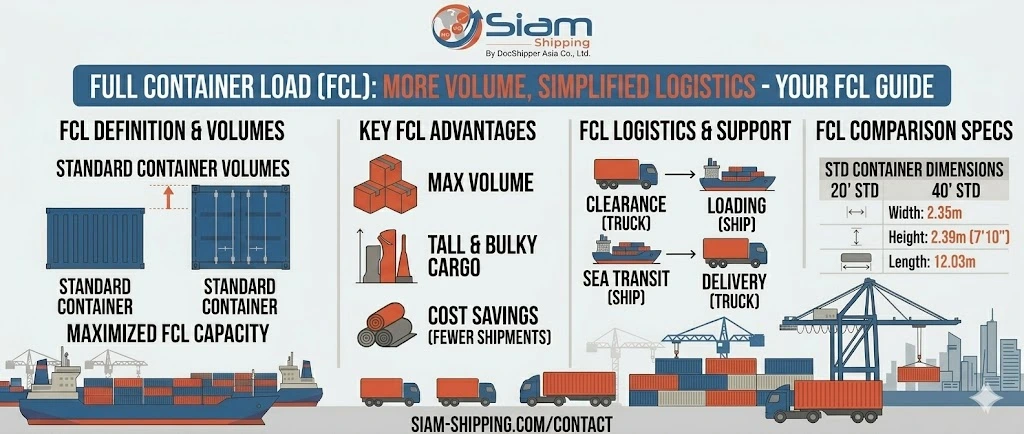
Standard 20ft and 40ft FCL container dimensions and capacity
We once watched a shipper book a 40ft for dense goods, then hit payload limits and had to leave cartons behind.
They paid for a second shipment anyway, the classic avoidable mistake in fcl vs lcl planning.
For FCL container selection, you care about inner dimensions, door opening, and max gross weight, not just “20ft vs 40ft”.
Use this table as a practical baseline when you do load planning and palletization.
| Equipment | Best for | Operational watch-outs |
| 20ft | Heavy, dense fcl cargo | Weight distribution, axle limits on trucking, fewer pallets |
| 40ft | General cargo, larger volumes | Space can tempt poor bracing, more movement risk if under-filled |
| 40ft High Cube | Bulky, light cartons | Cube improves, but gross limits still apply, confirm warehouse dock height |
If you want broader context about the container in Thailand market and availability patterns, see container in Thailand.
Specialized container options (reefer, open-top, flat-rack)
Direct tip, if your product needs temperature control or doesn’t fit standard doors, decide the equipment before you negotiate the purchase order.
Otherwise, your supplier will quote EXW with packaging that can’t be loaded safely into the right unit.
In fcl shipping, specialized equipment changes booking lead time, freight rate, and sometimes port acceptance rules.
Here are the common choices and what they imply.
- Reefer, temperature-controlled, requires pre-trip inspection and power availability at ports.
- Open-top, top loading for tall cargo, needs proper tarping and weather protection.
- Flat-rack, out-of-gauge cargo, demands lashing expertise and often special carrier approval.
Looking for a Reliable Shipping & Sourcing Partner?


DocShipper Platform
One platform. Your entire supply chain
Sourcing, freight, customs & documents, all centralised, all visible, 24/7.
How to select the right FCL container for your goods
Bold statement, equipment selection is quality control.
Pick the wrong FCL container, and you’ll “discover” the problem only after the container is already gated in.
To choose correctly, you need to match product constraints to logistics constraints, weight, fragility, moisture sensitivity, and unloading reality.
Use this checklist before booking, it prevents 80% of avoidable containerization mistakes.
- Confirm cargo specs, CBM, gross weight, dimensions, stackability, and any tilt limits.
- Validate packaging, carton strength, pallets, corner boards, and internal cushioning.
- Decide loading method, floor load vs palletized, and whether you need dunnage or airbags.
- Plan unloading, forklift access, dock height, and whether you can de-stuff fast enough for free time.
- Match equipment, standard vs HC vs reefer vs open-top, based on constraints not habits.
Avoiding costly mistakes with FCL containers
Working with an FCL container looks simple on paper, but in real operations, small miscalculations can turn into expensive disruptions. You’ve probably seen shipments where freight was fine, yet margins disappeared because of preventable errors.
When we manage full container load projects at DocShipper, most losses don’t come from the ocean freight itself. They come from decisions made before the container is even booked.
Siam Shipping Alert
Audit container size, weight, documents, and stuffing plans to prevent avoidable disruptions.
Run a pre-shipment risk check before your container moves.
Choosing the wrong container size, type, or weight configuration
We once handled an FCL container shipment from Shenzhen where the supplier insisted a 20ft was “more than enough.” On loading day, the cargo exceeded payload limits, and the container had to be switched to a 40ft at the last minute, with new trucking and port fees.
When you choose a container for full container load shipping, you must validate three elements together: volume, weight, and cargo nature.
Here is what you should verify before confirming your FCL container:
- Total cubic meters versus internal container capacity
- Gross cargo weight versus maximum payload
- Port and road weight restrictions
- Need for specialized units such as reefer or open-top
- Stackability and pallet configuration
For reference, the International Maritime Organization enforces SOLAS VGM rules, meaning you must declare the verified gross mass before loading. If you underestimate weight, your container simply won’t board.
In practice, you should always simulate container loading using packing software or a detailed load plan. Guessing is where mistakes begin.
Miscalculating total landed cost and FCL/LCL break-even
Ocean freight is only one line on your invoice.
When comparing an FCL container to LCL, you need to calculate the full landed cost, not just the freight rate per cubic meter.
You should break down your calculation like this:
- Origin charges, including THC and documentation
- Ocean freight
- Destination port charges
- Customs clearance and duties
- Inland transport at destination
- Insurance
Many shippers assume LCL is cheaper until around 15 cubic meters. In reality, the break-even often sits between 12 and 18 CBM depending on trade lane and local charges. The World Bank logistics performance indicators consistently show how destination handling fees impact final costs.
We’ve seen clients move 14 CBM as LCL at a higher total cost than a 20ft FCL container, simply because of multiple consolidation and deconsolidation fees. You’ll only see the difference once you calculate everything side by side.
Use this simplified comparison as a starting framework:
| Cost Component | FCL Container | LCL Shipment |
| Ocean Freight | Flat rate per container | Rate per CBM |
| Handling | Single handling | Multiple handling points |
| Destination Fees | Fixed per container | Per CBM, often higher cumulatively |
| Break-even | Better at mid to high volume | Better at low volume |
Documentation and customs errors that delay FCL cargo
Have you ever had an FCL container stuck at port because one HS code was wrong?
Customs authorities cross-check commercial invoices, packing lists, and bills of lading. A mismatch between declared goods and HS classification can trigger inspection, storage fees, and demurrage.
This is the moment most importers get stuck.
Before your FCL shipment departs, review this checklist carefully:
- Commercial invoice with accurate HS codes
- Packing list matching actual pallet count and weight
- Bill of lading consistent with Incoterm used
- Certificates if required, such as CE, FDA, or phytosanitary
- Correct consignee and notify party details
From experience, you should never rely blindly on supplier-prepared documents. Always cross-check quantities and values against your purchase order before the container sails.
Overlooking stuffing, packing, and weight-limit constraints
Container stuffing is where theory meets reality.
If your FCL container is poorly packed, shifting cargo can damage goods even if the sea voyage is smooth. We’ve seen electronics pallets collapse because no proper lashing was used inside a 40ft unit.
You should define a stuffing plan that includes:
- Proper palletization and shrink wrapping
- Blocking and bracing to prevent movement
- Weight distribution across the floor
- Moisture protection, especially for long transits
Remember that exceeding axle weight limits during inland transport can lead to fines or forced cargo rework. A balanced container is not just about sea safety, it’s about road compliance too.
Incoterms 2020 and their impact on full container load shipping
Your FCL container strategy makes no sense without understanding Incoterms 2020. These rules define who pays, who arranges freight, and where risk transfers.
The International Chamber of Commerce publishes and updates Incoterms, and ignoring their details is one of the fastest ways to lose control over your shipment.
Siam Shipping Info
Align your FCL container strategy with the right term to avoid hidden exposure.
Review your Incoterm setup before confirming the PO.
The most relevant Incoterms for FCL (FOB, CIF, CFR, EXW, DAP)
Last year, we supported a buyer who accepted EXW for an FCL container from inland China. They didn’t realize they would handle export clearance and local trucking, which quickly became complicated.
For full container load shipping, these Incoterms are the most common:
- EXW, you handle almost everything from factory gate
- FOB, supplier clears export, you control main freight
- CFR, supplier pays ocean freight, risk transfers at loading
- CIF, similar to CFR but includes insurance
- DAP, supplier delivers to your premises, excluding import duties
In FCL container shipping, FOB is often preferred because you control the ocean leg while the supplier manages export formalities.
How Incoterms shift freight, insurance, and customs costs
Incoterms do not change ownership, they change risk and cost allocation.
With CIF, your supplier books the FCL container and insurance, but you have limited visibility on freight rates. With FOB, you negotiate directly with your forwarder and often secure better terms.
Here is a simplified comparison:
| Incoterm | Who books FCL container | Who pays main freight | Risk transfers |
| EXW | Buyer | Buyer | Factory |
| FOB | Buyer | Buyer | On board vessel |
| CIF | Seller | Seller | On board vessel |
| DAP | Seller | Seller | Destination place |
You should align the Incoterm with your level of logistics expertise and bargaining power.
Matching Incoterms to your control, risk, and budget preferences
Are you trying to maximize control over your FCL container, or minimize operational workload?
If you’re experienced and ship regularly, FOB or even EXW may reduce costs long term. If you’re new or testing a supplier, DAP or CIF can simplify coordination.
Ask yourself these three questions before confirming the Incoterm:
- Do you have a reliable freight forwarder on this trade lane?
- Are you comfortable managing export procedures?
- Can you monitor insurance coverage details yourself?
Choosing the wrong Incoterm won’t always show immediate consequences, but you’ll feel it when delays or claims occur.
Practical roadmap to manage an FCL shipment step by step
Managing an FCL container from purchase order to delivery requires coordination across suppliers, carriers, customs brokers, and truckers. If one link fails, your schedule slips.
Let us walk you through a clear operational roadmap you can follow for full container load shipping.
Essential FCL documents and compliance checklist
Before your FCL container even reaches the port, paperwork must be perfectly aligned.
You should prepare and verify the following compliance checklist:
- Signed commercial invoice
- Detailed packing list
- Bill of lading instructions
- Verified Gross Mass declaration
- Import license if required
- Insurance certificate
One missing detail can trigger storage and demurrage charges that escalate quickly. You’ll avoid most delays simply by validating documents line by line before departure.
Booking, loading, sealing, and container tracking
Here’s a practical sequence we follow when coordinating an FCL container shipment.
Step 1: Confirm cargo readiness and volume. Step 2: Book container space with carrier. Step 3: Arrange trucking to factory. Step 4: Supervise stuffing and apply seal. Step 5: Submit VGM and export documents. Step 6: Track vessel departure and ETA.
During loading, you should always record the container number and seal number. If a discrepancy appears at destination, those details become critical evidence.
Common operational challenges and how to solve them
Delays happen, even in well-planned FCL container shipments.
You might face rolled cargo due to overbooked vessels, customs inspections, or last-minute supplier delays.
Here are frequent issues and practical responses:
- Rolled container, secure priority booking and confirm cut-off times earlier
- Customs inspection, ensure documents and HS codes are pre-validated
- Port congestion, consider alternative ports or earlier sailings
- Supplier delay, build buffer time into production schedule
From experience, the key is proactive communication. If you anticipate a problem before the vessel sails, you still have options. Once the container misses the ship, your flexibility shrinks fast.
Siam Shipping Advice
We provide a step-by-step operational roadmap covering booking, stuffing, documents, and tracking.
Standardize your container process to keep schedules predictable.
Conclusion
An FCL container can dramatically reduce handling, improve cargo security, and optimize cost when volumes justify it. But the advantage only materializes if you manage the details correctly.
You now understand how full container load shipping compares to LCL, how Incoterms shape responsibility, and how to avoid operational traps.
Here are the key takeaways you should remember:
- Validate volume and weight before booking your container
- Calculate total landed cost, not just ocean freight
- Align Incoterms with your control and risk strategy
- Prepare documents meticulously before departure
- Supervise stuffing and sealing to protect cargo integrity
If you apply these principles, your next FCL container shipment won’t just move. It will move predictably and profitably.
FAQ | FCL container: how full container load shipping cuts costs and risk
Moisture is one of the most underestimated risks in FCL. To reduce it significantly, you can:
- **Audit your packaging**
- Use double‑wall cartons for hygroscopic goods (textiles, paper, wood, leather).
- Avoid bare metal surfaces; use VCI bags or anti‑rust paper for metal parts.
- **Control humidity inside the container**
- Add desiccant bags or blankets (calculate quantity based on CBM and route length).
- Use pallets instead of floor‑loading directly on the container floor.
- **Prepare for condensation (“container rain”)**
- Avoid loading goods while they’re still warm or damp from production.
- Leave a small air gap under the roof using dunnage or top‑decking for the upper layer.
- **Specify requirements to your supplier**
- Include moisture‑control instructions in the purchase order.
- Ask for photos of loading showing desiccants, pallets, and wrapping before the door closes.
A seal mismatch is a red flag, but there is a clear way to handle it:
- **Before opening the container**
- Take clear photos of the doors, visible seal, and seal number.
- Compare with the bill of lading, packing list, and pre‑loading photos you (should) received.
- **If the seal is different or missing**
- Note the discrepancy on the delivery receipt (CMR / POD) before signing.
- Inform your freight forwarder and insurer immediately in writing.
- **During de‑stuffing**
- Inspect and count cargo while unloading.
- Record any damage or shortage with time‑stamped photos and a written survey report.
- **After inspection**
- File a reserve with the carrier or forwarder the same day.
- If insured, follow your cargo insurance claim procedure using all evidence collected.
Most “surprise” bills come from poor planning around free time. To avoid them:
- **Clarify free time in writing before booking**
- Ask specifically: days of free demurrage (at terminal) and detention (with container out of port).
- Confirm whether weekends and holidays count.
- **Align delivery with your warehouse capacity**
- Schedule delivery when you have staff and dock space ready to unload immediately.
- For labor‑intensive unloading, consider live‑unload versus drop‑and‑pick options.
- **Prepare customs and paperwork early**
- Share documents with your broker before vessel arrival so clearance can start as soon as possible.
- **Monitor ETA and terminal deadlines**
- Track changes in vessel schedule and ask your forwarder when free time starts ticking.
- If delays are unavoidable, negotiate extra free days before the container lands; it’s cheaper than last‑minute charges.
You can still keep control remotely by setting a clear verification routine:
- **Define a loading protocol in your PO or contract**
- Required pallet type and orientation.
- Blocking and bracing method (dunnage, airbags, straps).
- Maximum stack height and weight per pallet.
- **Request visual proof for every shipment**
- Photos of: empty container interior, first layer, mid‑load, full load, doors closed, seal applied.
- Short video walking through the container before door closure for high‑value cargo.
- **Use third‑party inspection if risk is high**
- Book a loading supervision service (QC or surveyor) for first shipments or critical orders.
- **Create a simple acceptance checklist**
- Reject or rework loading if pallets are crushed, gaps are not braced, or cargo leans visibly.
- Keep this checklist shared with supplier, forwarder, and inspector so expectations are consistent.
You can’t stop random inspections, but you can reduce impact when they happen:
- **Before shipment**
- Make sure HS codes, values, and descriptions are consistent across all documents.
- Avoid vague descriptions like “samples” or “goods”; use precise product names.
- **When notified of inspection**
- Ask your forwarder for a breakdown of expected costs (inspection, handling, storage).
- Provide any additional certificates or documents customs may request immediately.
- **After inspection**
- Check the warehouse and inspection invoices carefully for duplicate or unjustified charges.
- If inspection delays cause contractual issues with your customer, document the event as force majeure where applicable.
- **For future shipments**
- If you get flagged repeatedly, review HS classification and supplier profiles; frequent issues can indicate a compliance problem rather than pure randomness.
You don’t need to change your whole logistics setup; you can adapt the last mile:
- **Discuss delivery constraints upfront**
- Tell your forwarder about narrow streets, low bridges, or limited yard space.
- Confirm whether a 20ft or 40ft chassis can access your facility safely.
- **Consider alternative unloading options**
- Use a nearby off‑dock warehouse or cross‑dock for devanning, then receive by smaller trucks.
- Ask for a “drop trailer” if you need more hours to unload and local rules allow it.
- **Plan labor and equipment**
- Ensure you have the right forklifts, pallet jacks, and ramps if unloading from ground level.
- Pre‑assign pallet locations so stock can move directly from container to racks.
- **Optimize future FCL planning**
- If access is permanently constrained, favor 20ft containers or split shipments by lane to match your site’s real capacity.
Need Help with
Logistics or Sourcing ?
First, we secure the right products from the right suppliers at the right price by managing the sourcing process from start to finish. Then, we simplify your shipping experience - from pickup to final delivery - ensuring any product, anywhere, is delivered at highly competitive prices.


Fill the Form
Prefer email? Send us your inquiry, and we’ll get back to you as soon as possible.
Contact Us