Freight shipping between Thailand and Indonesia : Rates -Transit time – Duties & taxes
Shipping between Thailand and Indonesia looks simple on a map, but you are dealing with an archipelago of more than 17,000 islands, different port infrastructures, and customs procedures that can quickly impact your cost and timeline if you misjudge them. You will notice fast that choosing between Laem Chabang, Bangkok Port, or a regional departure point in Thailand, and targeting Tanjung Priok in Jakarta or another Indonesian hub, changes everything from transit time to inland delivery strategy. If you are exporting electronics, vehicles, seafood, or agricultural products, you need clarity on rates, documentation, and duties before you lock in production or sales terms. In this Destination guide, we will cover the real decision points for shipping between Thailand and Indonesia, including transport modes, transit logic, customs clearance, and the duties and taxes you need to anticipate.
What is the most suitable method of transport between Thailand and Europe?
If you are moving full containers or heavy cargo between Laem Chabang and Tanjung Priok, you will usually choose sea freight for lower cost per cubic meter and better suitability for large volumes. If you are shipping urgent, high-value, or lightweight goods, air freight via Suvarnabhumi to Jakarta makes sense because you gain speed and tighter delivery control.
You will not use rail on this route, and road freight is not realistic due to geography, so your real decision is speed versus cost. The first thing we always tell you is to check cargo profile, lead time, and current capacity, and you can always contact our team because we track real-time space and rate conditions and will help you choose the right option before we go deeper into each mode below.
Docshipper Note:
Besoin d'aide pour votre expédition ? N'hésitez pas à nous contacter, même pour une simple question. Choisissez l'option qui vous convient.
Chat en direct avec un expert Discutez-nous sur WhatsApp Remplissez le formulaire
Sea freight from Thailand to Indonesia
If you are planning sea freight shipping between Thailand and Indonesia, the first thing you need to decide is simple. Does sea transport match your timeline and cargo profile?
On this maritime transport Southeast Asia corridor, ocean freight makes sense when you ship more than a few cubic meters, when cost control matters more than speed, and when your supply chain can tolerate 1 to 3 weeks of transit depending on the ports. If you are moving urgent samples or high value electronics with tight launch dates, air freight is usually safer. For regular replenishment, machinery, consumer goods, food products or industrial inputs, ocean freight Thailand to Indonesia is often the most balanced option.
You will notice quickly that this route is operationally active but not always direct. Some services are direct between major hubs, others use feeder vessels or transshipment via Singapore or Port Klang. That detail alone can change your sea transit time Thailand to Indonesia by several days.
The most common mistakes we see are practical ones. You choose the wrong Incoterms for shipping between Thailand and Indonesia and lose control of destination charges. You assume every shipment is direct. Or you focus only on the ocean rate and ignore origin charges and destination charges. Sea freight works well here, but only if you look at the full picture from day one.
Which incoterms should you use?
Your Incoterm will define who controls the shipment, who pays what, and who carries the risk between the port of loading and port of discharge. On this route, the debate usually comes down to FOB vs CIF Thailand Indonesia shipment, and sometimes EXW vs DDP for cross-border sea freight.
If you buy under FOB in Thailand, you control the freight forwarder Thailand Indonesia, the sailing schedule and vessel frequency, and the insurance. In practice, that gives you visibility over the Bill of Lading B/L or Sea Waybill and prevents unpleasant surprises at destination. Most experienced importers prefer FOB because they keep control of the ocean freight quotation process.
If you buy under CIF, your supplier chooses the carrier and adds freight into their invoice. It looks convenient, but you often lose transparency on freight cost breakdown sea shipment. You may also face higher destination charges in Indonesia that you did not anticipate.
EXW can work if you have a strong agent in Thailand, but you then take responsibility from the factory gate. DDP looks simple on paper, yet you depend entirely on your supplier for customs compliance in Indonesia. If documents are wrong, you still suffer delays.
From experience, if you want control and predictable landed cost, FOB from Thailand and local customs handling in Indonesia is often the safest structure.
Main ports to know in Thailand and Indonesia
- Laem Chabang, Thailand. The main deep sea gateway for container shipping Thailand Indonesia route. You get better carrier options and more frequent departures.
- Bangkok Port, Thailand. Closer to the city and some factories, but draft and vessel size limitations mean fewer direct services.
- Map Ta Phut, Thailand. Relevant if you move petrochemical or industrial cargo.
- Tanjung Priok, Jakarta. Indonesia’s largest port and the primary hub for international sea cargo Thailand to Indonesia.
- Tanjung Perak, Surabaya. Key for East Java and eastern Indonesia distribution.
- Belawan, Medan. Strategic near the Malacca Strait, useful for Sumatra bound cargo.
Your choice affects inland trucking cost, container availability, and whether you rely on direct service vs transshipment via regional hub. If your supplier is near Bangkok but you ship from Laem Chabang, you add inland cost in Thailand but gain more vessel frequency. It is always a trade-off.
Transit times: How long does it take to ship from Thailand to Indonesia?
| Route | Service Type | Estimated Transit Time |
|---|---|---|
| Laem Chabang to Tanjung Priok | Direct or feeder | 5 to 8 days |
| Bangkok to Tanjung Priok | Feeder via Laem Chabang or hub | 7 to 12 days |
| Laem Chabang to Tanjung Perak | Direct or transshipment | 7 to 14 days |
| Laem Chabang to Belawan | Mostly transshipment | 12 to 18 days |
In most standard cases, you should plan around one week between main hubs and up to two to three weeks for secondary ports or transshipment services.
You need to read transit time correctly. The number given by the carrier is port to port sailing time, not door to door sea freight. It does not include container stuffing and devanning, customs clearance, or possible congestion. During peak season, carriers may roll containers to the next vessel. If your shipment connects through a regional hub, a missed feeder can add several days. Always build buffer into your planning.
Shipping rates: how much does a sea freight shipment cost from Thailand to Indonesia?
| Mode | Equipment / Basis | Estimated Ocean Freight |
|---|---|---|
| LCL consolidation service Southeast Asia | Per CBM | USD 40 to 90 per CBM |
| FCL | 20ft dry container | USD 800 to 1,500 |
| FCL | 40ft dry container | USD 1,200 to 2,200 |
For most standard shipments, sea freight rates Thailand to Indonesia remain relatively competitive compared to long haul routes. Your final cost depends on container type, whether you use Full Container Load FCL Thailand Indonesia or Less than Container Load LCL Thailand Indonesia, seasonality, and carrier capacity. Remember that ocean freight is only one part of your total invoice. Local handling, documentation, customs and delivery often represent a significant share of your total landed cost.
How to estimate your sea freight cost before requesting a quote
If you want a realistic budget, you need four elements before asking for an ocean freight quotation process. Your cargo volume in cubic meters CBM, total weight, chosen Incoterm, and exact origin and destination ports.
For LCL, carriers charge on the higher value between weight and volume, based on the rule 1 CBM equals 1 metric ton. If you ship 8 CBM weighing 5 tons, you pay on 8 revenue tons. If you ship 8 CBM weighing 12 tons, you pay on 12 revenue tons.
Example. You ship 10 CBM from Laem Chabang to Jakarta at USD 60 per CBM. Your base ocean freight is 10 x 60, so USD 600. Then you add origin charges and destination charges, terminal handling charges THC, documentation, and customs clearance. This is where many importers underestimate the real budget.
A cheap ocean rate can hide high local fees. Always ask for a full freight cost breakdown sea shipment, not only the port to port number. If you send us your packing list and Incoterm, we can provide a free, route specific quotation within 24 hours.
Surcharges and hidden cost drivers to watch for
First, destination charges in Indonesia. You will pay THC, documentation, delivery order fees and sometimes container cleaning or scanning fees. If you bought CIF, you might discover these only after arrival.
Second, time related costs. demurrage and detention charges apply if you exceed the free time for container pickup or return. Storage at port can accumulate quickly if customs documents are incomplete.
Third, operational surcharges. Carriers may apply bunker adjustment factor BAF, peak season surcharge PSS, or congestion surcharges when ports are busy. These are market driven and can change monthly. You cannot control them, but you can anticipate them in your budget.
Step-by-step: how a sea freight shipment usually works on this route
When you book sea freight between Thailand and Indonesia, you are setting in motion a chain of coordinated steps between factory, port, carrier and customs. On this route, the surprises usually come from documentation timing and feeder connections. If you know what happens behind the scenes, you avoid most delays.
- We receive your packing list, commercial invoice and confirm volume, weight and Incoterm.
- We book space with the carrier and issue the booking confirmation and shipping instructions.
- Your cargo is picked up or delivered to the warehouse for LCL consolidation or container stuffing.
- Export customs clearance is completed in Thailand before loading.
- The container is loaded on the vessel at the port of loading and sails to Indonesia, sometimes via a regional hub.
- We issue the Bill of Lading B/L or Sea Waybill and share copies for pre clearance.
- Upon arrival at the port of discharge, import customs clearance is completed in Indonesia.
- The container is released, delivered to your warehouse, and empty equipment is returned within free time.
Should I choose FCL or LCL when shipping between Thailand and Indonesia?
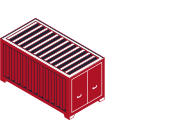
Full Container Load
For this type of shipment, one person will use the entire capacity of the container. This minimizes the risk of damage to the goods.
This method would still be advantageous even if you did not fill the container completely. However, it is the most cost-effective for shipments over 15 m³.
Less than Container Load
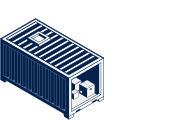
This type of shipment, allows several people, who do not have enough goods to fill an entire container, to use the same container. The goods of various people are thus combined to fill an entire container.
This is the most cost-effective choice for small shipments of less than 15 m³.
Advantages of LCL
- The advantageous rate for small volumes.
- Allows for fewer but more frequent shipments, reducing storage expenses.
Disadvantages of LCL
- Often longer delivery times due to loading and unloading of goods from all customers.
- Increased risk of loss and damage from multiple loading and unloading.
Advantages of FCL
- The advantageous rate for large shipments of goods.
- Reduced risk of damage or loss of goods because containers are not opened during transit.
Disadvantages of FCL
A minimum volume of at least 15 m³ to be profitable.
Special sea freight solutions
Reefer container
The reefer container is used to transport chemicals or perishable products at controlled temperatures. It is equipped with a cooling system.
Roro
RORO (Roll On/Roll Off) vessels are used to transport vehicles such as cars, trucks, vans, semi-trailers, and rail cars. They are considered the safest and most efficient vessels for heavy or special cargo.
Bulk
Bulk carriers are used to transport solid bulk materials such as minerals, grains, coal, or liquids such as crude oil, gas, and chemicals. These vessels are larger and easier to load and unload.
OOG
OOG cargo is cargo that exceeds the dimensions of a standard container. Two types of containers exist for these goods:
- Open Top Container: they have no roof, which allows loading cargo that exceeds the height of the containers.
- Flat Rack Container: these are flat containers without side walls or roofs, used for goods that cannot be loaded in standard containers.
Air freight from Thailand to Indonesia
If you are planning air freight shipping between Thailand and Indonesia, you usually choose air because time matters. You use it for urgent replenishment, product launches, spare parts, e commerce air shipping Thailand Indonesia, or perishable goods air shipment. But you should not assume it is always “3 days door to door” or automatically too expensive. On this Southeast Asia lane, speed depends on flight schedule and cargo capacity, cargo cut off time, and how early your supplier is really ready.
You will also notice fast that air freight is precise and unforgiving. If you ignore chargeable weight calculation, weak export packing for air freight, or incomplete documents like the Air Waybill AWB, your shipment can be blocked at security screening air cargo or miss the flight. The most common costly mistakes we see are underestimating volumetric weight vs gross weight, confusing airport to airport vs door to door air freight, and booking space with airline too late during peak season.
Air cargo vs express: how should you ship on this route?
There are two types of air freight:
- Classic air freight: This option uses the space available on board commercial flights of airlines such as Garuda Indonesia, Thai Airways, China Southern Airlines, or even Lion Air and exploits the empty spaces.
- Express airfreight: This option uses aircraft dedicated solely to airfreight. This solution is offered by courier companies, such as FedEx, DHL, UPS, or even TNT, which offers door-to-door solutions.
Should you choose air cargo from Thailand to Indonesia?
You should usually choose air cargo Thailand to Indonesia when your shipment is above roughly 1 CBM or 100 to 150 kg, or when you ship regularly B2B. This is the typical setup for standard air freight service, air freight consolidation service, or even back to back air shipment when you need direct space. It works well if you manage suppliers, have predictable volumes, or move general cargo vs special cargo by air such as temperature controlled air freight or dangerous goods IATA air freight.
Before requesting an air cargo quotation process, you need to have dimensions, gross weight, number of packages, Incoterm, ready date, origin and destination airport, and product details. If you ship lithium batteries air cargo handling or other regulated goods, you must confirm compliance early. The common trap is thinking airport to airport automatically includes delivery, customs bonded warehouse airport storage, or destination handling. It does not. Another frequent issue is missing the cargo cut off time, which pushes your freight to the next flight.
Should you choose express air freight from Thailand to Indonesia?
You should consider express air freight Thailand Indonesia if you ship small parcels, urgent samples, spare parts, or same day air cargo Southeast Asia where speed and simplicity matter more than cost control. Express makes sense if you do not have a logistics team and want a single door to door solution with simplified paperwork.
The trade off is control. You may face reweigh or remeasure charges if you underestimate volumetric weight vs gross weight, and fuel or security add ons can increase your final invoice. Many shippers assume everything is included, then discover remote area fees or duties billed separately. Express is good if your cargo is compact, compliant, and time critical. It becomes risky if your packaging is weak, your dimensions are inaccurate, or your Incoterm responsibilities are unclear.
Main airports to know in Thailand and Indonesia
- Suvarnabhumi Airport, Bangkok: Thailand main international cargo hub with strong regional connectivity. If your supplier is in central Thailand, this is usually the most efficient option in terms of flight frequency and cargo capacity.
- Don Mueang Airport, Bangkok: Often used by low cost and regional carriers. You may find competitive options here, but you should verify handling capabilities for special cargo.
- Chiang Mai Airport: Useful for northern Thailand factories. You reduce inland trucking time, but you may have fewer direct flights to Indonesia.
- Soekarno-Hatta International Airport, Jakarta: Indonesia primary gateway for international air cargo. Most international air shipping Southeast Asia flows into Jakarta, which gives you better frequency but can mean congestion during peak periods.
- Ngurah Rai International Airport, Bali: Relevant if your final market is Bali. Good connectivity, but you should check available cargo capacity for larger shipments.
- Sultan Hasanuddin Airport, Makassar: Strategic for eastern Indonesia distribution. It can reduce domestic repositioning, but you must confirm available international links.
Transit times: how long does air freight take from Thailand to Indonesia?
On this route, air transit time Thailand to Indonesia is usually short because of the geographic proximity. Direct flights between Bangkok and Jakarta can move cargo in about 1 to 2 days airport to airport under normal conditions. For secondary airports or transshipments, you should expect around 2 to 4 days, depending on flight schedule and cargo capacity.
You should always verify four elements before promising a deadline to your client. First, the cargo cut off time and pre flight handling. Second, security screening air cargo or checks for sensitive goods. Third, airline capacity and seasonal congestion. Fourth, whether you book consolidation or direct space. Even on a short Southeast Asia lane, one missed document can easily add an extra day.
Shipping rates: how much does air freight cost from Thailand to Indonesia?
If you are asking how much does air freight cost Thailand to Indonesia, the honest answer is that it depends mainly on your chargeable weight. Airlines calculate on the higher value between gross weight and volumetric weight, using the IATA volumetric formula. This is why two shipments with the same kilos can have very different prices.
Your final air freight rates Thailand Indonesia will vary based on four key drivers. First, chargeable weight calculation. Second, dimensions, density, and packaging quality. Third, urgency, season, and available capacity. Fourth, airport choice and pre carriage or last mile delivery. On top of that, you may see air freight surcharge fuel and security applied by the airline. The first thing we always tell you is simple: measure accurately before requesting a quote.
Step-by-step: how an air shipment usually works on this route
If you have never handled a step by step air freight process Thailand Indonesia, it is more structured than it looks. Once you see the logic, it becomes predictable. The key is timing and document accuracy.
- You confirm cargo details, Incoterm, ready date, and choose between consolidation or direct booking space with airline.
- We request space from the airline based on forecasted chargeable weight and receive a booking confirmation.
- Your supplier prepares export packing for air freight and delivers the cargo to the airport or we arrange pickup.
- The cargo enters the terminal, goes through security screening air cargo, and may be palletization and ULD build up.
- The airline issues the Air Waybill AWB, with house AWB and master AWB if consolidation is used.
- The flight departs to Indonesia. At arrival, the cargo is transferred to the bonded area for customs clearance.
- After clearance and payment of duties and taxes if applicable, the cargo is released for delivery or collected airport to airport.
The moments where delays usually happen are incomplete documents, last minute changes in weight or dimensions, and missed cargo cut off time. This is also where extra storage or rebooking costs can appear.
What is the difference between volumetric and gross weight?
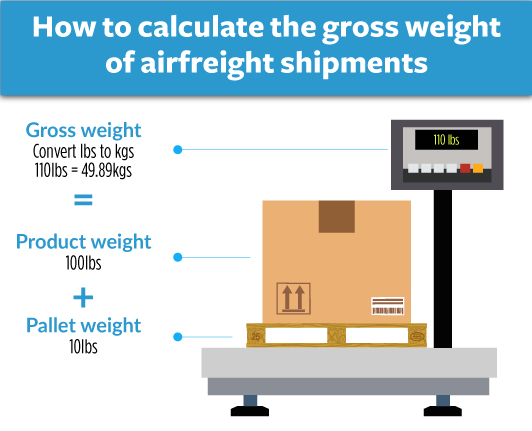
If you ship by air, you always pay based on chargeable weight. That means the airline compares your gross weight with your volumetric weight and charges the higher one. Understanding volumetric weight vs gross weight is essential if you want to control your budget.
- Gross weight: the real physical weight of your cargo on the scale.
- Volumetric weight: the weight calculated from the dimensions of your cargo.
- Chargeable weight: the higher value between gross and volumetric weight.
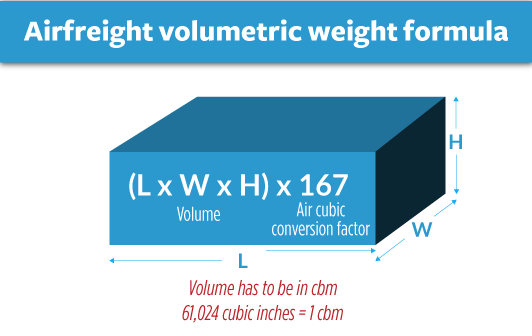
- IATA volumetric formula: the standard formula used to convert volume into weight for air freight.
How to calculate:
For air cargo, you usually use the divisor 6000 in cm. The formula is: (Length x Width x Height in cm) / 6000. For express, the divisor is often 5000. For example, if your box measures 60 x 50 x 40 cm, the volumetric weight in air cargo is 20 kg. If the gross weight is 15 kg, you will pay on 20 kg.
As a quick reference, Air cargo uses approximately 1 m³ = 167 kg, while express uses 1 m³ = 200 kg. The most common mistake is rounding down dimensions or forgetting pallets. A few extra centimeters can change your entire quotation.
| Suvarnabhumi | Don Mueang | Chiang Mai | |
|---|---|---|---|
| Soekarno-Hatta | 2 jours | 2 jours | 4 jours |
| Ngurah Rai | 4 heures | 3 heures | 3 heures |
| Soetta Sultan Hasanuddin (UPG) – Makassar | 2 jours | 2 jours | 2 jours |
*These transit times between Indonesia and Thailand are given as an indication.
How much does it cost to transport cargo by air from Indonesia to Thaïland ?
To know the price of your goods transported from Thailand to Indonesia by air freight, you must consult the tariffs of the airline companies. Their tariffs are presented by weight bands in decreasing prices.
The weight taken into account by the airlines will always be the one that is to their advantage, that is to say, the highest between the real weight and the volumetric weight.
How to calculate the volumetric weight of your shipment?
The volumetric weight is the volume occupied by a package, based on its dimensions and its gross weight. To know it, you must measure the dimensions of the package (length, width, and height), then convert them into cubic meters. Then use the formula below:
Volumetric weight = (length x width x height) / 5000
Road freight between Thailand and Indonesia
Overview – Road freight from Thaïland to Indonesia
Used to transport goods simply between different terminals, such as an office or a warehouse to or from an airport, port or railway station, road freight is a method that remains indispensable in the transportation field.
Advantages of Truck Transportation
Provides Door-to-Door Services
The first and foremost benefits of trucks transportation is that it provides door-to-door services to anyone who wishes to get the goods and services available at their doorstep. Trucking industries are much benefitted from these services. Local transportation companies help in providing day-to-day services.
Best Mode of Transportation
It is the best mode of transportation and is the cheapest of all. It is very good for short distances travels and hauls as it provides the best traveling experience. Not only that, but it is best suited for traveling within 700 km of distance.
Faster Delivery
Another major use of truck is that it is best suited for small cargo shipments and delivery as it will emerge out to be cheapest and best for shipments, and the distance will not matter at all.
Fastest for Short Transportation Services
It is considered to be the fastest for short transportation services as it will not take much time for short and very less distance hauls. So, it can be considered as best for this type of transportation.
Useful for Customers
The trucking business is very much useful for customers, and it provides services whenever they want, so these trucks can be used frequently for transporting goods and services.
Easy and Flexible
Trucking Services are very much easy and flexible, and they can go in every direction and wherever they want and wherever they want to go. The roads and streets are very much immune to these transportation services.
Disadvantages of Truck Transportation
Expensive
It is considered a little expensive for long-distance transportation of goods and services. This becomes a little expensive for the traveling expenses in the transit of goods and services.
High Cost
Truck transporting is very much of high cost for the commodities which are little low graded and are to be transported to the other city, as it will be of high cost for the driver of truck services.
How much does it cost to ship goods by truck?
The cost of shipping goods by truck between Thailand and Indonesia can vary depending on several factors. Here are some of the factors that can influence the cost of road transport:
- The distance between the two countries is a key factor affecting transport costs. The longer the distance, the higher the cost.
- The weight and volume of the goods to be shipped play a role in determining the cost of transport. Trucks have weight and capacity limits, which can influence rates.
- Certain types of goods may require special precautions or equipment for transport. This may entail additional costs.
- The route taken can also affect the cost of road transport. Some routes may be more direct and efficient, while others may be longer and involve additional costs.
- Additional charges may be added to cover customs clearance, administrative formalities, tolls, fuel costs, etc.
What are the main routes from Thaïland to Indonesia ?
Road freight offers a practical solution for transporting goods between the two countries. It can be used to transport a wide range of goods, from manufactured products to agricultural produce and bulk goods. Trucks and trailers are often used for this type of transport.
However, it is important to note that road freight between Indonesia and Thailand may be subject to specific customs formalities and regulations. It is essential to comply with the customs requirements and import/export procedures of both countries.
Rail freight from Thailand to Indonesia
Overview – Rail freight from Thaïland to Indonesia
The two countries are linked by the Trans-Asian Railway Network (TARN), a transcontinental rail network designed to promote trade and commerce between Asian countries. The network includes rail links between several countries in the region, including Indonesia and Thailand.
Rail freight offers an alternative to other modes of transport, such as sea or air, and can be used to transport bulk or containerized goods. It can be faster than sea freight and more economical than air freight for certain goods. However, specific details such as routes, tariffs and customs formalities need to be checked with rail operators and the relevant authorities in each country.
How much does it cost to ship goods by train?
The cost of shipping goods by rail between Thailand and Indonesia can vary depending on a number of factors. Here are some of the factors that can influence the cost of rail transport:
- The distance between the two countries is a key factor affecting the cost of rail transport. The longer the distance, the higher the cost.
- The weight and volume of the goods to be shipped play a role in determining the cost of transport. Trains have specific loading capacities, which can influence the rate.
- Certain types of goods may require special precautions or equipment for transport. This may entail additional costs.
- The route taken can also affect the cost of rail transport. Some routes may be more direct and efficient, while others may be longer and involve additional costs.
What are the advantages of rail freight between Thaïland and Indonesia?
There are several advantages of using rail freight to transport goods between the UK and Germany:
- Faster than sea freight: While sea freight is often the most cost-effective option for transporting goods over long distances, it can be quite slow. Rail freight is generally faster than sea freight, with transit times between the UK and Germany typically ranging from 2–4 days.
- Environmentally friendly: Rail freight is one of the most environmentally friendly modes of transportation, producing lower levels of greenhouse gas emissions per tonne-kilometer than road or air transport. This can be an important consideration for companies looking to reduce their carbon footprint and meet sustainability targets.
- Cost-effective for large volumes: While rail freight may not always be the cheapest option for transporting small volumes of goods, it can be very cost-effective for larger volumes. This is especially true for goods that are not time-sensitive and can be transported over longer distances.
- Reliable: Rail freight is generally quite reliable, with regular departure and arrival times and fewer delays compared to road or air transport. This can be important for companies that need to meet tight delivery deadlines or have just-in-time inventory requirements.
- Good connectivity: Rail freight between the UK and Germany is well-developed, with several established routes and regular services. This can make it easy for companies to transport goods between the two countries.
Overall, rail freight can be an attractive option for companies looking to transport large volumes of goods between the UK and Germany in a cost-effective, environmentally friendly, and reliable manner.
Door-to-door delivery between Thailand and Indonesia
If you don’t have time to devote to transportation, door-to-door delivery is for you. This method is simple, your goods will be picked up directly at your home, and then delivered to the desired destination. You will not need to take care of anything and your goods will be safe with professionals.
What are the advantages of door-to-door services?
- Quick delivery: As everything is completed in a 24-hour period, you can send it if your delivery time is during the day.
- Door-to-door delivery is always available, so your package will come even late at night or on a holiday.
- Convenience: Receiving the package at your location rather than having it delivered to you is better for you.
- Your cargo can be qualified for courier delivery if it is a manageable size.
What are the disadvantages of door-to-door services?
- High cost: The cost increases with the urgency of the cargo, as well as with the package’s size and weight, which also affect the cost.
Customs clearance in Indonesia for goods imported from Thailand
When you handle customs clearance in Indonesia for goods from Thailand, you are not just ticking a box. You are locking in your final landed cost, your release timing, and who carries the legal responsibility as Importer of Record. On this Thailand to Indonesia route, we coordinate with a licensed customs agent and manage the filing through the Indonesian electronic customs filing system so you do not discover issues at the last minute.
From experience, the most common customs clearance issues Thailand Indonesia importers face are wrong HS code classification for imported goods, weak country of origin declaration, and incomplete commercial invoice requirements. One mismatch and your shipment can be redirected to inspection, which means delays and storage. Below, you will see exactly how to calculate and control your duties and taxes step by step.
How to calculate duties & taxes when importing from Thailand to Indonesia?
To understand how to calculate import duties Thailand to Indonesia, you need three inputs: the correct HS code, the confirmed country of origin, and the customs value calculation method used by Indonesian Customs. Your supplier quote is rarely enough. The final assessed amount can differ because customs may adjust the CIF value for customs purposes or question the origin. If a quote looks cheap but ignores VAT or additional import taxes, you will pay the difference at clearance.
Step 0 – Quick checks before you calculate
- Importer of Record: confirm who is legally responsible in Indonesia and who holds the import license requirements Indonesia may demand.
- Incoterm: check who controls the import customs process Thailand to Indonesia and who pays duties.
- Low-value or simplified path: verify whether your shipment qualifies for simplified clearance or requires full customs declaration form Indonesia submission.
Step 1 – Identify the Country of Origin
You must clearly distinguish shipping country from production origin. Indonesia will assess duties and taxes on imports from Thailand based on the real manufacturing origin, not the port of loading. Your certificate of origin Thailand Indonesia trade documentation determines whether you can claim preferential origin vs non preferential origin treatment. If your country of origin declaration is inconsistent with your invoice or packing list details for customs, customs risk assessment can flag your file for inspection.
Step 2 – Find the HS Code of your product
Your HS code classification for imported goods drives the customs duty rate by HS code, possible restrictions, and even product compliance and standards Indonesia may require. The first thing we always tell people is to start with a structured harmonized system code lookup using the official Indonesian customs portal at Indonesian Customs, then cross-check with your supplier’s export declaration. If you are unsure, request a written opinion from your customs broker Indonesia before shipping.
If your HS code is wrong, you can face retroactive duty adjustments, penalties, or a post clearance audit customs review months later. Here’s an infographic showing you how to read an HS code.
Step 3 – Calculate the Customs Value
Indonesia generally applies transaction value as the primary customs valuation method. In practice, customs will look at your invoice price and adjust it to reach the CIF value for customs purposes. Depending on your Incoterm, freight and insurance may need to be added. Assists, packing costs, commissions, or royalties linked to the goods can also increase the taxable base.
For example, if your goods cost 20,000 USD EXW Thailand and you pay 2,000 USD for freight and insurance to Indonesia, your customs value may be based on 22,000 USD. That amount becomes the base for both customs duty and import VAT and other import taxes.
Step 4 – Figure out the applicable Import Tariff in Indonesia
The import tariff Indonesia is the percentage applied to your customs value according to your HS code.
You can determine it in three steps. First, open the official Indonesian customs tariff tool. Second, enter your full HS code. Third, read the customs duty rate by HS code displayed for your product.
- Check whether a preferential rate applies for Thailand origin.
- Confirm if additional measures such as anti-dumping duties are listed.
- Verify if your goods fall under restricted and prohibited goods Indonesia categories.
If your HS code shows a 10 percent duty rate and your customs value is 22,000 USD, your customs duty would be 2,200 USD before VAT. On this route, we always double-check the tariff output against the actual commercial invoice requirements to avoid mismatches during document compliance check.
Step 5 – Consider other Import Duties and Taxes in Indonesia
After customs duty, you calculate import VAT and other import taxes. VAT is usually applied on the customs value plus duty. If your customs value is 22,000 USD and duty is 2,200 USD, VAT will be calculated on 24,200 USD, not only on the goods value.
Depending on your product, you may also face luxury tax or sector-specific charges. If your product requires special permits, import license requirements Indonesia and product compliance and standards Indonesia checks can delay release.
- Confirm VAT registration status of the Importer of Record.
- Review whether temporary import procedure or bonded warehouse Indonesia schemes are more cost-efficient.
- Assess if a duty drawback process could apply for re-export scenarios.
Step 6 – Calculate the Customs Duties
Use this logic. Duty = customs value × duty rate. VAT = tax base × VAT rate, where tax base usually equals customs value plus duty.
With a 22,000 USD customs value and a 10 percent duty rate, duty equals 2,200 USD. If VAT applies on 24,200 USD, you multiply that base by the applicable VAT rate to obtain the VAT amount.
You normally pay duties before customs release and cargo delivery order issuance. If payment is delayed or documents are inconsistent, your shipment can be held for customs inspection process, generating storage and demurrage costs.
Step-by-step: how customs clearance usually works on this route
When you organize step by step customs clearance Thailand to Indonesia, the sequence matters. The process differs depending on the port of entry, the Incoterm, and whether you ship by sea or air. We coordinate closely with your licensed customs agent Thailand Indonesia route contact to reduce risk and align documents before arrival.
- You prepare commercial invoice requirements, packing list details for customs, bill of lading or airway bill, and certificate of origin.
- We review documents for consistency and confirm HS code and customs valuation methods before cargo arrival.
- We submit the customs declaration form Indonesia through the electronic customs filing system, often using pre arrival customs clearance when available.
- Customs performs document compliance check and automated customs risk assessment and green channel allocation or inspection channel.
- If selected for inspection, the customs inspection process can include physical checks or value verification, this is a key moment where errors increase time and cost.
- Once duties and taxes are confirmed and paid, customs release and cargo delivery order are issued.
- Cargo exits the port or airport and moves to your warehouse or to a bonded warehouse Indonesia facility if planned.
- After clearance, you should keep records in case of post clearance audit customs review.
The customs services
On this Thailand to Indonesia lane, you can rely on us to coordinate with your customs broker Indonesia, validate HS code classification, manage electronic filing, and monitor how long does customs clearance take Indonesia in real conditions at your specific port of entry. You stay in control of your costs, and you avoid the usual surprises that slow down first-time importers.
Indonesian Customs
Official name: Direktorat Jenderal Bea dan Cukai
Official website: Indonesian Customs

Required documents for customs clearance in Indonesia
When you ship from Thailand to Indonesia, you will notice that customs issues rarely come from the border itself. They usually come from inconsistent paperwork. Your documents must match each other exactly, same shipper and consignee, same values, same product descriptions, same Incoterm. If one line differs, you can expect questions. The first thing we always tell you is simple: align everything before the vessel arrives.
Commercial Invoice
This is the document where you declare what you sold, to whom, and at what price.
Indonesian customs use it to assess customs value, duties, and taxes, and to verify that your HS code and declared value make sense for the product.
Example: 1,000 plastic household containers, HS code 3924, FOB Laem Chabang, unit price 1.20 USD, total 1,200 USD, sold to your Indonesian importer in Jakarta.
Common mistake: Declaring a value that does not match the sales contract or payment proof, which almost always triggers a valuation check.
Bill of Lading or Air Waybill
This is the transport document issued by the carrier confirming that your cargo has been accepted for shipment.
Customs use it to verify shipment details such as port of loading in Thailand, port of discharge in Indonesia, consignee name, and number of packages.
Example: Ocean Bill of Lading showing Laem Chabang to Tanjung Priok, 1 x 20’ container, consignee registered under the Indonesian importer’s legal entity.
Common mistake: Using a consignee name that differs slightly from the importer’s registered company name in Indonesia.
Packing List
This document breaks down exactly what is inside each package or container.
Customs and your broker rely on it to cross-check quantities, weights, and packaging details during inspections.
Example: 100 cartons, each containing 10 units, gross weight 850 kg, net weight 800 kg, with carton dimensions clearly stated.
Common mistake: Providing only total weight without carton-level details, which can slow down physical inspections.
Certificate of Origin (Form D under ASEAN)
This document certifies that your goods originate in Thailand.
If your products qualify under the ASEAN Trade in Goods Agreement, you can claim preferential or reduced import duty in Indonesia, provided the rules of origin are met.
Example: Thai-manufactured machinery accompanied by a valid Form D allowing your Indonesian importer to apply the ASEAN preferential tariff rate.
Common mistake: Requesting the certificate too late or shipping goods that do not meet ASEAN origin criteria.
Import License and Product-Specific Approvals
This refers to any prior authorization required before your goods enter Indonesia.
Depending on your product, your Indonesian importer may need sectoral approvals, for example for food, cosmetics, electronics, or certain industrial goods.
Example: Processed food products requiring prior registration with the relevant Indonesian authority before customs clearance.
Common mistake: Shipping regulated goods before confirming that your importer holds the necessary approval.
Customs Declaration and Tax Payment Proof
This is the formal declaration submitted electronically by your licensed Indonesian customs broker.
It consolidates all shipment data and is used to calculate import duty, VAT, and any other applicable taxes before release.
Example: Broker submits the import declaration referencing your invoice, HS codes, customs value, and attached supporting documents.
Common mistake: Incorrect HS classification, which can lead to reassessment, fines, or retroactive duty claims.
Prohibited and restricted items when importing into Indonesia
Before you ship, you need to understand the difference. Restricted products are allowed, but only if your importer meets specific conditions or obtains prior approval. Prohibited products should not enter Indonesia at all, and you risk seizure, re-export, or penalties if you try.
Restricted products
- Food and beverages, require prior registration and labeling compliance.
- Cosmetics and health supplements, require product notification and safety documentation.
- Electronics and telecommunications devices, often require technical certification.
- Medical devices, subject to licensing and product registration.
- Chemicals and hazardous materials, controlled due to safety classification.
- Used machinery or equipment, may require inspection and condition verification.
- Textiles and certain consumer goods, sometimes subject to import quotas or monitoring.
Prohibited products
- Narcotics and illegal drugs.
- Counterfeit goods and intellectual property infringements.
- Certain weapons and ammunition without special authorization.
- Obscene or prohibited printed materials.
- Endangered species and protected wildlife products.
If you are unsure about your product classification, you should confirm the HS code and import status with your Indonesian broker before shipment. Once the cargo arrives, your options become limited and expensive.
Trade agreements and preferential duties for imports from Thailand to Indonesia
When you ship from Thailand to Indonesia, you operate within the ASEAN framework. Both countries are members of the ASEAN Trade in Goods Agreement, which allows preferential tariff treatment for qualifying goods of ASEAN origin.
In practice, you can benefit from reduced or zero import duty on many product categories, provided your goods meet the ASEAN rules of origin and you present a valid Certificate of Origin Form D. You should always verify the exact tariff line applicable to your HS code, because preferential rates depend on correct classification.
You also need to check whether your product is subject to trade remedies, such as anti-dumping measures, or additional national controls that may apply regardless of ASEAN preferences. The first thing we always recommend is to confirm three points before pricing your shipment: the HS code, the standard duty rate, and the ASEAN preferential rate. That way, you build your margin on facts, not assumptions.
Additional logistics services
Venture beyond shipping and customs with SIAM Shipping! Explore our wide array of additional logistics services, ensuring your supply chain operation runs smoothly from start to finish. Let's take care of everything, together.
Warehousing and storage
Finding the right warehouse for your goods can feel like a treasure hunt—a steady temperature for your delicate items is a must. Storing chocolates? You wouldn’t want a meltdown! For a stress-free solution that considers all conditions, explore our warehousing services, designed to keep your goods in prime condition.
Packaging and repackaging
Inherent challenges in shipping from China to France make quality packaging vital. Having a reliable agent can help ensure your wine barrels or electronics are suitably packed and repacked, reducing the risk of damages. Whether it's ceramics securely cushioned or machinery components assembly-segregated, great packaging caters to every product. Find out more about securing your cargo on our dedicated page: Freight packaging.
Cargo insurance
Contrary to fire insurance limited to premises, transport insurance is your flotation device over rough trade seas. Imagine sending a pricey, custom-built machinery and it gets damaged in transit. Ouch! But, with cargo insurance, you're covered and can breeze through such setbacks. It's the booster dose of prevention to keep your trade immunity sky-high.
Personal effects shipping
Moving precious belongings from China to France? No worries, we manage fragile or bulky items with extra care, ensuring they reach your new French home intact. Like Aunt Mei's porcelain vase, we pack, transport, and deliver with professionalism. Save time and energy for croissants and vin rouge!