Freight from China to Thailand | Your Operational Standard for This Route
Shipping betwwen china and thailand looks simple on paper, but you’ll quickly notice that customs alignment, port congestion, and supplier coordination are where most timelines slip. If you’re planning freight from China to Thailand, you need clear answers on cost logic, transit strategy, and documentation before you confirm anything.
This guide gives you the real operational framework we use every day so you can plan your shipment with clarity, not guesswork.
Docshipper Note:
Besoin d'aide pour votre expédition ? N'hésitez pas à nous contacter, même pour une simple question. Choisissez l'option qui vous convient.
Chat en direct avec un expert Discutez-nous sur WhatsApp Remplissez le formulaire
Sea freight between Thailand and China
Overview – Ocean cargo from Thailand to China
As said before, China has one of the largest coastlines in the world. Combined with its massive population and strong economy, this makes its ports some of the busiest globally. The port authority recently reported a total traffic of 399.25 million tons, including 53.32 Mt of iron ore and 53.86 Mt of crude oil.
In 2014, Ningbo-Zhoushan port surpassed Busan to become the fifth-largest container port in the world, and by 2016, it became the largest cargo port (over 900 million tonnes). It’s known for specializing in furniture transport.
Shenzhen port, located in the south in Guangdong Province, is another major hub. It plays a crucial role in electronic commerce, primarily due to manufacturers like Apple, Dell, HP, and Foxconn.
Finally, the port of Guangzhou (Canton) is the largest multipurpose port in southern China, trading with over 300 ports worldwide and playing a critical role in the economy of Guangdong Province and the Pearl River Delta.
Here is a table showing the average transit times between major Thai and Chinese ports. Smaller ports may experience slightly longer durations due to lower traffic:
| Hong Kong / Shenzhen / Guangzhou | Dalian | Tianjin | Qingdao | Ningbo | Shanghai | |
|---|---|---|---|---|---|---|
| Bangkok | 12 days | 16 days | 16 days | 15 days | 14 days | 14 days |
| Phuket | 13 days | 17 days | 17 days | 16 days | 15 days | 15 days |
| Songkhla | 11 days | 15 days | 16 days | 15 days | 14 days | 14 days |
*Please note: These transit times are indicative and may vary.
Main shipping ports in Thailand
Port of Laem Chabang
Location and Volume: Located in Chonburi Province, Laem Chabang is Thailand’s largest deepwater port, handling over 8.4 million TEUs per year and serving as the country’s primary gateway for containerised trade with China.
Key Trading Partners and Strategic Importance: China is its top trading partner, followed by Japan and Vietnam. Its position on the Gulf of Thailand and proximity to the Eastern Economic Corridor (EEC) make it the default entry point for Chinese manufactured goods.
Context for Businesses: If you’re importing goods from China for distribution across Thailand or onward into Southeast Asia, Laem Chabang is almost always your best option — it offers the widest carrier choice and most competitive rates.
Port of Bangkok
Location and Volume: Situated on the Chao Phraya River, Bangkok Port handles over 1.8 million TEUs annually and is Thailand’s second busiest container port.
Key Trading Partners and Strategic Importance: China, Malaysia, and Singapore are its primary partners. Its central Bangkok location provides direct access to the capital’s commercial zones and road network.
Context for Businesses: Useful when your final delivery point is central Bangkok and you’re shipping smaller volumes. Note that its draft limitations mean it cannot accommodate the largest vessels used on the China–Thailand route.
Map Ta Phut Port
Location and Volume: Located in Rayong, Map Ta Phut specialises in industrial and bulk cargo with a capacity of approximately 30 million tonnes per year.
Key Trading Partners and Strategic Importance: Primarily trades with China, Japan, South Korea, and India, with a focus on petroleum, petrochemicals, and raw materials.
Context for Businesses: If you’re importing industrial chemicals, raw materials, or energy products from China, Map Ta Phut’s specialised infrastructure is the most efficient option.
Main shipping ports in China
Port of Shanghai
Location and Volume: The world’s busiest container port, handling over 47 million TEUs annually. Located at the mouth of the Yangtze River, it connects central and eastern China directly to Thailand via weekly services to Laem Chabang.
Key Trading Partners and Strategic Importance: Serves all major global trade lanes. For Thailand-bound cargo, it is the dominant departure point for goods from the Yangtze Delta industrial zone.
Context for Businesses: If your supplier is based in Jiangsu, Zhejiang, or Anhui, Shanghai is typically your most efficient export port.
Port of Ningbo-Zhoushan
Location and Volume: The world’s largest cargo port by tonnage, with over 1.2 billion tonnes handled annually and over 33 million TEUs. Specialises in furniture, machinery, and bulk commodities.
Key Trading Partners and Strategic Importance: A key departure point for goods destined for Southeast Asia, including Thailand. Strong in containerised manufacturing exports.
Context for Businesses: If you’re sourcing furniture, home goods, or machinery from Zhejiang Province, Ningbo often offers better vessel frequency and rates than Shanghai for the Thailand route.
Port of Guangzhou (Nansha)
Location and Volume: The largest multipurpose port in southern China, trading with over 300 ports worldwide. Nansha terminal handles over 20 million TEUs annually.
Key Trading Partners and Strategic Importance: Strategically positioned for Southeast Asia trade. For Thailand, it offers some of the shortest sea transit times thanks to its proximity.
Context for Businesses: If your suppliers are in Guangdong Province, Guangzhou-Nansha provides fast, frequent services to Laem Chabang, often with transit times as short as 5–6 days.
Port of Shenzhen
Location and Volume: Handles over 29 million TEUs annually across Yantian, Chiwan, and Shekou terminals. A critical hub for electronics and high-tech exports.
Key Trading Partners and Strategic Importance: Closely linked to the Pearl River Delta’s manufacturing base — Apple, Foxconn, Huawei, and other major electronics manufacturers export through here.
Context for Businesses: For electronics, consumer tech, and components sourced from the Pearl River Delta, Shenzhen offers strong carrier choice and competitive rates to Thai ports.
Port of Tianjin
Location and Volume: China’s primary northern port, handling over 21 million TEUs per year. Serves Beijing and the broader Bohai Economic Rim.
Key Trading Partners and Strategic Importance: Gateway for goods produced in Beijing, Hebei, and Inner Mongolia. Longer transit times to Thailand but well-connected to northern manufacturing zones.
Context for Businesses: If your supplier is in northern China, Tianjin is your starting point. Expect transit times to Laem Chabang of around 14–16 days.
Should I choose FCL or LCL when shipping from China to Thailand?
The choice between Full Container Load (FCL) and Less than Container Load (LCL) directly affects your cost, transit time, and cargo security on this route.
Full Container Load (FCL) Definition: You book an entire container — typically a 20ft or 40ft — exclusively for your cargo. When to use: FCL is the right choice when your shipment exceeds 13–15 CBM. At that volume, booking a full container costs less per CBM than sharing space, and your goods won’t be co-loaded with other cargo, which reduces handling risk. Example: A Thai retailer importing 500 flat-pack furniture sets from Guangdong would use FCL — the volume justifies it, and keeping the container sealed from Shenzhen to Laem Chabang protects against damage and loss. Cost implications: Higher fixed cost, but more economical per unit at large volumes. Also faster through customs since only your cargo is inside.
Less than Container Load (LCL) Definition: Your cargo shares container space with other shippers’ goods, and you pay only for the CBM you use. When to use: LCL makes sense when your shipment is under 13–15 CBM and waiting to consolidate a full container would delay you unnecessarily. Example: A Bangkok importer ordering 8 CBM of promotional merchandise from Yiwu would use LCL — paying for a fraction of a container is far cheaper than booking a full 20ft box for a small consignment. Cost implications: Higher per-CBM rate than FCL, and additional handling charges apply since cargo is loaded and unloaded multiple times. Also, LCL typically takes 2–5 extra days compared to FCL due to consolidation and deconsolidation.
Full container load (FCL)
Definition: FCL shipping, or Full Container Load, refers to when an entire container is booked by one shipper for transporting goods. It can involve a 20'ft container or a larger 40'ft container, depending on the volume of your cargo. When to Use: FCL is a smart choice if your shipment is larger than 13/14/15 CBM. The reasons are two-fold: it's economical for high volume shipments as you pay a singular FCL shipping quote for the entire container, and more secure since the container remains sealed from origin to destination. Example: For instance, let's say your Bangkok-based furniture business frequently exports high-volume shipments to Hong Kong. Opting for FCL shipping guarantees secure transportation for sensitive items like shelving units, chairs, and tables. Cost Implications: Although an FCL container generally costs more than LCL (Less Container Load), it may lead to significant cost savings for large shipments. For instance, when shipping over 15 CBM, the cost per unit in an FCL shipment will typically be less, making the overall expense lower than that of LCL shipping.
Less container load (LCL)
Definition: LCL (Less than Container Load) shipping, also known as groupage, is a method of transporting goods that aren't enough to fill a whole container. In LCL shipment, your cargo shares space with other freight. When to Use: Choose LCL freight when your cargo volume is less than 13-15 cubic meters (CBM), as it provides price flexibility for low-volume shipments. Example: Consider a Thai furniture manufacturer who wants to send 10 CBM of chairs to a retailer in Hong Kong. Instead of paying for an unused full container, they could share the container space with other businesses and only pay for their portion, which is more cost-effective. Cost Implications: While the lcl shipping rate per CBM is higher than full container load (FCL), the overall cost is often lower for small volumes. However, be mindful that you may face additional handling charges due to freight being loaded and unloaded multiple times.
If you are unsure which option fits your shipment, share your CBM, weight, and timeline with our team and we will calculate the full landed cost comparison for both options before you commit.
Siam Shipping Advice
To have precise rates and transit times for your Sea freight from Thailand to India, don’t hesitate to contact our SIAM Experts.
SIAM Shipping has collaborators positioned in every major port of Thailand. Thanks to them, we’re proud to deliver a complete range of sea freight services to India. We can plan LCL (less than a container) and FCL (Full container) for 20’, 40’, and 40’ HQ containers. For special goods, we’re also able to arrange reefer containers, bulk cargos, or RoRo.
Here is a table that defines average transit times between the largest Thai and Indian ports. Smaller ports may have slightly higher times due to lower traffic volumes:
| Bangkok / Laem Chabang | Phuket | Songkhla | |
|---|---|---|---|
| Kandla | 14 days | 11 days | 13 days |
| Paradip | 10 days | 7 days | 9 days |
| JNPT | 17 days | 10 days | 12 days |
| Mumbai | 17 days | 9 days | 11 days |
| Visakhapatnam | 12 days | 6 days | 9 days |
| Chennai | 10 days | 7 days | 9 days |
| Kolkata | 15 days | 7 days | 9 days |
| Krishnapatnam | 10 days | 7 days | 9 days |
| Mangalore | 11 days | 8 days | 10 days |
| Tuticorin | 10 days | 7 days | 9 days |
*Please note that these transit times are indicative for Thailand–India routes.
Special transportation services
Out of Gauge (OOG) Container
Designed for cargo that exceeds standard container dimensions — industrial machinery, construction equipment, or oversized factory components imported from Chinese manufacturers. If you’re sourcing heavy equipment from Shandong or Liaoning, OOG avoids the cost of break bulk while accommodating non-standard dimensions.
Break Bulk
Cargo too large or heavy for any container is loaded individually onto the vessel. Relevant for large infrastructure imports from China such as cranes, pre-fabricated structures, or turbine components destined for Thailand’s industrial zones.
Reefer Containers
Temperature-controlled containers for perishable or sensitive goods. Relevant on this route for pharmaceutical ingredients, food ingredients, or cold-chain chemicals imported from Chinese manufacturers. Thailand’s growing pharmaceutical and food processing sectors make this an increasingly common requirement.
Roll-on/Roll-off (Ro-Ro)
Used for wheeled vehicles and self-propelled machinery driven directly onto the vessel. Relevant when importing vehicles, trucks, agricultural machinery, or construction equipment from Chinese manufacturers. China is now one of Thailand’s largest sources of imported vehicles, making Ro-Ro an active and growing service on this corridor.
Air freight between Thailand et China
Air freight can be very attractive, because the two countries are well-equipped in International Airports. China and Thailand have always been deeply linked economically. There always have been small colonies of Chinese merchant in the major cities of the Kingdom through time. As a testimony, Bangkok has the oldest and one of the biggest Chinatowns in the world.
The links between the two countries are strong by air. There’s a lot of direct lines linking the biggest cities in Thailand to the major Chinese cities. Also, numerous Chinese Airlines have branches and daily flights departing from Thailand and going to China.
An air freight will take less than one day to join the two countries. In total a courier freight will ensure a 3-day freight performance (on average), when regular air freight will enable us to deliver your goods in less than 6 days (on average).
Our well negotiated partnership with the Airlines, enables us to provide a complete range of Air freight services. Courier services (Express), Regular Air freight, Delivery at the Airport terminal, Air freight coupled with trucking…
Main international airports in China for freight to Thailand
Shanghai Pudong International Airport
China’s largest air cargo hub, handling over 3.5 million tonnes per year. Well connected to Bangkok Suvarnabhumi via multiple daily frequencies. Best option for shippers in eastern China.
Beijing Capital / Daxing International Airport
Primary cargo gateway for northern China. Frequencies to Bangkok are slightly lower than Shanghai but still regular. Best for shippers in Beijing, Tianjin, and Hebei.
Guangzhou Baiyun International Airport
Southern China’s primary cargo airport and one of the busiest in Asia. Excellent connectivity to Bangkok for shippers in Guangdong, Guangxi, and Hainan. Shortest flight time to Thailand.
Shenzhen Bao’an International Airport
A growing air cargo hub serving the Pearl River Delta electronics cluster. Strong for express and high-value shipments from Shenzhen and Dongguan manufacturers.
Chengdu Tianfu / Shuangliu International Airport
The key air cargo gateway for western China. Important for shippers in Sichuan, Chongqing, and Yunnan, particularly for electronics components and manufacturing exports heading to Thailand.
How long does air freight take between China and Thailand?
| Service type | Estimated transit time |
|---|---|
| Direct flight (e.g. PVG/CAN to BKK) | Approximately 1 to 3 days airport to airport |
| Transshipment via regional hub | Approximately 3 to 5 days airport to airport |
| Express courier door to door | Approximately 2 to 4 days depending on origin city |
How much does it cost to ship by air freight from China to Thailand?
| Service type | Indicative range per kg |
|---|---|
| Standard air cargo (above 100 kg) | Market-dependent, quoted case by case |
| Small shipment (below 100 kg) | Higher per kg due to minimum charges |
| Express courier | Premium tariff, depends on size and urgency |
Pricing fluctuates significantly around peak periods: Chinese New Year, Golden Week, and Q4 electronics launch season. Booking capacity in advance during these windows is strongly recommended.
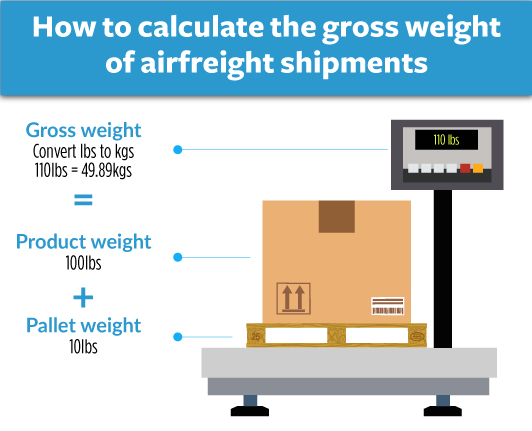
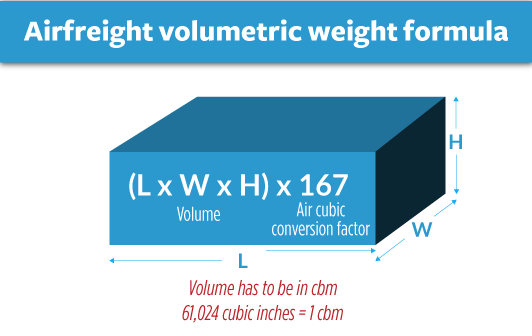
What is the difference between volumetric and gross weight?
Gross weight is the actual physical weight of your shipment including packaging. Volumetric weight reflects the space your shipment occupies in the aircraft, regardless of its actual weight. Airlines charge based on whichever is higher.
For standard air cargo: Volumetric weight = (L × W × H in cm) ÷ 6,000 For express courier: Volumetric weight = (L × W × H in cm) ÷ 5,000
Example: A box of electronics measuring 60 × 50 × 40 cm with a gross weight of 15 kg.
- Air cargo volumetric weight: (60 × 50 × 40) ÷ 6,000 = 20 kg → you are billed on 20 kg
- Express courier volumetric weight: (60 × 50 × 40) ÷ 5,000 = 24 kg → you are billed on 24 kg
This is especially relevant when importing light but bulky goods from China — foam products, garments, plastic housewares — where volumetric weight often far exceeds gross weight.
Road freight between Thailand and China
*You will prefer road freight if you want your goods to arrive in less than a week
As mentioned before, road freight between China and Thailand follows routes similar to those used by rail. While China, Thailand, and Laos have well-developed road networks, Myanmar and Vietnam are still improving theirs. If your cargo originates from central or western China, it will most likely transit via Vietnam and Laos, or through Myanmar.
Since road freight takes about half the time of rail, it can be a better option when time is critical. Based on your business needs, we’ll compare road and rail rates to help you save time—often for a similar price.
Here is a table detailing the average transit times between major Thai and Chinese cities by road:
| Bangkok | Chiang Mai | Phuket | Udon Thani | |
|---|---|---|---|---|
| Shenzhen / Guangzhou | 3 days | 3 days | 4 days | 2 days |
| Xi’an | 4 days | 3 days | 5 days | 3 days |
| Qingdao | 5 days | 4 days | 6 days | 4 days |
| Ningbo / Shanghai | 4 days | 4 days | 5 days | 4 days |
| Beijing | 5 days | 4 days | 6 days | 4 days |
| Chongqing | 3 days | 2 days | 4 days | 2 days |
| Kunming | 2 days | 1 day | 3 days | 2 days |
| Nanchang | 3 days | 3 days | 4 days | 3 days |
| Harbin | 6 days | 6 days | 7 days | 6 days |
| Changsha | 3 days | 3 days | 4 days | 2 days |
Moreover, it will almost always be more expensive than other freight solutions. Road freight is best used in combination with other methods—like sea + trucking or air + trucking—for optimal efficiency.
For example, if you need to send goods in provenance of Kunming to Udon Thani, your goods will transit through Laos by crossing the border between the cities of Boten (Laos), and Mohanzhen (China).
For your information, the Chinese-Vietnamese border is crossed only on one point to go to Thailand. It is called the “Friendship pass” between the cities of Pingxiang (China) and Đồng Đăng (Vietnam). Then your goods can join the territory of Laos on two principal border venue, between Dansavan (Laos) and Tt. Lao Bao (Vietnam), and at the Nam Phao International Checkpoint. Afterwards, they will enter to Thailand.
*If you’re sending goods from north-west China, your goods will flow through Myanmar first. The border between China and Myanmar will be crossed between the cities of Mongla (Myanmar) and Daluozhen (China). Then it will enter the Thai territory between Tachileik (Myanmar) and Wiang Phang Kham (Thailand).
Here is a table of the usual transit times between Chinese and Thai cities:
| Bangkok | Chiang Mai | Udon Thani | Phuket | |
|---|---|---|---|---|
| Shenzhen / Guangzhou | 6 days | 6 days | 4 days | 8 days |
| Xi’an | 8 days | 6 days | 7 days | 10 days |
| Qingdao | 10 days | 9 days | 9 days | 12 days |
| Ningbo / Shanghai | 9 days | 9 days | 8 days | 11 days |
| Beijing | 10 days | 10 days | 9 days | 12 days |
| Chongqing | 6 days | 5 days | 5 days | 8 days |
| Kunming | 4 days | 3 days | 3 days | 6 days |
| Nanchang | 7 days | 7 days | 6 days | 9 days |
| Harbin | 12 days | 12 days | 11 days | 14 days |
| Changsha | 6 days | 6 days | 5 days | 8 days |
*Please note that these transit times are indicative and may vary.
Door to door between China and Thailand
Door-to-door shipping handles the entire logistics chain — supplier pickup in China, export clearance, ocean or air transport, Thai import customs, and final delivery to your warehouse or business address — under a single contract.
Why use it on the China–Thailand route?
This route involves two distinct customs procedures, multiple inland legs, and the complexity of coordinating between Chinese suppliers and Thai receiving conditions. Door-to-door removes the operational burden from your team entirely.
- One point of contact instead of managing a Chinese freight agent, a Thai customs broker, and a local delivery company separately
- Predictable timelines with visibility from origin to delivery
- Customs handled by specialists on both sides, reducing the risk of delays caused by documentation errors
- Special handling arranged for sensitive, fragile, or oversized goods
DocShipper manages door-to-door shipments on the China–Thailand corridor daily. Whether you’re shipping by sea or air, our team handles the full chain. Contact us for a free quote within 24 hours.
What duties and taxes will I pay for my goods ?
Import duties have been heavily reduced for a wide range of products and services, thanks to free trade agreements between Thailand and China.
The reduction of duties applies to various kinds of goods:
- Pharmaceutical products
- Dairy products
- Commercial trucks
- Aluminum structures
- Many other products
*Trade between both countries is thus facilitated and shall allow manufacturers in Thailand to import cheap raw materials to export afterwards at a competitive price.
How Can you get tax exemption for goods imported from China?
Your supplier must provide us with an E-form, in order to be checked and validated by our import service.
*Please note that E-Form exempts duties and taxes, but Thai VAT is still mandatory (7%).
Definition of CO
A Certificate of Origin (CO) is a document proving that the export goods have been produced in a particular country, ready to be shipped to another country. It must be provided by a notary public, government. The exporter of the goods can also issue it. It is usually divided into GSP certificate of origin (Form A), and various regional preferential certificates of origin, and non-preferential certificates of origin.
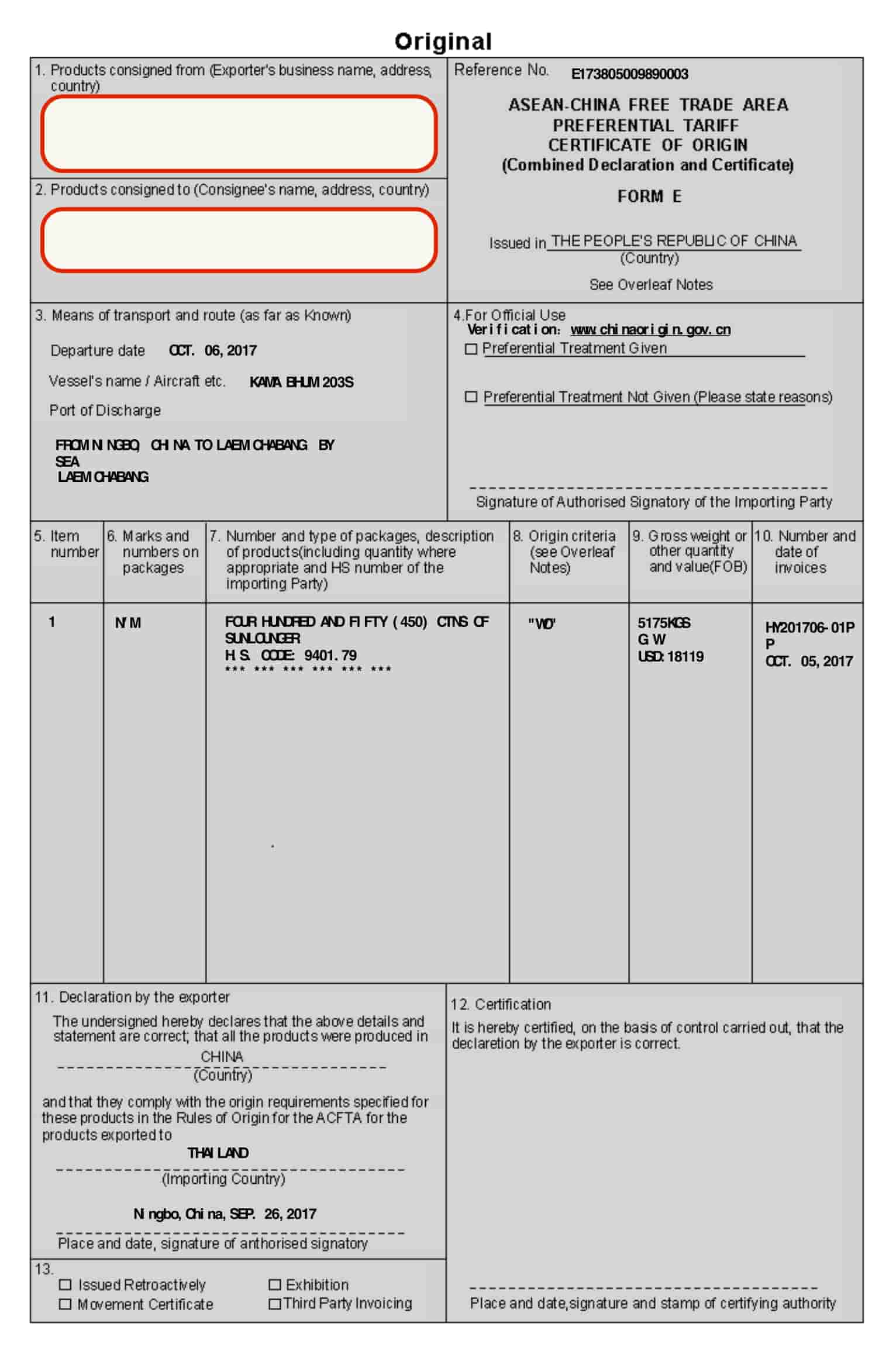
ASEAN-China Free Trade Certificate of Origin
The China – ASEAN Free Trade Certificate of Origin (FORM E) is now valid for exportations to the main following countries: Indonesia, Thailand, Malaysia, Vietnam, the Philippines, Singapore, Brunei, Cambodia, Myanmar, Laos. It has to comply with the relevant provisions of the product, as issued by the China – ASEAN free Trade Area of preferential origin confirmation letter (FORM E). The 10 countries mentioned before can benefit from preferential tariffs (up to a 5% lower tax rate).
The “Trade in Goods Agreement” defines the sample format of certificates of origin that must be respected. The “trade in goods agreement” Protocol II also requires a description of the contents that must be mentioned on the back page.
Reduced import duties thanks to FTAs between China and Thailand come with a probable future development of infrastructures, such as railways. This should generate a significant reduction of logistics costs, enhancing business and touristic flows in Thailand.
Thailand is trading 79% of its goods to/from another ASEAN member, at a very competitive price. This kind of business relationships between countries has been a real driver for the development of the ASEAN bloc. We can be sure that such an agreement between China and Thailand would be a key asset for both countries.
mport duties between Thailand and China
Tariffs and Taxes
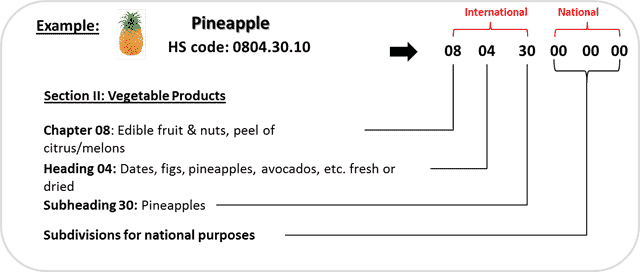
China is aligned with the Harmonized Tariff System (HTS) for imported and exported goods coming from members states of the Association of Southeast Asian Nations (ASEAN).
Here is the composition of an HS Code, you can now see what an HS code is and what does it mean.
Import / Export Relations between China and Thailand
Important flows guided by a free trade agreement
Import / Export flows between China and Thailand are growing steadily from year to year. These two countries have good relations; culturally speaking, it is estimated that between one-third and one-half of Thai people would have Chinese origins. The ties between the two countries have tightened even more since the 2014 coup d’état, with Thailand diverting from the United States. China is the first economic partner of the ASEAN (Association of Southeast Asian Nations).
A Framework Agreement between the People’s Republic of China (PRC) and the ASEAN Kingdom entered into force in 2003 to promote comprehensive economic cooperation. Indeed, it was decided that a free trade area would be established within 10 years.
The main points of this agreement are:
- The elimination of tariff and non-tariff barriers on international trade in products,
- The liberalization of international trade in services
- Foreign direct investment
- Simplification of customs procedures and
- Mutual recognition agreements.
The ASEAN-China Free Trade Area is the third largest free trade area in the world, and here are some important points:
- 1.9 billion people (30% of the world’s population)
- GDP: $ 2 billion
- International trade: $ 1.1 billion
- International trade will increase by 38.9%
- Imports and exports are expected to increase by 50%
- Five ASEAN countries are China’s largest trading partners
- China is the third largest source of imports from ASEAN (Association of Southeast Asian Nations)
An agreement favoring the activity of Chinese seaports
China-ASEAN free trade agreement was signed in January 2007 and entered into force on 1 July 2007. In addition, the ASEAN-China Free Trade Agreement (ASEAN-China) is applying by the LAC countries of the Association of Southeast Asian Nations (Cambodia, Laos, Myanmar and Vietnam) since the 1st January 2015.
China relies on several major ports to keep this maritime activity in constant evolution. Indeed, China has more than 2,000 ports, 130 of which are open to foreign ships. China has 16 major seaports with a capacity of more than 50 million tons per year. Amongst these, the port of Ningbo-Zhoushan, located in the Zhejiang Province, on the East China Sea coast, south of Hangzhou Bay.
Guangzhou’s port is also tremendous for the Chinese Import/ Export activities, we will detail it lower. This important traffic is largely due to the Canton Fair, which takes place twice a year (spring and autumn). This huge fair is co-sponsored by the Ministry of Commerce and the People’s Government of Guangdong, while China’s Foreign Trade Center oversees the organization.
The customs services
Customs contact in China

Official name: General Administration of Customs of China
Official Website: Chinese Customs Website
How to calculate duties and taxes when importing from China to Thailand
Step 1 – Identify the Country of Origin
For goods manufactured in China, the country of origin is China. This sounds straightforward, but it carries significant commercial implications on this specific route.
Thailand and China are linked by two major trade agreements — the ASEAN-China Free Trade Agreement (ACFTA) and the Regional Comprehensive Economic Partnership (RCEP). Both can dramatically reduce the import duty you pay in Thailand, but only if the country of origin is correctly declared and supported by the right documentation.
Getting this step right also means being aware of what is restricted or requires special permits when importing Chinese-origin goods into Thailand. Certain product categories — including some steel and aluminium products, ceramics, and electronics — are subject to anti-dumping investigations or safeguard measures that may apply specifically to Chinese-origin imports. Knowing your product’s origin and HS code before shipment lets you identify these situations in advance rather than discovering them at the Thai border.
Step 2 – Find the HS Code of your product
The Harmonized System (HS) code is a six-digit international classification number that identifies your product for customs purposes. Thai customs uses this code to determine your applicable duty rate, any FTA preferences, and whether any restrictions or licensing requirements apply.
The most reliable way to find your HS code is to ask your Chinese supplier. They export this product regularly and typically know the correct classification. However, always verify independently — suppliers occasionally use codes that minimise their Chinese export obligations, which may not correspond to the correct Thai import classification.
If you need to find the code yourself, you can use the Harmonized Tariff Schedule tool or the Thai Customs Department’s online tariff database. Search by product description and review the heading and subheading that best matches your goods.
Why accuracy matters on the China–Thailand route specifically: Thai customs has tightened scrutiny on Chinese-origin imports since 2025, with increased checking of HS code accuracy and declared values. An incorrect code can result in goods being held for inspection, reclassification, back-payment of duties, and in repeat cases, formal penalties. It is far cheaper to get the code right before the shipment moves.
Step 3 – Calculate the Customs Value
Thailand’s customs value is not the same as the price you paid your supplier. It is the CIF value — Cost of goods, Insurance, and Freight — all added together. This combined figure is the base on which both import duty and VAT are calculated.
How to calculate it:
Take your commercial invoice value (the price you paid your supplier in China), add the international freight cost (ocean or air), and add the cargo insurance cost.
Example: You purchase goods from a Guangdong supplier for $12,000. Sea freight from Shenzhen to Laem Chabang costs $800. Marine insurance costs $150.
Your CIF customs value = $12,000 + $800 + $150 = $12,950
All subsequent duty and VAT calculations are based on $12,950, not the $12,000 invoice price. This distinction matters — underestimating your customs value base by omitting freight and insurance is a common mistake that leads to incorrect duty payments and potential audits.
Step 4 – Figure out the applicable Import Tariff
Thailand applies import tariffs based on HS codes. The rate varies widely depending on the product — from zero percent for many industrial inputs to over 30 percent for some agricultural and consumer goods.
However, because both China and Thailand are members of the ASEAN-China Free Trade Agreement (ACFTA) and the Regional Comprehensive Economic Partnership (RCEP), many products qualify for significantly reduced or zero preferential tariff rates. The standard MFN (Most Favoured Nation) rate and the preferential FTA rate can differ substantially.
To find the applicable rate:
- Take your verified HS code
- Check it against Thailand’s tariff schedule on the Thai Customs Department website
- Identify both the standard MFN rate and the ACFTA/RCEP preferential rate for your product
- Confirm with your supplier that they can provide the correct origin certificate (Form E for ACFTA, or the RCEP self-declaration/certificate) to unlock the preferential rate
Example: You are importing plastic household goods (HS 3924.10). The standard MFN rate might be 20%, but the ACFTA preferential rate could be 0%. That difference, applied to a $12,950 CIF value, is $2,590 in duty — a significant saving that disappears entirely if your supplier fails to provide the correct Form E certificate.
Step 5 – Consider other Import Duties and Taxes
Beyond the standard import tariff, several additional charges may apply to your shipment depending on the product category.
VAT (Value Added Tax): Thailand applies 7% VAT to all imports. It is calculated on the CIF value plus the import duty — not just the goods value. As of January 1, 2026, this applies to all shipments regardless of value, including small parcels that previously benefited from a 1,500 THB low-value exemption. That exemption no longer exists.
Excise Duty: Applies to specific product categories including alcoholic beverages, tobacco, vehicles, and certain electronics. Excise duty is calculated separately and adds to your total customs cost. If you are importing any of these categories from China, identify the excise rate for your specific HS code before placing your order.
Anti-dumping duties: Thailand has active anti-dumping measures on a number of Chinese-origin product categories including certain steel products, ceramic tiles, float glass, and chemical compounds. Anti-dumping duties are applied in addition to standard tariffs and can be substantial — sometimes exceeding the product value itself. Check whether your product category is subject to any Thai anti-dumping orders against China before importing.
Import licensing: Certain Chinese-origin products require an import licence or permit before they can clear Thai customs. Categories include food and agricultural products, medical devices, chemicals, and some electrical equipment. Missing a required licence means your goods are held at the port until it is obtained — which can take weeks.
Step 6 – Calculate the Total Customs Cost
Example: Importing machinery worth $10,000 CIF, duty rate 5%, VAT 7%.
- Import duty: $10,000 × 5% = $500
- VAT base: $10,000 + $500 = $10,500
- VAT: $10,500 × 7% = $735
- Total customs cost: $1,235
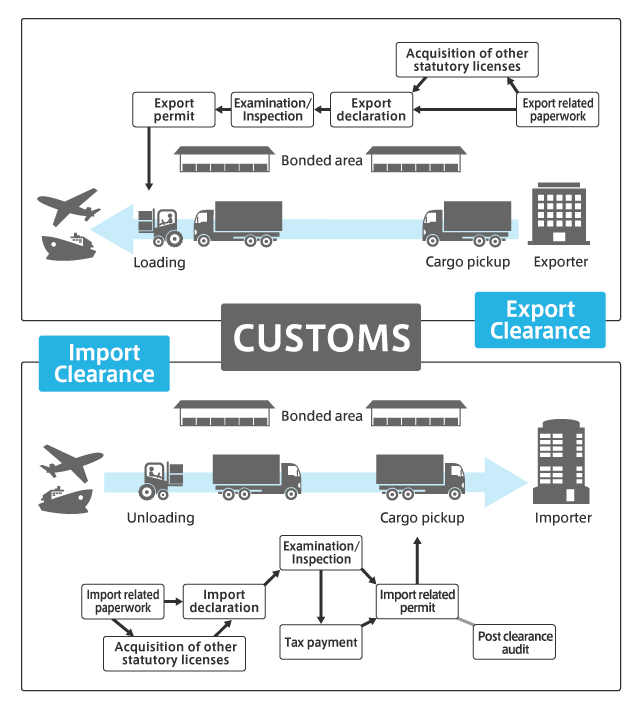
Customs process

Prohibited & Restricted Items
Drugs

Explosives

Biohazard

Chemicals

Corrosive

Counterfeit

Ivory

Batteries

Flammable

Firearms

Prescription Drugs

Counterfeit Notes

Poison

Pornography

Knife

Tobacco

Gambling

Hazardous

China–Thailand trade and economic relationship
China and Thailand share one of the most significant bilateral trade relationships in Southeast Asia. Understanding the scale, structure, and direction of this relationship helps you anticipate market trends, plan procurement cycles, and take full advantage of the preferential frameworks available to you.
Trade Value China has been Thailand’s largest single trading partner for over a decade. Bilateral trade exceeded $130 billion in 2023 and has continued growing, driven by a combination of Chinese manufacturing investment in Thailand, Thai agricultural exports to China, and the expansion of cross-border e-commerce. The relationship is genuinely two-directional — Thailand both imports heavily from China and exports significant volumes back, which means freight capacity and vessel schedules on this corridor are well-balanced in both directions.
Key import sectors — what Thailand buys from China
- Machinery and industrial equipment: China is Thailand’s largest source of imported machinery, supplying manufacturing equipment for Thailand’s automotive, electronics, and food processing sectors.
- Electronics and components: From finished consumer electronics to semiconductor components and PCBs, Chinese suppliers dominate Thailand’s electronics supply chain at multiple tiers.
- Chemicals and plastics: Thailand’s manufacturing sector relies heavily on Chinese chemical inputs and plastic raw materials, particularly for the packaging, automotive, and agriculture industries.
- Vehicles and automotive parts: Chinese EV manufacturers — BYD, SAIC (MG), Great Wall Motor — have established assembly operations in Thailand, with components and fully assembled vehicles both flowing through the import corridor.
- Textiles and garments: Chinese fabric and finished garments remain a large import category, sourced primarily from Guangdong, Zhejiang, and Jiangsu.
- Steel and construction materials: Despite anti-dumping measures on some categories, Chinese steel, aluminium, and construction materials represent significant import volumes into Thailand’s infrastructure and real estate sectors.
Key export sectors — what Thailand sells to China
- Agricultural products: Thailand is one of China’s most important sources of tropical produce. Durian alone accounts for billions of dollars in annual Thai agricultural exports to China, followed by rubber, cassava, rice, and longan.
- Processed food: Thai food products — canned goods, sauces, snacks, seafood — have strong market penetration in China, driven by Chinese consumer demand for Southeast Asian cuisine.
- Automotive parts: Thailand’s established automotive supply chain, particularly for Japanese brand manufacturers, exports components to Chinese assembly operations.
- Rubber and petrochemicals: Thailand is the world’s largest natural rubber producer, with China as its primary buyer.
Investment flows Chinese foreign direct investment into Thailand has accelerated significantly since 2020. Thailand’s Eastern Economic Corridor (EEC) has been a major beneficiary, attracting Chinese manufacturers in the EV, electronics, and solar energy sectors who are relocating or expanding production outside China. This investment dynamic is strengthening the physical trade corridor — more Chinese factories in Thailand means more inbound shipments of Chinese machinery, components, and raw materials.
The impact of global supply chain restructuring The US-China trade tensions and post-pandemic supply chain diversification have made Thailand a increasingly important manufacturing hub for Chinese companies seeking to serve global markets, including the US and EU, from a non-Chinese base. This “China+1” dynamic has increased freight volumes on the China–Thailand corridor in both directions and is expected to continue through 2026 and beyond. For Thai importers, it also means more Chinese suppliers with Thai operations — and more complex questions about country of origin documentation.
Trade agreements in force
| Agreement | Status | Benefit |
|---|---|---|
| ASEAN-China FTA (ACFTA) | In force since 2005 | Zero or reduced tariffs on most goods with Form E |
| RCEP | In force since 2022 | Additional tariff reductions, single framework across 15 countries |
Both agreements require valid origin certification to unlock preferential rates. Under ACFTA, your supplier must provide Form E. Under RCEP, a self-declaration or third-party certificate depending on the exporter’s certified status. If your supplier cannot or does not provide the correct certificate, you pay standard MFN rates — and on some product categories, the difference is substantial.
Additional logistics services
Venture beyond shipping and customs with SIAM Shipping! Explore our wide array of additional logistics services, ensuring your supply chain operation runs smoothly from start to finish. Let's take care of everything, together.
Warehousing and storage
Finding the right warehouse for your goods can feel like a treasure hunt—a steady temperature for your delicate items is a must. Storing chocolates? You wouldn’t want a meltdown! For a stress-free solution that considers all conditions, explore our warehousing services, designed to keep your goods in prime condition.
Packaging and repackaging
Inherent challenges in shipping from China to France make quality packaging vital. Having a reliable agent can help ensure your wine barrels or electronics are suitably packed and repacked, reducing the risk of damages. Whether it's ceramics securely cushioned or machinery components assembly-segregated, great packaging caters to every product. Find out more about securing your cargo on our dedicated page: Freight packaging.
Cargo insurance
Contrary to fire insurance limited to premises, transport insurance is your flotation device over rough trade seas. Imagine sending a pricey, custom-built machinery and it gets damaged in transit. Ouch! But, with cargo insurance, you're covered and can breeze through such setbacks. It's the booster dose of prevention to keep your trade immunity sky-high.
Personal effects shipping
Moving precious belongings from China to France? No worries, we manage fragile or bulky items with extra care, ensuring they reach your new French home intact. Like Aunt Mei's porcelain vase, we pack, transport, and deliver with professionalism. Save time and energy for croissants and vin rouge!
Frequently Asked Questions
Suppliers usually quote port‑to‑port transit time. That is not your real delivery timeline.
Here’s what we actually see on this route in 2026:
- Sea freight (FCL): 6 to 13 days port to port from South China to Laem Chabang or Bangkok
- Door to door sea freight: typically 10 to 18 days including export handling, vessel wait time, Thai customs clearance, and local delivery
- Air freight: 1 to 3 days airport to airport, usually 3 to 5 days door to door
- Cross-border truck (South China to Thailand): around 4 to 7 days total depending on border clearance
If someone promises 7 days total by sea, they are quoting pure sailing time. The gap between sailing time and real delivery time is where most importers get frustrated.
We always plan using door-to-door timing, not vessel timing. That’s how you avoid stockouts.
This is critical because the rules changed on January 1, 2026.
Thailand removed the low-value exemption. That means all imported goods are now subject to VAT and applicable import duty, even low-value shipments.
- VAT: 7% on CIF value plus duty
- Import duty: depends on HS code, some categories reduced under trade agreements
- No more 1,500 THB exemption: even small parcels are taxed
This matters especially for e-commerce and sample shipments. Many importers were used to informal clearance for small parcels. That’s over.
If your supplier declares undervalued goods, Thai Customs is actively targeting that. We strongly recommend correct HS classification and realistic invoice values to avoid audits and delays.
It depends on your margin structure and urgency.
Sea freight is usually the right choice if:
- Your cargo is over 2 to 3 cubic meters
- You are shipping full containers
- Your inventory planning allows 2 to 3 weeks total lead time
Air freight makes sense if:
- Your goods are high value or time sensitive
- You are testing a product
- You cannot afford stock gaps
On this route, sea freight between South China and Laem Chabang is relatively fast compared to Europe or the US. That’s why many Thai importers default to sea unless the shipment is urgent.
We often see companies overusing air freight because they miscalculated their first sea shipment timeline. Good planning reduces that cost dramatically.
Most containers from China enter through Laem Chabang. It is Thailand’s main deep-sea port and handles the majority of industrial cargo.
Bangkok Port is closer to central Bangkok but has draft and size limitations.
- Laem Chabang: better for FCL, industrial cargo, automotive, electronics
- Bangkok Port: suitable for smaller volumes and cargo destined for central Bangkok
If your warehouse is near Bangkok, sometimes Laem Chabang plus trucking is still faster and more reliable.
We choose the port based on vessel schedule reliability, container availability, and final delivery location, not just geography.
Yes, but only if your paperwork is correct.
China and Thailand are both members of the Regional Comprehensive Economic Partnership. Many tariff lines are reduced or progressively eliminated under this agreement.
However, preferential duty applies only if:
- The product qualifies under rules of origin
- The supplier provides the correct RCEP certificate or declaration
- The HS code is declared correctly in Thailand
We often see shipments miss preferential rates because the exporter used the wrong origin documentation. That mistake costs real money.
If your margins are tight, verifying origin eligibility before production starts is the right move.
Rates fluctuate, but as of early 2026, sea freight pricing on this route is relatively stable compared to long-haul lanes.
Indicative port-to-port ranges:
- 20ft container: roughly a few hundred USD from major South China ports to Laem Chabang
- 40ft container: typically proportionally higher but still competitive due to short distance
But container freight is only part of your landed cost.
You must also account for:
- Origin handling in China
- Thai port charges and terminal handling
- Customs clearance fees
- Inland trucking
- VAT and import duties
The cheapest ocean rate is meaningless if local charges are unclear. We always calculate full landed cost before confirming a booking.
Most delays are paperwork problems, not port congestion.
Common causes we see:
- Incorrect HS code declaration
- Undervalued commercial invoices
- Missing import licenses for controlled goods
- Product labeling not compliant with Thai regulations
Since January 2026, Thai Customs has tightened control on undervalued and small parcels. Clearance is less informal than before.
If you are a first-time importer, this is where things usually go wrong. Clearance in Thailand is generally efficient when documentation is correct, but strict when it is not.
We review documents before cargo departure to prevent surprises on arrival. Prevention is cheaper than storage fees and inspections.