In short ⚡
HS code is the Harmonized System product classification used worldwide to identify goods for import and export, determine customs duties and VAT, and decide what documents, licenses, and controls apply. Built on a standardized 6‑digit base often extended nationally, the HS code directly affects clearance speed, costs, and the legal compliance of your shipments.In this article, you will find how HS codes are structured and governed, how they affect customs, duties, and e‑commerce shipping, common misclassification mistakes, practical research steps, and the legal and financial consequences of using the wrong codes.
We hope you’ll find this article genuinely useful, but remember, if you ever feel lost at any step, whether it’s finding a supplier, validating quality, managing international shipping or customs, DocShipper can handle it all for you!
What is an HS code and why your business depends on it
Your HS code is the product classification that customs uses to decide what you pay, what documents you need, and whether your cargo gets waved through or pulled aside.
Here’s the thing, in global logistics, one wrong digit can snowball into duty re-assessments, blocked customs clearance, warehouse holds, and missed delivery windows.
We’ve seen importers do everything right in procurement and freight forwarding, then lose weeks because the hs tariff code didn’t match the actual materials or function of the product.
Siam Shipping Alert
Let our experts validate your HS code before you ship, so your cargo moves without costly reassessments or delays.
Definition of HS, HS tariff code, and harmonized code
A few years ago, we handled a shipment of “stainless steel accessories” that turned out to include mixed items, some were kitchen fittings, some were furniture hardware.
The supplier’s invoice used a single harmonized code for the whole carton, and customs didn’t buy it.
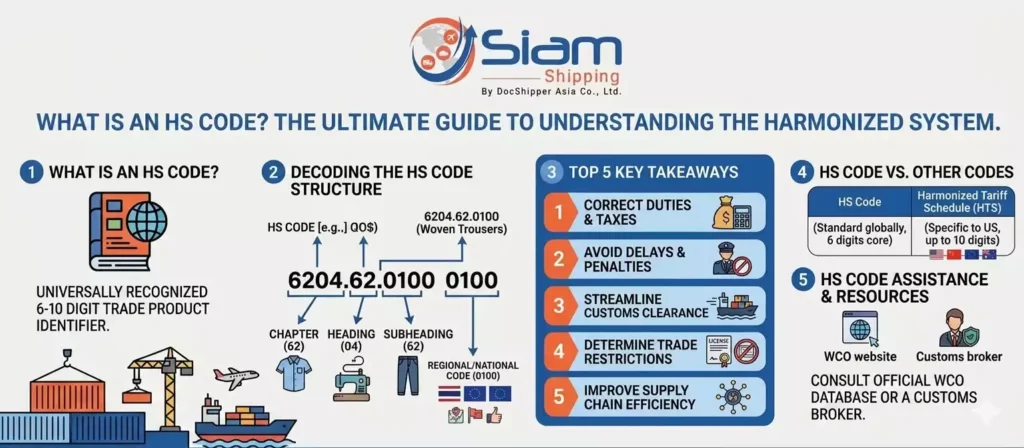
HS stands for the Harmonized System, a standardized way to classify goods for import and export.
In practice, you’ll hear three terms that mean almost the same thing, but are used differently depending on who you’re talking to in supply chain management.
- HS code: the standard 6-digit base classification used internationally.
- HS tariff code: HS code plus the destination country’s extra digits used to calculate tariffs and apply local rules.
- Harmonized code: common shorthand for HS, often used by suppliers and freight forwarders.
If you want the official foundation behind the system, the reference text is The International Convention on the Harmonized Commodity Description and Coding System.
How HS codes fit into international shipping codes and customs rules
Direct tip, treat your HS code as a customs “key” that unlocks everything else, duties, licenses, labeling checks, and sometimes even whether you can import at all.
In hs code shipping, carriers and customs systems use classification to run automated risk screening before your cargo even hits the port.
This is where you’ve probably gotten stuck before, your forwarder asks for an HS code, your supplier gives you something vague, and then customs brokerage can’t finalize the declaration.
To make it operational, here’s a simple workflow we use to keep international shipping codes aligned from purchase order to last-mile delivery.
HS code workflow for smoother customs clearance:
- Step 1, confirm product reality: materials, function, tech specs, and packaging unit.
- Step 2, classify at 6 digits, using HS notes and comparable rulings.
- Step 3, extend to the destination’s tariff code, then validate duty rate and restrictions.
- Step 4, lock the code into your procurement and inventory management records (SKU master, BOM, WMS).
- Step 5, reuse consistently across invoice, packing list, bill of lading or airway bill, and customs entry.
Once this is stable, your freight audit gets cleaner, your landed cost forecasting improves, and you avoid surprise charges during consolidation or cross-docking.
Real-world examples of HS codes for common products
What does a “correct” HS code look like when you’re actually shipping product, not reading theory?
Here are practical examples that come up all the time in warehousing, distribution, and order fulfillment, but you must still validate based on exact specs.
| Product (typical description) | Common HS code family (6-digit) | What changes the code fast |
| 100% cotton T-shirts | 6109.xx | Knitted vs woven, fiber blend %, gender/size categories in some national extensions |
| Stainless steel screws/bolts | 7318.xx | Thread type, specific fastener design, coatings, whether it’s a “set” with tools |
| Bluetooth earbuds | 8518.xx | Standalone vs bundled, wireless protocol, whether it includes microphone, declared principal function |
| Lithium-ion batteries (loose) | 8507.xx | Chemistry, watt-hour rating, assembled into equipment or shipped separately |
You’ll notice fast that the product name alone isn’t enough.
Customs will classify based on what it is and what it does, not what your supplier calls it on Alibaba.
Inside the HS code structure: from 6 digits to national extensions
The HS code system looks intimidating until you see the logic, it’s a hierarchy that narrows from broad categories down to specific goods.
If you’re trying to cut landed cost without risking compliance, understanding this structure is as important as negotiating freight rate or Incoterms.
We once saw a buyer ship “plastic containers” under a plastics heading, but the product was actually insulated food jars, and customs reclassified it, reassessed duties, and held the cargo in a bonded warehouse.
Siam Shipping Info
We map 6-digit codes to each market’s extension to secure compliant, cost-efficient entries across destinations.
Sections, chapters, headings, and subheadings explained
One shipment we managed included a “kitchen set” where half the items were steel and the other half were plastic.
The invoice used one HS code, and that’s where the trouble started.
Here’s the structure you’re working with when you classify an hs tariff code, and why small details matter in cargo handling and customs clearance.
- Section: broad grouping (for example, textiles, metals, machinery).
- Chapter: 2 digits, more specific category (like 61 for knit apparel).
- Heading: 4 digits, product family.
- Subheading: 6 digits, the international HS level used worldwide.
From experience, the biggest classification mistakes happen when you skip the section or chapter notes, especially for “sets,” kits, and multi-material products.
Extra digits for national tariff systems (HTSUS, CN, TARIC, Mercosur, Japan, China)
Direct tip, always ask yourself, “Am we classifying for the HS system, or for the destination’s tariff schedule?” because that’s where the extra digits kick in.
The harmonized code is typically 6 digits, then countries add digits for local duty rates, trade remedies, and statistical tracking.
To keep it concrete, here’s a comparison table you can use when you’re planning export, import, and customs brokerage by destination.
| Region/Country | National extension name | Typical length | What it impacts for you |
| United States | HTSUS, based on the US Harmonized Tariff Schedule system | 10 digits | Duties, admissibility, additional tariffs, customs entry data |
| European Union | CN and TARIC | 8 to 10 digits | Duties, anti-dumping measures, VAT rules, licensing requirements |
| China | China Customs tariff code | Typically 10 digits | Import controls, VAT, inspection triggers, statistical reporting |
| Japan | Japan tariff schedule | Typically 9 digits | Tariffs, local restrictions, trade statistics |
| Mercosur | NCM | 8 digits | Regional tariff application and reporting |
This is also why reusing a code your supplier gave you for a different destination can backfire fast.
How to know which country’s tariff code format you must use
Which format should you apply when you’re shipping cross-border with multiple legs and multiple carriers?
You’ll base the declaration on the HS code plus the importing country’s national extension, not the export country’s format.
Before you ship, run this quick checklist so you don’t end up with a mismatch between your documents and your customs entry.
- Confirm the country of import for the customs declaration, not just the ship-to address.
- Verify whether your shipment uses a free trade zone or bonded warehouse that changes reporting steps, but not classification.
- Align the code across commercial invoice, packing list, and bill of lading or airway bill.
- Check if your Incoterm makes you responsible for customs clearance, especially under DDP.
- Validate whether your 3PL or 4PL requires HS codes at SKU level in the WMS for pick-pack-ship.
If you’re managing multi-country distribution, store the 6-digit HS in your master data, then map destination extensions per market.
Who governs HS codes and how updates affect your products
Your HS code isn’t “set forever,” and that’s a nasty surprise when you’ve built your procurement, inventory management, and compliance process around last year’s classification.
In real operations, HS updates can change duty rates, trigger new controls, or break your classification mapping for a whole product line.
We’ve seen this hit hardest when an online seller expands to a new market, only to discover the national extension now splits the old category into two, with different tariff treatment.
Siam Shipping Advice
Implement a controlled classification review process to protect margins when products, components, or markets evolve.
The role of the WCO and the HS Convention
One of the most frustrating calls we get is after customs says, “your code doesn’t exist anymore,” and the shipment is already in the port’s cargo handling queue.
That’s when you realize classification isn’t just admin, it’s governed.
The global HS standard is maintained by the WCO, which coordinates how the 6-digit Harmonized System is defined and updated.
This matters to you because customs authorities and customs brokerage platforms align their databases to these definitions.
So if you’re doing hs code shipping at scale, you need a controlled process, not a spreadsheet that nobody owns.
HS revisions, new products, and why codes change over time
Bold truth, if your product evolves, your HS code may need to evolve too.
New technologies, regulatory priorities, and trade patterns push authorities to split headings, add subheadings, or redefine scope, especially in electronics, chemicals, and environmental goods.
When you change a component, a battery type, or even a coating, you might cross into a different classification, and that can alter duties, documentation, and carrier acceptance rules.
To keep control, build a small “change trigger” rule in your supply chain management process.
- New material or ingredient
- New function or software feature
- New bundle or retail set composition
- New country of origin or manufacturing process
If any trigger fires, you re-check the hs tariff code before the next production run ships.
How HS codes are used in customs, taxes, and trade statistics

Your HS code drives what happens at customs, what you pay in duty and VAT, and what gets recorded in trade data.
And yes, even if you’re “just shipping samples,” classification still matters for customs clearance and compliance.
We’ve had shipments cleared in hours when codes, values, and descriptions were consistent, and the exact same goods held for days when the HS code on the invoice didn’t match the courier declaration.
HS codes on invoices, CN22/CN23, and customs declarations
Ever had a courier ask you for an HS code after pickup, then suddenly your tracking freezes?
That’s the paperwork gap showing up in real time.
You’ll use your HS code on key documents across freight forwarding and last-mile delivery, especially when parcels move under postal rules.
Here’s where it typically appears, depending on the mode and shipment type.
- Commercial invoice, line-level classification tied to item value and currency
- Packing list, supporting detail for inspections and discrepancy checks
- Customs declaration, the formal entry filed by you or your customs broker
- CN22/CN23 forms, for postal and some express parcel flows
- Bill of lading or airway bill, usually not the primary classification document, but often cross-checked
If you want fewer delays, keep the product description consistent with the HS logic, not marketing language.
How HS codes drive duties, VAT, and trade statistics
Direct tip, don’t treat duty and VAT as “finance problems,” your HS code is the lever that sets them in motion.
Customs uses your harmonized code to pull the duty rate, apply excise rules where relevant, and decide whether additional measures apply.
It also feeds national reporting systems, which is why misclassification stands out when authorities compare your entries to typical pricing, origin patterns, and volumes.
To keep your landed cost stable, you’ll want a clean chain from classification to transport cost and cargo insurance.
If you’re reviewing shipment risk, this is also the moment to consider Freight Insurance as part of your standard export playbook.
HS code for online retailers: what you must do before you ship
If you sell cross-border, you need an HS code for online retailers that’s consistent at SKU level, not “whatever the supplier typed on the invoice.”
This is where most e-commerce teams feel the pain, you’re scaling order fulfillment, juggling returns, and then customs asks for a classification you never documented.
We’ve watched fast-growing stores lose margin because they guessed the hs tariff code, then had duties re-billed after delivery, right when they were trying to optimize cash flow.
Siam Shipping Advice
We help online retailers map and integrate HS codes into WMS and shipping tools to avoid margin-killing re-billings.
Mapping your product catalog to HS codes
One retailer we supported had 2,000 SKUs, but only 40 true product “families.”
Once you map those families correctly, maintenance gets much easier.
You’ll get better results if you build HS mapping like a master data project in your supply chain management, not a one-time customs task.
Use this checklist to structure your catalog mapping before you expand internationally.
- Create a SKU-to-HS mapping table, with 6-digit HS plus destination extensions per market.
- Store supporting attributes, material, function, composition %, power rating, usage, and packaging unit.
- Flag SKUs with classification risk, kits, mixed materials, and regulated goods.
- Set an owner, someone must approve HS changes before procurement reorders.
- Keep evidence, datasheets, photos, and supplier declarations for audits.
When you do this well, your customs brokerage doesn’t have to guess, and your lead time becomes more predictable.
Integrating HS codes into your e-commerce and fulfillment workflow
Bold statement, if your HS codes aren’t in your operational systems, you don’t really “have” HS codes.
To avoid customs holds, your hs code shipping data must flow from product setup to shipping label to export docs, especially when a 3PL runs your warehouse management system.
Here’s a practical integration workflow we recommend for cross-border fulfillment.
E-commerce HS integration workflow:
- Step 1, add HS fields to your product master, 6-digit HS, country extensions, and origin.
- Step 2, push HS data to your WMS, so pick-pack-ship prints accurate invoice data.
- Step 3, sync with your shipping tool or carrier portal for electronic customs pre-advice.
- Step 4, validate at dispatch, HS, value, and description must match the order.
- Step 5, monitor exceptions, returns, and reverse logistics cases for recurring HS issues.
If your flows include consolidation or cross-docking, that system consistency becomes even more important.
Using tools and customs databases to look up HS codes
Where do you actually look when you need a reliable HS code, and you don’t want “forum answers”?
You’ll want a mix of official tariff databases, customs guidance, and broker-grade tools, then you validate against your product’s technical facts.
Here’s a short, practical approach that works for most import and export cases.
- Start with the 6-digit HS logic, then move to the destination’s national tariff database.
- Search by keywords, then confirm by reading the legal descriptions and notes, not just the result list.
- Compare similar goods and watch for “parts” vs “finished goods” traps.
- When stakes are high, request an advance ruling through the destination’s customs authority process.
If you also manage procurement workflows and logistic transactions across suppliers, store your final decision with the evidence so you don’t re-litigate it every reorder.
And if you need an operational partner for complex multi-leg lanes, Multi-modal services can reduce handoff errors, where HS data often gets distorted.
For broader shipping support, you can also coordinate with SIAM Shipping when your lanes run through Thailand and Southeast Asia.
HS code in shipping: reduce risk, delays, and extra charges
When you handle international shipping, the HS code becomes more than a formality. It directly shapes your customs clearance speed, duty rates, inspections, and even whether your cargo boards the plane or vessel at all.
If you have ever faced a shipment stuck at the airport with no clear explanation, chances are the HS code was part of the problem. Let us break down why shipping providers are stricter than ever and what really happens when things go wrong.
Siam Shipping Alert
Audit your codes before booking freight to prevent holds, storage fees, and rejected shipments.
Why carriers and postal services are tightening HS code requirements
Last year, we supported an online retailer shipping beauty accessories to Europe. Everything moved smoothly until the postal operator rejected dozens of parcels because the HS code field was empty on the electronic data. The parcels were returned before even leaving origin.
Carriers and postal services now demand precise HS codes because they must transmit advance electronic data to customs authorities before arrival. According to the World Customs Organization, risk-based controls rely heavily on product classification data.
Here is why you are seeing stricter enforcement:
- Pre-arrival risk analysis by customs based on HS code
- Security screening for dual-use or restricted goods
- Automated duty and VAT calculation systems
- E-commerce volume surge requiring structured data
From experience, you will notice that express carriers are the strictest. They integrate HS codes directly into their clearance systems, and if the code looks inconsistent with your product description, they may flag it automatically.
To reduce risk before booking freight, use this quick operational checklist.
- Confirm the correct 6-digit HS code minimum
- Verify national extensions for destination country
- Align product description with HS wording
- Ensure HS code appears on invoice and shipping label data
- Double-check restricted or controlled goods lists
If you skip one of these steps, you increase your exposure to unexpected inspections and manual reviews.
Looking for a Reliable Shipping & Sourcing Partner?


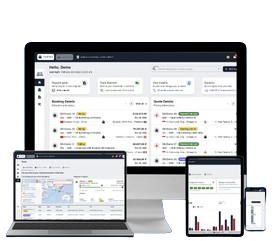
DocShipper Platform
One platform. Your entire supply chain
Sourcing, freight, customs & documents, all centralised, all visible, 24/7.
What happens in customs when your HS code is missing or wrong
What actually happens behind the scenes when your HS code is wrong?
First, customs systems compare the declared HS code with the product description, declared value, and sometimes even historical importer data. If something looks inconsistent, your shipment moves into a control lane.
The process usually follows this sequence.
- Automated system flags inconsistency
- Shipment held for documentary check
- Possible request for technical specs or catalogs
- Physical inspection if doubt remains
- Reclassification by customs authority
We once handled industrial LED modules classified as basic lighting parts. Customs reclassified them under electronic control components, triggering higher duties and additional compliance checks. The shipment was delayed ten days, and storage fees accumulated quickly.
When customs reclassifies your product, you may face:
- Additional duties and VAT reassessment
- Administrative penalties
- Storage and demurrage charges
- Longer transit times
This is the moment most importers get stuck. A simple HS code mistake turns into a chain reaction affecting cost, compliance, and customer satisfaction.
Common HS code mistakes that cost you money

Errors with your HS code rarely look dramatic at first. But small classification shortcuts often lead to higher duties, retroactive penalties, or blocked shipments.
You have probably dealt with suppliers who “suggest” a code to reduce duties. That is where many problems start.
Siam Shipping Alert
Request a professional HS review to eliminate hidden risks before audits or retroactive duty claims hit your cash flow.
Misclassification, “cheaper” codes, and relying on product names
Here is a hard truth. Choosing a “cheaper” HS code to lower duties is a high-risk strategy.
Customs do not classify based on marketing names. They rely on technical characteristics, material composition, function, and the General Rules for Interpretation.
Typical risky behaviors include:
- Selecting a code with lower duty without technical justification
- Copying a competitor’s code blindly
- Using generic descriptions like “accessories” or “parts”
- Trusting supplier-provided HS codes without validation
We supported a client importing composite backpacks with integrated solar panels. The supplier declared them as textile bags. Customs reclassified them under electrical apparatus, which significantly changed duty rates and compliance obligations.
You must always align your HS code with the principal function of the product, not its appearance.
Using outdated or foreign national codes for the wrong destination
Are you using the right country-specific format for your destination?
The core 6-digit HS code is harmonized globally, but countries add extra digits for national tariffs. Using a US HTSUS code for a shipment to the EU will not work.
Here is a simple comparison to clarify.
| Region | Base HS | National Extension |
| United States | 6 digits | Up to 10 digits (HTSUS) |
| European Union | 6 digits | 8 digits CN, 10 digits TARIC |
| China | 6 digits | 8 to 10 digits |
We have seen exporters use a valid 10-digit US code for shipments to Germany. Customs rejected the declaration because the national extension did not match the EU Combined Nomenclature.
This is how you avoid that mistake:
- Identify the destination country first
- Confirm required number of digits locally
- Cross-check in the official tariff database
- Align with your importer or customs broker
Forgetting section notes and General Rules for HS interpretation
Many classification errors happen because you skip the legal notes.
The HS system includes Section Notes, Chapter Notes, and General Rules for Interpretation that legally define how goods must be classified. These rules override simple keyword logic.
From experience, composite or multi-function products cause the most confusion. Think smart devices, kits, or unfinished goods.
Before validating your HS code, run through this control list.
- Read relevant Section and Chapter Notes
- Apply General Rule 1 first, then others sequentially
- Determine essential character for composite goods
- Check if special exclusions apply
If you ignore these legal elements, you expose yourself to retroactive duty claims during audits.
Practical steps to find the right HS code for your product
Finding the correct HS code is not guesswork. It is a structured research process that combines official databases, product analysis, and sometimes formal rulings.
If you treat classification as a strategic step rather than an administrative task, you will prevent most customs issues before they happen.
Siam Shipping Advice
Use official databases and advance rulings to lock in compliant, defensible classifications for high-value shipments.
How to research HS codes using official tools and advance rulings
Start with official sources, not random online lists.
You should always base your HS code research on government or customs authority databases. Many countries publish searchable tariff tools aligned with WCO nomenclature.
Follow this step-by-step workflow.
- Gather full technical specifications and material breakdown
- Identify potential chapters based on function
- Review Section and Chapter Notes carefully
- Compare similar official classification rulings
- Validate at 6-digit level before national extension
If doubt remains, request an advance ruling from customs. This legally binds authorities to a specific classification for your product, offering long-term certainty.
We often recommend this for high-value or recurring imports. It protects you against future disputes and gives you predictable duty rates.
When to involve customs brokers or trade consultants
We once assisted a tech company launching a new IoT device with sensors, SIM connectivity, and cloud integration. Internal teams debated three possible HS codes for weeks.
This is where external expertise saves time and money.
You should involve a customs broker or trade consultant when:
- Your product is innovative or multi-functional
- Duty rates vary significantly between headings
- Regulatory controls depend on classification
- You plan high shipment volumes
At DocShipper, we step in when classification complexity intersects with logistics execution. You gain operational clarity and reduce compliance exposure before goods even leave the factory.
Legal and business consequences of wrong HS codes
A wrong HS code does not only affect paperwork. It can trigger legal consequences, financial losses, and long-term reputational damage.
If you think customs mistakes are minor, wait until you face an audit.
Siam Shipping Alert
Protect your business with a documented HS compliance strategy before authorities review your declaration history.
Fines, audits, seizures, and denied imports
Customs authorities do not treat misclassification lightly.
Depending on the jurisdiction, incorrect HS codes may result in administrative fines, seizure of goods, or even criminal proceedings in cases of deliberate fraud.
Typical enforcement actions include:
- Post-clearance audits
- Duty reassessments with interest
- Financial penalties
- Temporary suspension of import privileges
We supported a client during a customs audit where authorities reviewed three years of declarations. Incorrect HS codes led to back payments and penalties that seriously impacted profitability.
According to international trade reports from institutions like the World Bank, compliance transparency increasingly shapes trade facilitation and risk scoring. Your classification history matters.
How HS codes impact transit time, customer experience, and cash flow
Your HS code directly influences how fast your goods reach customers.
When classification is clear and consistent, shipments pass through green channels more often. When doubts arise, inspections and document requests slow everything down.
The operational consequences are very concrete:
- Longer clearance time
- Higher storage and demurrage costs
- Delayed customer deliveries
- Cash tied up in blocked inventory
If you sell online, a single delayed batch can trigger refunds, chargebacks, and negative reviews. That small HS code field suddenly affects your brand reputation.
Think of HS code accuracy as a risk management tool, not just a customs requirement.
Conclusion
The HS code is one of the most powerful control points in international trade. When you master classification, you reduce duties, prevent delays, and protect your business from legal exposure.
Before you ship internationally, keep these key takeaways in mind.
- Always validate the correct 6-digit HS code first
- Use the destination country’s national extension
- Align product description with technical characteristics
- Review Section Notes and General Rules for Interpretation
- Consider advance rulings for high-value or complex goods
- Treat HS code compliance as a strategic process, not admin work
If you approach HS classification with discipline and proper research, you will significantly reduce costly disruptions in your global shipping operations.
FAQ | HS code essentials: how to classify products and cut costs in global shipping
Think of the HS code as the “ID number” of your product in international trade.
If the HS code is wrong, customs assumes the product is “mis‑identified,” which is why so many delays, reclassifications, and extra costs start from that single number.
- It’s a standardized, 6‑digit product description used by customs worldwide.
- Those 6 digits describe what the product is and what it does (material, function, type).
- Countries then add extra digits on top to set local duty rates, VAT rules, and controls.
In shipping, the HS code is the piece of data carriers and customs use to pre‑screen your cargo before it physically arrives. It’s critical because it:
If the HS code is missing or looks inconsistent with your description, express carriers and postal services can:
- Feeds the carrier’s electronic pre‑advice to customs (pre‑arrival risk checks).
- Triggers duty/VAT calculation and checks for restricted or dangerous goods.
- Determines whether your parcel can even be loaded on a plane or vessel.
- Reject the shipment at origin.
- Hold it for manual review.
- Force re‑declaration by you or your broker, adding time and fees.
You don’t “invent” an HS code, you map your product to an existing one using a structured method:
1. **Gather product facts**
2. **Find the likely Chapter and Heading**
3. **Apply the HS rules**
4. **Lock the 6‑digit HS, then extend**
Finally, document your decision (screenshots, rulings, specs). That’s what you’ll need in case of audit or dispute.
- Exact materials and composition %
- Main function and how it’s used
- Technical specs (power, capacity, components, software, etc.)
- Start from function (electronics, textiles, machinery, etc.).
- Use official tariff tools to search by keyword, then read the legal descriptions.
- Read Section and Chapter Notes.
- Check if your item is a part, a set, or a finished good.
- Compare with similar official rulings.
- Confirm the 6‑digit code first.
- Add the importing country’s extra digits using its national tariff database.
Treat supplier codes as a starting point, never as automatic truth. Validate them by:
If anything feels off—wrong material, wrong function, or obviously “too cheap” duties—re‑classify before shipping or ask a customs broker to confirm.
- Comparing the supplier’s code description with your real product specs.
- Checking the code in the importing country’s official tariff system.
- Looking at similar products’ classifications and customs rulings.
- Making sure the duty rate “story” makes sense (extremely low rates on sensitive goods are a red flag).
When two codes look plausible, don’t guess—reduce the risk methodically:
For recurring or high‑value shipments, the safest play is to:
- Re‑read the Section and Chapter Notes for both options.
- Compare which code best matches the **principal function** of the product.
- Check sample classification rulings from customs for similar items.
- Run landed cost scenarios (duty, VAT, controls) for both to see the impact.
- Ask your customs broker for a written recommendation, and/or
- Request an **advance ruling** from the destination customs authority so the chosen code is officially confirmed and binding.
The key is to stop classifying SKU by SKU and work in “families.” A practical setup looks like this:
Handled this way, you only seriously classify a limited number of families, then maintain them, instead of re‑doing the work for every new color or size.
- Group SKUs into product families that share the same HS logic.
- Create a central table: SKU → family → 6‑digit HS → per‑country extensions.
- Store attributes needed for classification (material, function, power, set vs single item).
- Assign an internal owner (compliance, logistics, or purchasing) who must approve any HS changes.
- Build HS fields into your e‑commerce platform, WMS, and shipping tools so the code flows automatically to invoices and labels.
Need Help with
Logistics or Sourcing ?
First, we secure the right products from the right suppliers at the right price by managing the sourcing process from start to finish. Then, we simplify your shipping experience - from pickup to final delivery - ensuring any product, anywhere, is delivered at highly competitive prices.


Fill the Form
Prefer email? Send us your inquiry, and we’ll get back to you as soon as possible.
Contact Us