DAP Incoterms Explained: Responsibilities in 2026

  • admin 24 Min
  • Published on May 21, 2024 Updated on May 11, 2026
img

In short ⚡

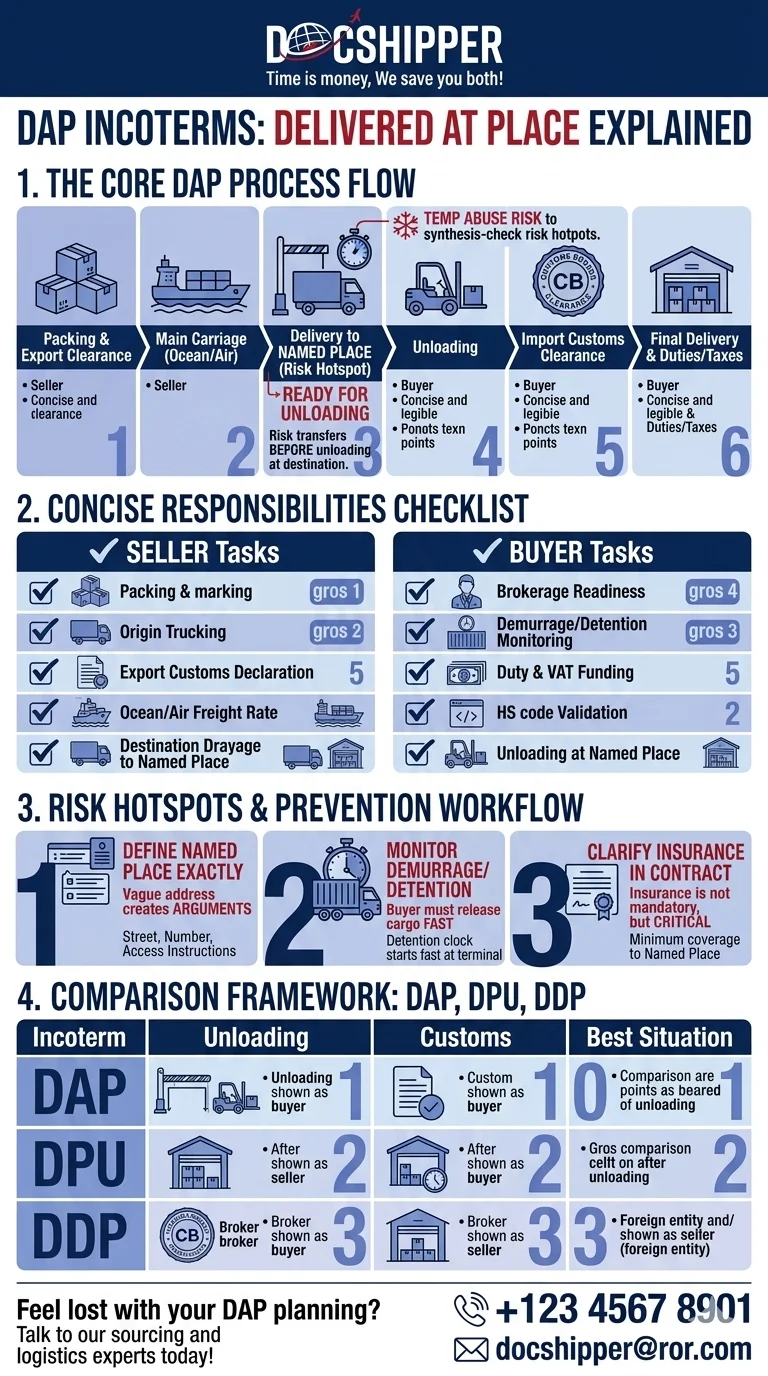
Dap incoterms, or Delivered At Place, mean the seller is responsible for arranging and paying for transport until the goods reach a named place at destination, ready for unloading, while the buyer handles unloading, import customs clearance, and all duties and taxes; risk transfers when the goods arrive at the named place, before unloading.

In the full content, you will find detailed DAP responsibilities for sellers and buyers, risk transfer points, cost breakdowns, comparisons with EXW/FOB/CIF/DPU/DDP, and step‑by‑step guidance to implement DAP and avoid delays and extra charges.

We hope you’ll find this article genuinely useful, but remember, if you ever feel lost at any step, whether it’s finding a supplier, validating quality, managing international shipping or customs,  DocShipper can handle it all for you!

Free shipping quote 24h      I want to talk to a sourcing expert

What DAP means in Incoterms and how it works in practice

If you’re trying to decode dap incoterms without getting lost in legal jargon, here’s the thing, DAP is one of the most practical dap delivery terms for real-world logistics.

It’s built for modern supply chains where your shipment moves via multimodal transport and you want a clean split of responsibilities between consignor and consignee.

In plain operations language, the seller delivers the cargo to a named place at destination, ready for unloading, then the buyer takes over for unloading and import customs clearance.

The DAP full form and official Incoterms definition

One morning, we saw a buyer approve “DAP warehouse” on a proforma invoice, then panic later because no one had planned the import clearance and the container sat at the port racking up charges.

That’s why you want the official meaning clear from day one, DAP full form is Delivered At Place, and the incoterms dap meaning is simple, the seller delivers when the goods are placed at the buyer’s disposal at the named destination, not unloaded.

You’ll usually see DAP written on the commercial invoice and mirrored in the shipping documents like the bill of lading or airway bill, plus a clean packing list for trade compliance.

To make DAP actionable, use this quick definition table as your baseline.

TermWhat “delivery” meansUnloadingImport customs clearance
DAPGoods arrive at the named place, ready for unloadingBuyer pays and managesBuyer pays and manages
Operational takeawaySeller controls transport up to destination pointBuyer needs a local handler and equipment planBuyer needs broker, license, and HS classification

How DAP evolved from earlier Incoterms (DDU, DAT, DPU)

Direct tip: if you still see “DDU” in supplier templates, treat it as a red flag and force an update to today’s dap shipping terms in writing.

DAP replaced the old idea of “Delivered Duty Unpaid” (DDU) and aligned better with how freight forwarding works today, especially when your cargo switches from ocean to truck to last-mile delivery.

You’ll also hear people confuse DAP with DAT and DPU, mainly because they all sound like “delivered somewhere,” but the unloading point is the trap.

Here’s a quick comparison you can reuse in negotiations, and it’ll save you a painful back-and-forth with your supplier.

Term (legacy/current) Core idea Unloading responsibility Best use
DDU (legacy) Delivered, duties unpaid Varied, often unclear Avoid, replace with DAP + clear clauses
DAT (older) Delivered at terminal Seller unloads at terminal Terminal deliveries where unloading is controlled
DPU (current) Delivered at place unloaded Seller unloads When you need seller to handle unloading risk
DAP (current) Delivered at place, not unloaded Buyer unloads Door/terminal delivery with buyer-controlled unloading
DAP Incoterms Explained

When the risk transfers from seller to buyer under DAP

When does risk actually switch under dap incoterms, at loading, at port of discharge, or at your door?

Bold truth: risk transfers when the goods are ready for unloading at the named place, not earlier, not later.

So if the truck arrives at your warehouse gate and the driver is waiting, the seller has performed delivery under dap shipping, even if your team hasn’t touched the pallets yet.

This is where many importers get stuck, the named place is often too vague, and vague places create arguments when there’s damage, shortage, or temperature abuse in transit.

Use this short workflow to lock the risk point down in your contract and shipment instructions.

  • Step 1: Specify a named place with an exact address and access constraints (gate hours, dock height, appointment rules).
  • Step 2: Define the delivery condition, “ready for unloading” with truck type and whether tail-lift is required.
  • Step 3: Require proof of arrival, ePOD or signed POD, plus seal number for FCL containerization.
  • Step 4: Align documents, bill of lading/airway bill, packing list, and invoice must show the same named place.

For the official Incoterms framework behind this, you’ll notice the reference point is consistent with guidance published by the International Chamber of Commerce (ICC).

Key responsibilities under DAP: what the seller does

With dap incoterms, the seller carries a surprisingly big operational load, even if they don’t pay import duties.

If you’ve dealt with suppliers who promise “DAP” but then go quiet when you ask about trucking, appointments, or last-mile constraints, you already know why clear task ownership matters.

Siam Shipping Advice

Before signing DAP, validate every seller obligation in writing.
We help you map tasks, documents, and delivery conditions to avoid costly grey zones.

Seller’s tasks from origin to export: packing, local transport, and clearanceSeller’s tasks from origin to export packing, local transport, and clearance

Last quarter, we saw a supplier ship DAP but forget to include the packing list details needed for export declaration, the cargo missed the vessel cut-off and the buyer ate the delay downstream.

Direct tip: treat origin readiness as a seller KPI under dap shipping terms, and ask for photo evidence plus document drafts before pickup.

At origin, the seller typically handles export packing, labeling, and local pre-carriage to the port of loading or airport, then completes the export declaration under local trade compliance rules.

Here’s a practical checklist you can send your supplier to prevent “it’s DAP, not my problem” discussions later.

  • Export-ready packaging matched to mode (cartons, pallets, crate) and containerization plan (FCL or LCL).
  • Markings aligned with consignee, PO, carton count, and any compliance labels.
  • Document set, commercial invoice, packing list, export license if applicable, and draft bill of lading/airway bill data.
  • Export customs clearance completed, including accurate harmonized system code and tariff classification inputs where required.

Main carriage and destination charges covered by the seller

Want to avoid hidden costs in dap shipping costs?

Under dap delivery terms, the seller pays the main carriage, ocean freight or air freight, and usually the destination-side transport up to the named place, depending on the contract and route design.

This includes the freight rate and typical surcharges, and in real freight forwarding contracts it often involves choices like spot rate vs. allocated rates, plus planning for lead time and transit time buffers.

To keep it operational, here’s what the seller commonly pays, and where disputes show up.

  • Main carriage, ocean or air transport, plus fuel and security surcharges.
  • Freight forwarding and handling fees tied to the shipment, including documentation charges.
  • Destination handling that’s required to move the container out, sometimes including drayage, depending on the named place definition.
  • Risk hotspots, demurrage and detention often become negotiation points if the buyer delays import release.

Delivery at place: named location, risk, and delivery conditionsDelivery at place named location, risk, and delivery conditions
Bold statement: the “P” in DAP is where deals either work smoothly or fall apart.

The seller’s obligation ends when the cargo is delivered to the named place, ready for unloading, which can be a terminal, a cross-dock, a bonded warehouse, or your final facility for last-mile delivery.

You’ll benefit from specifying the named place like a logistics operator would, not like a lawyer would, address, delivery window, truck restrictions, and who books the appointment.

Use this short workflow to make delivery conditions measurable, not debatable.

  • Define the place, exact site address, unloading bay reference, and contact name/phone.
  • Define the vehicle, container truck, box truck, tail-lift, or temperature-controlled equipment.
  • Define “arrived” proof, POD format, time stamp, and seal condition notes for FCL.
  • Define waiting time, who pays if the truck queues, and when detention starts.

Key responsibilities under DAP: what the buyer does

Under dap incoterms, you control the destination-side legal and operational pieces that usually create delays, unloading, customs clearance, and paying duties and taxes.

This is also where most buyers get frustrated, because one missing code or license can freeze the shipment even when transport was perfect.

Siam Shipping Alert

Under DAP, delays often start on the buyer side.
Secure your customs, unloading, and duty planning early to prevent storage and detention fees.

Buyer’s role at destination: unloading and import clearance

We once saw a consignee schedule warehouse labor for Friday, but the container arrived Thursday evening, nobody could unload, and the trucker billed waiting time that wasn’t in anyone’s budget.

Direct tip: align your unloading plan with the carrier’s ETA and cut-off rules, especially for FCL deliveries where detention clocks start fast.

Operationally, your job is unloading, receiving, and then managing the import process through your broker, including matching documents to what customs expects.

If you want a reliable baseline, use this checklist before the shipment reaches the port of discharge.

  • Unloading plan, equipment, labor, dock appointment, and receiving SOPs.
  • Broker readiness, power of attorney, importer record details, and contact escalation path.
  • Document match, bill of lading/airway bill, invoice, packing list, and any certificates required.
  • Exception handling, what you do if cartons are damaged, seals don’t match, or quantities are short.

If you need help setting up the destination process, you can also review our customs clearance approach to understand what your broker will ask for.

Duties, taxes, and local regulations the buyer must handleDuties, taxes, and local regulations the buyer must handle

Have you ever had a shipment arrive, then learn the HS code on the invoice doesn’t match your broker’s tariff classification?

That mismatch is exactly why dap shipping can feel “easy” until import duties, VAT, product compliance, or import licenses show up at the worst time.

With dap shipping terms, you pay duties and taxes and you ensure trade compliance, including correct harmonized system code, valuation method, and any permits for controlled goods.

To keep your imports moving, here are the common buyer-side regulatory items that trigger holds.

  • HS code validation and supporting product description consistency across documents.
  • Import licenses or registrations for regulated categories.
  • Local standards, labeling, testing reports, or conformity requirements.
  • Payment readiness, duty/VAT funding and broker disbursement approvals.

For a broader view of customs processes and compliance expectations across markets, you’ll see similar principles referenced by the World Customs Organization in its trade facilitation guidance.


Optional variations and contract clauses that shift responsibilities

Bold truth: DAP on its own doesn’t prevent arguments, your contract language does.

You can keep the incoterms dap meaning intact while still adding clauses on who pays what if something goes sideways, like exams, storage, or re-delivery after a customs stop.

Here’s a clause menu you can use with your supplier or freight forwarder to prevent surprise dap shipping costs that weren’t priced.

  • Demurrage/detention split if import clearance is delayed by missing documents or inspections.
  • Named place precision including whether delivery is to terminal, curbside, dock, or inside delivery.
  • Re-delivery terms if customs requests a different facility or scheduled appointment is missed.
  • Insurance requirement specifying minimum coverage and who provides the insurance certificate.

DAP shipping costs: who pays what and how to control your budget

Dap incoterms can make your landed planning cleaner, but only if you separate transport costs from import costs and control the gray areas where carriers add fees.

You’ve probably dealt with quotes that look “all-in,” then you later discover destination handling, storage, or re-delivery wasn’t included.

Siam Shipping Info

Unsure how to structure your DAP cost breakdown?
We analyze transport vs import expenses to protect your margin and eliminate hidden destination fees.

Typical cost components in a DAP shipment

We once reviewed a DAP quote where the seller paid the ocean freight, but the buyer got hit with a terminal fee the seller assumed was “destination handling,” the invoice landed after cargo arrival, of course.

Direct tip: request a cost breakdown by leg, origin, main carriage, destination, and last-mile, and map it to who controls each activity under dap shipping terms.

To make the split obvious, here’s a practical cost map for dap shipping costs you can use in your budgeting and negotiation.

Cost item Usually paid by Notes that affect your budget
Export packing, labeling Seller Impacts damage claims and container utilization
Origin trucking and export clearance Seller Needs correct export declaration data
Main carriage freight rate + surcharges Seller Spot rate volatility can be priced in by supplier
Destination handling and drayage to named place Seller (if required to reach named place) Clarify terminal fees vs. truck delivery, avoid double-charging
Unloading Buyer Warehouse labor, equipment, appointment fees
Import duties and taxes Buyer Driven by HS code, valuation, and trade measures
Customs brokerage Buyer Broker disbursements and exam fees can apply

How DAP affects cash flow for exporters and importers

Why do some sellers love dap shipping while some buyers hesitate?

Because DAP shifts transport cash flow to the seller, but import cash flow still hits you, often as a lump sum right when the cargo lands.

From experience, the cleanest way to avoid cash crunch surprises is to time your duty and VAT funding against your transit time, and confirm whether your broker requires prepayment before release.

Use this simple workflow to align cash flow with the shipment timeline.

  • Before departure: confirm duty/VAT estimate using HS code and customs value assumptions.
  • Mid-transit: pre-submit entry data where possible, validate invoice, packing list, and consignee details.
  • Pre-arrival: approve broker disbursement, schedule unloading resources, confirm delivery appointment.
  • Arrival week: track release, manage exams, and prevent storage, demurrage, or detention.

For context on how trade costs and border delays affect working capital globally, you’ll see these patterns discussed in World Bank trade logistics research.

Using DAP vs EXW/FOB/CIF to optimize total shipping costs

Bold statement: choosing DAP isn’t about picking the “best” Incoterm, it’s about choosing what you can control.

If you can’t manage origin pickup and export processes, dap incoterms often beats EXW because the seller stays responsible for export clearance and the first mile.

If you already have strong freight forwarding contracts and consolidation lanes, FOB or CIF might reduce supplier margin padding inside their freight rate, but you’ll take on more coordination and risk earlier in the chain.

Here’s a quick comparison table you can use to decide based on control, not habit.

Incoterm Who controls main carriage Export clearance Best when you want
EXW Buyer Buyer (often messy in practice) Maximum buyer control, but high execution burden
FOB Buyer Seller Control from port of loading onward
CIF Seller Seller Seller-managed ocean + basic insurance to port
DAP Seller Seller Seller-managed delivery to a named place, you manage import and unloading

If you want to reduce financial exposure on high-value cargo, build in freight insurance requirements even when the seller arranges the transport under DAP.

When you should use DAP for your international deliveries

If you’re wondering when dap incoterms actually make sense, you’re not alone. Delivered At Place can look simple on paper, but in practice it fits very specific commercial situations.

From experience, you’ll benefit from DAP when you want clarity on transport responsibility, yet you prefer to keep import control on the buyer’s side. According to the ICC Incoterms Committee, choosing the right rule is less about price and more about aligning risk, control, and capability.

Situations where DAP favors the buyer

Last year, we supported a distributor in the Middle East importing machinery from Europe under dap incoterms. The buyer had strong customs expertise locally, but zero leverage with European carriers.

With DAP, the seller handled the full transport to the warehouse door. The buyer only managed unloading and import formalities, which they already mastered.

You’ll find DAP favors you as a buyer when:

  • You want door delivery without organizing international freight.
  • You understand local customs rules better than your supplier.
  • You prefer to control duties and VAT payments directly.
  • You want clear risk transfer at the arrival point.

Here is a quick checklist to see if DAP works in your favor:

  • Do you have a customs broker in destination country?
  • Can you manage unloading equipment at site?
  • Are you comfortable handling import taxes and compliance?
  • Do you want predictable transport pricing from your supplier?

If you answered yes to most of these, DAP is often a balanced option.

Looking for a Reliable Shipping & Sourcing Partner?

We handle the entire sourcing process, supplier research, negotiation, production, and inspections, so you can focus on what matters most: growing your business.

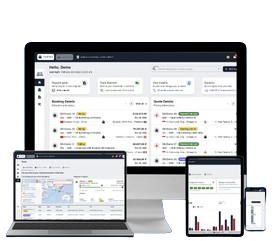
DocShipper Platform

One platform. Your entire supply chain

Sourcing, freight, customs & documents, all centralised, all visible, 24/7.

Situations where DAP favors the seller

Here’s a direct tip. If you already negotiate strong freight rates, using dap incoterms allows you to monetize that advantage.

We’ve seen Chinese manufacturers bundle competitive ocean freight into their sales price, increasing margin while still offering attractive delivered pricing.

DAP is particularly favorable to you as a seller when:

  • You have volume contracts with carriers.
  • You want tighter control over transit timing.
  • You aim to offer a “near door” solution without dealing with foreign customs.
  • You prefer to avoid foreign tax registration, unlike DDP.

You stay responsible until goods arrive at the named place, but you avoid the complexity of import duties.

Practical risks, delays, and how to avoid extra charges

What usually goes wrong with dap incoterms? The problem is rarely the rule itself, but vague contracts.

We once handled a DAP shipment stuck at destination because the “named place” was simply listed as “client warehouse.” The truck couldn’t access the site due to weight restrictions.

You can avoid typical DAP pitfalls by following this workflow:

Step 1: Specify the exact address and delivery conditions. Step 2: Confirm truck accessibility and unloading equipment. Step 3: Align on who pays demurrage and storage if customs is delayed. Step 4: Clarify insurance coverage in writing.

Watch out for these red flags:

  • Unclear delivery address.
  • No written agreement on detention costs.
  • Assumption that insurance is “included” without policy details.
  • Destination country with unstable import procedures.

Small ambiguities quickly turn into unexpected charges.

DAP vs other delivery terms: DPU and DDP compared

Choosing between dap incoterms, DPU, and DDP is not about letters, it’s about operational control. Each shifts risk and responsibility differently, especially at destination.

You’ll see why this comparison matters when delays hit customs or when unloading equipment is missing.

DAP vs DPU: unloading responsibilities and delivery point

Imagine a container arriving at a bonded terminal. Under dap incoterms, you as buyer handle unloading.

Under DPU, the seller must unload at the named place.

That single difference can change everything.

Aspect DAP DPU
Delivery point Named place, ready for unloading Named place, after unloading
Unloading cost Buyer Seller
Risk transfer Before unloading After unloading

If your facility lacks forklifts or cranes, DPU may protect you better.

DAP vs DDP: who handles customs, duties, and last-mile issues

Let’s be blunt. DDP is operationally heavier than dap incoterms.

With DDP, the seller handles import customs, duties, and often tax registration. With DAP, you as buyer manage import clearance and taxes.

According to the World Trade Organization, customs compliance complexity varies widely by country, and that’s where DDP becomes risky for sellers.

If you sell into markets with complex VAT systems, DAP reduces your exposure.

How to choose between DAP, DPU, and DDP for your shipment

Which rule fits your shipment best? Start with control and compliance capability.

Here is a simple decision framework for dap incoterms and alternatives:

  • If you control customs locally, choose DAP.
  • If you lack unloading capacity, consider DPU.
  • If your supplier has a local entity and manages taxes, DDP may work.
  • If duties are high and sensitive, avoid DDP unless fully calculated.

You’re not just selecting a term. You’re allocating operational risk.

How to implement a DAP agreement step by step

Using dap incoterms successfully requires precision. Most disputes come from vague execution, not from the rule itself.

At DocShipper, we’ve seen well-negotiated DAP contracts fail because the named place was unclear or insurance was assumed rather than defined.

Siam Shipping Advice

Turn DAP into a fully controlled process.
From named place definition to insurance and documentation, we secure every step before dispatch.

Defining the named place and route with your trading partner

We once managed a DAP delivery where the address included no postal code. The truck driver delivered to the wrong industrial zone.

Under dap incoterms, the named place must be exact. Not just the city, but the street, building number, and access instructions.

Before signing, confirm:

  • Full legal delivery address.
  • Opening hours and contact person.
  • Truck size restrictions.
  • Alternative delivery plan in case of access issues.

Precision at this stage avoids costly re-deliveries.

Contracting carriers, insurance, and freight forwarders under DAP

Here’s something many overlook. DAP does not require insurance, but you absolutely should define it.

When you negotiate dap incoterms, clarify:

  • Who selects the freight forwarder.
  • What level of cargo insurance applies.
  • Whether coverage extends to the named place.
  • How claims are handled if damage occurs.

In complex routes, working with a FIATA-aligned forwarder improves procedural compliance and documentation quality.

Documentation checklist for smooth DAP delivery

Paperwork delays more DAP shipments than transport issues. Missing one certificate can freeze goods at customs.

Use this checklist before dispatch under dap incoterms:

  • Commercial invoice with correct HS code.
  • Packing list aligned with shipment details.
  • Bill of lading or airway bill.
  • Export declaration.
  • Certificates of origin if required.
  • Insurance certificate, if agreed.
  • Import license, when applicable.

This simple control step often saves days of storage fees.

Conclusion

Dap incoterms offer a balanced approach between transport control and customs responsibility. You get clarity on who handles what, provided you define every operational detail.

If you want a quick recap, here are the key takeaways:

  • DAP means seller delivers to the named place, buyer handles unloading and import clearance.
  • Risk transfers before unloading at destination.
  • DAP suits buyers with strong local customs expertise.
  • Sellers benefit when they control freight contracts but avoid foreign tax complexity.
  • Precise delivery address and written cost allocation prevent disputes.
  • Comparing DAP with DPU and DDP is essential before signing any contract.

Used correctly, DAP becomes a powerful negotiation tool, not just a shipping term.

FAQ | DAP Incoterms explained: how Delivered At Place can simplify your international shipping

DAP in shipping means “Delivered At Place,” but “DAP warehouse” alone is too vague to protect you. To make it workable and avoid disputes, you should always ask your supplier to specify:

  • The **exact address** (street, ZIP/postcode, building, country).
  • The **type of place** (3PL warehouse, bonded warehouse, your own facility, terminal, etc.).
  • **Access conditions** (dock height, max truck size, opening hours, appointment rules).
  • Whether the named place is **inside customs territory** or a **bonded/FTZ area**.

If they refuse to add this detail in writing, you’re accepting a gray area on risk transfer, waiting time, and re-delivery costs.

Ask us anything!

Need Help with
Logistics or Sourcing ?

First, we secure the right products from the right suppliers at the right price by managing the sourcing process from start to finish. Then, we simplify your shipping experience - from pickup to final delivery - ensuring any product, anywhere, is delivered at highly competitive prices.

Component-15.png

Live Chat

Get instant assistance from our team - just click and start chatting!

Chat now
image

Fill the Form

Prefer email? Send us your inquiry, and we’ll get back to you as soon as possible.

Contact Us
image

Call us

Reach out to us on WhatsApp for a quck and personal support.

Call us
image