In short ⚡
LCL shipment is a less than container load ocean shipment where your cargo shares space in a container with other shippers’ goods, so you pay based on volume (CBM) or chargeable weight instead of a full container; it suits small to mid volumes, mixed SKUs, and frequent replenishment but involves extra CFS handling, destination fees, and higher damage or delay risk.In this article, you will find how LCL works from booking to deconsolidation, when to choose LCL vs FCL or air, how rates and extra fees are calculated, the role of documents and Incoterms, how to select a forwarder, and practical tips to cut costs, protect cargo, and track shared-container shipments.
We hope you’ll find this article genuinely useful, but remember, if you ever feel lost at any step, whether it’s finding a supplier, validating quality, managing international shipping or customs, DocShipper can handle it all for you!
What is an LCL shipment and when should you use it?
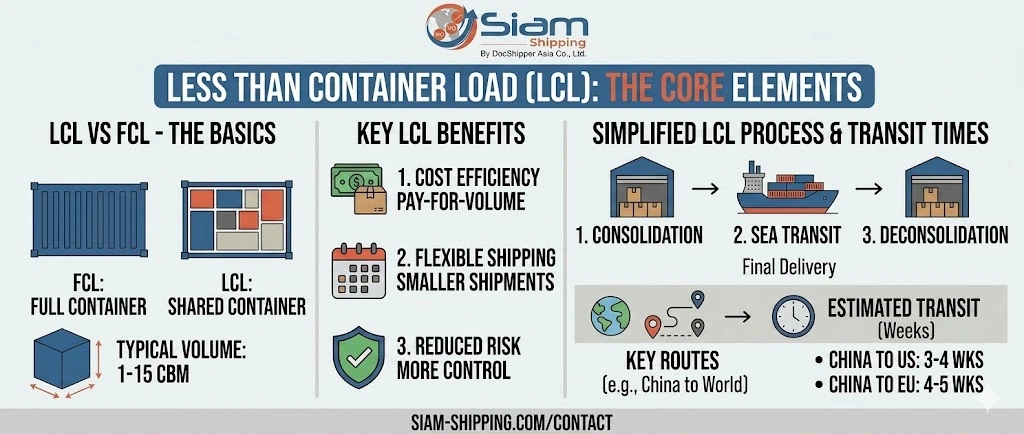
An LCL shipment is when your cargo shares a container with other shippers’ goods, so you pay for space instead of paying for a full box.
Here’s the thing, if you’ve ever had “not enough volume” to justify a full container, LCL ocean freight is usually the first lever to pull.
We see it constantly, you’re growing, your SKUs are multiplying, and your purchase orders don’t line up neatly into 20’ or 40’ containers.
That’s exactly where lcl cargo shipping makes sense, as long as you understand how consolidation, cut-offs, and destination fees work.
Siam Shipping Info
We model your CBM, cut-offs, and destination fees to validate the smartest mode before you book.
How LCL cargo shipping works in ocean logistics
Last quarter, we handled an LCL shipment for a buyer shipping mixed cartons, some were fragile, some were dense, and the supplier insisted “it’s fine” to stack everything together.
At the CFS, the weak cartons collapsed, and the forwarder re-packed them at the shipper’s cost, a small mistake that became a real invoice.
To make lcl cargo shipping feel predictable, you should picture it as a shared pipeline with fixed touchpoints.
One reliable end-to-end workflow looks like this:
- Booking with a consolidator or freight forwarder, based on your cargo details (CBM, weight, cartons, commodity).
- Origin delivery to CFS, where your cargo gets received, measured, and labeled.
- Consolidation with other shipments into one container.
- Main ocean leg, same vessel network as FCL, but with extra handling steps.
- Deconsolidation at destination CFS, then customs release and last-mile delivery.
You’ll notice fast that lcl freight lives and dies by correct measurements, because a single “rounded up” CBM can distort your costs.
LCL vs FCL vs air freight: which mode fits your load?
Want the simplest way to choose between LCL shipment, FCL, and air freight?
Start with your constraints, time, volume stability, and how much handling your product can tolerate.
This comparison table gives you a clear decision snapshot for lcl cargo shipping versus the alternatives:
| Criteria | LCL ocean freight | FCL (Full Container) | Air freight |
| Best for | Small to mid volumes, mixed SKUs, regular replenishment | High volume, heavy freight, consistent production | Urgent, high value, low volume, product launches |
| Speed | Slower due to CFS consolidation and deconsolidation | Faster port-to-port than LCL (fewer touchpoints) | Fastest (but airport processes still take time) |
| Handling risk | Higher, more moves at CFS | Lower, you control container loading | Moderate, less time in transit but strict packaging rules |
| Cost driver | CBM or chargeable weight, plus destination charges | Flat container cost, plus drayage and port fees | Chargeable weight, surcharges, security fees |
From experience, most importers get stuck because they compare only the ocean rate, not the full landed cost.
And yes, with LCL, those destination charges can surprise you if you don’t model them upfront.
When LCL freight makes more sense than a full container
LCL freight is the right call when you need inventory flowing without waiting weeks to “fill a box”.
That’s the moment many fast-growing brands hit, your sales move, but your container math doesn’t.
Here’s a practical checklist we use to validate whether an LCL shipment is a smart decision for you:
- Your volume is typically under 10 to 15 CBM per supplier pickup.
- Your SKU mix changes often, and you prefer smaller, more frequent restocks.
- Your cargo can handle extra handling (cartons, pallets, proper strapping).
- Your timeline allows buffer for CFS cut-offs and deconsolidation delays.
- Your destination plan accounts for local fees and final delivery constraints.
One insider note, destination fees vary a lot by port and local practices, something the World Bank logistics benchmarks regularly highlight when comparing trade friction across hubs.
Step-by-step journey of your LCL ocean freight
Your LCL ocean freight doesn’t move like a single straight line, it moves through shared infrastructure designed to batch shipments.
If you’ve dealt with suppliers who “ship whenever it’s ready”, this is where structure saves you time and money.
We like to treat every LCL shipment as a mini project, with fixed milestones and clear owners for each step.
Siam Shipping Advice
We map each milestone, CFS, documentation, and delivery step to avoid delays and hidden costs.
Booking your LCL shipment and preparing documents
One small tip that prevents big headaches, lock your booking only after you’ve confirmed carton count, dimensions, and gross weight for your LCL shipment.
Then align paperwork with your commercial reality, not what the supplier copy-pastes from the last invoice.
Use this simple booking workflow for lcl freight to keep control:
- Share cargo data, commodity, cartons, dimensions, weight, pickup address, readiness date.
- Confirm shipping terms under Incoterms 2020 before anyone issues documents.
- Validate customs data, especially product description and HS codes.
- Set cut-offs, cargo receiving deadline at origin CFS, document cut-off, and VGM if required.
- Confirm delivery mode, port-to-port, door-to-door, or door-to-port, so costs match reality.
When you prepare documents for lcl cargo shipping, you’ll also want to double-check who issues what, because LCL often involves both a master and a house bill.
Pickup, CFS handling, and consolidation into a shared container
Ever wondered why your LCL shipment can sit “received” for days before it actually sails?
That time is usually consolidation time, your cargo waits for the container build, plus it may need re-measurement, labeling, or palletizing.
Here’s a quick real-world scenario, a shipper booked 6.8 CBM, but the CFS measured 8.1 CBM after re-stacking for safety, and the rate applied to the higher figure.
To reduce surprises in lcl ocean freight, focus on how CFS works and what it charges for.
If you need a baseline definition, the Container Freight Station (CFS) is the facility where LCL cargo is received, processed, and consolidated into a shared container.
Use this checklist before cargo reaches the CFS, it’s where we see the biggest preventable issues in lcl freight:
- Cartons are strong enough for stacking, double-wall if needed.
- Marks and labels match the shipping instruction and purchase order.
- Dimensions are accurate, no “estimated” carton sizes.
- Pallet plan is clear, including pallet size, height limit, and whether pallets are accepted.
- Photos are taken at pickup, including seals if any and condition of cargo.
Main sea voyage, deconsolidation, customs, and final delivery
This is where LCL often wins or loses. Not at sea, but right after arrival, when deconsolidation and customs timelines collide.
We’ve seen shipments arrive on time, then miss a sales window because the consignee didn’t pay destination charges fast enough to release cargo.
In LCL shipment operations, documentation and release procedures matter as much as the vessel schedule.
At this stage, you’ll typically deal with bill of lading structures, including the Master Bill of Lading, and sometimes additional house documents depending on the consolidator.
If you’re comparing structures, this overview of House Bills of Lading helps you understand who is responsible for release and claims.
Advantages and drawbacks of LCL cargo shipping
LCL cargo shipping can feel like a cheat code when you’re trying to keep inventory lean.
But it can also feel messy if you expect it to behave like FCL, fewer touchpoints, fewer line items, fewer surprises.
We’ve probably all dealt with that moment, the rate looked cheap, then the destination bill arrived.
Siam Shipping Alert
Ask for a full landed cost simulation before choosing this mode.
Cost and flexibility benefits for small and growing shippers
Back when a DTC brand we supported started importing, they used one LCL shipment per month, then two, then weekly, without ever “waiting to fill” an FCL.
That cadence reduced stockouts and helped them test new SKUs without gambling on container quantities.
Here are the core benefits you actually feel in day-to-day lcl freight operations:
- Lower upfront spend, you pay for CBM, not a whole container.
- Better inventory flow, smaller, more frequent replenishment.
- Supplier flexibility, you can split POs across factories and still ship.
- Risk spreading, you avoid over-ordering just to optimize freight.
Just keep your eyes on the full cost, because cash flow gains disappear when destination fees get ignored.
Limits, risks, and when LCL is not the right option
Here’s a direct tip, if your product is fragile, high-claim, or extremely time-sensitive, you should challenge the default choice of an LCL shipment.
More handling means more opportunities for damage, mis-sorting, or delays at consolidation points.
To help you decide quickly, here are common red flags where lcl cargo shipping becomes the wrong tool:
- Volume is consistently high, you’re regularly above 15 to 18 CBM and climbing.
- Packaging is weak, soft cartons, poor inner protection, no corner reinforcement.
- Commodity is sensitive, batteries, liquids, powders, or regulated goods with tight paperwork.
- Delivery is urgent, you can’t absorb consolidation and deconsolidation lead time.
- Destination is complex, strict appointment delivery, limited receiving windows, or high demurrage risk.
When you see two or more of these, it’s often time to price FCL or consider air freight for part of the volume.
 LCL freight costs and less than container load shipping rates
LCL freight pricing is rarely “one rate”, it’s a stack of charges across origin, ocean, and destination.
If you’ve been burned before, it’s usually because someone quoted only the ocean portion, not the full door cost of the LCL shipment.
We’ll keep it practical here, so you can forecast and negotiate with confidence.
How LCL ocean freight charges are calculated
Anecdote from the field, a consignee once argued for days because they thought they were paying by weight, but the consolidator billed by volume for their LCL shipment.
They weren’t being cheated, the cargo was light, bulky, and charged on CBM rules.
To understand less than container load shipping rates, you need to know the pricing logic.
Here’s the typical calculation structure for lcl ocean freight, based on a published pricing structure approach you’ll see across the industry:
- Chargeable volume, CBM after CFS measurement, sometimes with minimums (for example 1 CBM).
- W/M rule, charged on weight or measure, whichever is higher (varies by lane and forwarder rules).
- Base ocean rate, per CBM or per ton, plus carrier surcharges (seasonal, equipment, etc.).
- Origin and destination fees, CFS handling, documentation, security, and release charges.
If you want stable numbers, you’ll need your supplier’s packing list to be accurate, not “close enough”.
Typical extra fees from origin to final delivery
Could your LCL shipment be “cheap at origin” and expensive at destination? Absolutely, and it happens all the time.
We once saw a buyer choose LCL on a low ocean rate, then pay more than expected because destination CFS and delivery add-ons weren’t budgeted.
To avoid that trap in lcl freight, you should map the usual fee buckets before you book.
Here’s a clean list of common extras you may see on lcl cargo shipping invoices:
- Origin, pickup, export customs clearance, origin documentation, CFS receiving and handling.
- Ocean, base freight, carrier surcharges, peak season adjustments on some lanes.
- Destination, CFS deconsolidation, handling, terminal fees, doc fee, customs broker charges.
- Final mile, delivery appointment, waiting time, liftgate, residential surcharge where applicable.
One quick habit that saves money, request a line-item quote including destination charges, not just the port-to-port figure.
Comparing LCL shipment costs with FCL and air freight
Here’s the blunt truth. The cheapest LCL shipment on paper can be more expensive than FCL when you’re near the break-even volume.
That’s why you should compare all-in costs at your realistic CBM range, not at “best case” assumptions.
Use this simple break-even thinking for less than container load shipping rates versus alternatives:
- At low CBM, LCL usually wins because you avoid paying for unused container space.
- In the middle range, you’re in the danger zone, destination charges can erase LCL’s advantage.
- At high CBM, FCL often becomes cleaner and cheaper per unit, with fewer handling steps.
- For urgent SKUs, air can be cost-effective when stockouts cost more than transport.
If you want a tight quote, bring your exact packing data and delivery constraints to the discussion, that’s how we model the real landed cost for lcl ocean freight.
Paperwork and Incoterms that shape your LCL shipment
In any lcl shipment, paperwork and Incoterms are not administrative details, they are the backbone of your risk and cost control. When you ship less than container load, your cargo shares space, handlers, and documents with others, so precision becomes critical.
You’ve probably experienced a shipment delayed because of a small mismatch in the invoice or HS code. In LCL ocean freight, that “small” mistake can block an entire consolidated container at customs.
Looking for a Reliable Shipping & Sourcing Partner?


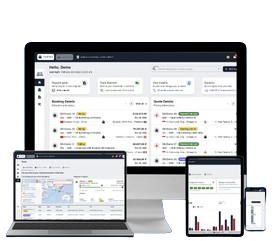
DocShipper Platform
One platform. Your entire supply chain
Sourcing, freight, customs & documents, all centralised, all visible, 24/7.
Essential documents for compliant LCL ocean freight
We once handled an lcl shipment from Shenzhen where the supplier copied an old HS code from a previous order. Customs flagged the container at destination, and every consignee inside had to wait. That’s how one inaccurate line can disrupt multiple importers.
For compliant LCL ocean freight, you need to control every document before cargo reaches the CFS.
Here are the core documents you must prepare correctly:
- Commercial Invoice, with accurate HS codes, Incoterm, currency, and full product description
- Packing List, detailing cartons, dimensions, gross and net weight
- Bill of Lading, usually a House B/L issued by your freight forwarder
- Certificate of Origin, when required for preferential duties
- Import or export licenses, depending on product category
- Insurance certificate, if you insure the cargo separately
According to the World Customs Organization, data accuracy is one of the top factors affecting customs clearance delays worldwide. In LCL shipping, that impact is multiplied because one issue can hold a consolidated box.
Before your cargo leaves the warehouse, use this quick compliance checklist.
- HS codes verified against destination tariff database
- Invoice value aligned with payment terms
- Incoterm clearly stated and consistent across documents
- Weights and CBM confirmed with actual measurements
- Consignee and notify party details double-checked
If you skip this control step, you’re taking a gamble with your timeline and storage costs at destination.
Using Incoterms 2020 to divide LCL risks and costs
Here’s a direct tip from experience: never agree to an Incoterm for your lcl shipment without mapping who pays what at both CFS points.
In LCL freight, charges accumulate at origin CFS, during consolidation, and at destination CFS during deconsolidation. If your Incoterm is unclear, you’ll discover surprise invoices when your cargo is already at port.
Incoterms 2020, defined by the ICC Incoterms Committee, clearly allocate risk transfer and cost responsibility. But in shared container logistics, practical interpretation matters even more.
| Incoterm | Who Pays Origin CFS | Main Freight | Destination Charges | Risk Transfers |
| EXW | Buyer | Buyer | Buyer | At seller’s premises |
| FOB | Seller | Buyer | Buyer | On board vessel |
| CIF | Seller | Seller | Buyer | On board vessel |
| DAP | Seller | Seller | Seller (except duties) | At named place |
For most less than container load shipping from Asia, you’ll often see FOB or CIF. But you should calculate the total landed cost under each scenario before committing.
We’ve seen importers choose CIF because the freight looked cheaper, only to face high destination handling fees that were not transparent at booking. When you understand Incoterms deeply, you stay in control of your margin.
Siam Shipping Info
We break down origin CFS, freight, and destination charges so your risk and cost are clear upfront.
How to choose the right LCL freight forwarder
Your lcl shipment is only as reliable as the forwarder managing consolidation, documentation, and CFS coordination. In LCL cargo shipping, execution discipline matters more than marketing promises.
You’ll notice fast that not all forwarders have the same network strength or consolidation frequency on specific trade lanes.
What to look for in an LCL shipping partner
One importer came to us after three delayed lcl shipments in a row. The issue was not the ocean carrier, it was irregular consolidation schedules at origin CFS.
Strong consolidation frequency should be your first criterion. If your forwarder only consolidates once per week on your route, you’re automatically adding waiting time.
Here’s what you should evaluate before selecting a partner:
- Number of weekly LCL consolidations per trade lane
- Owned or controlled CFS network
- Experience with your product category
- Transparent breakdown of origin and destination charges
- Digital tracking capability for shared containers
The International Air Transport Association often highlights visibility as a key competitiveness factor, and the same applies to ocean LCL logistics. If you cannot track milestones clearly, you lose control.
Before signing, use this internal validation checklist.
- Transit time confirmed door-to-door, not just port-to-port
- Written quotation with detailed local charges
- Clear claims procedure for damage or shortage
- Dedicated operational contact
You don’t need the cheapest forwarder. You need the most operationally reliable one.
Key questions to ask before you book LCL cargo
What happens if your cargo misses the consolidation cut-off for your lcl shipment?
This is the kind of question most importers forget to ask, and it directly affects your lead time.
Before you confirm your LCL cargo booking, ask these critical questions:
- What is the exact CFS cut-off date and time?
- How many free storage days are included at destination?
- Are destination charges fixed or estimated?
- Who handles customs clearance and at what fee?
- What is the claim timeline in case of cargo damage?
We’ve seen cases where importers assumed five free days at destination, but the tariff allowed only three. Storage started accruing immediately at high daily rates, eating into their profit.
Clear answers upfront protect your schedule and your cash flow.
Pro tips to optimize, protect, and track your LCL freight
Managing an lcl shipment successfully is not just about booking space. It’s about preventing avoidable costs, protecting cargo integrity, and maintaining visibility from origin warehouse to final delivery.
This is where experienced shippers separate themselves from beginners.
Avoiding common LCL shipping mistakes
We once reviewed an lcl shipment where cartons were labeled only with a brand name, no shipment marks. During deconsolidation, two pallets were misrouted to another consignee.
Small oversights create big complications in shared containers.
Here are frequent mistakes you should actively prevent:
- Underestimating volume, leading to higher final CBM charges
- Weak packaging not designed for stacking in consolidated containers
- Ignoring destination CFS free-time limits
- Accepting vague Incoterm definitions
- Skipping cargo insurance for high-value goods
The World Trade Report regularly emphasizes operational resilience in global trade. In LCL freight, resilience starts with disciplined preparation.
Before every shipment, run this quick prevention checklist.
- Cartons clearly marked with shipment reference and consignee
- Actual measured CBM confirmed by warehouse
- Insurance coverage aligned with cargo value
- Buffer days included in planning
These small controls reduce most avoidable incidents.
Negotiating better less than container load shipping rates
Rates in LCL shipment are negotiable.
If you treat LCL ocean freight as a fixed tariff product, you’ll always pay more than necessary.
To negotiate effectively, follow this simple workflow:
1. Consolidate volume forecasts for 3 to 6 months. 2. Share estimated monthly CBM with your forwarder. 3. Request a volume-based rate agreement. 4. Compare at least two detailed quotations. 5. Negotiate destination charges, not only ocean freight.
We’ve helped clients reduce total LCL freight cost by focusing on destination handling fees rather than only the base ocean rate. That’s where margins often hide.
If your cargo flow becomes stable, you can even negotiate fixed seasonal rates to avoid peak season spikes.
Packaging, volume calculation, and tracking best practices
Did you know that in lcl shipment, you’re usually charged on W/M, meaning weight or measure, whichever is higher?
This means accurate volume calculation directly impacts your cost.
Use this simple reference table for volume calculation.
| Unit | Formula | Result |
| Carton CBM | Length x Width x Height in meters | m³ per carton |
| Total CBM | Carton CBM x Quantity | Total m³ |
| Chargeable | Compare CBM vs weight ratio | Higher value applies |
Strong packaging matters just as much. Your cargo will be handled multiple times, from origin CFS to destination deconsolidation.
Follow these best practices:
- Use double-wall cartons for fragile goods
- Palletize when possible to reduce handling damage
- Apply moisture protection for long sea transit
- Request milestone tracking updates at CFS in and CFS out
When you combine accurate CBM calculation, solid packaging, and proactive tracking, your less than container load shipping becomes predictable and controlled.
Siam Shipping Advice
We help you optimize packaging, negotiate rates, and track milestones from CFS in to final delivery.
Conclusion
An lcl shipment gives you flexibility and cost efficiency when you don’t fill a full container, but it demands rigor in documentation, Incoterms alignment, forwarder selection, and operational control.
If you approach LCL ocean freight strategically, you protect your margins and your timelines.
Here are the key takeaways you should remember:
- Accurate documentation prevents consolidated container delays
- Incoterms 2020 directly shape your total landed cost
- Forwarder consolidation frequency affects transit time
- Destination charges often hide significant costs
- Proper packaging and CBM calculation protect both cargo and profit
- Negotiation is possible when you commit consistent volume
When you treat less than container load shipping as a structured process rather than a simple booking, you turn a shared container into a controlled, efficient supply chain tool.
FAQ | LCL shipment: ship smaller loads by sea at lower cost
Think “over-protect and over-communicate” for anything going LCL. Focus on:
- Packaging
- Use double‑wall cartons and inner cushioning (foam, bubble, corner protectors).
- Do not mix very heavy and very light items in the same box.
- Keep cartons as uniform in size as possible so they stack safely.
- Palletizing
- Use solid pallets (no broken boards), shrink‑wrap tightly, and strap vertically and horizontally.
- Keep pallet height reasonable (often max 1.6–1.8 m) to avoid collapse.
- Labelling
- Apply clear “FRAGILE”, “THIS SIDE UP”, and center‑of‑gravity labels where relevant.
- Put shipment reference, consignee, and PO on at least two adjacent sides of each carton.
- Instructions to your supplier/warehouse
- Send a simple one‑page packing standard with photos.
- Ask for pictures of packed pallets/cartons before they leave the warehouse.
You need to replace guesses with verifiable data and align incentives:
- Before production finishes
- Ask for an exact packing plan: number of cartons, each carton’s L×W×H, and gross weight.
- Have them measure with a tape measure and send photos of the tape on the carton.
- In your documents
- Put carton dimensions on the packing list, not just weights and quantities.
- Ask your forwarder to quote “subject to CFS re‑measurement” with a defined tolerance (e.g. ±3–5%).
- Operational controls
- If a lane is stable, have your own warehouse (or a 3PL) measure a sample shipment once, then lock that as the reference.
- When CFS re‑measurement is much higher, request the CFS measurement sheet and photos, and dispute if needed.
Treat destination release like a separate mini‑project you prepare for in advance:
- Before booking
- Ask for a written list of all expected destination charges and free‑time (CFS, storage, documentation).
- Confirm who pays them under your Incoterm, you or your supplier.
- Before arrival
- Ask your forwarder to send the pro‑forma destination invoice and payment instructions several days before ETA.
- Prepare funds and, if needed, set your customs broker as an approved vendor in your system.
- After arrival
- Pay charges immediately and send proof of payment.
- Have your broker pre‑file customs where possible to avoid parallel delays (storage + customs).
You can run a “multi‑supplier, one consolidation” play if you coordinate tightly:
- Planning
- Pick a single origin CFS and a fixed weekly (or bi‑weekly) cut‑off.
- Tell every supplier the same delivery window and labeling standard.
- Supplier instructions
- Give each supplier:
- CFS address and contact
- Your forwarder’s booking number
- Exact marks and labels to use (including your company + consolidation reference).
- Documentation
- Decide whether each supplier issues its own commercial invoice to you, or whether a trading company aggregates them.
- Ensure all invoices use the same consignee, Incoterm, and destination to avoid customs confusion.
- Control
- Ask your forwarder for a pre‑load summary: list of suppliers, CBM per supplier, and total CBM before container build.
Build a simple recurring “mode check” instead of guessing:
- Step 1: Gather real data
- Actual total CBM and weight for the shipment.
- Full LCL quote (origin + ocean + destination).
- FCL quote for the smallest suitable container (usually 20’).
- Step 2: Normalize
- Convert both to “cost per CBM delivered door‑to‑door”.
- For LCL, don’t forget destination CFS and deconsolidation fees.
- Step 3: Decide thresholds
- Define a CBM range where you automatically request both LCL and FCL (e.g. 10–18 CBM).
- Above your historical break‑even (e.g. 16 CBM on a certain lane), default to FCL unless timing/constraints say otherwise.
- Step 4: Review quarterly
- Re‑check your break‑even every few months, because local charges and ocean rates shift.
Yes, especially when you lose visibility and pay inflated destination fees:
- Red flags that CIF may hurt you
- You receive only a very low “freight included” price, with no breakdown of destination charges.
- You discover at arrival that the local destination agent (chosen by your supplier) is charging high release and handling fees.
- When to keep control (FOB or EXW instead of CIF)
- You ship regularly on the same lane and can negotiate better all‑in rates yourself.
- You need predictable, transparent destination costs for margin control.
- How to transition
- Ask your supplier to quote FOB alongside CIF for 2–3 POs.
- Share those FOB terms with your own forwarder and compare full landed cost (including destination).
Combine clear physical identification with clean data:
- On the cargo
- Put a unique shipment reference (your internal code + B/L or booking number) on every carton.
- Use large, legible labels (not just tiny stickers) on multiple sides of each pallet/carton.
- In the documents
- Ensure packing list and shipping instructions repeat the same reference and clearly state number of packages.
- Avoid generic descriptions like “goods” or only a brand name, customs and CFS need more detail.
- With your forwarder
- Ask them to share CFS “in” and “out” tally sheets (received quantity vs. loaded quantity).
- For higher‑risk shipments, request photos at origin CFS and at deconsolidation to confirm your cargo is correctly identified.
Need Help with
Logistics or Sourcing ?
First, we secure the right products from the right suppliers at the right price by managing the sourcing process from start to finish. Then, we simplify your shipping experience - from pickup to final delivery - ensuring any product, anywhere, is delivered at highly competitive prices.


Fill the Form
Prefer email? Send us your inquiry, and we’ll get back to you as soon as possible.
Contact Us