In short ⚡
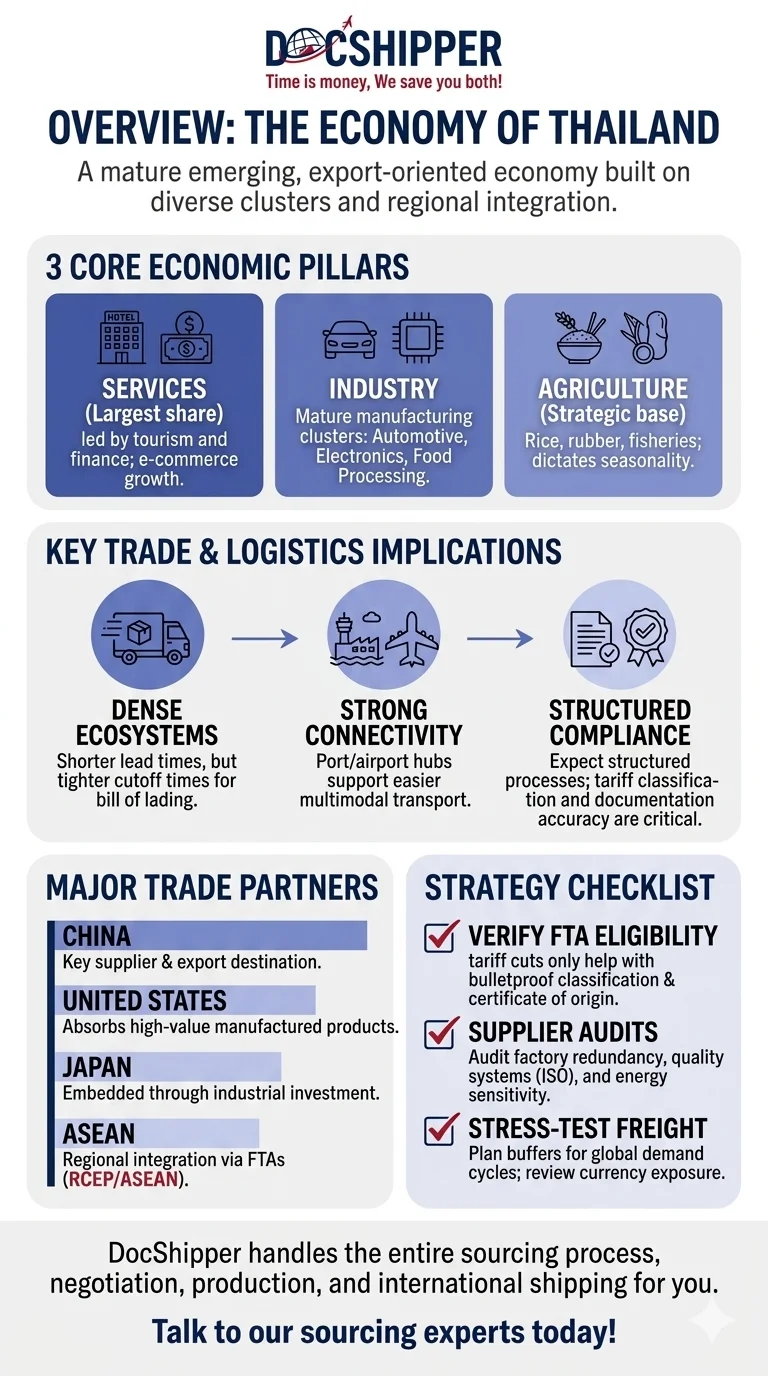
Economy of Thailand is a mature emerging, export‑oriented economy built on manufacturing clusters (automotive, electronics, food processing), a still-strategic agricultural base (rice, rubber, fisheries), and a dominant service sector led by tourism and finance. It combines strong trade integration via ASEAN/RCEP, solid logistics infrastructure, and resilient yet debt-constrained domestic demand.In this article, you will find Thailand’s historical economic evolution, sectoral structure, key exports and trade partners, logistics implications, current challenges like productivity and household debt, and how geopolitics and regional agreements shape future trade and investment opportunities.
We hope you’ll find this article genuinely useful, but remember, if you ever feel lost at any step, whether it’s finding a supplier, validating quality, managing international shipping or customs, DocShipper can handle it all for you!
Thailand’s economic profile and recent performance
The Economy of Thailand sits in a sweet spot you’ll notice fast, it’s diversified enough to absorb shocks, yet still export-dependent enough that global freight rates and demand cycles hit your margins.
If you’re moving cargo in or out, the thailand economy isn’t just “macro news”, it directly shapes transportation planning, customs clearance timing, and even how you negotiate Incoterms with suppliers and buyers.
Siam Shipping Info
Talk to our logistics experts to secure space, optimize Incoterms, and protect margins when demand shifts.
From Asian tiger to mature emerging economy
A few years back, we handled a mixed shipment for a client combining auto parts and packaged food, both made in Thailand, and the supplier casually said, “we ship weekly like clockwork.” That’s the tell, the Economy of Thailand has built repeatable export routines like a mature manufacturing hub, not a “developing” wildcard.
You can think of the thai economy as an “Asian tiger” that grew up, it still competes on cost, but it wins more often through clusters, supplier depth, and stable cargo handling and containerization practices.
Here’s a simple way to map what “mature emerging economy” means for your logistics and supply chain management decisions.
| What you observe | What it changes for your shipments |
| Dense manufacturing ecosystems (automotive, electronics, agro-processing) | More options for freight consolidation, shorter lead times, but tighter cutoff times for bill of lading finalization |
| Strong port and airport connectivity | Easier multimodal transport (sea-air, road-sea), better shipment tracking consistency |
| Export exposure | Your freight rates and space availability move with global demand, plan buffers |
| Structured trade compliance culture | HS code discipline matters, expect questions on tariff classification and documentation accuracy |
GDP growth, inflation and household debt trends
Direct tip: when you quote landed cost in the Economy of Thailand, don’t stop at supplier price, you’ll want a clean view of inflation pressure, currency moves, and how household debt affects local consumption and inventory turns.
In practical terms, shifting demand inside the thailand economy changes how factories allocate capacity, and you’ll feel it as longer production queues, tighter warehousing slots, or sudden swings in load optimization needs.
This is the quick workflow we use with clients to keep forecasts realistic.
- Step 1: Separate demand signals, domestic vs. export orders, because thailand exports can surge even when local demand slows.
- Step 2: Re-check Incoterms and cost responsibilities, especially insurance, pre-carriage, and terminal handling.
- Step 3: Validate HS codes and import duties exposure early, tariff classification mistakes often “look like” inflation.
- Step 4: Stress-test freight options, compare sea freight with air freight for peak periods and urgent SKUs.
For macro framing, you’ll see institutions like the World Bank frequently track Thailand’s growth and resilience metrics, and those reports help you sanity-check your internal forecasting.
Political cycles, shocks and their impact on the thai economy
What happens to your shipments when politics heats up or a shock hits, and suddenly everyone talks about “risk” in the Economy of Thailand?
You’ve probably dealt with suppliers who promise “no issue” right until port congestion, regulatory changes, or a spike in inspections slows down customs brokerage and your delivery order timing.
Use this short checklist before you lock production and book space, it’s the easiest way to keep your supply chain management calm when headlines get loud.
- Trade compliance: confirm export regulations, restricted goods, and document requirements for your commodity.
- Customs readiness: validate the harmonized system code, invoice values, and cargo manifest consistency.
- Routing plan: keep a Plan B, alternate ports, intermodal shipping options, or earlier gate-in deadlines.
- Insurance: align cargo insurance coverage with Incoterms so you don’t discover gaps after a delay.
- Cash flow: model longer transit and storage, demurrage, detention, and extra warehousing days.
Historical evolution of the thai economy
The Economy of Thailand didn’t become a regional production base by accident, it grew through investment waves, export discipline, and continuous upgrades in infrastructure that affect how you plan freight forwarding today.
And yes, history matters, because the way Thailand reacts to risk, currency swings, and regulation comes straight from what it lived through in prior crises.
Siam Shipping Advice
Audit your sourcing and shipping model with us to anticipate regulatory swings and currency exposure.
Industrial takeoff, Japanese investment and export-led growth
We’ve seen a real pattern when visiting industrial zones, a Tier-2 supplier will often say their quality system exists “because the Japanese customer required it years ago.” That legacy is part of the Economy of Thailand, and it still shapes factory discipline and packaging specs for containerization.
The industrial takeoff leaned heavily on export-led growth, which is why thailand exports became a core engine and why your buyers often expect reliable lead times and clean paperwork, down to the bill of lading details.
Here’s the simple sourcing-to-shipping workflow that matches how many Thai factories still operate.
- RFQ and specs: lock palletization, labeling, and carton marks early to avoid rework at the distribution center.
- Production slot: confirm capacity allocation, export orders often get priority in peak cycles.
- Pre-shipment checks: verify packing list, HS codes, and cargo handling constraints.
- Booking: choose sea freight vs air freight based on urgency and freight invoice sensitivity.
- Docs and release: align shipment tracking, delivery order issuance, and proof of delivery needs.
The 1997 Asian crisis, financial reforms and recovery
Direct tip: if you want to understand why Thai partners can be conservative on payment terms, look back at 1997, the crisis taught the Economy of Thailand hard lessons about leverage, currency exposure, and liquidity.
That caution still shows up in negotiation, you might be pushed toward deposits, tighter credit, or faster document release, especially when the supplier fears FX risk tied to thailand imports and exports.
This is a clean way to compare “before vs after” from an operator’s perspective.
| Area | What changed after 1997 | Impact on your trade logistics |
| Finance and risk controls | Stronger oversight and more disciplined credit | Expect stricter compliance on invoices, values, and banking documents |
| Corporate governance | More structured reporting and controls | Better predictability for long-term supply chain contracts |
| Trade execution | More focus on export resilience | More standardized documentation and customs processes |
For a global reference point on crises and trade recovery dynamics, you’ll see the IMF often cited in retrospective analyses that help explain regional policy responses.
Post-2010 developments, elections and economic confidence
Is the Economy of Thailand “stable enough” for multi-year sourcing and long-term freight forwarding contracts, even with elections and policy swings?
From experience, you can run stable lanes if you build operational buffers, split suppliers where it makes sense, and keep your customs clearance files audit-ready, especially for products that draw scrutiny in trade compliance.
Use this short checklist before you commit to long-term volume allocations.
- Supplier redundancy: qualify at least one backup factory or subcontractor for critical SKUs.
- Routing resilience: validate road haulage access to port, and keep rail freight options when available.
- Contract clarity: define Incoterms, cutoffs, and liability for delays in your freight forwarding contract.
- Inventory plan: set safety stock rules and cross-docking vs storage decisions at your distribution center.
- Visibility: require milestone-based shipment tracking and clear proof of delivery processes.
Economic structure: sectors and employment
The Economy of Thailand works because its sectors complement each other, agriculture feeds processing, industry powers exports, and services keep domestic demand and tourism moving.
If you’re designing a logistics outsourcing model, this structure tells you where to place warehousing, how to plan last mile delivery, and which nodes need the tightest cargo handling controls.
Siam Shipping Info
Design a warehousing and distribution strategy aligned with Thailand’s production clusters and demand nodes.
Contribution of agriculture, industry and services to GDP
Bold statement: you can’t understand the thailand economy if you look at factories only, services and agriculture silently dictate seasonality, storage needs, and export peaks.
What you’ll see on the ground is simple, harvest cycles fill warehouses, processing plants ramp up, and then thailand exports surge through ports with heavy container volumes.
Here are the sector signals that typically show up in your transportation planning.
- Agriculture: seasonality drives warehousing and inventory management, plus tighter quality requirements for food-grade cargo.
- Industry: steady outbound flows, predictable freight consolidation, frequent use of containerization.
- Services: tourism and retail demand affect import cycles and last mile delivery capacity.
For an internationally comparable lens on how sectors shift over time, the OECD framework and datasets often guide how analysts segment productivity and value creation.
Labor market, demographics and unionization
We once had a shipment delayed because a factory changed shift patterns right before a holiday week, and the packing team simply wasn’t there to finish palletization. That’s the kind of “small” labor reality that can disrupt the Economy of Thailand at your shipment level.
Demographics, skills availability, and union dynamics influence overtime, peak production capacity, and how reliable your booking windows are for sea freight and air freight.
Use this quick checklist to reduce labor-related surprises in your supply chain management.
- Calendar control: map public holidays and factory shutdown periods into your lead times.
- Packaging labor: confirm who handles labeling, palletization, and cargo manifest prep.
- Cutoff discipline: agree on documentation deadlines for bill of lading drafts and freight invoice issuance.
- Contingency: plan buffer days for peak season and arrange optional warehousing near port.
Agriculture and natural resources in Thailand
Agriculture still plays a strategic role in the Economy of Thailand, not because it dominates GDP, but because it drives food processing, rural employment, and a big slice of export seasonality.
If you ship commodities or food products, you’ll deal with inspection regimes, moisture risks, and stricter traceability expectations during customs clearance.
Siam Shipping Advice
Secure compliant packaging and pre-shipment checks before peak season tightens container availability.
Major crops, rice leadership and rubber exports
During one peak season, we watched a warehouse team rework dozens of pallets because the liner bags weren’t sealed properly, humidity was creeping in, and the buyer rejected the lot. In the Economy of Thailand, rice and rubber move in huge volumes, but the win is in the details.
These flows matter for thailand exports because they create predictable surges that influence container availability, freight rates, and port cutoffs.
Here are the practical controls that keep agro-exports shippable.
- Packaging: specify inner liners, desiccants, and pallet wrap standards for moisture-sensitive cargo.
- QC points: add weight checks and photos before stuffing, so disputes don’t happen after the bill of lading is issued.
- Documentation: align certificates, labeling, and HS code selection early to avoid customs holds.
For global context on commodity trade patterns, you’ll often see UNCTAD referenced in discussions around export concentration and price cycles.
Forestry, livestock and fisheries
Direct tip: if your product touches forestry, meat, or seafood, treat compliance as part of your logistics plan, not an afterthought, because one missing document can freeze your customs brokerage process.
In the Economy of Thailand, these sectors also mean cold chain, faster transit, and tighter coordination between cargo handling and shipment tracking.
This is the workflow that keeps temperature-sensitive or regulated goods moving.
- Classify: confirm harmonized system code and any special permits tied to the product category.
- Pack: validate insulation, gel packs, or reefer settings, and record loading temps.
- Move: choose air freight for shelf-life urgency, or sea freight with reefer monitoring for cost control.
- Clear: pre-submit documents when possible, and keep a clean cargo manifest and certificates pack.
Mining, energy resources and environmental pressures
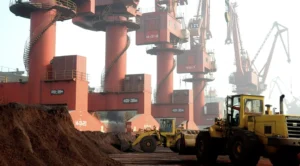
Do you expect Thailand to behave like a mining powerhouse, or more like a manufacturing and services hub that imports a chunk of its energy inputs?
The Economy of Thailand relies heavily on stable energy supply for industrial zones, so energy pricing and environmental rules can ripple into factory schedules and transport planning.
Use this checklist to stress-test energy and resource exposure in your sourcing and shipping decisions.
- Energy sensitivity: ask suppliers how power cost changes affect pricing and lead times.
- Route risk: confirm whether hazardous or controlled materials require special cargo handling.
- Compliance: verify permits and documentation for regulated inputs to avoid customs clearance delays.
- Seasonality: account for weather impacts that can affect road haulage and last mile delivery.
For the standards side of environmental and energy management systems, ISO references often come up in supplier audits and compliance discussions.

Thailand’s industrial base and manufacturing strengths
The Economy of Thailand is often described through its factories for a reason, Thailand industry is built around scalable manufacturing, export execution, and supply chains that can support high-frequency shipping.
If you’re buying finished goods or components, this is where your choices about incoterms, freight forwarding, and inventory management become competitive advantages.
Siam Shipping Info
Plan capacity, documentation, and multimodal routing with a freight partner who knows Thai cutoffs.
Automotive, electronics and food processing clusters
We’ve seen a common situation, a buyer negotiates a great unit price on electronics, then loses the savings because they didn’t plan for peak-season air freight. In the Economy of Thailand, clusters run fast, and you need to match them with realistic transport capacity.
These industries drive a large share of thailand exports, and they tend to operate with strict documentation discipline, labeling rules, and packaging requirements that affect palletization and cargo manifests.
Here’s a quick comparison to help you choose the right shipping approach by cluster.
| Cluster | Typical logistics priority | Common shipping mode |
| Automotive | Reliability, sequencing, damage prevention | Sea freight with strong packaging, plus road haulage to ports |
| Electronics | Speed, low damage rate, documentation accuracy | Air freight for high value SKUs, sea freight for volume |
| Food processing | Compliance, shelf life, traceability | Sea freight, reefer when needed, strict customs clearance prep |
For global manufacturing competitiveness context, you’ll often see the World Economic Forum cited around supply chain resilience and industrial capability benchmarks.
Textiles, chemicals and other key industries
Bold statement: the fastest way to get burned in Thailand industry is to treat regulated cargo like “normal freight.”
The Economy of Thailand includes chemicals and industrial inputs where trade compliance, correct tariff classification, and cargo handling rules matter as much as price.
This checklist keeps your Thailand shipments clean and predictable.
- Classification: verify HS codes and any dual-use or controlled classifications.
- Documentation: align SDS, packing list, and cargo manifest fields, inconsistencies trigger holds.
- Incoterms: clarify who pays for special handling, storage, or inspections before you ship.
- Insurance: ensure cargo insurance matches the risk profile and declared value.
Infrastructure, logistics and transport networks
Ever had a container arrive on time, but the cargo missed the factory gate because the final trucking slot wasn’t secured? That “last mile” slip happens more than people admit, even in the Economy of Thailand with its strong transport backbone.
Your routing options typically combine sea freight via major ports, air freight through Bangkok’s gateways, and inland moves using road haulage and some rail freight, which is exactly where multimodal transport planning pays off.
Use this step-by-step workflow to design a robust Thailand export or import lane.
- Step 1: Pick the right node, port, airport, or inland distribution center based on cargo type and lead time.
- Step 2: Choose the transport mix, intermodal shipping when it lowers risk, direct when it saves time.
- Step 3: Lock operational details, container type, palletization, VGM, cutoff times, and bill of lading instructions.
- Step 4: Run customs clearance prep early, HS codes, tariff classification, and document consistency.
- Step 5: Execute with visibility, shipment tracking milestones, delivery order control, proof of delivery capture.
For a neutral reference on global trade logistics norms, the WCO is often mentioned in discussions about customs modernization and standardized clearance procedures.
External context: Thailand’s modern political history is often associated with figures such as Prem Tinsulanonda, and those eras help explain why political cycles still influence confidence and investment timing.
Looking for a Reliable Shipping & Sourcing Partner?
DocShipper Platform
One platform. Your entire supply chain
Sourcing, freight, customs & documents, all centralised, all visible, 24/7.
Services, tourism and financial system
The Economy of Thailand relies heavily on its service sector, which now contributes the largest share of GDP and employment. If you’re analyzing Thailand from a trade or logistics perspective, you quickly realize that services drive demand for imports, infrastructure, and cross-border flows.
Tourism, finance, telecom, and business services are not just complementary sectors. They shape cargo volumes, airport traffic, warehousing demand, and even last-mile distribution models.
Siam Shipping Advice
Forecast tourism-linked demand to secure warehousing and last mile capacity ahead of surges.
Tourism’s role, evolution and resilience
We once handled urgent air freight for a European hotel chain expanding into Phuket, and within weeks, their occupancy was back above expectations. That’s how powerful tourism remains inside the Economy of Thailand, even after major shocks.
Before the pandemic, tourism accounted for roughly 20% of GDP when including indirect effects, according to the UN World Tourism Organization. You feel this weight immediately when borders close or reopen.
Here’s what makes Thai tourism structurally resilient:
- Diversified source markets, from China and ASEAN to Europe and the Middle East
- Segmented offerings, beach tourism, medical tourism, MICE, eco-tourism
- Strong aviation connectivity through Bangkok, Phuket, Chiang Mai
- Government support measures during downturns
If you’re exporting to Thailand, you should track tourism flows carefully. A surge in arrivals often translates into higher imports of food products, consumer goods, hotel equipment, and construction materials.
Banking, finance and business services
Here’s a practical tip: if you’re planning operations in the Economy of Thailand, open discussions with local banks early. Credit conditions and documentation standards can be stricter than you expect.
The financial system is relatively stable and supervised by the Bank of Thailand. Commercial banks dominate, but you’ll also find strong insurance, leasing, and asset management players supporting trade and industrial activity.
To assess the financial ecosystem quickly, use this checklist:
- Check foreign ownership limits in financial services
- Confirm LC and trade finance practices with your Thai counterpart
- Review currency exposure and hedging tools
- Understand local collateral requirements
From experience, most importers get stuck on documentation mismatches. Align Incoterms, payment terms, and customs valuation rules upfront, or you’ll face delays that affect both cash flow and shipping schedules.
Media, telecommunications and digital economy
What happens when 5G penetration accelerates in a country integrated into global supply chains? In the Economy of Thailand, it boosts e-commerce, fintech, and cross-border digital services almost overnight.
Thailand has invested heavily in fiber optics and mobile infrastructure. The digital economy now fuels online retail, cross-border marketplaces, and digital payment systems.
You’ll notice fast growth in:
- E-commerce logistics platforms
- Digital payment ecosystems
- Cloud and data center investments
- Cross-border online trade
If you ship consumer goods into Thailand, digital channels are no longer optional. They directly influence import volumes, bonded warehouse usage, and last-mile delivery contracts.
Thailand exports, imports and trade partners
The Economy of Thailand is deeply export-oriented. You can’t understand its growth model without analyzing trade flows, manufacturing competitiveness, and regional integration.
Thailand consistently ranks among the world’s top trading nations, with merchandise trade representing a high share of GDP, as highlighted in WTO trade statistics. That level of openness shapes everything from port infrastructure to customs modernization.
Siam Shipping Alert
Pre-book space and validate documentation to avoid delays at strategic ports and airports.
Export composition and competitiveness of thailand’s industry
We once supported a European buyer sourcing auto parts from Eastern Thailand. Within a 50-kilometer radius, you had dozens of Tier 1 and Tier 2 suppliers. That density explains a lot about the Economy of Thailand and its export strength.
Main export categories include:
- Automotive and auto parts
- Electronics and integrated circuits
- Agro-food products
- Petrochemicals and plastics
Here is a simplified overview:
| Sector | Competitive Advantage | Logistics Implication |
| Automotive | Regional production hub | High containerized exports |
| Electronics | Skilled workforce, clusters | Air freight sensitivity |
| Agro-food | Strong agricultural base | Cold chain requirement |
If you’re importing from Thailand, align your inspection protocols with ISO-certified factories. Quality is generally strong, but batch variation still occurs, especially in agro-based products.
Thailand imports and exports with major partners
Have you checked where most Thai exports actually go? The Economy of Thailand is closely tied to China, the United States, Japan, and ASEAN neighbors.
China is both a key supplier of intermediate goods and a major export destination. The US absorbs high-value manufactured products, while Japan remains deeply embedded through long-standing industrial investment.
To evaluate trade exposure, consider this quick checklist:
- Identify top three export markets for your sector
- Assess currency risk exposure
- Monitor geopolitical tensions affecting supply chains
- Track freight rate volatility on major routes
From a logistics standpoint, Laem Chabang port and Suvarnabhumi airport are strategic nodes. If congestion builds up there, the entire regional supply chain feels it.
Trade agreements, tariffs and regional integration
Free trade agreements are not just political tools. In the Economy of Thailand, they directly affect your landed cost.
Thailand is part of ASEAN and RCEP, which lowers tariffs across Asia-Pacific markets. It also maintains bilateral agreements with several partners.
Before shipping, follow this practical workflow:
- Step 1: Verify HS code classification
- Step 2: Confirm FTA eligibility rules of origin
- Step 3: Prepare certificate of origin documentation
- Step 4: Cross-check customs valuation method
We’ve seen shipments delayed simply because origin documentation was incomplete. A small paperwork gap can wipe out your tariff advantage.
Current challenges and future outlook for the thai economy
The Economy of Thailand stands at a crossroads. Growth continues, but structural constraints are becoming more visible.
If you’re investing, sourcing, or expanding logistics operations, you should understand both the opportunities and the friction points shaping the next decade.
Siam Shipping Advice
Stress-test your supply chain against debt trends, productivity gaps, and geopolitical balancing.
Competitiveness, innovation and productivity gaps
We often hear the same concern from industrial clients. Why is productivity growth slower than in some regional peers within the Economy of Thailand?
Challenges include:
- Aging workforce trends
- Skills mismatch in high-tech sectors
- Limited R&D intensity
- SME digital adoption gaps
The World Bank has pointed to innovation capacity as a key driver for long-term competitiveness. If you rely on Thai suppliers, invest time in auditing their automation level and quality systems.
Household debt, inequality and social issues
Let’s be direct. High household debt is one of the most sensitive issues in the Economy of Thailand.
Debt-to-GDP ratios for households remain elevated, which can constrain domestic consumption. That matters if you’re targeting the Thai consumer market.
Use this checklist before launching a consumer-focused strategy:
- Analyze urban versus rural purchasing power
- Review credit availability trends
- Segment price sensitivity carefully
- Consider distribution financing models
You’ve probably seen markets where credit-fueled growth suddenly slows. Thailand is not in crisis, but debt levels require close monitoring.
Geopolitics, “bamboo diplomacy” and investment prospects
Thailand practices what many call “bamboo diplomacy,” bending with global winds while staying rooted. In the Economy of Thailand, this flexible foreign policy reduces extreme alignment risks.
The country maintains strong ties with China, the US, Japan, and ASEAN partners. This balancing act helps attract diversified FDI inflows.
If you’re considering long-term investment, focus on:
- Eastern Economic Corridor incentives
- Infrastructure megaprojects
- Regional supply chain diversification
- Green and renewable energy initiatives
From our experience, investors who align logistics strategy with government priority zones gain faster customs clearance and better infrastructure access.
Conclusion
The Economy of Thailand combines export-driven manufacturing, a powerful service sector, and strategic regional integration. If you look closely, you’ll see a system that is both resilient and exposed to global cycles.
Before making trade or investment decisions, keep these key takeaways in mind:
- Services and tourism remain central growth engines
- Manufacturing exports anchor trade performance
- Trade agreements directly impact your landed costs
- Household debt and productivity shape domestic demand
- Geopolitical flexibility supports diversified partnerships
If you approach Thailand with a clear understanding of its trade structure, logistics backbone, and regulatory framework, you position yourself to benefit from one of Southeast Asia’s most dynamic economies.
FAQ | Economy of Thailand: structure, key sectors and trade opportunities
Thailand’s export dependence creates very visible “high” and “low” seasons in logistics. To turn that into an advantage:
- Identify your sector’s peak:
- Agro-food: around harvest/export seasons (often Q3–Q4 depending on product)
- Automotive/electronics: global launch cycles, back‑to‑school, pre‑Christmas
- During peaks:
- Book sea freight space 3–4 weeks earlier than usual
- Lock trucking slots to/from port/airport at time of factory booking
- Expect tighter cut‑offs for VGM, container gate‑in and bill of lading instructions
- During off‑peak:
- Renegotiate long‑term rates (FCL and LCL) with carriers/forwarders
- Test slower but cheaper routings (e.g. transshipment instead of direct)
- Push for better free‑time at destination (demurrage/detention)
Most problems are avoidable and come from paperwork, not “bad luck”. The main traps are:
To avoid this:
- Misaligned documents:
- HS code on commercial invoice ≠ HS code on packing list or manifest
- Inconsistent Incoterms between sales contract, invoice and LC
- Under- or over-valuation:
- Declared value not matching payment terms or banking documents
- “Free samples” with zero value declared (triggering questions or reassessment)
- Missing or late certificates:
- Certificate of origin and health/phytosanitary docs not ready at arrival
- Incorrect description of goods (too generic) in the manifest
- Have your forwarder or customs broker pre‑check the full doc pack before loading
- Lock HS codes and valuation method in writing with your customs advisor
- Use clear, non‑generic product descriptions on all documents
SMEs in Thailand can be excellent on product, but weaker on process and documentation. To stabilize your supply chain:
- Audit the basics:
- Who prepares export documents? (factory vs. forwarder)
- Who books transport and by when?
- Standardize operations:
- Send them a simple “shipping playbook” with: labels, palletization, carton marks, doc deadlines
- Require photo evidence of packing and stuffing for the first shipments
- Build buffers:
- Add 3–5 days of extra lead time around Thai holidays and local festivals
- Keep a small safety stock near your destination market for critical SKUs
- Formalize responsibilities:
- Use Incoterms that match their capabilities (e.g. FCA/FOB instead of CIF if they are weak on international freight)
Distance to gateways changes both cost and risk profile. For inland plants (e.g. Northern or Northeastern Thailand):
- Plan the inland leg as a separate “mini‑project”:
- Confirm road haulage transit time plus realistic buffer (traffic, weather, checkpoints)
- Check truck access, loading hours and equipment (tail‑lift, side‑loader, etc.)
- Control hand‑over points:
- Define exactly where risk and cost transfer (factory gate, consolidation warehouse, port)
- Make sure CMR/waybill and seal numbers are recorded at each transfer
- Prevent missed departures:
- Set truck departure at least one working day before port or airport cut‑off
- Use GPS‑tracked trucking for high‑value cargo so you can react if delays happen
Political noise usually translates into operational friction, not total shutdowns. On the ground, you may see:
To prepare without overreacting:
- More frequent inspections at ports/airports
- Sudden changes in required documents for specific HS codes
- Stricter enforcement of valuation and origin rules
- Ask your broker/forwarder for:
- Any new “sensitive HS list” or sectors getting extra scrutiny
- Average clearance time changes at your chosen port or airport
- Increase preparedness:
- Pre‑submit documents when available (e‑clearance)
- Add 2–3 days extra buffer in transit time during tense periods
- Ensure cargo insurance explicitly covers delay‑related costs where possible
Most preferential duty claims fail on “admin”, not on real origin. The main errors are:
To secure the benefit:
- Wrong or incomplete certificate of origin:
- Form type not matching the agreement used (e.g. generic CO instead of FTA‑specific form)
- Missing or inconsistent HS code or product description
- Rules of origin misunderstood:
- Assuming “assembled in Thailand” is enough, while value‑added or specific processing rules aren’t met
- Mixing originating and non‑originating components without tracking them
- Poor internal traceability:
- No clear link between supplier invoices, BOM, and the final CO claim
- Map your bill of materials against the specific FTA rules of origin
- Have your Thai supplier provide an origin statement per component when relevant
- Get an advance opinion from a trade specialist or customs broker before your first preferential shipment
Beyond price, focus on their ability to execute consistently in Thailand’s environment:
This kind of upfront screening is often what decides whether your Thailand strategy scales smoothly or gets stuck after the first few containers.
- Operational capability:
- Tour the facility or request recent photos/videos of production, packing, and loading areas
- Ask for on‑time shipment statistics over the last 12 months
- Compliance and finance:
- Check export history (which markets? which products?)
- Request copies of recent customs entries or export declarations (redact prices if needed)
- Verify banking details with a call to the bank via a publicly listed number
- Contingency readiness:
- Ask how they handled COVID/previous disruptions (alternative routes, backup facilities, overtime, etc.)
- Verify they work with at least one experienced international freight forwarder
Need Help with
Logistics or Sourcing ?
First, we secure the right products from the right suppliers at the right price by managing the sourcing process from start to finish. Then, we simplify your shipping experience - from pickup to final delivery - ensuring any product, anywhere, is delivered at highly competitive prices.
Fill the Form
Prefer email? Send us your inquiry, and we’ll get back to you as soon as possible.
Contact Us