In short ⚡
Dangerous goods regulations are the set of international and national rules that govern how hazardous materials are classified, packaged, marked, documented, and transported so they do not harm people, property, or the environment. Built on UN Model Regulations and adapted by mode (air, sea, road, rail, inland waterways), they define hazard classes, UN numbers, packing groups, and legal responsibilities across the supply chain.In this article, you will find how UN-based classification works, the main modal rules (IMDG, IATA, ADR, RID, ADN), packaging and labeling requirements, documentation and liability for shippers and carriers, and practical routines to stay compliant with frequently updated dangerous goods regulations.
We hope you’ll find this article genuinely useful, but remember, if you ever feel lost at any step, whether it’s finding a supplier, validating quality, managing international shipping or customs, DocShipper can handle it all for you!
What counts as a dangerous good and why regulations matter
Dangerous goods regulations kick in the moment your cargo can harm people, property, or the environment during transportation of dangerous goods.
You’ve probably dealt with suppliers who say “it’s just a chemical” or “it’s only batteries”, then your freight forwarder flags it and your shipment gets stuck at slot booking or customs clearance.
Here’s the thing, classification drives everything that follows, packaging, labels, documentation, carrier acceptance, and even whether you can move by air or must reroute to sea.
Definition of dangerous goods and key risk concepts
We’ve seen a “simple cleaning liquid” arrive at a consolidation hub with no DG note, then the warehouse team smelled solvent and stopped cargo handling on the whole pallet row.
That’s exactly why dangerous goods regulations exist, they cover substances and articles that present a hazard in transport, not only in use.
A practical way to think about it is this, DG classification reflects what can go wrong when you move, store, and handle cargo across a supply chain.
To make that concrete, here are the main risk concepts used in hazardous materials transportation regulations:
- Hazard class, the type of danger (flammable, toxic, corrosive, etc.).
- UN number, the four-digit identifier used worldwide on the dangerous goods list.
- Packing group, the severity level (I high, II medium, III low) where applicable.
- Quantity and concentration, thresholds can change the rules, exemptions, or required packaging.
- Physical state, solid, liquid, gas, plus temperature control for some cargo.
- Mode sensitivity, what’s allowed by ocean freight may be rejected for air freight.
In day-to-day dangerous goods logistics, misdeclaring often happens at the product data stage.
You’ll notice fast that missing details like flash point, battery watt-hours, or aerosol classification can break your freight tender and trigger extra cargo insurance conditions.
How international and national rules are built on UN recommendations
Tip: start compliance from the UN framework, then verify the local add-ons where your shipment touches the ground.
Most international dangerous goods rules trace back to the UN Recommendations on the Transport of Dangerous Goods, often called the “UN Model Regulations”.
From experience, if you align your product classification and documentation with that base, you avoid 80% of painful rework later in freight forwarding and carrier contracting.
This is the workflow we use with shippers before we even quote a freight rate:
Step-by-step sourcing-to-shipping DG workflow
- Step 1: Collect product data, SDS, composition, battery spec sheets, test reports, and intended use.
- Step 2: Determine UN number, proper shipping name, class, packing group, and any special provisions.
- Step 3: Select compliant packaging and quantity limits for your chosen mode and route.
- Step 4: Prepare DG documentation aligned with commercial invoice, packing list, and bill of lading data.
- Step 5: Book with a carrier that accepts the class, then schedule pickup and cross docking with DG-capable handling.
- Step 6: Keep records for audits, claims, and post-shipment traceability.
This matters because enforcement isn’t theoretical, agencies coordinate under the World Customs Organization approach to controls, and carriers do their own safety screening too.
Siam Shipping Advice
Let DocShipper validate your classification, packaging, and documents before you request carrier quotes, we prevent costly rework and rejected bookings.
Global framework and main dangerous goods regulations you must know
Dangerous goods regulations aren’t one single book, they’re a framework that gets “translated” into mode-specific codes and national laws.
You’re not only managing compliance, you’re managing multimodal transport, carrier acceptance, warehousing constraints, and the realities of freight brokerage.
We’ve watched importers lose a week because they had the right UN number, but used the wrong packing instruction for the chosen route, so the airline rejected it at acceptance.
Siam Shipping Alert
We align mode, route, and packaging before booking, so airlines and shipping lines accept cargo first time.
UN model regulations and the international dangerous goods system
What’s the fastest way to stop guessing with hazardous goods transport?
Anchor your process on the UN system, it standardizes the language: UN number, proper shipping name, class, packing group, labels, and packaging performance.
Once you use that structure, your documentation lines up cleanly with tariff classification work like HS code selection and the consistency checks customs may run against your commercial invoice.
To make the landscape easier, here’s a plain comparison of what the UN model covers versus what mode codes add:
| Layer | What it gives you | What it doesn’t replace |
| UN Model Regulations | Core classification logic, UN numbers, hazard classes, packing groups, general packaging principles | Carrier-specific limits, mode-specific packing instructions, local permits and enforcement practices |
| Mode codes | Operational rules for air, sea, road, rail, inland waterways, including quantity limits and stowage | Local administrative requirements (registrations, reporting, fines), and some country deviations |
| National implementation | Legal enforceability, inspections, penalties, domestic route restrictions, licensing | Consistency across borders, you still need to check transit and destination rules |
If you’re building a supplier onboarding process, you’ll benefit from making “UN classification data” a mandatory field right next to your packing list and carton specs.
How regional and national authorities adapt the global framework
Bold statement: the same UN number can be “legal” in one corridor and rejected in another because authorities add deviations.
That’s the trap most importers hit when they scale from one lane to several, the product didn’t change, the compliance perimeter did.
We’ve handled cases where a shipper planned a road pre-carriage to a port, but the domestic route crossed a tunnel with DG restrictions, so the carrier contract had to be rewritten and the pickup rescheduled.
Before you lock your shipment scheduling, run this quick checklist to avoid surprises in transportation of dangerous goods:
- Transit countries checked for DG deviations and route bans (tunnels, bridges, urban zones).
- Carrier acceptance confirmed for your class, packaging type, and quantity per package.
- Port/airport terminal rules validated for DG cut-off times and storage limits.
- Warehousing capability verified (segregation, spill control, ventilation, trained staff).
- Document alignment ensured across DG declaration, bill of lading, invoice, and packing list.
For context, global trade rules encourage harmonization, but local enforcement still varies, and UNCTAD regularly highlights how compliance costs and regulatory fragmentation affect cross-border logistics.
Siam Shipping Advice
Run a deviation check with our DG specialists before scheduling pickup, we review transit bans, tunnel limits, and terminal rules.
Dangerous goods regulations by mode of transportation
Dangerous goods regulations change depending on whether you ship by air freight, ocean freight, road haulage, rail freight, or inland waterways.
You’ll save time and money if you choose the mode after confirming what’s permitted for your UN number, not the other way around.
We once saw a shipper insist on air because of a retail launch date, then discover their lithium battery configuration exceeded passenger aircraft limits, and the reroute cost more than the inventory itself.
Siam Shipping Alert
We compare modes against your UN number and quantities to secure the safest, most cost-efficient routing.
Road, rail and inland waterways rules (ADR, RID, ADN and others)
Anecdote time, a pallet of “paint” cleared export paperwork, then the trucking company refused pickup when they realized the labels didn’t match the declared class.
That’s road reality, drivers and dispatchers live by acceptance rules because they carry the liability on public infrastructure.
In Europe and many connected corridors, you’ll hear these names constantly in hazardous materials transportation regulations:
- ADR for road, it governs vehicle placards, driver training, equipment, and route constraints.
- RID for rail, focused on tank/container requirements, documentation, and rail operator safety rules.
- ADN for inland waterways, with strong emphasis on vessel suitability and segregation.
If your supply chain includes pre-carriage by road or a segment by rail, treat it as a full compliance leg, not “just domestic”.
One reference point many safety managers use for broader policy alignment is the OECD work on transport safety and risk governance.
Siam Shipping Info
Our team verifies ADR, RID, and ADN compliance across pre-carriage and rail segments to avoid last-minute refusals.
Maritime and air regulations (IMO, IMDG, ICAO, IATA)
Tip: if you want fewer surprises, pick the mode code first, then build packaging and documents backward from its acceptance checklist.
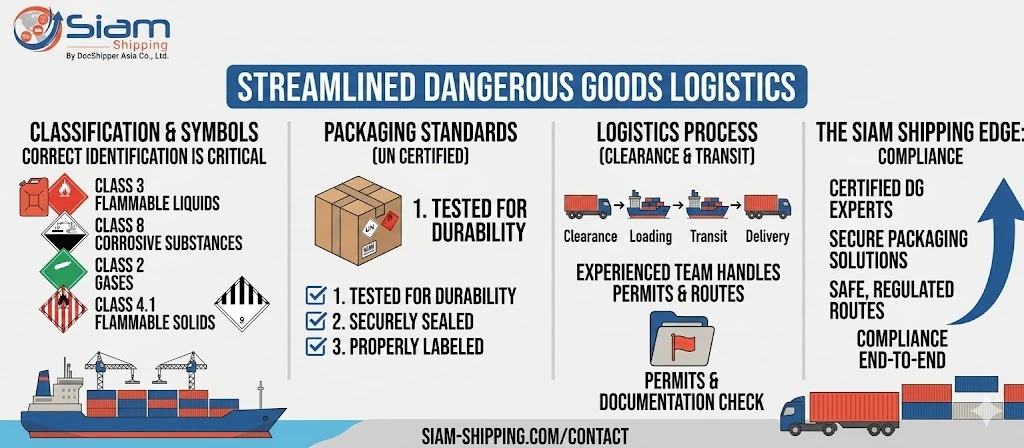
For ocean freight, the backbone is the IMDG Code under the International Maritime Organization, and it drives stowage, segregation, and container packing rules for dangerous goods logistics.
For air freight, ICAO Technical Instructions and the IATA Dangerous Goods Regulations are what airlines and ground handlers actually enforce at the counter.
You don’t need to memorize the books, but you do need to know what typically triggers rejection:
- Incorrect packing instruction for the mode, especially for batteries and aerosols.
- Missing or wrong marks/labels on the outer package or overpack.
- Document mismatches between DG declaration and commercial invoice or packing list.
- Quantity limits exceeded per package, per aircraft type, or per container.
We’ve seen “perfect” cargo get stopped because the shipper used a generic product name on the invoice, while the DG paperwork used the proper shipping name, and the airline requested a full re-issuance.
In practice, these standards connect with broader international safety governance led by bodies like the International Civil Aviation Organization.
Comparing risk by mode: what is the most dangerous type of transport?
Is there really a single most dangerous mode of transportation for hazardous goods transport?
Not in a way that helps you make decisions, because “danger” depends on quantity, packaging integrity, exposure, and consequence of an incident.
Air feels strict because it is, consequences escalate quickly, and acceptance checks are unforgiving, but the volumes are usually smaller.
Sea moves huge quantities, so the systemic risk sits in container packing, stowage, and firefighting constraints.
To help you choose operationally, here’s a decision table we use in multimodal planning under dangerous goods regulations:
| Mode | Where risk concentrates | What you should watch |
| Air freight | Rapid escalation, limited emergency response options onboard | Quantity limits, packing instructions, DG declaration accuracy, trained shipper process |
| Ocean freight | Large consolidated loads, hidden misdeclaration, long voyages | IMDG stowage/segregation, container stuffing quality, VGM and documentation consistency |
| Road haulage | Public exposure, route constraints, human factors | Placarding, driver requirements, tunnel restrictions, last mile delivery constraints |
| Rail freight | Tank integrity, network restrictions, incident complexity | RID compliance, operator acceptance, terminal handling procedures |
| Inland waterways | Water contamination consequences, vessel suitability | ADN rules, segregation, emergency planning on waterways |
The real win is designing your lane so you minimize handling events like cross docking and deconsolidation, because every touchpoint increases incident probability.
Siam Shipping Info
We design multimodal lanes with minimal cross docking to keep your DG cargo compliant and stable from origin to destination.
Classes of dangerous goods and how the list is organized
Dangerous goods regulations rely on a universal structure, hazard classes and UN numbers, so every actor in the chain speaks the same language.
Once you understand the list logic, you’ll stop arguing with carriers and start fixing the data that drives acceptance.
We’ve had customers swear a product was “non-hazardous”, then a quick SDS check showed a flash point that pushed it into a flammable liquid entry on the dangerous goods list.
The 9 hazard classes and UN numbers explained
Bold statement: if you get the UN number wrong, everything else you do becomes noise.
The “9 classes” are broad hazard families, and the UN number pinpoints the exact regulated entry on the dangerous goods list.
Here’s the high-level map used across international dangerous goods systems:
- Class 1: Explosives
- Class 2: Gases
- Class 3: Flammable liquids
- Class 4: Flammable solids, self-reactive substances, substances liable to spontaneous combustion, substances which emit flammable gas when wet
- Class 5: Oxidizing substances and organic peroxides
- Class 6: Toxic and infectious substances
- Class 7: Radioactive material
- Class 8: Corrosives
- Class 9: Miscellaneous dangerous substances and articles (including many lithium batteries)
From a supply chain management angle, UN numbers are what tie together labeling, packaging tests, documentation, and carrier contracts.
When you align UN number data with your inventory management and SKU master data, you reduce “surprise DG” events at the distribution center.
Siam Shipping Alert
We audit SDS data and SKU masters to eliminate surprise DG findings at your warehouse or carrier terminal.
Typical products found in each class and what they imply for transport
Ever wondered why two “similar” products get treated completely differently in hazardous materials transportation regulations?
Small formulation differences can push you into a new class, which changes packaging, segregation, and whether consolidation is even allowed.
We’ve seen this with fragrances, one batch had a higher alcohol percentage, and suddenly the carton count per package had to drop to meet limits for the chosen lane.
To translate classes into operational implications for transportation of dangerous goods, use this quick checklist before you request a shipping quote:
- Check compatibility if you plan consolidation, some classes can’t be packed or stowed together.
- Confirm packaging performance, UN-tested packaging may be mandatory depending on class and packing group.
- Plan quantity strategy, smaller inner packagings can unlock acceptance where single large bottles fail.
- Validate temperature sensitivity, self-reactive and peroxides often require strict controls.
- Prepare for inspections, corrosives and flammables commonly trigger closer cargo handling checks.
It’s also worth aligning with ISO terminology and management-system thinking for consistent internal controls, many teams use ISO frameworks to formalize these processes.
Siam Shipping Advice
Our DG review transforms class data into operational decisions that protect consolidation plans and delivery deadlines.
Packaging, marking and hazard labels under dangerous goods regulations
Dangerous goods regulations become “real” at the packaging table, because compliant classification without compliant packaging still gets rejected.
You might feel this is the moment where suppliers get sloppy, generic cartons, weak inner packaging, or labels applied like an afterthought.
We’ve had shipments where the product was correctly classified, but the outer box failed a basic handling test in the warehouse, and the carrier refused it for safety.
Looking for a Reliable Shipping & Sourcing Partner?


Approved packaging for hazardous goods transport
Anecdote from the floor, a supplier used a double-wall carton for a corrosive, no certified inner, no absorbent, and it leaked during palletization.
That one “small” packaging shortcut can shut down a lane and trigger claims, rework, and missed delivery windows.
In hazardous goods transport, approved packaging usually means UN performance packaging tested for drop, stack, and leak resistance where required by the entry.
Before you release a PO for packaging, run this quick checklist with your supplier and 3PL services partner:
- Packaging type matches the DG entry and packing instruction (single, combination, composite).
- UN marking present and legible on the outer packaging when required.
- Inner packaging compatible with the substance, plus cushioning and absorbent if required.
- Closure method follows manufacturer instructions, especially torque and sealing.
- Overpack rules respected if you shrink-wrap or add an over carton.
This is where tight coordination with your supplier, your freight forwarder, and your warehouse team protects your schedule and freight invoice from expensive last-minute fixes.
Siam Shipping Alert
We verify UN packaging, inner compatibility, and overpack rules before cargo reaches the warehouse floor.
Hazard labels, placards and UN numbers on vehicles and cargo
Tip: treat labels and marks like a “machine-readable language” for humans, if they’re wrong, somebody will stop the shipment.
Labels communicate the hazard class on the package, placards do the same at vehicle or container level, and UN numbers connect the physical cargo to the paperwork.
You’ll see why this matters during carrier acceptance, mismatched labels versus documents often trigger immediate holds, even if the cargo itself is fine.
Here’s a simple workflow you can use to prevent labeling failures under dangerous goods regulations:
- Step 1: Confirm the proper shipping name and UN number on the dangerous goods list entry.
- Step 2: Apply required hazard labels and any handling marks (orientation arrows, limited quantity marks, etc.).
- Step 3: If you use an overpack, repeat marks and labels as required and keep them visible.
- Step 4: Verify placarding needs for the transport unit, especially in road haulage segments.
- Step 5: Cross-check package markings against the DG declaration, packing list, and bill of lading data.
In audits and incident investigations, regulators and carriers look for this alignment first, and the ICC Incoterms Committee logic reminds you that risk and responsibilities shift, but labeling obligations don’t disappear with an Incoterm choice.
Siam Shipping Info
We cross-check markings against declarations and Incoterms responsibilities to prevent audit findings and shipment holds.
Documentation and responsibilities in the transportation of dangerous goods
When it comes to dangerous goods regulations, documentation is not paperwork for the sake of paperwork. It is your legal shield and your operational roadmap at the same time.
You have probably experienced a shipment blocked because of a missing declaration or a mismatch between the invoice and the dangerous goods description. This is exactly where most importers get stuck, not on the product, but on the documents.
Under international transport rules, every actor in the chain carries specific responsibilities. If one link fails, the entire shipment can be stopped, fined, or even destroyed.
DocShipper Platform
One platform. Your entire supply chain
Sourcing, freight, customs & documents, all centralised, all visible, 24/7.
Dangerous goods list, safety data sheets and shipper’s declaration
Last year, we handled a shipment of industrial adhesives classified under UN 1133. The product looked harmless, but the safety data sheet mentioned flammable vapors. The shipper forgot to update the flash point after a formula change. Customs flagged the file within hours.
This is why understanding the documentation requirements under dangerous goods regulations is critical before you book any freight.
Three core documents form the backbone of compliance:
- Dangerous Goods List reference, confirming the UN number, proper shipping name, class, and packing group.
- Safety Data Sheet, detailing hazards, handling measures, and emergency response information.
- Shipper’s Declaration for Dangerous Goods, a signed statement certifying full compliance.
You should never treat the Safety Data Sheet as a generic supplier document. Always verify:
- Section 14 matches the transport mode.
- UN number and class are consistent with the invoice and labels.
- Packing group and tunnel restriction codes, when applicable.
- Revision date is current.
Here is a simple workflow we recommend before shipping hazardous cargo:
Step 1: Classify the product according to the UN model regulations. Step 2: Cross-check the classification with the SDS. Step 3: Prepare the Shipper’s Declaration using the exact proper shipping name. Step 4: Validate packaging codes and marking requirements. Step 5: Submit documents for pre-check before cargo delivery.
According to guidance aligned with the International Civil Aviation Organization, even a minor spelling error in the proper shipping name can invalidate an air shipment. You do not want your goods sitting in a restricted storage area while storage fees accumulate.
Siam Shipping Alert
We perform pre-submission document audits to secure air and sea acceptance before goods reach restricted storage.
Obligations of shippers, carriers and logistics providers
Here is the hard truth: under dangerous goods regulations, liability does not disappear once the cargo leaves your warehouse.
If you act as the shipper, you are legally responsible for correct classification, packaging, marking, and documentation. Even if you outsource logistics, your name on the declaration makes you accountable.
Carriers, on the other hand, must verify visible compliance. They are not expected to reclassify your goods, but they must refuse cargo that is obviously non-compliant.
To make responsibilities crystal clear, here is a practical checklist you can use before shipment release:
- Is the product correctly classified and assigned a UN number?
- Are UN-approved packaging and markings applied?
- Is the Shipper’s Declaration signed and accurate?
- Has the carrier reviewed and accepted the dangerous goods booking?
- Are emergency contact details valid for the transport route?
We have seen cases where a forwarder accepted undeclared lithium batteries. When authorities discovered them during a routine inspection, fines reached five figures. Everyone in the chain was questioned.
When you work with experienced partners like us at DocShipper, we systematically review classification, documentation, and labeling before cargo moves. This is not overcautious, it is operational risk control.
Siam Shipping Info
We clarify shipper, carrier, and forwarder responsibilities so every DG shipment leaves your warehouse fully compliant and defensible.
Ever-changing dangerous goods regulations and how to stay compliant
Dangerous goods regulations are not static. They evolve every two years in most modes, and sometimes faster when new risks emerge.
You might think your product was compliant last year, but an update in lithium battery provisions or marine pollutant criteria can change everything. Staying informed is part of your risk management strategy.
Regulatory update cycles and international alignment
Have you ever checked which edition of the regulation your carrier is applying?
Many transport rules follow a biennial amendment cycle based on the UN Model Regulations. Air transport often adopts changes earlier than sea or road, which creates temporary differences between modes.
This alignment process is coordinated globally, and the United Nations Economic Commission for Europe plays a key role in harmonizing road and rail provisions across regions.
Here is how the update cycle generally works:
- UN Committee of Experts publishes revised Model Regulations.
- Modal bodies, such as ADR or IMDG, integrate the changes.
- National authorities transpose them into local law.
- Transition periods allow old and new editions to coexist temporarily.
We once assisted a client shipping corrosive liquids by sea and road. The sea leg accepted the new labeling format, but the road leg still applied the previous edition during the transition period. Without adjusting the documentation, the truck would have been rejected at the port gate.
Siam Shipping Advice
We monitor amendment cycles across modes to keep your dangerous goods flows aligned during transition periods.
Practical steps to keep your dangerous goods logistics up to date
Start with one simple habit: always verify the edition year of the regulation before preparing documents.
If you manage hazardous materials regularly, you should build an internal compliance routine instead of reacting shipment by shipment.
This short checklist will help you structure your compliance monitoring:
- Track amendment cycles for each transport mode you use.
- Update internal SOPs after every regulatory revision.
- Train staff on classification and documentation changes.
- Audit suppliers’ Safety Data Sheets annually.
- Request periodic compliance confirmation from carriers.
From experience, most compliance failures come from outdated templates. A Shipper’s Declaration saved on someone’s desktop two years ago can become non-compliant overnight.
At DocShipper, we maintain updated regulatory libraries and conduct pre-shipment reviews to ensure your dangerous goods logistics remain aligned with current standards. You benefit from proactive monitoring instead of emergency corrections.
Siam Shipping Info
Our proactive regulatory monitoring and pre-shipment reviews keep your DG logistics aligned with the latest standards.
Conclusion
You now understand that dangerous goods regulations are not just about labels or symbols. They define how your product is documented, declared, handled, and monitored across the entire supply chain.
If you remember only a few things, make them these:
- Accurate documentation is your first line of defense against fines and delays.
- Classification must match the Safety Data Sheet and the UN list.
- Responsibilities are shared, but the shipper carries primary legal liability.
- Regulations evolve regularly, and you must track amendment cycles.
- Proactive compliance saves far more than reactive crisis management.
Transporting hazardous materials is complex, but it becomes manageable when you apply structured processes, updated knowledge, and expert verification. When you approach dangerous goods with discipline and precision, you protect not only your cargo, but your reputation and long-term operations.
FAQ | Dangerous goods regulations: how to move hazardous materials safely and legally
Don’t rely on the product name or brochure. In practice, you can screen “suspect” products in a few minutes by checking:
If anything looks unclear or inconsistent (e.g. flammable H‑statements but “not regulated” in Section 14), treat it as potential DG and ask for a formal classification review before you quote or book transport.
- The Safety Data Sheet (SDS):
- Section 2: any hazard statements (H‑codes) related to flammability, toxicity, corrosivity, gases, etc.
- Section 14: if a UN number, class, or “Not regulated as dangerous goods” is explicitly mentioned.
- The composition:
- High % of solvents, alcohol, propellants, or oxidizers is a red flag.
- Lithium content or watt‑hours for batteries; gas pressure for aerosols.
- The physical form and packaging:
- Sprays, pressurized cans, power banks, cleaning agents, adhesives, inks, fragrances are often mis‑declared.
You shouldn’t. Using an outdated or poor‑quality SDS is one of the fastest ways to create a compliance problem. Here’s what to do instead:
Shipping with “we think it’s OK” instead of a solid SDS is exactly what gets cargo blocked at terminals or during inspections.
- Check SDS basics first:
- Revision date not older than 3–5 years.
- Section 14 fully filled in for transport (UN number, proper shipping name, class, packing group, marine pollutant info, etc.).
- If the SDS is weak or old:
- Ask the manufacturer for an updated SDS aligned with current GHS and transport rules.
- If they can’t provide it, use a specialized DG consultant to classify the product from test data and composition.
- Document your decision:
- Keep email evidence of how the classification was reached.
- Attach the updated SDS and classification notes to your shipment file.
Even experienced teams repeat the same errors. The ones that most often cause rejections are:
To reduce errors, build a template library by UN number, have a second person perform a line‑by‑line check against the SDS and DG list, and send documents for pre‑check to your forwarder or carrier before delivering cargo.
- Data inconsistencies:
- UN number or proper shipping name not matching the dangerous goods list.
- Different quantities on the invoice vs. the DG declaration.
- Wrong packing group or missing special provisions.
- Format and wording issues:
- Abbreviated or translated proper shipping name instead of the exact English entry.
- Missing or incorrect certification statement and signature.
- Packaging and mark mismatches:
- Declared as “combination packaging” but shipped as single packagings.
- Declared UN packaging code not actually visible on the outer packaging.
Treat each mode as a separate compliance leg and build from the strictest rule upward:
If one mode can’t accept the configuration (e.g. air limits exceeded), redesign packaging or routing before you book anything, otherwise you’ll get stuck mid‑lane.
- Start with classification:
- Use the UN Model Regulations as the base (UN number, class, packing group).
- Then check each mode code (IATA/ICAO, IMDG, ADR, RID, ADN) for specific packing instructions and quantity limits.
- Design the shipment around the strictest mode:
- If air is involved, assume air is the “bottleneck” for quantity, packaging, and documentation.
- Ensure the same basic data (UN number, PSN, class, PG) runs through all paperwork for all modes.
- Align documents per leg:
- One DG declaration for air, another for sea, and adapted road/rail documentation if required.
- Make sure any overpacks, limited quantities or exemptions used on one leg are still legal on the others.
Often yes, but only if you apply them precisely. Misused LQ/EQ is a common cause of fines. Follow this approach:
Use LQ/EQ as a deliberate strategy, not as a guess; one gram over the limit and your “simplified” shipment becomes a full‑regulation DG shipment that may be rejected on arrival.
- Check eligibility:
- Confirm your UN entry actually allows LQ or EQ in the relevant mode code.
- Verify inner and outer packaging quantity limits (they differ between air, sea, and road).
- Adjust packaging:
- Use multiple small inner packagings instead of one large container where limits require it.
- Apply the correct LQ/EQ marking instead of full hazard labels when permitted.
- Understand the trade‑offs:
- LQ/EQ can reduce documentation burden and sometimes training requirements, but not eliminate all obligations.
- Some carriers or routes simply do not accept LQ/EQ, so always confirm acceptance first.
If your upstream partners are weak on DG, you need a structured onboarding process:
Treat DG capability as a quality criterion: if a supplier can’t manage basic compliance, they’re a structural risk to your logistics.
- During supplier selection:
- Ask directly which of their products are classified as dangerous and request sample SDS files.
- Check whether they have any staff with DG training or external advisors.
- Before the first shipment:
- Make “complete and current SDS + UN classification” a mandatory data requirement.
- Share your minimum packaging and labeling standards, including UN packaging expectations.
- For ongoing control:
- Audit SDS annually and after any formulation change.
- Track incidents: refused cargo, relabeling at warehouse, leaks, or documentation corrections.
- Phase out or “quarantine” suppliers who repeatedly misdeclare or ignore DG instructions.
Regulators and carriers expect you to prepare for the “what if” scenario, not react improvisationally. At a minimum, you should have:
Even if not every mode explicitly requires all of this in writing, having robust, accessible emergency information is a strong risk‑control measure and is often checked after any incident or inspection.
- A 24/7 emergency contact:
- Phone number printed on the Shipper’s Declaration and/or transport documents.
- Person or service trained to answer questions about the specific substances shipped.
- Clear on‑file instructions:
- Basic first‑aid, fire‑fighting, and spill containment measures (from the SDS).
- Specific incompatibilities (e.g. “do not use water”, “keep away from oxidizers”).
- Internal procedures:
- Who gets notified internally if there’s an incident (roles, not just names).
- How to access SDS and shipment data remotely (cloud or shared drive).
Need Help with
Logistics or Sourcing ?
First, we secure the right products from the right suppliers at the right price by managing the sourcing process from start to finish. Then, we simplify your shipping experience - from pickup to final delivery - ensuring any product, anywhere, is delivered at highly competitive prices.


Fill the Form
Prefer email? Send us your inquiry, and we’ll get back to you as soon as possible.
Contact Us