In short ⚡
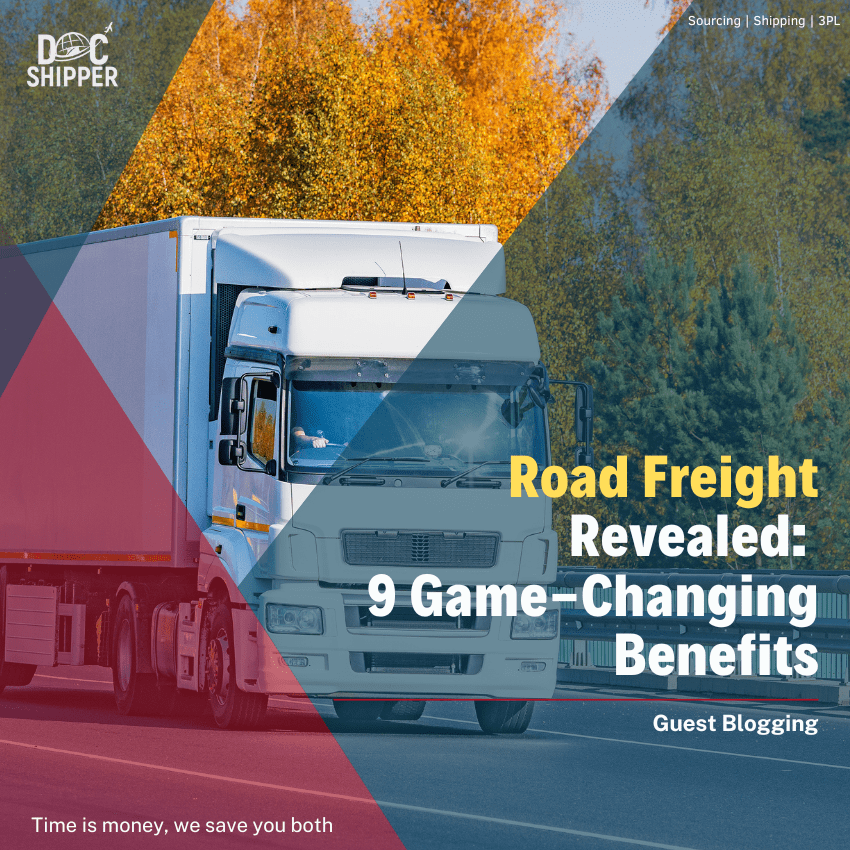
Benefits of road transportation include reliable door-to-door delivery, high flexibility on short and medium distances, and fewer handling risks because there are fewer terminal transfers. Trucks connect ports, airports, rail terminals, warehouses, and end customers, support just‑in‑time inventory, enable direct B2B/B2C and last‑mile deliveries, and can be tailored via FTL, LTL, groupage, and specialized equipment.In this article, you will find a detailed comparison of road versus other modes, pricing models, load configurations, equipment choices, security and tracking practices, multimodal integration, environmental innovations, and the skills and licensing that underpin modern truck transport.
We hope you’ll find this article genuinely useful, but remember, if you ever feel lost at any step, whether it’s finding a supplier, validating quality, managing international shipping or customs, DocShipper can handle it all for you!
What is road freight transport and why it matters to your business
If you’re looking for the real, day-to-day benefits of road transportation, start with the basics, road freight transport is the movement of cargo by truck, from a pickup point to a delivery point, locally or across borders.
Here’s the thing, it’s often the only mode that can truly do origin-to-destination without handing your shipment off three times.
In practice, road freight becomes the backbone of your supply chain when you need predictable lead times, flexible routing, and door delivery for everything from pallets to parcels.
We’ve seen importers obsess over ocean rates, then lose money on detention charges, missed delivery slots, and messy last-mile handoffs.
Road freight fixes a lot of that, because you can align transport with inventory management, order fulfillment, and customer delivery windows, not just port schedules.
To make it operational, think of road transport as a service you can contract with clear carrier contracts, service level agreements, and a track-and-trace routine tied to your internal planning.
Here’s a simple workflow we use to keep road freight solutions under control.
- Request for quotation (RFQ), define lanes, Incoterms, weights, dims, delivery deadlines
- Carrier selection, validate licenses, insurance, equipment fit, service history
- Load planning, palletization, load optimization, consolidation plan if needed
- Dispatch, pickup appointment, driver instructions, documentation pack
- Track and trace, milestone checks, exceptions management
- Proof of delivery, reconcile freight invoice, claims handling if any
One detail you’ll notice fast, road freight transport touches your paperwork too, commercial invoices, packing lists, sometimes a customs declaration and tariff classification when you cross borders.
That’s why we always ask you to map Incoterms early, so your responsibilities stay clear before the truck even shows up.
Siam Shipping Advice
Secure trucking capacity early to avoid rollovers, storage fees, and broken delivery promises across your multimodal flows.
Key advantages of road transportation compared to other modes
The benefits of road transportation get obvious when you compare real constraints, cut-off times, port handling queues, and handover risks.
You can still use sea transport or rail freight, but trucks often decide whether your shipment arrives on the day your customer expects.
From experience, the moment most shippers get stuck is not “choosing the mode”, it’s managing the interfaces between modes.
That’s where the advantages of road transport shine, fewer transfers, tighter scheduling, and a direct path to your warehouse or customer dock.
To keep the comparison concrete, here’s a quick table you can use during procurement.
| Decision factor | Road freight transport | Air / Sea / Rail (general) |
| Door access | High, delivers to docks, stores, job sites | Medium, needs first/last mile trucking |
| Transit time control | High on short and medium distances | Varies, often fixed schedules and cut-offs |
| Handling risk | Lower, fewer handovers | Higher, more terminals and transfers |
| Best for | Pallets, mixed loads, time-sensitive replenishment | Long-haul bulk, containers, international lanes |
We’ve watched teams save 8 percent on ocean freight, then lose the entire gain because trucks weren’t booked for the pickup window and the container rolled to the next vessel.
One overlooked “mode” is actually the combination, and you’ll often win by planning multiple transportation modes with trucking as the connector.
For an external benchmark on why modal choices matter at scale, you’ll see this topic regularly covered in OECD transport and logistics work, especially around reliability and infrastructure constraints.
Cost savings and pricing options for road freight
On a fast-moving retail lane, we once saw a buyer negotiate a low rate, then get hit with “extras” for waiting time, redelivery, and weekend delivery, the freight invoice ended up higher than the first quote.
A direct tip, when you’re evaluating the advantages of truck transportation, ask for an all-in quotation with a clear accessorials list, not just a base rate per km.
You’ll usually pay road freight through a few common models, and each one fits a different shipment profile.
- Per trip, best for stable lanes and predictable volumes
- Per km, useful when distances vary and routes change
- Per ton / per pallet, common in consolidation networks
- Contract rates with SLAs, better if you need capacity guarantees
- Spot rates, okay for occasional loads but more volatile
To keep your pricing clean, use this short checklist before you approve a carrier contract.
- Waiting time rules, free time at pickup and delivery, then hourly rate
- Toll and fuel policy, fixed, indexed, or pass-through
- Loading responsibility, who provides labor and equipment
- Cargo insurance, limits, exclusions, claims timeline
- Damage reporting, how POD notes must be written
Once you control those variables, you’ll see the real advantages of road transportation, fewer surprise fees and a clearer cost-to-serve per customer.
Flexibility, accessibility, and route adaptability
Why do so many planners default to trucks even when another mode looks cheaper on paper?
Because the advantages of road transport include access to places that don’t have a port, rail terminal, or airport, and you can still hit a delivery slot.
A bold statement, flexibility is your hidden profit lever when customers change quantities late or your supplier finishes production earlier than expected.
You can reroute, split drops, or swap equipment without rebuilding your whole transport plan.
Here’s a practical “route adaptability” workflow we use when you need to adjust mid-stream without losing control.
- Confirm the exception, new delivery window, new address, or added stop
- Recalculate capacity, weight, volume, axle limits, pallet count
- Validate compliance, restricted zones, driving hours, permits if needed
- Re-quote accessorials, redelivery, extra stop, time window service
- Update milestones, new ETA, customer notification, warehouse slot
If you’ve ever dealt with a supplier who ships “whenever it’s ready”, this is where road freight solutions save you, you can respond without blowing up your week.
And when you want the most straightforward execution, you can structure the lane as road freight transport with fixed pickup days and agreed cutoffs.
Speed and reliability on short and medium distances
On regional lanes, we’ve seen a two-day buffer disappear because a warehouse missed a cutoff by 40 minutes.
That’s exactly where the benefits of road transportation feel real, you can often recover faster with a later pickup or a direct run.
A direct tip, match your trucking plan to your replenishment model, especially if you run just-in-time (JIT) inventory.
For short and medium distances, road reliability comes from reducing variability, not promising miracles.
Use this quick checklist to protect on-time performance without paying premium on every load.
- Book time slots, align pickup with production end and warehouse receiving
- Define a cutoff, what “same-day dispatch” really means operationally
- Set milestones, pickup, in-transit, arrival, POD within 24 hours
- Plan contingencies, backup carrier, alternate route, transload option
- Measure OTIF, on-time in-full, not just “truck departed”
When you implement this, the advantages of road transportation translate into lower stockouts and fewer expedited shipments.
How door-to-door truck transport supports your customers
The benefits of road transportation aren’t only internal, your customer feels them when delivery becomes simpler and more predictable.
This is where trucks win, they connect your warehouse, your 3PL, and your end customer in one operational line.
You’ve probably dealt with customers who demand narrow delivery windows, refuse partials, or change receiving rules without warning.
Door delivery gives you a way to handle those constraints with fewer parties involved.
We often structure this as a door-to-door service so your Incoterms responsibilities and delivery scope stay crystal clear.
For a broader reference point on delivery reliability expectations, the ICC Incoterms Committee is a useful anchor when you’re aligning handover points and risk transfer in your contracts.
Siam Shipping Info
Design a door-to-door setup that aligns Incoterms, responsibilities, and customer expectations in one seamless transport plan.
Direct deliveries for B2B and B2C shipments
Last quarter, we saw a B2B consignee reject a shipment because the driver arrived without an appointment number and the pallets weren’t labeled to their inbound standard.
A direct tip, when you’re using road freight transport for direct deliveries, treat delivery instructions like compliance documents, not casual notes.
You’ll reduce failed deliveries by standardizing what the driver receives before dispatch.
- Delivery slot and contact name
- Dock requirements, tail lift needed, pallet jack allowed or not
- Labeling rules, SKU, PO number, carton count
- Receiving constraints, no partials, no mixed pallets, specific stacking
- POD format, digital signature, stamp, photo requirements
If you sell into e-commerce, these basics become non-negotiable, because customer experience gets measured in minutes, not days.
Last-mile distribution and parcel logistics
What breaks last-mile performance faster than anything else?
It’s poor data, wrong addresses, missing phone numbers, or vague delivery notes, and then your costs creep up through redelivery and returns.
A bold statement, last mile delivery is where margins go to die if you don’t control exceptions.
Here’s a simple workflow to keep last-mile trucking aligned with order fulfillment and reverse logistics.
- Pre-alert, validate address, phone, and delivery constraints
- Route plan, cluster drops, set realistic ETAs
- Scan events, out for delivery, delivered, failed attempt
- Exception handling, reschedule, reroute to pickup point, return-to-sender
- Reverse logistics, inspect returns, restock, dispose, or refurbish
When you run it this way, the advantages of road transport show up as fewer failed attempts and tighter control of customer promises.
Siam Shipping Advice
Match truck type and load configuration to your cargo profile before booking, not after damage occurs.
Cargo types and road freight solutions you can use
The benefits of road transportation get even more practical when you match the right truck and loading method to your cargo.
You don’t need “a truck”, you need an equipment decision that protects product quality, reduces claims, and keeps loading fast.
We’ve seen fragile goods shipped on the wrong setup, then everyone argues about liability because packaging, handling, and insurance weren’t aligned.
So yes, road freight solutions can be simple, but only after you choose the right configuration.
Vehicle options and specialized equipment for different goods
We once handled a shipment of oversized parts that arrived with scratches because the shipper booked a standard box truck instead of a secured open platform.
A direct tip, when you’re planning road freight transport, pick equipment based on handling risk first, then price.
Use this quick comparison table to shortlist equipment for your cargo.
| Equipment | Best for | Operational watch-outs |
| Box / dry van | Palletized cartons, general cargo | Moisture control, load bars, sealing |
| Reefer | Food, pharma, temperature-sensitive goods | Setpoint logs, pre-cool, door openings |
| Flatbed | Oversized, machinery, construction | Lashing plan, weather protection, permits |
| Tail-lift truck | Sites without docks, retail drops | Weight limits, ground stability |
If you need specific references, refrigerated trucks guidance is worth reviewing for temperature-control considerations.
FTL, LTL and groupage: choosing the right load configuration
Have you ever paid for a full truck and realized you only used half the trailer?
That’s where advantages of road transportation meet smart procurement, you can choose FTL, LTL, or groupage to match volume and urgency.
A bold statement, the cheapest rate per unit often costs you more in lead time when your freight sits waiting for consolidation.
Here’s a practical selection checklist we recommend before you decide.
- Choose FTL when speed, security, and fewer touches matter most
- Choose LTL when you ship small volumes frequently and can accept hubs
- Choose groupage when you want consolidation savings with planned schedules
- Check handling count, more terminals often equals more damage risk
- Verify cutoffs, consolidation deadlines affect lead time
If LTL is on the table, you’ll want to align packaging, pallet quality, and labeling with network requirements, because mixed freight gets handled hard.
For a deeper operational view, see less-than-truckload (LTL) practices and where it fits best.
Dangerous, refrigerated and high-value cargo by road
We once saw a high-value electronics load delayed because the shipper didn’t declare the lithium battery classification correctly, and the carrier refused pickup at the gate.
A direct tip, with road freight transport for sensitive cargo, lock compliance and security before you book, not after the truck arrives.
Use this short checklist to reduce claims and prevent refusal at pickup.
- Hazmat classification, correct UN number, labels, and documents
- Temperature plan, setpoint, logging, contingency for breakdown
- Security measures, sealed trailer, GPS, no-stop rules if needed
- Insurance fit, declared value, exclusions, claims evidence
- Chain of custody, clear handover points and signed POD
If you’re shipping on open equipment, understanding setups like flatbed trailers helps you plan lashing and protection properly.
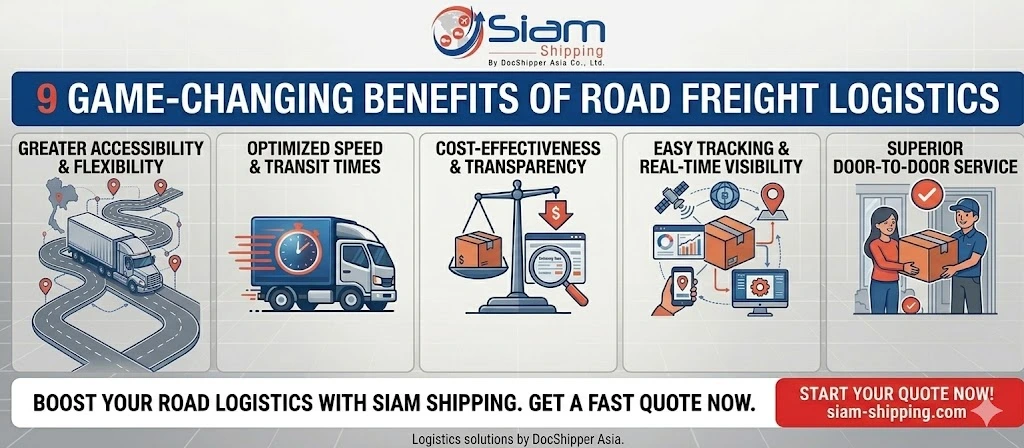
Security, tracking and risk control in truck transportation
The benefits of road transportation don’t mean much if you can’t control theft, damage, or delivery disputes.
You’ve probably dealt with vague ETAs, missing PODs, or carriers who “can’t locate” a shipment for six hours.
Good road freight solutions fix this through visibility, disciplined documentation, and clear liability rules.
We also recommend you treat risk like a process, not a one-off insurance purchase.
For a broader view on international transport security and facilitation practices, WCO guidance is a solid reference point for risk-based control and trade facilitation.
Siam Shipping Alert
Implement strict tracking and POD validation to reduce theft exposure, delays, and invoice conflicts.
Real-time visibility and shipment monitoring
On one urgent replenishment run, the consignee insisted the truck never arrived, but the driver had delivered to the wrong entrance and left with no signed POD.
A direct tip, for road freight transport you should define your “proof” upfront, GPS pings alone won’t settle disputes.
Here’s a simple monitoring workflow you can run with any carrier or freight broker.
- Pre-departure check, seal number, photos, dispatch confirmation
- Milestone tracking, pickup, departure, mid-route, arrival at gate
- Exception alerts, delays, route deviation, temperature alarms
- POD capture, signature, stamp, time, and delivery photos
- Invoice reconciliation, match POD to freight invoice and accessorials
If you’re modernizing this, investments in technological advancements like ePOD and automated exception alerts can cut disputes dramatically.
Safety standards, regulations and driver training
Do you know what your carrier’s driver training actually covers?
A bold statement, compliance is a cost control tool because crashes, fines, and rejected loads always cost more than prevention.
When you’re auditing a road freight transport partner, focus on the rules and habits that reduce incident rates and claims.
- Driver qualification, license validity, medical fitness, ongoing training
- Hours-of-service discipline, fatigue management and scheduling realism
- Vehicle inspections, brakes, tires, refrigeration units, seals
- Loading safety, weight distribution, lashing, pallet stability
- Incident procedure, who to call, evidence collection, claims timeline
If you’re building an in-house fleet, understanding a Commercial Driver’s License (CDL) pathway helps you plan staffing, compliance, and specialization for higher-value work.
Siam Shipping Info
Integrate road freight early in multimodal planning to cut idle time, demurrage, and coordination failures.
Road transport in your wider logistics strategy
When you look at the real benefits of road transportation, you quickly realize trucks are not just a standalone mode. They are the connecting tissue of your entire supply chain, linking ports, airports, rail terminals, warehouses and final customers.
If you’ve ever had a container stuck at port because no truck was scheduled, you already know how critical road freight is. At DocShipper, we’ve seen multimodal plans collapse simply because the road leg was underestimated.
Looking for a Reliable Shipping & Sourcing Partner?


DocShipper Platform
One platform. Your entire supply chain
Sourcing, freight, customs & documents, all centralised, all visible, 24/7.
Integrating road freight with air, sea and rail
Last year, we handled a time-sensitive shipment from Shenzhen to Lyon. Air freight covered the long haul, but without a synchronized road transport plan on both ends, the cargo would have missed its retail launch window.
This is where the benefits of road transportation become strategic, not tactical. You use trucks to ensure smooth first-mile and last-mile connections across modes.
Here is a simple multimodal workflow you can apply:
- Step 1: Align Incoterms and responsibilities before booking any mode.
- Step 2: Reserve road capacity in parallel with sea or air booking.
- Step 3: Confirm cut-off times and terminal handling windows.
- Step 4: Share unified documentation with all carriers.
- Step 5: Monitor handovers between modes in real time.
You reduce idle time and demurrage when road freight is integrated early. According to the World Trade Organization, multimodal efficiency plays a major role in reducing overall trade costs, and road legs often determine whether you stay on schedule.
When road freight is the best choice for your routes
Is road transport always the cheapest or fastest option for you? Not necessarily, but on short and medium distances, it often delivers the strongest operational benefits of road transportation.
You should consider road freight first when:
- Your route is under 1,500 km.
- You need door-to-door delivery without terminal transfers.
- Your cargo volume does not justify a full container.
- You face urgent replenishment needs.
- Your customer requires flexible delivery slots.
To help you compare quickly, here’s a practical overview:
| Criteria | Road | Sea | Air | Rail |
| Short distances | Excellent | Limited | Costly | Moderate |
| Door-to-door | Yes | No | No | No |
| Flexibility | High | Low | Medium | Medium |
| Transit time control | High | Low | High | Medium |
When you map your routes carefully, you’ll see road freight is often the most agile link in your logistics chain.
Environmental performance and the future of road transportation
You may wonder whether the benefits of road transportation still make sense in a world focused on carbon reduction. The reality is changing fast, and road freight is evolving under pressure from regulators, customers, and investors.
At DocShipper, we’ve noticed more clients asking for emissions data during tenders. Sustainability is no longer optional for your transport strategy.
Cleaner trucks, alternative fuels and greener operations
We once supported a distributor switching part of its regional fleet to LNG trucks. The result was lower emissions and improved brand perception, which mattered just as much as cost.
The modern benefits of road transportation now include greener technologies that help you reduce your carbon footprint.
Key developments you should monitor:
- Euro VI and equivalent low-emission engines.
- Electric trucks for urban distribution.
- Biofuels and LNG for long-haul routes.
- Route optimization to cut empty miles.
The International Energy Agency highlights that road freight remains a major emissions source, but also a priority sector for electrification. If you align carrier selection with environmental targets, you’ll future-proof your logistics network.
Siam Shipping Info
Audit driver certifications and CDL scope to secure specialized transport and reduce compliance risk.
Digitalization and technology trends in road freight
Technology is reshaping road freight faster than most importers expect.
You can now leverage the benefits of road transportation through digital tools that improve transparency and performance.
Before choosing a carrier, run through this checklist to assess their digital maturity:
- Do they offer real-time GPS tracking?
- Can you access automated proof of delivery?
- Do they integrate with your ERP or TMS?
- Are KPIs like on-time delivery shared transparently?
- Do they use predictive maintenance systems?
You’ll notice fast that digitalized carriers reduce disputes and administrative workload. Smart tachographs, AI route planning, and e-CMR documentation are becoming standard in many regions.
Careers in road freight and the role of commercial driver licensing (CDL)
Behind every shipment, there’s a skilled professional ensuring your goods move safely. The benefits of road transportation rely heavily on trained drivers, planners, and compliance specialists.
If you’re building your own fleet or auditing carriers, understanding the human side of trucking gives you a strategic edge.
Job opportunities and skills in truck transportation
You’ve probably faced capacity shortages during peak season. In many markets, the driver gap is real, which directly affects the benefits of road transportation you experience as a shipper.
The road freight sector offers roles such as:
- Long-haul and regional truck drivers.
- Fleet managers and dispatch planners.
- Logistics coordinators.
- Compliance and safety officers.
Skills that matter most include regulatory knowledge, route optimization, cargo securing, and digital tool proficiency. The International Road Transport Union regularly reports on driver shortages, which explains why reliable partners are so valuable to your operations.
How a CDL unlocks specialized and higher-paid driving roles
Think a standard driving license is enough for heavy freight? Not if you want access to the full benefits of road transportation in specialized segments.
A Commercial Driver’s License, or CDL, allows drivers to operate:
- Heavy articulated trucks.
- Hazardous material vehicles.
- Refrigerated units.
- Tanker trucks.
You should verify that your carriers’ drivers hold valid and appropriate certifications, especially for ADR or hazardous goods. This reduces liability risks and ensures compliance with national transport authorities.
Conclusion
When you step back and look at the complete picture, the benefits of road transportation go far beyond simple cargo movement. Trucks anchor your multimodal strategy, support sustainability goals, and rely on skilled professionals to keep everything running.
To help you retain the essentials, here are the key takeaways:
- Road freight connects air, sea, and rail into one cohesive supply chain.
- It offers unmatched flexibility for short and medium distances.
- Environmental performance is improving with cleaner technologies.
- Digital tools enhance visibility and operational control.
- Qualified drivers and proper licensing are critical to reliability.
If you structure your logistics strategy around these realities, you’ll unlock the full operational and financial competitive edge that road transport can provide.
FAQ | Benefits of road transportation: how trucks strengthen your supply chain and your bottom line
To keep “hidden” trucking costs under control, structure your process before the first shipment:
- Before booking
- Ask for a written, all‑in quote including: waiting time, redelivery, weekend/night delivery, tolls, fuel surcharge, tail‑lift, residential delivery, restricted‑zone access.
- Define what is “free” (e.g. 1–2 hours free at loading/unloading) and what is billable (hourly rate after free time).
- In your operations
- Share realistic loading/unloading times with the carrier (don’t promise 30 minutes if it always takes 2 hours).
- Lock delivery appointments in advance with consignees to avoid redelivery.
- Avoid vague instructions like “morning delivery” that often trigger waiting time.
- In your contracts
- Cap accessorial charges per shipment or per day where possible.
- Require pre‑approval for any extra fee above a set threshold (e.g. >50 USD).
- Audit 2–3 random invoices per month to spot “creative” surcharges early.
Treat supplier uncertainty as a planning variable, not a surprise:
- Structure supplier commitments
- Use a simple supplier calendar: fixed pickup days (e.g. Mon/Wed/Fri) instead of “any day”.
- Ask for a firm “available from” time at least 24–48 hours before pickup.
- Include penalties or priority rules for late readiness in your purchase terms.
- Build flexible trucking capacity
- Reserve a base capacity (FTL or LTL) per week with your core carrier.
- Keep 1–2 backup carriers for peaks and last‑minute changes.
- Use clear change rules
- Define a cut‑off time for changes (e.g. no routing changes after 16:00 the day before).
- When the supplier shifts readiness, trigger a standard playbook: re‑book slot, re‑quote if distance/volume changes, notify warehouse and customer.
Most claims come from basic oversights rather than “bad driving”:
- Packaging errors
- Under‑strength cartons for heavy items (crushed boxes).
- No corner protection or edge guards on palletized goods.
- Shrink‑wrap not going below pallet level, so loads slide off.
- Palletization issues
- Mixed, unstable pallets (heavy on top of light, overhanging cartons).
- Using damaged pallets (broken boards, missing blocks).
- No straps/bands for tall or top‑heavy loads.
- Loading mistakes
- Poor weight distribution (too much weight on one side or axle).
- No blocking/bracing in box trucks, so pallets move under braking.
- Inadequate tarping or lashing on flatbeds.
- How to fix it
- Standardize packing specs by product family (carton quality, pallet type, wrap pattern).
- Photograph loaded pallets before truck departure.
- Include “loading sign‑off” between warehouse and driver stating goods were secured and intact at pickup.
You need a tight quantity‑control and documentation routine:
- At loading
- Count and record the exact number of pallets/colis on the CMR or waybill.
- Take photos of: loaded truck (showing pallet count) and seal number if used.
- If the driver refuses to check counts, note “shipper’s load and count” on documents.
- At delivery
- Ask consignees to:
- Count pallets before signing.
- Note any discrepancy or visible damage directly on the POD (e.g. “1 pallet missing”, “2 boxes crushed”).
- Avoid clean PODs when there is a problem—claims are nearly impossible afterwards.
- Internally
- Maintain a simple “discrepancy log” with shipment ID, claimed shortage, photos, and POD copy.
- Share this log in monthly reviews with carriers to spot patterns (same route, same depot, same shift).
Use a mixed strategy instead of locking yourself into one model:
- Map your demand
- Classify lanes and customers into: stable/high volume, seasonal/peak, and low/irregular.
- Apply a rule per profile
- Stable/high volume:
- Negotiate FTL contract rates for base loads.
- Fix weekly departures (e.g. 3 trucks/week) to secure capacity and price.
- Seasonal/peak:
- Keep optional FTL capacity plus pre‑agreed “overflow” rates with LTL/groupage carriers.
- Accept slightly longer transit on overflow to avoid crazy spot prices.
- Low/irregular volume:
- Use LTL/groupage only; optimize packaging to standard pallet sizes to reduce handling fees.
- Review quarterly
- Recalculate average fill rate per lane.
- Upgrade from LTL to FTL on routes where you consistently reach >70–75% of a truck.
Go beyond the sales pitch and ask for concrete proof:
- Documentation and credentials
- Valid operating licenses and liability insurance certificates.
- Specific certifications for hazmat, pharma, or food if relevant (e.g. ADR, GDP, HACCP).
- Fleet and tech
- Age and maintenance schedule of vehicles (ask for a sample maintenance record).
- GPS tracking with geofencing and route‑deviation alerts.
- Locking or sealing procedures for trailers and boxes.
- Driver management
- Driver vetting (background checks where legal, experience thresholds).
- Regular safety training (defensive driving, cargo securing, incident response).
- Incident history
- Request statistics: accident rate, theft incidents, on‑time performance, claims ratio.
- Ask how they handled their last major incident—what changed afterwards?
Focus on operational levers before paying premiums for “green” labels:
- Optimize how you use trucks
- Increase average truck fill (better planning, consolidate orders per route).
- Cut empty returns by backhauls or triangulation with other lanes.
- Reduce failed deliveries and redeliveries (clean data, better pre‑alerts).
- Improve routing and planning
- Use route‑optimization tools or ask carriers to share their optimization logic.
- Avoid unnecessary detours due to known restricted zones or recurring bottlenecks.
- Work with carriers on greener assets
- Prioritize Euro VI or equivalent fleets in tenders.
- Use electric or CNG/LNG trucks for short urban routes where available.
- Introduce a simple KPI: grams CO₂ per ton‑km by lane, reviewed annually.
- Contractual levers
- Include environmental criteria (fleet standards, load factor targets) in RFQs.
- Reward carriers who meet both cost and emissions goals with longer contracts.
Need Help with
Logistics or Sourcing ?
First, we secure the right products from the right suppliers at the right price by managing the sourcing process from start to finish. Then, we simplify your shipping experience - from pickup to final delivery - ensuring any product, anywhere, is delivered at highly competitive prices.


Fill the Form
Prefer email? Send us your inquiry, and we’ll get back to you as soon as possible.
Contact Us