


Freight Shipping between Thailand and Iraq | Rates – Transit times – Duties and Taxes
Shipping between Thailand and Iraq isn’t just about distance, it’s about aligning Gulf transit routes, Iraqi customs procedures, and realistic timelines from day one.
If you’re planning freight transport from Bangkok or Laem Chabang to Basra or Baghdad, you need clear numbers on rates, transit times, and duties, plus a practical view of risks and bottlenecks. This guide gives you the operational standard we use every day, so you can budget accurately, avoid common missteps, and move forward with control.
How can Siam Shipping help you
Which are the different modes of transportation between Thailand and Iraq?
If you’re looking at this route, here’s the logic: choose sea freight via Laem Chabang to Umm Qasr when cost per cubic meter matters more than speed, especially for full containers or heavy cargo, and switch to air freight into Baghdad International Airport when timelines are tight or your goods are high value and compact.
Overland combinations through regional hubs can work for specific projects, but you need to factor in border controls and handling points, which is where we help you compare real-time capacity, pricing, and constraints before you commit. We’ll break down each option in detail below so you can match the mode to your cargo, budget, and deadline without guesswork.
Need help with your shipment?
Need assistance with your shipment? Dont hesitate to contact us even for a simple question. Choose the option that suits you
Live chat with an expert Chat on WhatsApp Free Quote 24h
Sea freight between Thailand and Iraq
Thailand and Iraq, both hubs of thriving industries, teem with a dynamic trade relationship, marking a continuous stream of goods moving across oceans. They are linked via key cargo ports, namely Laem Chabang in Thailand and Umm Qasr in Iraq.
If you’re seeking a cost-effective solution for high-volume goods transport, ocean shipping sails in as your lifeboat – despite being the tortoise in the race compared to air freight’s hare.
Yet, riding this wave is no easy sail. Many businesses feel the sting of the sea breeze when agonizing over the complexities and potential pitfalls of shipping between these countries.
Have you ever felt lost amidst the sea of documentation or struggled to make sense of maritime laws and customs? If you’re nodding silently, prepare to find equilibrium with our array of best practices and specifications design to make your sea voyage smoother.
You’ll soon realize that the seemingly intricate labyrinth of international shipping is not as daunting when you’re navigated by a reliable guide.
Main shipping ports in Thailand
Port of Laem Chabang
Location and Volume: The Port of Laem Chabang, located in the Bang Lamung District of Chon Buri, Thailand, is an important worldwide shipping hub and Southeast Asia’s third-largest gateway port. It provides easy access to essential industries such as automotive, electronics, petrochemicals, and food processing as a significant player in the Eastern Economic Corridor (EEC). With a cargo capacity of 18 million TEUs in 2022, the port assures efficient operations for shippers through low pricing and strong accessibility via road, rail, air, and ocean, making it a cornerstone of Thailand’s international trade.
Key Trading Partners and Strategic Importance: This port serves as a central shipping node for Thailand’s trade with China, the United States, and Japan. Laem Chabang is also of strategic importance to ASEAN (Association of Southeast Asian Nations) trade, providing vital market access to this regional bloc.
Context for Businesses: If you’re looking to expand your business within the Asia-Pacific region, the Laem Chabang Port could be an integral part of your shipping strategy due to its high-volume capacity and proximity to key Asian economies.
Bangkok Port
Location and Volume: This port, located in Bangkok’s lively Khlong Toei District, encompasses around 1,473 acres and handles an amazing 8.7 million TEUs yearly. It is well-known for its strategic location and efficient operations, and it acts as a vital hub for international trade, connecting enterprises all over the world.
Key Trading Partners and Strategic Importance: The port’s key trading partners include China, Japan, and the United States. Its strategic location enables a significant part of Thailand’s domestic trade and contributes substantially to its GDP.
Context for Businesses: If your business deals in non-containerized goods or if your logistics require close proximity to Bangkok’s urban market, the Port of Bangkok could be a strong logistical choice.
Map Ta Phut Port
Location and Volume: Map Ta Phut, situated in the Gulf of Thailand, is a pivotal port managing 16 million tons of bulk and liquid cargo annually, offering seamless connections for businesses and contributing significantly to the region’s economic vitality. Its strategic location and advanced infrastructure make it a preferred choice for international trade.
Key Trading Partners and Strategic Importance: A crucial hub in Thailand’s trade with Japan, South Korea, and China, Map Ta Phut is vital for Thailand’s petrochemical, automotive, and electronics industries due to its specialized handling of bulk and liquid cargo.
Context for Businesses: If you’re in the petrochemical or similar industries that require specialized bulk liquid cargo transports, Map Ta Phut Port is well-positioned to meet your business needs.
Port of Sattahip
Location and Volume: The port, located in Sattahip District, Chon Buri Province, encompasses 436 acres and handles 1.1 million TEU annually. Its strategic location and cutting-edge facilities make it an important worldwide trade hub, promoting economic growth and seamless logistics. The port, with its unwavering efficiency and commitment to quality, continues to play a critical role in facilitating international trade and improving regional connectivity.
Key Trading Partners and Strategic Importance: Supporting trade primarily with ASEAN countries, China, and Japan, the port enhances Thailand’s automobile industry by facilitating the import and export of vehicles.
Context for Businesses: If you’re in the automotive sector looking to facilitate efficient import/export with the Asia-Pacific region, Sattahip Port’s specialized handling of auto-carriers might be of significant advantage to your logistics chain.
Port of Songkhla
Location and Volume: The port, which is located in Songkhla Province, serves as an important hub for regional trade and commerce. This 740-acre maritime facility plays an important role in the transportation business, supporting the smooth transit of products and commodities. The port manages a significant yearly volume with an exceptional capacity, carrying around 3 million tons of cargo each year. Its strategic location and excellent infrastructure make it a cornerstone of the local economy, ensuring efficient goods exchange and supporting regional development.
Key Trading Partners and Strategic Importance: It serves as a strategic hub for Thailand’s trade with Malaysia, Indonesia, and Singapore, making it crucial for the country’s barter trade.
Context for Businesses: If you’re focusing on regional or barter trade opportunities within the ASEAN region, especially with Malaysia and Singapore, Songkhla port can support your shipping requirements with its strong regional connectivity.
Phuket Port
Location and Volume: Phuket Port is located off the Andaman Sea. As Thailand’s main gateway to the west, it primarily handles cruise ships but also serves cargo vessels, carrying approximately 50,000 tons of goods annually. Additionally, the port boasts an impressive container handling capacity, with over 150 000 TEUs processed each year, further emphasizing its vital role in the region’s trade and logistics operations.
Key Trading Partners and Strategic Importance: This port fosters trade with Malaysia, Singapore, and India as well neighboring countries like Myanmar. The port’s primary strategic importance lies in promoting tourism, but it also supports Thailand’s trade connectivity to the west.
Context for Businesses: If your shipping needs incorporate both goods and passenger transport, or if you’re keen on westward expansion of your trade, Phuket Port can offer comprehensive support.
Main shipping ports in Iraq
Port of Umm Qasr
Location and Volume: Situated in southern Iraq, near Basra, the Port of Umm Qasr is vital for the region’s trade and economic growth. Handling over 6,000 TEUs annually, it is Iraq’s largest maritime logistics hub.
Key Trading Partners and Strategic Importance: As Iraq’s primary seaport, Umm Qasr facilitates trade with key partners including China, Turkey, and South Korea. The port is strategically vital for Iraq’s oil exports and grain imports.
Context for Businesses: If you’re exploring oil-associated trade or agri-food sector expansions, the Port of Umm Qasr might be central to your logistics, given its substantial oil-extraction infrastructure and vast grain silos.
Port of Al Maqal
Location and Volume: Located in Basra, the Port of Al Maqal is a smaller logistics hub, with an annual volume of around 1,000 TEUs.
Key Trading Partners and Strategic Importance: Al Maqal has a historic and strategic value, serving as a hub for local imports and hosting several passenger terminals, connecting to nearby Gulf countries.
Context for Businesses: For smaller-scale operations or businesses targeting local markets, leveraging the Port of Al Maqal could be beneficial, especially given its provisions for passenger transit.
Port of Khor Al Zubair
Location and Volume: Near Basra, Khor Al Zubair is a crucial port for Iraq’s industrial sector, handling over 4,000 TEUs each year.
Key Trading Partners and Strategic Importance: This port mainly channels Iraq’s trade with China, India, and the UAE. It plays a strategic role in the export of petrochemicals and the import of industrial goods.
Context for Businesses: If your business is centred around the petrochemical industry or industrial goods, the Port of Khor Al Zubair may play a key role in your shipping strategy due to its prominent petrochemical handling facilities.
Port of Abu Flous
Location and Volume: Based in the Shatt Al-Arab waterway near Basra, the Port of Abu Flous handles cargo and passenger shipping, with an annual volume of 2,000 TEUs.
Key Trading Partners and Strategic Importance: As a smaller commercial port, it focuses primarily on regional trade partners.
Context for Businesses: If you’re seeking to tap into local markets or seeking passenger transit logistics in the Gulf region, the Port of Abu Flous might be a strategic choice.
Port of Al-Faw
Location and Volume: Located in the Al-Faw Peninsula, the Port of Al-Faw is a developing port with growing importance in trans-continental trade.
Key Trading Partners and Strategic Importance: The port has been attracting significant international investment, with a focus on boosting Iraq’s presence in regional trade.
Context for Businesses: If opening up to emerging markets is in your agenda, familiarizing with the Port of Al-Faw might be beneficial. With major infrastructure developments underway, potential future growth is expected.
Please note the website links direct to the National Iraqi Ports Company, as the specified individual port websites were not available.
Should I choose FCL or LCL when shipping between Thailand and Iraq?
Choosing the right sea freight option – be it Full Container Load (FCL) or Less than Container Load (LCL), also known as consolidation, can be a game-changer for shipping your goods between Thailand and Iraq. It determines not just your costs and delivery time, but also the broader success of your shipping venture. Dive into this section to unravel the subtle differences, benefits, and drawbacks of each, allowing you to make a thoughtful and strategic decision that is best suited to your specific needs. Strap in for a journey of knowledgeable decision-making!
Full container load (FCL)
FCL, or Full Container Load, refers to the exclusive use of a 20'ft or 40'ft container for shipping goods. In the realm of FCL shipping, only your goods fill this container, making it a more cost-effective choice for larger volumes. Typically, choosing FCL becomes economical when shipping more than 13/14/15 CBM of goods. A real-life scenario might be a Thai furniture manufacturer dispatching a large order of wooden tables to a reseller in Iraq. The volume of product makes FCL a natural choice given its cost-benefit and safety, as the container remains sealed from origin to destination. The cost implications of FCL can vary, but typically an FCL shipping quote is less per unit volume than LCL because fixed costs are spread over the larger volume. While initial costs may be higher, the per-unit shipping cost decreases with volume, making FCL an economical choice for larger shipments. Still, it's critical to acquire comprehensive FCL shipping quotes and compare them with LCL options to ensure you're making the most cost-effective decision for your specific shipment needs.
Less container load (LCL)
Definition: LCL, or Less than Container Load, is a type of shipping where your goods share space with others in a single container. This is a cost-effective option for low-volume shipments. When to Use: Opt for LCL shipping between Thailand and Iraq when your cargo is less than 15 Cubic Meters (CBM). It provides flexibility since you don't need to wait until you have enough goods to fill an entire container. Example: Suppose your business needs to deliver 10 CBM of handmade Thai ceramics to a buyer in Iraq. LCL would be a better choice as your cargo doesn’t reach the full container capacity. Cost Implications: With LCL freight, you save money by only paying for the space you use in the container. However, bear in mind, LCL shipment rates can be influenced by several factors including destination charges, warehouse handling fees, customs charges, among others. Thus, while affordable for small volumes, LCL could become more expensive as the volume increases due to these additional charges.
Hassle-free shipping
Looking to ship between Thailand and Iraq but unsure about consolidation or full container? DocShipper, your trusty freight forwarder, is here to simplify the ordeal. Our ocean freight experts can pinpoint the best possible option for you, considering your cargo's weight, volume, and nature. We're all about making cargo shipping a fuss-free affair for businesses. So why wait? Connect with us for a free estimation and let's set sail towards seamless shipping.
How long does sea freight take between Thailand and Iraq?
Sea freight between Thailand and Iraq takes on average between 20and 30 days. These shipping times depend on multiple factors, from the specifics of the exiting and entering ports to the type and weight of your goods. For a customized and precise estimate, you might want to reach out to freight forwarders like DocShipper to help navigate complexities and provide a tailored quote.
Here’s an illustrative table revealing typical sea freight durations between the major freight ports in Thailand and Iraq:
From (Thailand) To (Iraq) Average Transit Time (days) Laem Chabang Umm Qasr 21 Bangkok Umm Qasr 22 Songkhla Umm Qasr 26 Sattahip Umm Qasr 21Note: The transit times pretend, for illustration purposes, as placeholders until the actual times are ascertained.
How much does it cost to ship a container between Thailand and Iraq?
Deciphering ocean freight rates between Thailand and Iraq isn’t a one-size-fits-all process. Factors like Point of Loading, Point of Destination, the carrier in use, the nature of your goods, and even monthly market fluctuations can cause the shipping cost per CBM to vary greatly. But worry not! Our team of seasoned shipping specialists is always ready to crunch the numbers. We dig deep into the specifics of your shipment, taking into consideration all relevant factors to provide an optimized, case-by-case quote. Rest assured, our commitment is to always offer you the best shipping solution at the most competitive rate.
Special transportation services
Out of Gauge (OOG) Container
Definition: An OOG container is a specialty transport structure designed to handle Out of gauge cargo that exceeds standard container dimensions.
Suitable for: Oversized cargo like heavy machinery, construction equipment, windmill parts, industrial equipment, etc.
Examples: Transporting larger agricultural equipment or an oversized generator from Thailand to Iraq.
Why it might be the best choice for you: If your business deals with oversized or heavy cargo, navigating the logistics can be challenging. An OOG container offers a secure way to navigate these complexities while ensuring safe delivery.
Break Bulk
Definition: Break Bulk refers to the shipping of goods that are loaded individually rather than in shipping containers.
Suitable for: Large items which can’t be containerized like boats, heavy machinery, cranes, or construction equipment.
Examples: Shipping a yacht or oversized turbines from Thailand to Iraq.
Why it might be the best choice for you: If your cargo cannot be efficiently containerized or is too large, the Break Bulk method offers the flexibility to ship diverse cargo types.
Dry Bulk
Definition: Dry Bulk refers to the shipping of large amounts of homogenous, loose cargo load like coal, grain, or ore.
Suitable for: Commodities that are unpackaged and are shipped in large quantities.
Examples: Shipping vast amounts of rice, or minerals from Thailand to Iraq.
Why it might be the best choice for you: This method proves cost-effective and efficient for loose, free-flowing cargo that aggregates in large quantities.
Roll-on/Roll-off (Ro-Ro)
Definition: This method involves vehicles being driven or towed onto the ro-ro vessel, providing seamless movement.
Suitable for: Vehicles, trailers, caravans, trucks or anything that can be rolled on and off the shipping vessel.
Examples: Importing/exporting cars or heavy-duty trucks between Thailand and Iraq.
Why it might be the best choice for you: Provides an easy, efficient way for businesses shipping vehicles to achieve seamless transport and mitigate risks associated with handling.
Reefer Containers
Definition: A reefer container is a refrigerated container used predominantly in the shipment of perishable goods.
Suitable for: Perishable foodstuff, pharmaceuticals or any cargo needing a specific, constant temperature.
Examples: Transporting seafood, dairy products, or temperature-sensitive pharmaceuticals from Thailand to Iraq.
Why it might be the best choice for you: For businesses dealing with temperature-sensitive goods, reefer containers offer a reliable method to maintain product integrity throughout transportation.
Dealing with international shipping from Thailand to Iraq can be complex, but DocShipper ensures a smooth experience. Feel free to contact us and receive your free shipping quote in less than 24h. Your logistics needs are our priority.
Air freight between Thailand and Iraq
When it comes to fast and reliable shipping between Thailand and Iraq, air freight emerges as a strong contender, especially for small, valuable items like electronics or high-end fashion. Fast-paced industries require speedy delivery and air freight caters to just that, zipping your goods across borders swiftly, and often cost-effectively.
However, the pricey world of air freight can be a labyrinth for those unprepared. Common missteps include incorrectly estimating the shipment price, often due to miscalculating the weight of their goods – think of it like baking a cake but messing up your measurements, a small mistake can lead to quite the disaster. Hidden costs lurk in the shadows too, catching unwary shippers off-guard, like a sudden rainstorm at a picnic. Stay tuned to this guide for discovering best practices and avoiding these pitfalls in the future.
Air cargo vs express: how should you ship on this route?
When you compare air cargo vs express courier Thailand Iraq, you are really choosing between control and simplicity. With standard air freight service Thailand Iraq, your goods move under an air waybill and follow an airport-to-airport or door-to-door setup that you define. With express air freight Thailand to Iraq, you hand everything to an integrator who manages pickup, flight, customs, and delivery under one tracking number.
The first thing we always tell you is this: your decision depends on volume, urgency, and how much visibility you want over costs. If you ship regularly, air cargo Thailand to Iraq often gives you more flexibility. If you send small, urgent parcels occasionally, express can save you time internally.
Should you choose air cargo from Thailand to Iraq?
You should usually choose airport-to-airport air cargo Thailand Iraq once your shipment reaches around 1 CBM or 100 to 150 kg. From that threshold, standard air freight service Thailand Iraq becomes structurally more competitive than express. It is particularly adapted if you ship B2B pallets, consolidated cartons, or if you need specific services like dangerous goods by air Thailand Iraq or temperature controlled air freight Thailand Iraq.
Before booking, you need exact dimensions, gross weight, pickup address, destination airport, Incoterm, cargo ready date, and clear product description. If you miss one of these, your air freight booking process step by step will slow down immediately.
Common mistakes? Confusing airport-to-airport air cargo Thailand Iraq with full door-to-door air freight Thailand Iraq. Ignoring minimum charges. Forgetting cargo security screening Thailand Iraq cut-off times. This is often where air freight lead time Thailand Iraq suddenly increases.
Should you choose express air freight from Thailand to Iraq?
You should consider express air freight Thailand to Iraq if you ship small parcels under roughly 1 CBM or below 100 kg, or if you face an urgent shipment Thailand to Iraq that cannot wait. Express is practical when you do not have a logistics team and you want one provider to handle pickup and delivery air freight Thailand Iraq under a single contract.
The trade-off is clear. You gain simplicity, but you lose part of the cost breakdown control. You might face reweigh or remeasure adjustments if your volumetric weight vs gross weight calculation was wrong. You might also assume everything is included, while import handling at destination airport Iraq or duties are billed separately depending on the Incoterm.
Express is a good fit if you value speed and internal convenience. It becomes risky if your cartons are bulky, poorly packed, or if you do not double-check the chargeable weight calculation air freight before shipping.

Main airports to know in Thailand and Iraq
Suvarnabhumi Airport, Bangkok (BKK): The main cargo hub and one of the main airports in Thailand for cargo. You will find the widest flight options and better air cargo capacity Thailand Iraq. If your factory is near Bangkok, this usually reduces pre-carriage costs and stabilizes your schedule.
Don Mueang International Airport, Bangkok (DMK): Often used for regional and low-cost carriers. It can be relevant for certain direct flight vs transshipment air cargo options, but capacity is more limited than BKK.
Baghdad International Airport (BGW): The primary gateway and one of the main airports in Iraq for imports. Most air freight customs clearance Iraq operations happen here, and it offers the most consistent infrastructure for commercial cargo.
Basra International Airport (BSR): Strategically located in southern Iraq near key industrial and oil sector activity. You might use it for specific regional flows or if your consignee is based in the south, but you should always verify flight frequency and ground handling capacity first.
Erbil International Airport (EBL): A growing cargo hub serving the Kurdistan Region. It can be a relevant option if your destination is in northern Iraq, with relatively stable operations and increasing carrier coverage.
Your airport choice directly impacts inland trucking, total transit time, and storage risk. A cheaper air rate can become more expensive if your cargo sits waiting for capacity or if trucking distances increase.
Transit times: how long does air freight take from Thailand to Iraq?
| Service type | Estimated air transit time Thailand to Iraq |
|---|---|
| Standard air cargo (airport to airport) | About 2 to 4 days flight time, plus pre and post handling |
| Door-to-door air freight Thailand Iraq | Usually 4 to 7 days total, depending on pickup and customs |
| Express courier | Often 3 to 5 days door to door for major cities |
On paper, the routing is manageable but typically involves at least one transit hub, commonly in the Gulf region or the Middle East. In reality, your air freight lead time Thailand Iraq depends on cut-off times, cargo security screening Thailand Iraq, and customs clearance speed on arrival. If your shipment misses the airline cut-off by a few hours, you often lose a full day.
Seasonal peaks, limited air cargo capacity Thailand Iraq, and whether you book a direct flight vs transshipment air cargo also influence timing. The safest approach is to validate the exact ready date of your goods before confirming space.
Shipping rates: how much does air freight cost from Thailand to Iraq?
| Service | Cost structure |
|---|---|
| Standard air cargo | Based on cost per kilo air freight Thailand Iraq, using the higher of gross or volumetric weight, plus origin and destination charges |
| Express courier | All-in rate per kg or per parcel, adjusted after reweigh or remeasure if applicable |
Your air freight rates Thailand to Iraq are driven first by chargeable weight calculation air freight. Then come carton dimensions and density, urgency and available capacity, and finally pickup and delivery air freight Thailand Iraq distances.
If you want to know how to reduce air freight costs Thailand Iraq, start with packaging optimization and shipment consolidation. We also recommend reviewing your Incoterm and checking if air freight insurance Thailand to Iraq is required for your cargo value. Small adjustments here often save more than negotiating a few cents per kilo.
Step-by-step: how an air shipment usually works on this route
When you ship air cargo Thailand to Iraq, the process is structured and fast, but only if every document and timing point is aligned. You will see that most delays do not happen in the air. They happen before departure or right after landing.
- You confirm dimensions, weight, HS code, cargo type, and Incoterm so we can check feasibility, including dangerous goods by air Thailand Iraq if relevant.
- We book space with the airline and issue instructions for pickup and delivery air freight Thailand Iraq.
- Your supplier prepares export documentation for air cargo Thailand and the air waybill AWB requirements are validated, including master AWB and house AWB if consolidation applies.
- Cargo arrives at the departure airport, goes through cargo security screening Thailand Iraq, and must respect the airline cut-off time.
- The flight operates, either direct flight vs transshipment air cargo, depending on the selected routing.
- Upon arrival, import handling at destination airport Iraq and air freight customs clearance Iraq take place before final delivery.
The critical moments are document validation, screening, and customs. If one element is inconsistent with IATA cargo standards, you can face storage fees or missed connections within hours.
What is the difference between volumetric and gross weight?
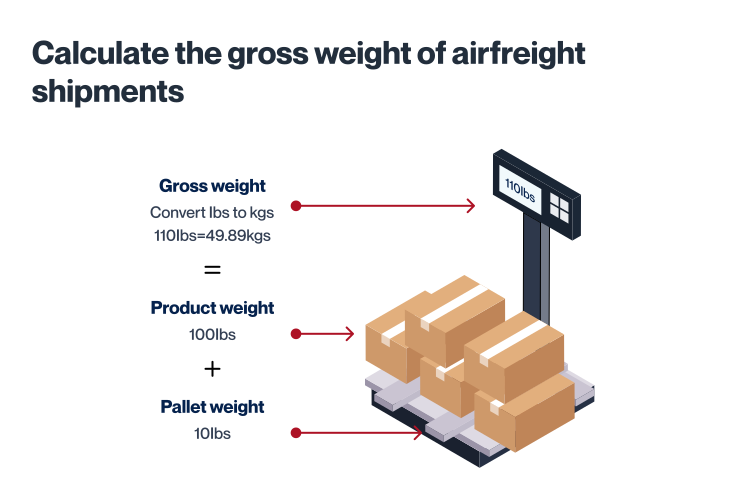
When you calculate your air freight cost, airlines always compare two figures, gross weight and volumetric weight. They charge you on the higher one, called the chargeable weight. This is why understanding volumetric weight vs gross weight is essential before you request a quote.
- Gross weight: The real weight of your goods including packaging.
- Volumetric weight: A theoretical weight based on the space your cargo occupies in the aircraft.
- Chargeable weight: The higher value between gross and volumetric weight.
How to calculate
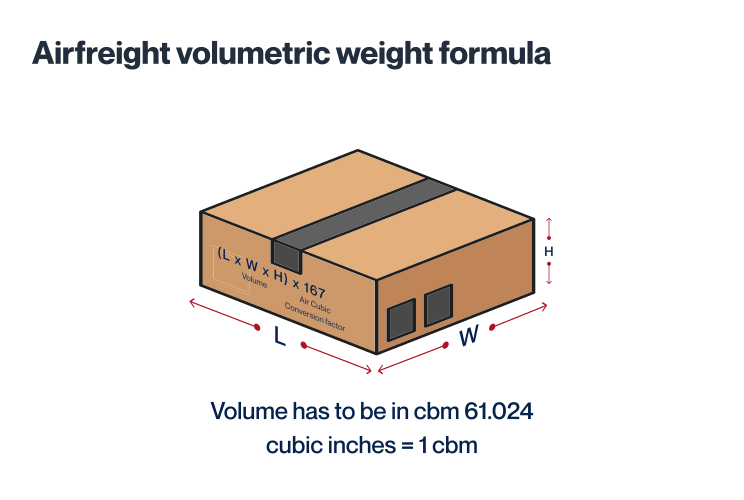
For standard air cargo, the usual formula is: Length x Width x Height in cm divided by 6000. Example: 120 x 100 x 100 cm / 6000 = 200 kg volumetric weight.
For express services, the formula is: Length x Width x Height in cm divided by 5000. The same carton would equal 240 kg volumetric weight.
| Service | Conversion rule |
|---|---|
| Air cargo | 1 m³ = 167 kg, divisor 6000 |
| Express courier | 1 m³ = 200 kg, divisor 5000 |
Common mistakes
You rely only on gross weight and ignore dimensions. You use approximate carton sizes instead of final packed measurements. Or you optimize product cost but forget packaging efficiency. This is often where unexpected cost per kilo air freight Thailand Iraq adjustments appear.

Door to door between Thailand and Iraq
Navigating the complex shipping landscape between Southeast Asia and the Middle East? Try Door to Door services that streamline the process from Thailand to Iraq. It’s shipping made simple, dispatching goods directly from the sender to the receiver. With easy tracking and no unnecessary transshipments, it’s a hassle-free, super-efficient route. Ready to simplify your logistics and propel your business forward? Let’s dive in!
Overview – Door to Door
Managing your Thailand to Iraq shipments can be a handful, given the intricate customs procedures and the considerable geographical distance involved. Imagine a service where everything’s handled for you – the perfect ease-off for your logistics headaches – Door to door shipping. This all-in-one solution covers transport, customs, and delivery, eliminating potential logistical nightmares. Drawbacks? It might cost more compared to other options.
However, the peace of mind it brings is priceless; our clients at DocShipper can vouch for this. Dive into the detailed analysis below to discover why this stress-free service is in high demand and if it’s the right fit for your shipping needs.
Why should I use a Door to Door service between Thailand and Iraq?
Fed up with juggling logistics like a street performer on a particularly gusty day? Well, breathe a sigh of relief! Here are 5 compelling reasons to opt for a door-to-door service when you’re shipping between Thailand and Iraq:
- Say Goodbye to Stress: Handling the pickup of your goods right from your doorstep, door-to-door service takes the logistical juggle out of your hands, eliminating middlemen and allowing you to relax.
- Timely Delivery: Urgent shipments require precision planning. Door-to-door services are tailored to ensure speedy transit, cutting down on potential delays usually associated with multiple transfers and long-haul routing.
- Specialized Cargo Handling: Complex or fragile cargo? No problem! Door-to-door services are equipped to provide specialized care, ensuring your goods make it through transit as pristine as they started.
- One-Stop Shop Convenience: Forget wrangling trucking needs yourself. From your door in Thailand to its final destination in Iraq, door-to-door service covers it all. You just sit back and track the progress.
- Cost Efficient: Considering the range of services bundled in, you might be surprised to find how cost-effective door-to-door services can be when compared to organizing each part of the journey yourself.
So the question is not ‘why choose door-to-door service,’ but ‘why aren’t you already?’ Upgrade your shipping game and take the pressure off, let the experts handle it!
DocShipper – Door to Door specialist between Thailand and Iraq
Experience the engage-and-forget convenience of DocShipper’s door-to-door freight services from Thailand to Iraq. Our skilled team not only arranges all modes of transportation for your goods but also takes care of packing and customs clearance. A dedicated Account Executive is always at your beck and call, ensuring you stay updated without having to delve into the logistics. In less than 24 hours, you could have a free estimate in your inbox. Alternatively, call our consultants for immediate, complimentary advice. Let us take on the stress of shipping so you don’t have to!
Customs clearance in Iraq for goods imported from Thailand
When you handle customs clearance in Iraq for goods from Thailand, you directly impact your landed cost, your delivery timeline, and who is legally responsible as Importer of Record. A small mistake in value, HS code, or documents can freeze your cargo at the border. We coordinate the full import customs process Iraq from Thailand for our clients, from pre-check to release.
You will notice fast that most delays on this route come from inconsistent invoices, missing certificate of origin Thailand to Iraq, or underestimated duties and taxes on imports from Thailand. This is where costs escalate. Let us walk you through the real logic behind the process so you can calculate, anticipate, and avoid surprises.
How to calculate duties & taxes when importing from Thailand to Iraq?
To understand how to calculate import duties Thailand to Iraq, you need four inputs: country of origin, HS code classification for Iraq imports, customs value calculation method, and the applicable import tariff in Iraq. Without these, any number you see is just a guess.
You should also expect your estimate to differ slightly from the final customs assessment. Customs may adjust the CIF value for customs purposes, question your classification, or request valuation adjustments. If someone gives you a very low “all-in” quote without checking your documents, you are likely missing VAT on imports Iraq or other import taxes and charges Iraq.
Step 0 – Quick checks before you calculate
- Confirm who is the Importer of Record in Iraq. That entity is legally liable for duties and compliance.
- Check your Incoterm. It determines who controls clearance and who pays duties.
- Verify if your shipment may qualify for a low-value or simplified declaration path.
Step 1 – Identify the Country of Origin
You must separate the shipping country from the country of origin rules Thailand to Iraq. If your goods are manufactured in Thailand, you may access preferential treatment, but only if you can prove it with the correct certificate of origin Thailand to Iraq.
Origin affects your tariff outcome, your eligibility for preferential rates, and the level of scrutiny from customs. If your documents are inconsistent, customs can challenge your claim and apply standard duties instead. The most common mistake we see is assuming that “shipped from Thailand” automatically means “Thai origin”. It does not.
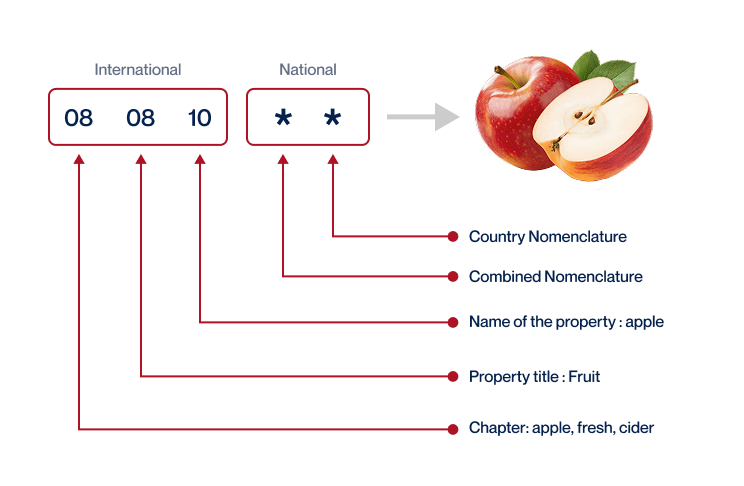
Step 2 – Find the HS Code of your product
Your HS code determines your duty rate, whether your goods are restricted, and whether additional measures apply. In short, it drives your entire import customs process Iraq from Thailand.
You can start with your supplier, but you should always validate the code yourself. Use a harmonized system code lookup Thailand Iraq trade tool such as the WCO HS database, compare product descriptions carefully, and match technical specifications, materials, and use.
If your HS code is wrong, you risk reassessment, fines, and delays during the customs inspection process Iraq. In some cases, goods move from green lane vs red lane customs simply because of a doubtful classification.
Step 3 – Calculate the Customs Value
Customs in Iraq generally rely on the transaction value, meaning the price you actually paid or will pay for the goods, adjusted where necessary. For most shipments, this results in a CIF value for customs purposes.
You must check what your Incoterm includes. If you buy EXW or FOB Thailand, you will need to add freight and insurance to reach the customs value. You may also need to include assists, certain commissions, royalties, special packing, or other customs valuation adjustments.
Example: if your goods cost 10,000 USD, and you pay 1,000 USD freight plus 200 USD insurance, your customs value becomes 11,200 USD. Duties will be calculated on that base, not only on the invoice price.
Step 4 – Figure out the applicable Import Tariff in Iraq
An import tariff in Iraq is the percentage applied to your customs value to determine duty payable.
You can calculate it in three steps:
- Open the official Iraqi Customs Authority portal.
- Enter your confirmed HS code.
- Read the duty rate applicable to your product.
When checking, look for:
- Standard duty rate
- Preferential rate based on origin
- Any additional measure linked to your HS code
- Notes about restricted and prohibited goods Iraq
Example: if your customs value is 11,200 USD and your duty rate is 15%, your import duty equals 1,680 USD. The formula is straightforward, but the classification behind it is not.
On the Thailand to Iraq route, preferential treatment eligibility depends heavily on documentation quality and bilateral trade agreements in force. We always double-check the tariff line before submission to avoid reclassification at the border.
Step 5 – Consider other Import Duties and Taxes in Iraq
After customs duty, you must calculate VAT on imports Iraq. VAT is usually applied on the customs value plus import duty, and sometimes other taxable elements.
Example: if your customs value is 11,200 USD and duty is 1,680 USD, VAT is calculated on 12,880 USD. You multiply that base by the applicable VAT rate to get your VAT amount.
You should also check for other import taxes and charges Iraq, such as reconstruction levies or excise duties for specific goods. Certain products may also require import license requirements Iraq or fall under temporary import procedure Iraq if they are not entering the market permanently.
Before you ship, make sure you:
- Confirm if your goods are restricted or require prior approval
- Verify if excise or special tax applies
- Check if bonded warehouse Iraq is an option for duty suspension
- Align your documents needed to import from Thailand to Iraq
Step 6 – Calculate the Customs Duties
Your formulas are simple:
- Customs duty = customs value × duty rate
- VAT = taxable base × VAT rate
Using our earlier example: 11,200 USD customs value × 15% duty = 1,680 USD duty. If VAT applies on 12,880 USD, you multiply that by the VAT rate to obtain the VAT payable.
What happens next? The Importer of Record pays the assessed duties before or at release, depending on the procedure and broker setup. If customs selects your file for inspection, or finds inconsistencies in the customs declaration form Iraq or single administrative document import, you may face storage, demurrage, or penalties. This is often where common customs clearance issues Thailand Iraq appear.
Step-by-step: how customs clearance usually works on this route
If you want a clear step by step customs clearance Thailand to Iraq view, here is how it typically unfolds. The sequence can differ depending on the border point, airport, shipment type, and Incoterm, but the logic remains similar.
- You prepare core documents, including commercial invoice requirements for customs, packing list for customs clearance, and bill of lading for customs Iraq or air waybill for customs clearance.
- We review HS classification, value, and origin proof before submission to ensure customs compliance Thailand Iraq trade.
- Your customs broker in Iraq lodges the customs declaration form Iraq into the system.
- Customs assigns a control channel, often referred to as green lane vs red lane customs, which determines whether inspection is required.
- If selected, customs inspection process Iraq takes place, and officers compare physical goods with declared data.
- Duties and taxes are assessed and confirmed in the system.
- The Importer of Record settles the payable amounts.
- Once payment is validated, customs releases the cargo for delivery or transfer to a bonded warehouse Iraq if applicable.
From experience, the real moments of truth are HS code validation, origin proof, and value consistency across documents. If you control those three, you dramatically reduce how long does customs clearance take Iraq and keep your shipment moving without unnecessary friction.
Does DocShipper charge customs fees?
No, DocShipper does not charge customs duties. As a custom broker in Thailand and Iraq, we differentiate between customs clearance fees, which are charged by us, and customs duties and taxes that directly benefit the government. Imagine you’re importing a shipment of graphics cards. You’d pay us for the paperwork (customs clearance) but the taxes on the merchandise (customs duties) go straight to the officials. We’ll supply you with actual documents from the customs office to validate that you’ve only covered the official charges. That’s transparency!
Contact Details for Customs Authorities
Thailand Customs

Official name: The Customs Department of Thailand
Official website: http://www.customs.go.th/
Iraq Customs
Official name: General Commission of Customs of Iraq
Official website: http://www.customs.mof.gov.iq/
Required documents for customs clearance in Iraq
When you import from Thailand into Iraq, customs does not block shipments because “the border is strict”. In our experience, you get delays because your documents do not match each other. Your shipper name, consignee details, product descriptions, HS codes and values must be consistent across every file. If one line differs, you risk inspection or reassessment. Here is the practical checklist you should validate before your cargo even reaches the destination airport or entry point.
Commercial Invoice
Your commercial invoice must meet commercial invoice requirements for customs in Iraq. You should include seller and buyer details, full product description, HS code where possible, unit price, total value, currency, and Incoterm.
Customs will use this document to validate your customs value calculation method. If the value looks inconsistent with market benchmarks, they may request justification or apply valuation adjustments. Always ensure your invoice matches your transport documents and declaration.
Packing List
Your packing list for customs clearance is not a formality. It supports quantity checks during the customs inspection process Iraq. You should clearly state number of packages, net and gross weight, dimensions, and detailed product description.
If your packing list is vague, customs may escalate your shipment to physical inspection. This is one of the most common customs clearance issues Thailand Iraq traders face, especially at entry points where inspections are frequent.
Bill of Lading
When you handle exporting from Thailand to Iraq documentation, your Bill of Lading is one of the core transport documents. It proves shipment, details the cargo, and links directly to your customs file. Customs will cross-check it against your commercial invoice and packing list.
If you ship by sea, ensure the consignee details match the Importer of Record in Iraq. If you use an electronic release, confirm it is properly recorded before arrival to avoid clearance delays. For air shipments, the Air Waybill plays the same role and must align perfectly with your declaration data.
Certificate of Origin
Your certificate of origin Thailand to Iraq is essential if you claim any applicable preferential tariff treatment. It must reflect the correct manufacturer, product description, and origin criteria.
If origin data conflicts with your invoice or production records, customs can reject the preferential rate and apply the standard import tariff in Iraq instead. Before shipping, verify that your supplier issues the correct format accepted by Iraqi authorities.
Import License or Company Registration Documents
These documents prove that you are legally registered to import into Iraq.
Customs needs them to validate that your company is authorized to conduct import operations.
Example: Iraqi business registration certificate and tax registration documents attached to the customs file.
Common mistake: expired company documents submitted with the declaration.
Product-Specific Certificates
These are compliance or sanitary documents required for certain controlled goods.
Customs requests them for products like food, cosmetics, chemicals or machinery.
Example: Health certificate for processed food or technical conformity documents for electrical equipment.
Common mistake: assuming that because goods come from a reputable origin country, no technical approval is required in Iraq.
Get Started with Siam Shipping
Prohibited and restricted items when importing into Iraq
Before you ship from Thailand, you need to understand one key distinction. Restricted means your goods are allowed, but only if you meet specific conditions such as licenses or inspections. Prohibited means customs can seize, return or destroy the cargo. If you are unsure, you should always check before loading the shipment. Once it is at the border or airport, your options become limited.
Restricted products
- Food and beverages, health certificates and product registration required
- Pharmaceuticals and medical devices, prior authorization and registration needed
- Cosmetics and supplements, labeling and regulatory approval required
- Chemicals and hazardous materials, safety data and special permits
- Used machinery, inspection and valuation scrutiny at entry point
- Agricultural products, phytosanitary certificates often mandatory
Prohibited products
- Illegal drugs and narcotics, zero tolerance and criminal penalties
- Weapons and explosives without state authorization
- Counterfeit goods and intellectual property infringements
- Obscene materials and items against public order and Islamic law
- Certain hazardous wastes and banned chemicals
- Alcohol and pork products, subject to strict prohibition under Iraqi regulations
If you have any doubt about classification, you should confirm the HS code and regulatory status before shipment. A wrong assumption can lead to cargo seizure at the border, and recovery is rarely simple.
Trade agreements and preferential duties for imports from Thailand to Iraq
When you import from Thailand into Iraq, it is important to note that the two countries do not share a regional free trade framework equivalent to ASEAN. Iraq is not a member of ASEAN, and no comprehensive bilateral free trade agreement between Thailand and Iraq is currently in force. This means most goods will be assessed under standard Most Favoured Nation tariff rates unless a specific arrangement applies to your product category.
In practice, this is where many importers underestimate their landed cost. You need to confirm the applicable duty rate for your HS code under Iraqi tariff schedules, and ensure your certificate of origin is correctly issued to avoid any classification disputes at customs.
Trade between the two countries has been growing, driven notably by Thai agricultural exports, processed food, machinery, and consumer goods flowing into the Iraqi market. Iraq’s reconstruction needs and import-driven economy make it an active destination, but customs authorities remain attentive to valuation and origin compliance, particularly for goods arriving via transshipment hubs.
Before you calculate your landed cost, you should verify three things with your broker: the applicable HS code in Iraq, whether any bilateral or unilateral preference applies to your goods, and whether additional taxes such as VAT, reconstruction levy, or excise duties apply. This is where you protect your margin, not after the goods arrive.
Your first steps with Siam Shipping
Additional logistics services
Warehousing
Finding dependable storage in Thailand for your goods destined for Iraq can be a hefty challenge. Ensuring optimal conditions like temperature control, particularly for perishable items or electronics, is equally tough. But the right warehousing solution can simplify the journey and maintain product integrity. Keen for in-depth insights? Check out comprehensive details at our dedicated page: Warehousing.
Packing
Shipping goods from Thailand to Iraq means battling varying climates. That's where our Packaging and Repackaging services come in handy, ensuring your products reach their destination in impeccable conditions. Our trusted agents can tailor the packaging of your tea leaves or auto parts to withstand the journey's demands. Doubts about fragility or perishables? We've got solutions tailor-made for you. Click here for more info on our dedicated page: Freight packaging.

Transport Insurance
Transporting goods often presents risks like damage or loss, risks that fire insurance doesn't cover. It’s not like covering a stationary building. Cargo Insurance provides a safety net, mitigates the uncertainties, and keeps your business moving. For instance, damage due to rough handling at ports can lead to big losses. But, with this cover, you're secured. More info on our dedicated page: Cargo Insurance.
Household goods shipping
Shipping personal effects from Thailand to Iraq can certainly feel like a puzzle. Whether it's heirlooms, furniture, or art, we handle your delicate and bulky items with the utmost care. Just like we did for an antique shop moving from Bangkok to Baghdad. You can trust our flexibility to accommodate every detail of your journey. More info on our dedicated page: Shipping Personal Belongings.
Procurement in Thailand
Sourcing products from Thailand for your Iraq-based business? Let DocShipper steer you through the procurement tricky waters. Our team bridges language gaps, locates reputable suppliers in Asia and East Europe, and handles the complete procurement process. Picture this: no hiccups, just smooth sourcing. Want to dive deeper? Check out more details at our dedicated page: Sourcing services.

Quality Control
Quality control is a crucial step when shipping from Thailand to Iraq. Inspections ensure your goods meet set standards, avoiding costly returns or rejections. Picture this – you're shipping customized furniture pieces. With quality inspections, you can spot any production defects or inconsistencies early, saving you time and resources. Trust in our quality control service to safeguard your business. Find out more on our Quality Inspection page.

Conformité des produits aux normes
Shipping goods involves adhering to unique regulatory norms of each country. Our Product Compliance Services provide you with robust testing in our laboratories to obtain certification and ensure your goods meet all requisite regulations. Let's make complexities of regulatory compliances hassle-free, and steer clear of unnecessary customs complications! More info on our dedicated page: Product Compliance Services.

Frequently Asked Questions
If everything runs smoothly, sea freight from Thailand to Umm Qasr takes around 26 to 32 days port to port. That is the sailing time most carriers currently publish for this corridor.
But that is not your door delivery timeline. You need to factor in:
- 3 to 7 days for export handling and vessel departure in Thailand
- Possible routing adjustments due to ongoing Strait of Hormuz security disruptions in early 2026
- Port waiting time at Umm Qasr, currently averaging around 3 to 4 days during congestion peaks
- 2 to 4 days for compliant customs clearance under Iraq’s updated electronic system
- Additional inland trucking time to Baghdad, Basra, or Erbil
In real operational terms, most importers should plan 35 to 45 days door to door for sea freight.
For urgent cargo, air freight from Bangkok to Baghdad or Erbil typically moves in about 5 to 8 days including clearance, assuming documentation is correct. This is where mistakes hurt the most because air storage fees accumulate fast.
We always recommend building buffer time into the first shipment on this lane. The Gulf security situation in early 2026 has already created periodic rerouting and insurance adjustments, and that can extend schedules without much notice.
For most commercial container shipments from Thailand, Umm Qasr remains the main entry point. It handles the majority of Iraq’s containerized cargo and infrastructure upgrades are ongoing to increase capacity.
That said, this is what most first-time importers miss: port choice affects inland cost and risk exposure.
- Umm Qasr is the standard gateway for southern and central Iraq. Best for Basra and Baghdad deliveries.
- Khor Al Zubair is more project and bulk oriented.
- Turkey land route with TIR transit can be faster for cargo destined to Erbil or northern Iraq.
Since April 2025, Iraq has fully activated the TIR system for international road transit. In some cases, goods routed via Turkey and entering Iraq by truck can reach inland destinations in under a week once in the region, which is significantly faster than waiting for southern port clearance and long inland hauls.
The right route depends on final delivery point, cargo type, and risk tolerance. We often compare total landed cost and transit reliability before confirming the routing.
Iraq is no longer operating on paper-based clearance at major ports. As of January 1, 2026, all commercial shipments must be declared electronically through the Unified Electronic Clearance System linked to ASYCUDA World.
This changes how you prepare shipments.
- Electronic pre-arrival filing is possible up to 14 days before vessel arrival
- Paper declarations are no longer accepted at major entry points
- All shipments above USD 150 must declare full commercial value
- Incorrect valuation can trigger heavy penalties under Iraqi Customs Law
Compliant shipments can clear in roughly 2 to 4 days. Non-compliant shipments can sit much longer and generate demurrage charges quickly.
We strongly advise first-time importers to submit documentation for compliance review before cargo departure from Thailand. This is where most delays originate, not at sea.
Yes, and this is one of the biggest pain points on this trade lane.
Since mid-2025, Iraq introduced stricter requirements around certificates of origin and third-party inspection procedures for certain goods. In addition, certificates must match product markings and declared values exactly.
For regulated categories such as electronics, pharmaceuticals, and many construction materials, prior approval from the relevant Iraqi ministry may be required before shipment.
If documentation does not match shipment details, customs can block the cargo. When that happens, you are paying storage and possibly re-documentation costs while the issue gets corrected.
We always confirm whether your HS code triggers inspection, conformity certification, or ministry approval before booking the shipment. This step alone prevents most clearance disasters.
Freight cost on this route depends heavily on three variables: container size, routing through the Gulf, and insurance premiums linked to regional security.
Sea freight is generally the most economical solution for cargo over 2 to 3 cubic meters. Air freight becomes viable when the cargo is high value, time sensitive, or below roughly 300 to 500 kg.
In 2026, insurers are closely monitoring Gulf risk exposure. During peak tension periods affecting the Strait of Hormuz, carriers may apply temporary surcharges or adjust routing. This can impact both transit time and freight rates.
On the Thailand side, exporters must also account for local charges such as documentation fees and terminal handling fees, which are billed per bill of lading.
Instead of asking "What is the freight rate?", the better question is "What is my total landed cost to my warehouse in Iraq?" That includes freight, insurance, duties, inland transport, and clearance charges. We calculate that before shipment so there are no surprises.
After handling multiple Thailand to Iraq shipments, the same issues keep appearing.
- Under-declaring cargo value to reduce duties, which leads to penalties
- Shipping before obtaining required Iraqi ministry approvals
- Sending documents that do not match the actual packaging or product labeling
- Ignoring pre-arrival electronic filing options
- Choosing the wrong port for the final delivery location
Another frequent issue involves Kurdistan Region deliveries. Some importers assume clearance rules differ significantly. In practice, federal customs controls have tightened and unified electronic systems now apply broadly. Misunderstanding this can create duplicate inspections and costly inland detours.
The good news is that this route is absolutely manageable when structured properly. The key is planning compliance before cargo departure, not reacting once the container is sitting at Umm Qasr accumulating storage charges.