In short ⚡
Cross border Thailand operations involve moving goods and passengers through Thai land borders within ASEAN economic corridors, using road-first planning, strict customs compliance, and coordinated trucking. To move cargo safely and predictably, you must align routes, documents, permits, and vehicle licenses with Thai Customs rules and bilateral agreements while factoring in border congestion and inspection risks.In this article, you will find practical checklists for land-routing, detailed breakdowns of Thailand–Cambodia and Thailand–Laos corridors, required customs and transport documents, key operational risks, and a step-by-step workflow to secure compliant, time-efficient cross-border trucking across ASEAN.
We hope you’ll find this article genuinely useful, but remember, if you ever feel lost at any step, whether it’s finding a supplier, validating quality, managing international shipping or customs, DocShipper can handle it all for you!
How cross border Thailand trade works in the ASEAN road network
If you’re planning cross border Thailand moves, you’ll notice fast that the road network is no longer “secondary” to ocean freight, it’s a strategic supply chain lane inside ASEAN.
Between industrial zones around Bangkok and the big land gates on the Thailand border, you can build predictable lead time with the right routing, customs clearance plan, and carrier control.
From experience, the importers who struggle aren’t the ones lacking freight rates, they’re the ones who underestimate border processes, corridor congestion, and how quickly a missing permit can freeze a consignment.
- Road-first planning: you lock routing and dispatch windows around border operating hours, not around your factory’s “ready date”.
- Document discipline: tariff classification, invoice values, and incoterms alignment decide whether your cargo glides through or gets parked.
- Multimodal reality: you’ll often mix cross border trucking Thailand with drayage, bonded warehouse storage, cross-docking, or containerization at inland depots.
We see the same pattern across ASEAN: land trade grows when infrastructure and regional agreements reduce transit time variability, not just when roads get wider.
That’s also where we step in at DocShipper, we coordinate freight forwarding, customs brokerage, and shipment booking so your transport plan survives contact with the border.
Checklist, before you commit to a land route:
- Confirm your incoterms and who owns customs clearance at export and import.
- Validate HS code and duty exposure, including any preferential ASEAN rules of origin.
- Choose a routing plan with realistic buffer for border queues and inspection peaks.
- Decide if you need bonded warehouse or cross-docking near the checkpoint.
- Set tracking expectations, TMS milestones, and exception escalation rules with your haulier.
Workflow, how we typically structure cross border Thailand shipments:
Step 1, confirm cargo specs, palletization, and load planning with your supplier.
Step 2, lock incoterms, commercial terms, and freight insurance responsibilities.
Step 3, run tariff classification, draft customs entries, and validate permits.
Step 4, book the carrier, dispatch the truck, and set tracking milestones in your transportation management system.
Step 5, execute export clearance, border transfer, then import clearance, with inspection management if triggered.
Step 6, deliver to warehouse, distribution hub, or last-mile delivery point, then close the file with proof of delivery.
Siam Shipping Info
DocShipper coordinates freight, customs, and trucking so your border strategy stays on schedule and on budget.
Thailand’s role as a land bridge in ASEAN and the Greater Mekong Subregion
In cross border Thailand logistics, Thailand acts like a practical land bridge between mainland ASEAN markets, especially through the Greater Mekong Subregion links to Laos, Cambodia, and Myanmar.
You’re not just moving cargo, you’re leveraging a regional transit structure that increasingly favors time-sensitive road freight when you can’t wait for port dwell time.
Here’s the thing, this isn’t theory.
We once handled a consumer goods shipment where the buyer insisted on sea freight “because it’s cheaper”, then missed a promotion window after a port rollover and a warehouse backlog.
We switched the next replenishment to cross border trucking Thailand with a controlled border slot, and the shorter transit time made the inventory plan work again, even with higher transport cost.
When you map Thailand’s role, you’ll see why the ASEAN framework matters, it pushes harmonization efforts that influence how you route, what documents your driver carries, and how fast customs brokerage can clear.
| What you’re optimizing | Why Thailand matters | What you should plan for |
| Lead time stability | Thailand connects production and consumption zones with multiple land exits | Border queue buffers, inspection probability, dispatch cutoffs |
| Cost-to-serve | Road can beat air on cost, and beat sea on speed for regional lanes | Freight consolidation, backhaul availability, tolls, fuel index |
| Compliance risk | Transit and cross-border rules vary by neighbor and checkpoint | Permits, driver documents, cargo controls, duties and taxes |
Looking for a Reliable Shipping & Sourcing Partner?


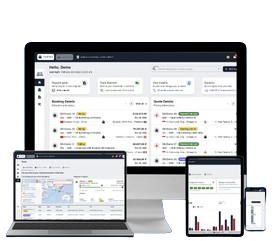
DocShipper Platform
One platform. Your entire supply chain
Sourcing, freight, customs & documents, all centralised, all visible, 24/7.
Key economic corridors and border checkpoints that drive Thailand’s border trade
For cross border Thailand trade, corridors are your “hidden schedule”, they determine real transit time more than the distance on a map.
You’ll run into familiar pressure points at major Thailand border nodes, where cargo, passengers, and local trade compete for the same lanes.
A quick real-world scenario we see a lot: your supplier finishes production Friday afternoon, your haulier picks up, then your truck hits a checkpoint Monday morning when everyone else does.
The result is predictable, long queues, missed warehouse receiving slots, and a domino effect on fulfillment.
Thailand’s corridor development, supported by agencies like the Asian Development Bank in the Greater Mekong Subregion, is designed to reduce those chokepoints, but you still need operational routing discipline today.
- Thailand Laos border crossing: key for Northeast Thailand flows into Laos, then onward transit lanes toward Vietnam and South China.
- Thailand Cambodia border: critical for automotive parts, FMCG distribution, and project cargo supporting industrial growth around Cambodia’s corridors.
- Thailand border with Malaysia: high-volume commercial trucking and time-sensitive distribution, but you must plan for peak-hour congestion.
- Myanmar-facing gates: often more sensitive to local operating constraints, so you’ll want tighter compliance checks and contingency routing.
If you want smoother customs clearance, you’ll align your shipment booking and dispatch with checkpoint patterns, then keep your commercial documents clean and consistent.
That sounds basic, but it’s where most border delays start.
Siam Shipping Advice
Book controlled border slots and pre-audit documents to reduce queues, inspections, and costly dwell time.
Cross border trucking Thailand: routes, customs and compliance you must know
Cross border trucking Thailand is where strategy turns into execution, and execution is where most shippers get burned.
You’re dealing with carriers, hauliers, driver constraints, cargo security, and country-specific customs procedures, all while trying to protect freight rates and delivery promises.
We’ll be blunt, you can have perfect procurement pricing and still lose money if your trucks wait two days at the border and your inventory pipeline breaks.
Checklist, to keep your trucking plan under control:
- Confirm truck type and loading method, loose cargo, palletization, or containerization.
- Define handover points, direct cross-border, or transloading at the border.
- Set tracking milestones, pickup, border arrival, export cleared, import cleared, POD.
- Pre-validate documents, invoice, packing list, permits, and origin evidence if relevant.
- Decide contingency actions, reroute, hold in bonded warehouse, or return to shipper.
Workflow, a practical way to run cross border trucking Thailand:
Step 1, confirm routing and border checkpoint choice based on commodity and risk.
Step 2, pre-check HS codes, duties and taxes exposure, and any controlled goods rules.
Step 3, prepare the driver pack, permits, commercial docs, and clearance references.
Step 4, dispatch with a buffer, then monitor tracking and exceptions.
Step 5, manage export and import clearance, including inspection and payment release timing.
Step 6, deliver to warehouse or cross-dock, then close with cost reconciliation and claims handling.
Siam Shipping Alert
Secure compliance, permits, and real-time tracking before dispatch to protect your delivery promises and margins.
Main cross border trucking routes with Laos, Cambodia, Myanmar and Malaysia
When you build cross border trucking Thailand lanes, you’re really choosing between speed, predictability, and how much border handling you can tolerate.
Routes to Laos are often favored for onward transit and regional distribution, while the thailand cambodia border lanes can be extremely effective for commercial replenishment when you plan around checkpoint rhythms.
We’ve seen a simple mistake derail an otherwise clean move: a shipper chose a “faster” route to the Thailand Cambodia border without checking local holiday traffic.
The truck arrived during a surge, missed the customs cut-off, and the cargo sat overnight, which then triggered a warehouse receiving penalty at destination.
- Laos lanes: used for Northeast Thailand distribution and transit corridors, common for FMCG, electronics, and consolidated cargo.
- Thailand Cambodia border lanes: popular for regional distribution, spare parts, and retail replenishment, but queues can spike fast.
- Malaysia lanes: strong commercial flows, often with tighter delivery windows and higher expectations on tracking and POD.
- Myanmar lanes: require more conservative risk planning, especially for sensitive commodities and insurance conditions.
| Lane | What it’s best for | Operational watch-outs |
| Thailand Laos border crossing | Regional transit, hub-and-spoke distribution | Border timing, document consistency, transloading rules |
| Thailand Cambodia border | Fast replenishment and B2B distribution | Queue volatility, security context, cut-off times |
| Thailand to Malaysia | Time-sensitive retail and industrial flows | Congestion windows, strict receiving appointments |
| Thailand to Myanmar | Selective projects and controlled flows | Higher compliance sensitivity, contingency routing |
Siam Shipping Advice
We design checkpoint-specific trucking plans to avoid holiday surges, missed cut-offs, and warehouse penalties.
Customs, permits and logistics documents required for cross border trucking
On cross border trucking Thailand, paperwork isn’t “admin”, it’s the difference between rolling and parking.
You’ll need clean commercial documents, correct tariff classification, and the right permits, plus a customs clearance plan that matches your incoterms and payment terms.
One of the most common frustrations we hear: you negotiated great pricing with your supplier, then customs asks for a clarification on value or product description, and suddenly your truck sits while your buyer argues about who pays storage.
This is the moment where a prepared customs brokerage team saves you real money.
Thailand’s procedures are driven by the Thai Customs Department, and you’ll benefit from aligning your document pack to their expectations before the truck ever departs.
- Core commercial documents: invoice, packing list, and any contract references tied to incoterms.
- Transport documents: trucking waybill, plus bill of lading or airway bill if your move is multimodal upstream.
- Customs data: HS code, declared value, origin details, and product descriptions that match reality.
- Permits and controls: commodity-specific licenses if you ship regulated goods, plus any route or vehicle permissions where required.
- Risk protection: freight insurance details, claim instructions, and photo records at loading for damage disputes.
If you want this to run smoothly, we recommend you standardize a driver document folder and a digital copy set, then sync it with your TMS milestones.
At DocShipper, we routinely combine freight forwarding coordination, customs clearance support, and on-ground trucking management so your cargo doesn’t get stuck between two systems.
“`html
Thailand Cambodia border: trade hubs, checkpoints and security context
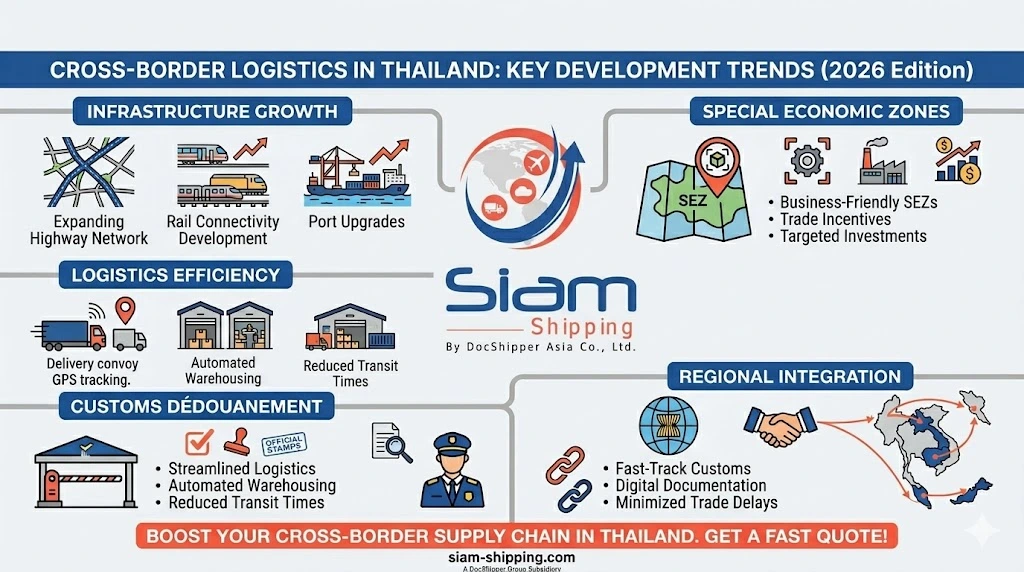
The Thailand Cambodia border is one of the most dynamic segments of cross border Thailand trade, especially for consumer goods, construction materials and agro-products. You are dealing with a corridor that connects Bangkok directly to Phnom Penh and further to Vietnam.
Most cargo flows through a limited number of strategic checkpoints, so your route selection directly impacts transit time and clearance complexity. You need to understand which gate fits your product and compliance profile.
- Aranyaprathet – Poipet: Main commercial hub, high-volume container and truck traffic.
- Khlong Yai – Cham Yeam: Key for trade toward Sihanoukville and coastal shipments.
- Chong Chom – O’Smach: Used for regional bulk and agricultural products.
- Ban Laem – Daung: Secondary crossing for SMEs and bonded cargo.
Aranyaprathet is integrated into Thailand’s Eastern Economic Corridor supply chain, which means you benefit from developed warehousing and bonded facilities. However, congestion can extend border dwell time during peak agricultural seasons.
| Checkpoint | Main Cargo Type | Risk Level | Infrastructure Quality |
| Aranyaprathet | FMCG, electronics, garments | Medium | High |
| Khlong Yai | Seafood, mixed cargo | Medium | Medium |
| Chong Chom | Agricultural bulk | Low to Medium | Medium |
Security context matters because informal trade and grey-channel imports still exist in some areas. You must ensure your documentation is aligned with both Thai Customs and Cambodian General Department of Customs to avoid inspections.
At DocShipper, we conduct pre-border document audits and coordinate with licensed brokers on both sides. This reduces your exposure to reclassification, valuation disputes and unexpected duty reassessments.
Siam Shipping Info
Pre-border audits and dual-broker coordination reduce reclassification risk and unexpected duty reassessments.
Thailand Laos border crossing: routes for cargo and passengers
The Thailand Laos border is central to the North-South Economic Corridor and supports transit cargo toward southern China. If you are moving goods by road to Kunming, this is your strategic gateway.
The First and Second Thai-Lao Friendship Bridges handle most freight traffic. Rail connectivity is expanding, which strengthens multimodal options for cross border Thailand logistics.
- Nong Khai – Vientiane: Major freight and passenger crossing, linked to Laos-China railway.
- Mukdahan – Savannakhet: East-West Economic Corridor, ideal for Vietnam-bound cargo.
- Chiang Khong – Houayxay: R3A route to southern China via Laos.
- Nakhon Phanom – Thakhek: Growing regional trade checkpoint.
If you are exporting from Thailand to Laos, most goods move under standard export declaration with Form D for ASEAN preferential tariffs. Transit cargo to China often uses bonded trucking with customs transit guarantees.
| Route | Primary Use | Transit Advantage |
| Nong Khai | General cargo, rail-linked | Access to Laos-China rail |
| Mukdahan | Thailand–Vietnam trade | Fast east-west corridor |
| Chiang Khong | China-bound trucking | Direct R3A highway |
Passenger flows are also significant, especially at Nong Khai and Mukdahan, which impacts border congestion. You should plan buffer time during regional holidays such as Songkran and Lao New Year.
We help you design land-based multimodal solutions combining truck and rail. This approach reduces your cost per CBM while improving predictability across the Mekong subregion.
Siam Shipping Advice
Combine bonded trucking and rail solutions to cut cost per CBM while protecting transit predictability.
Thailand border regulations, risks and practical tips for cross border operations
Cross border Thailand operations are governed by Thai Customs Act, ASEAN Framework Agreement on the Facilitation of Goods in Transit, and bilateral MOUs. You must align your shipment structure with these legal frameworks before dispatch.
Land transport requires strict control of documentation and vehicle permits. One missing endorsement can immobilize your truck at the checkpoint.
- Export declaration approved by Thai Customs
- Commercial invoice and packing list
- ASEAN Form D for preferential tariffs
- Transit permit or bonded transport guarantee
- Vehicle cross-border license and driver passport/visa
- Cargo insurance covering land transport
The most common operational risks include:
- HS code misclassification leading to duty reassessment
- Under-valuation disputes
- Mismatch between invoice and physical cargo
- Driver documentation issues
- Sudden regulatory tightening on sensitive goods
You can mitigate these risks with a structured workflow. This is the process we implement internally for clients.
| Step | Action | Objective |
| 1 | Pre-shipment compliance review | Avoid border rejection |
| 2 | Dual-side customs coordination | Synchronize declarations |
| 3 | Transport permit validation | Prevent truck immobilization |
| 4 | Real-time border monitoring | Reduce waiting time |
When you structure your operation correctly, land transport becomes faster than sea for regional ASEAN flows. In some corridors, you can cut lead time by 30% to 50% compared to maritime routing.
If you want a full operational setup, you can rely on DocShipper cross-border logistics solutions to manage sourcing, customs and trucking under one control tower. We act as your single point of accountability across Thailand, Cambodia and Laos.
Siam Shipping Alert
Implement structured compliance reviews and live border monitoring to prevent immobilization and financial exposure.
Conclusion
Cross border Thailand trade is accelerating under ASEAN integration and infrastructure expansion. If you understand the corridors and compliance layers, you can turn land borders into a competitive advantage.
- Thailand Cambodia border is ideal for FMCG and EEC-linked exports.
- Thailand Laos crossings connect you to China via road and rail.
- Customs documentation accuracy is your first risk control tool.
- Transit agreements under ASEAN reduce tariffs when properly applied.
- A structured workflow minimizes delays and financial exposure.
- Partnering with an experienced operator secures your regional supply chain.
You do not need to navigate these borders alone. With the right preparation and the right partner, your cross border Thailand operations can become faster, safer and more profitable.
“`FAQ | Cross border Thailand: how to move goods and travel safely across Thai land borders
Thailand sits in the center of mainland Southeast Asia, bordered by Myanmar to the west and northwest, Laos to the north and northeast, Cambodia to the east, and Malaysia to the south. This central mainland position turns Thailand into a natural land bridge between production hubs (like China and Vietnam) and consumer markets across ASEAN. For you, it means shorter overland routes, multiple alternative corridors, and the ability to re‑route cargo via different neighbors if one border becomes congested or restricted.
Thailand has land borders with 4 countries: Myanmar, Laos, Cambodia and Malaysia. Each one plays a different role in your routing strategy. Laos and Cambodia are typically used for transit and regional distribution (e.g. to Vietnam or southern China), Myanmar is more selective and risk‑sensitive for specific projects, and Malaysia is the most structured for high‑frequency commercial trucking to developed retail and industrial zones. When you design your lane, you’ll choose the neighbor based on where your final buyers are, the regulatory profile of your product, and how much border handling you’re prepared to manage.
Even without a direct land border, Thailand is used as a stepping stone to China via Laos and the North–South Economic Corridor. In practice, you move cargo from Thailand to Laos through crossings like Chiang Khong–Houayxay or Nong Khai–Vientiane, then continue north into southern China. For time‑sensitive goods, operators often combine Thai road legs with Lao rail segments to reach hubs like Kunming efficiently while still leveraging Thai infrastructure and services.
Yes, for intra‑ASEAN flows your reliance on seaports can drop significantly. Because Thailand connects to four neighbors by road, many regional shipments that used to move by feeder vessel now go by truck under transit or cross‑border regimes. This matters if you’re trying to cut lead times, avoid port congestion, or support just‑in‑time inventory: you can structure land‑based loops between Thailand and nearby markets instead of routing everything through deep‑sea terminals.
When you have multiple viable crossings into the same country (for example several Thailand‑Cambodia or Thailand‑Laos gates), you’ll compare them on congestion patterns, infrastructure, and control level rather than just distance. Some checkpoints are better equipped for containerized and bonded cargo, others are leaner but more exposed to local traffic or informal trade. The most resilient shippers regularly review actual dwell times and inspection rates per gate, then shift volumes toward the crossings that consistently offer the best balance of speed, predictability and compliance comfort for their specific commodity.
Read more
Looking for more? Check out these articles.
Need Help with
Logistics or Sourcing ?
First, we secure the right products from the right suppliers at the right price by managing the sourcing process from start to finish. Then, we simplify your shipping experience - from pickup to final delivery - ensuring any product, anywhere, is delivered at highly competitive prices.


Fill the Form
Prefer email? Send us your inquiry, and we’ll get back to you as soon as possible.
Contact Us