In short ⚡
Freight forwarding market outlook shows a structurally growing but more volatile industry, driven by e‑commerce, nearshoring, and shifting trade lanes between Asia, Europe, and North America. Since 2020, extreme rate spikes, capacity cuts, and recurring congestion have made reliability, digitalization, compliance, and resilience more decisive than simply chasing the lowest freight rate.In this article, you will find an analysis of recent ocean and air rate cycles, key demand shifts from e‑commerce and nearshoring, practical indicators to read freight market news, and strategic levers for SMEs and Amazon sellers around digitalization, sustainability, and resilient freight strategies.
We hope you’ll find this article genuinely useful, but remember, if you ever feel lost at any step, whether it’s finding a supplier, validating quality, managing international shipping or customs, DocShipper can handle it all for you!
What is happening in the global freight forwarding market right now?

If you’ve been following the freight forwarding market since 2020, you’ve watched it swing from “no space at any price” to “space is back, but the rules changed.”
Rates calmed down through 2022–2023 versus the peak years, yet your day-to-day reality still feels jumpy because capacity planning, carrier selection, and port reliability don’t normalize at the same speed.
From our side at DocShipper, you’ll notice fast that the winners aren’t the ones chasing the lowest spot rate, they’re the ones who lock clean processes around booking, cargo handling, customs clearance, and shipment tracking.
Checklist, what you should review this week (before you quote or book):
- Your latest freight rate vs spot rate spread on your core lanes.
- Carrier schedule reliability and rolled booking frequency.
- Current lead time, including warehouse dwell time and customs brokerage turnaround.
- Document readiness: bill of lading data, packing list, commercial invoice, HS code, and incoterms alignment.
- Any trade compliance constraints: tariff classification, duties and taxes exposure, export licensing needs.
Workflow, a simple way we align operations with the market:
Step 1: confirm incoterms and who controls the booking, then validate cargo readiness date.
Step 2: run lane options across multimodal transport (ocean, air, rail, trucking) and shortlist carriers based on reliability, not only price.
Step 3: validate customs data (HS code, value, origin) before tendering to avoid rework and holds.
Step 4: book, then monitor cut-offs, documentation, and exceptions daily until delivery and freight audit.

Market size, key regions and growth drivers you should know
The freight forwarding market stays structurally growth-oriented because global import export still runs on consolidation, deconsolidation, and efficient distribution center networks.
Asia remains the engine room for containerization and air cargo manufacturing flows, while North America and Europe keep pulling demand through consumer goods, industrials, and pharma.
Here’s the thing, growth isn’t only “more volume.”
It’s also more complexity per shipment, more SKUs, tighter delivery windows, and stricter trade compliance.
Industry bodies like the International Air Transport Association (IATA) have repeatedly highlighted how air cargo demand and capacity cycles can move fast when passenger belly capacity shifts, and you feel that instantly in transit time promises.
In practice, we often see forwarder performance split into two camps:
- Operational forwarders who control procurement, tendering, and carrier selection, then execute clean customs clearance and exception management.
- Quote forwarders who win on price but struggle with schedule changes, rolled containers, and missing paperwork.
Quick real-world scenario: you negotiate FOB with a supplier, thinking you control the shipment, then their local agent issues a bill of lading with inconsistent consignee data.
That one mismatch can trigger customs queries, delay deconsolidation at destination, and blow up your warehousing and inventory management plan for the week.
Mini table, what “growth” looks like operationally:
| Growth driver | What you feel in operations | What to control |
| E-commerce expansion | Smaller lots, higher frequency, tighter last mile delivery SLAs | Load optimization, palletization rules, faster customs brokerage |
| More compliance and enforcement | More holds, more document checks, more audits | HS code accuracy, tariff classification, commercial invoice integrity |
| Carrier network reshuffles | Blank sailings, schedule volatility, rebookings | Capacity planning, backup routing, shipment tracking discipline |
How e‑commerce, nearshoring and new trade flows reshape freight demand
In the freight forwarding market, demand doesn’t just “go up or down,” it migrates across lanes, modes, and service levels.
You’ve probably already felt it when a once-stable ocean lane becomes unpredictable, and suddenly air freight looks attractive even if the unit cost hurts.
E-commerce pushes you toward faster replenishment cycles, more cross docking, and tighter control of reverse logistics.
Nearshoring and “China+1” sourcing strategies pull volume into new origin points, which changes consolidation patterns and how you should design your warehousing footprint.
One small anecdote we see a lot: a seller moves production from South China to Vietnam to reduce risk, but keeps the same packing list format and SKU labeling.
Customs then flags inconsistencies in origin documentation, and duties and taxes calculations shift, so the shipment gets stuck right when you’re trying to protect lead time.
To stay ahead, you should map your flows like this:
- Trade lane view: origin region, destination region, transshipment dependency.
- Mode view: ocean vs air vs rail, including multimodal handoffs and cargo handling constraints.
- Service view: port-to-port vs door-to-door, including customs clearance, bonded warehouse use, and last mile delivery.
And yes, you can still negotiate better, even in volatile cycles.
When we support your procurement, we focus on total landed cost and reliability, not just the freight brokerage line item.
How to interpret freight market news, indices and updates
Most freight market news is noisy because it mixes spot quotes, contract behavior, and capacity signals without telling you what’s actually actionable.
You don’t need more headlines, you need a method to translate a freight market update into booking decisions, inventory buffers, and risk flags.
Checklist, your “signal vs noise” filter for freight forwarding news:
- Does the update specify the lane and equipment type (40’HC, reefer, air ULD), or is it generic?
- Is it talking spot rate, contract rate, or all-in landed cost including origin and destination charges?
- Does it mention capacity (blank sailings, aircraft utilization) and congestion, not only price?
- Does it include a time window, and is it aligned with your tendering cycle?
- Can you map it to your incoterms responsibilities and customs clearance lead times?
Workflow, how we convert freight market updates into an execution plan:
Step 1: tag the update by mode, lane, and time horizon (2 weeks, 1 month, 1 quarter).
Step 2: compare with your shipment calendar and supplier readiness dates.
Step 3: decide tactics, lock capacity, switch mode, split shipments, or adjust safety stock.
Step 4: update SOPs, booking cut-offs, documentation deadlines, and exception playbooks.
Looking for a Reliable Shipping & Sourcing Partner?
The main freight market indicators (rates, volumes, capacity, congestion)
A useful freight market read is built on four pillars: rates, volumes, capacity, and congestion.
If you only watch rates, you’ll keep getting surprised by rolled containers, missed ETDs, and warehouse bottlenecks.
- Rates: spot rate vs contract, plus accessorials and local charges that quietly inflate your freight rate.
- Volumes: bookings, loaded TEUs, air chargeable weight trends, which often lead price changes.
- Capacity: blank sailings, vessel deployment, belly capacity, charter activity, which drives space risk.
- Congestion: port dwell time, yard density, inland trucking constraints, which extend door-to-door lead time.
From experience, congestion is where plans go to die.
We’ve seen importers win a great rate, then lose two weeks because their container hits a congested node, misses a rail connection, and sits while demurrage and detention start ticking.
Quick comparison table, what each indicator tells you:
| Indicator | What it predicts | Operational move you can take |
| Spot rate swings | Short-term pricing pressure | Split bookings, pre-book, or switch to a stable service |
| Capacity cuts | Space risk and roll risk | Earlier cargo ready dates, premium options, alternative ports |
| Congestion metrics | Lead time extensions | Adjust inventory buffers, reroute, use bonded warehouse where relevant |
Where to find reliable freight market news and how to use it in your planning
Reliable freight market update sources share the same trait: they separate lane-level reality from global commentary.
You’ll do better when you combine public indices with what your forwarder sees at booking desks and terminals.
Here are sources we routinely triangulate, especially when you ask us for a go or no-go recommendation:
- Market indices and pricing dashboards for directional rate signals.
- Carrier advisories and schedule updates for capacity planning.
- Port and airport operational data for congestion and dwell time.
- Customs and trade bulletins for compliance risk, HS code enforcement, and export licensing changes.
For ocean specifically, an ocean freight market update becomes actionable when it tells you whether the shift is about blank sailings, equipment imbalances, or inland constraints.
And for daily freight forwarding news, we recommend you anchor your interpretation with one authoritative baseline like FIATA so you don’t overreact to every headline.
Micro-story that might sound familiar: you read freight market news saying “rates are down,” so you delay booking to wait for a better number.
Then your supplier misses the vessel cut-off, your consolidation window closes, and you end up paying a premium service anyway just to protect your distribution center replenishment.
When you work with us, you don’t just get headlines.
You get a lane-by-lane plan that ties procurement, documentation, customs brokerage, and shipment tracking into one execution rhythm.
Siam Shipping Info
Talk to our logistics experts to secure capacity, clean documentation, and reliable customs clearance on your core lanes. Turn rate swings into controlled execution.
Siam Shipping Advice
Ask us for a tailored market brief aligned with your suppliers, incoterms, and booking calendar.
Ocean and air freight market update: rates, capacity and trade lane shifts
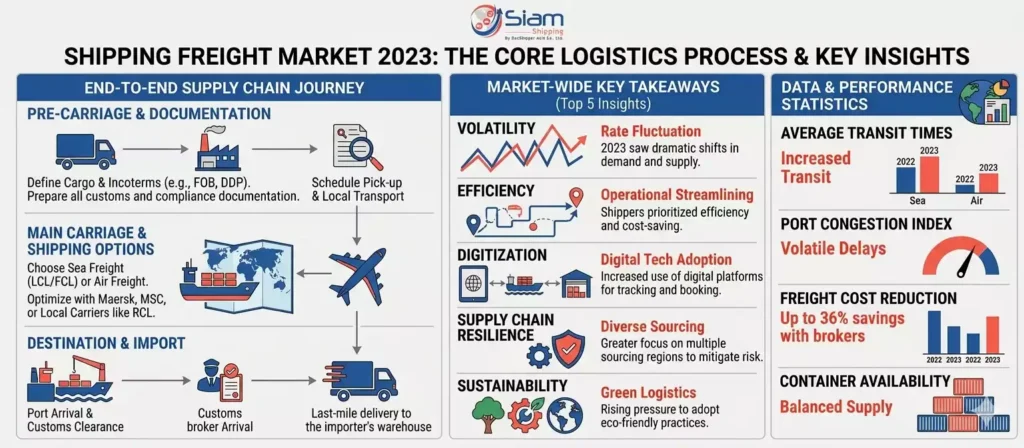
You cannot plan your logistics without understanding how the Freight forwarding market has evolved from 2020 to 2023. The rate cycles you saw during the pandemic are not anomalies, they reset expectations for volatility.
Between 2020 and late 2022, container rates on major East West trades increased by more than 300% to 500% at peak levels. In 2023, most lanes corrected sharply, but structural costs remain higher than pre COVID benchmarks.
| Indicator | 2020 | 2021–2022 Peak | 2023 Trend |
| Asia–US West Coast (40HQ) | Low and stable | Extreme surge, space crisis | Sharp correction, volatile |
| Asia–Europe (40HQ) | Moderate | Record highs, congestion | Declining, overcapacity signs |
| Air freight rates | Stable | Capacity crunch, high yields | Softening with passenger return |
| Port congestion | Localized | Severe global congestion | Improved but recurring hotspots |
You now operate in a market where capacity management is tactical, not static. Carriers blank sailings to control supply, and alliances reshape weekly departures.
- Ocean carriers manage capacity through blank sailings and slow steaming.
- Air cargo capacity rebounds as passenger flights return.
- New trade lanes grow, especially Southeast Asia and India.
- Nearshoring increases Mexico and Eastern Europe volumes.
If you import from China, you have seen production diversify to Vietnam, Thailand and India. We help you redesign your routing strategy when your sourcing footprint shifts.
You must also track equipment availability and inland bottlenecks, not just ocean rates. A low freight rate means little if your container misses the vessel cut off.
Siam Shipping Alert
Secure capacity and backup routing early to avoid rolled cargo, inland bottlenecks, and costly rebookings.
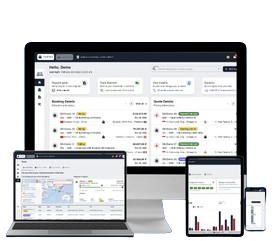
DocShipper Platform
One platform. Your entire supply chain
Sourcing, freight, customs & documents, all centralised, all visible, 24/7.
How SMEs and Amazon sellers can navigate freight cost volatility

You cannot control the market, but you can control your structure. The right freight strategy protects your margin even when the rate cycle turns.
- Diversify Incoterms, mix FOB and EXW depending on supplier maturity.
- Split shipments between ocean FCL, LCL and air for risk balancing.
- Negotiate validity periods aligned with your sales cycle.
- Build safety stock based on realistic transit time scenarios.
For Amazon sellers, timing is everything. A two week delay during peak season can destroy your ranking and cash flow.
| Strategy | Benefit | Risk if ignored |
| Forecast driven booking | Secures space early | Rolled cargo, stockouts |
| Hybrid sea air solutions | Reduces transit time | Lost sales during peak |
| Freight cost simulation | Better pricing decisions | Margin erosion |
| Supplier coordination | Fewer production delays | Missed vessel cut offs |
You should run quarterly cost scenarios, not annual ones. We regularly simulate landed cost models for our clients to anticipate swings of 20% or more in freight components.
When you work with us, you gain visibility from factory gate to final warehouse. That visibility is your strongest hedge against volatility.

Siam Shipping Advice
Request a landed cost simulation and build hybrid sea air strategies aligned with your sales forecasts.
Strategic trends for freight forwarders: digitalization, sustainability and resilience
The freight forwarding market is no longer only about price. You now compete on data, compliance and resilience.
- Digital booking platforms and real time tracking.
- Carbon reporting and sustainable fuel options.
- Multi sourcing and multi routing strategies.
- Integrated customs and trade compliance tools.
Digitalization accelerates decision making across your supply chain. You move from reactive firefighting to predictive logistics management.
| Trend | Operational Impact | What You Should Do |
| Automation | Faster documentation flow | Integrate systems with your forwarder |
| Data analytics | Better forecasting accuracy | Track KPIs monthly |
| Green logistics | Higher compliance pressure | Measure CO2 per shipment |
| Resilience planning | Lower disruption impact | Create alternative routing plans |
You should view sustainability as a commercial factor, not just regulatory. Large retailers increasingly require emissions transparency in tenders.
At DocShipper, we combine sourcing in China, quality control and freight coordination into one workflow. This integration reduces friction and strengthens your supply chain resilience.
Siam Shipping Info
Centralize sourcing, compliance, and freight coordination to reduce friction and strengthen long term performance.
Conclusion
You now understand that the freight forwarding market is cyclical, data driven and increasingly strategic. Your advantage comes from preparation, not prediction.
- Track ocean and air rate cycles, not just spot prices.
- Adjust your sourcing geography to evolving trade lanes.
- Build flexible shipping strategies for SMEs and Amazon models.
- Invest in digital tools and sustainability reporting.
- Work with a forwarder who understands end to end operations.
If you want to turn market volatility into competitive leverage, you need structure and expertise. We support you from supplier selection in Asia to final delivery, with full control over your global freight strategy.
FAQ | Freight forwarding market outlook: how to read today’s data, news and rate cycles
For most SMEs and Amazon sellers, a weekly deep dive is overkill. What works in practice is a layered rhythm: review lane-level rate movements and carrier advisories once per month, then do a quick check 10–15 days before any major shipment or sales peak. The key is to align your reviews with your tendering and replenishment cycles, not with every headline, so you only renegotiate or re-route when a change will really impact landed cost or lead time.
First, ask your forwarder to break down their offer: base ocean or air rate, surcharges, and local charges at both ends. Then compare the base rate with one or two trusted market indices on your exact lane and equipment type. If there’s a big gap, you can negotiate on validity periods, minimum volume commitments, or routing (alternative ports, different service levels) to narrow it. Often the issue is not the core rate, but unchecked accessorials and origin/destination fees that you can trim once they’re visible.
Mode-splitting pays off when part of your cargo is time-critical and the rest can move slowly without hurting sales. A common pattern is to send a small initial batch by air to secure product launch or Amazon ranking, then push the bulk by ocean FCL or LCL. It also makes sense when you face sudden production delays: you can rush best-sellers or spare parts by air to protect revenue, while keeping your freight budget under control by shipping the remainder by sea.
The biggest traps are treating the new origins as “plug and play” and copying your old setup. Importers often reuse HS codes and origin descriptions without checking local regulations, keep the same consolidation hubs even when routing logic has changed, and overlook different cut-off times or export documentary requirements. The safest approach is to re-validate classification, origin statements, and export paperwork per country, then redesign your consolidation and warehousing plan around the new geography instead of forcing the old one.
Look at how they behave before something goes wrong. An operational partner will ask detailed questions about your incoterms, cargo readiness, HS codes, and distribution constraints, and will proactively suggest routing options, buffer times, and documentation checks. A pure price broker tends to send one-line quotes with little context, rarely challenges your data, and only reacts once you flag a delay or customs issue. If your forwarder never talks about process, only about numbers, you’re probably not getting the level of control you need.
You can’t remove the risk, but you can make it visible earlier. Ask your forwarder to share weekly updates on vessel schedule reliability and congestion for your main ports, and agree on predefined backup options (alternative ports, different services, or earlier cargo ready dates) that you activate when certain thresholds are hit. Keeping a small additional inventory buffer on SKUs that depend on the most fragile trade lanes is often cheaper than last-minute premium freight once a sailing is blanked.
Start with one or two low-friction gains: a simple shipment visibility dashboard from your forwarder and digital document sharing (BL drafts, invoices, packing lists) in a centralized workspace instead of email threads. Once those basics are stable, you can add structured data (standard SKU, HS code, and supplier catalogs) that your forwarder can plug into their systems. This gradual approach gives you the benefits of real-time visibility and fewer document errors without needing an in-house IT team.
Read more
Looking for more? Check out these articles.
Need Help with
Logistics or Sourcing ?
First, we secure the right products from the right suppliers at the right price by managing the sourcing process from start to finish. Then, we simplify your shipping experience - from pickup to final delivery - ensuring any product, anywhere, is delivered at highly competitive prices.
Fill the Form
Prefer email? Send us your inquiry, and we’ll get back to you as soon as possible.
Contact Us