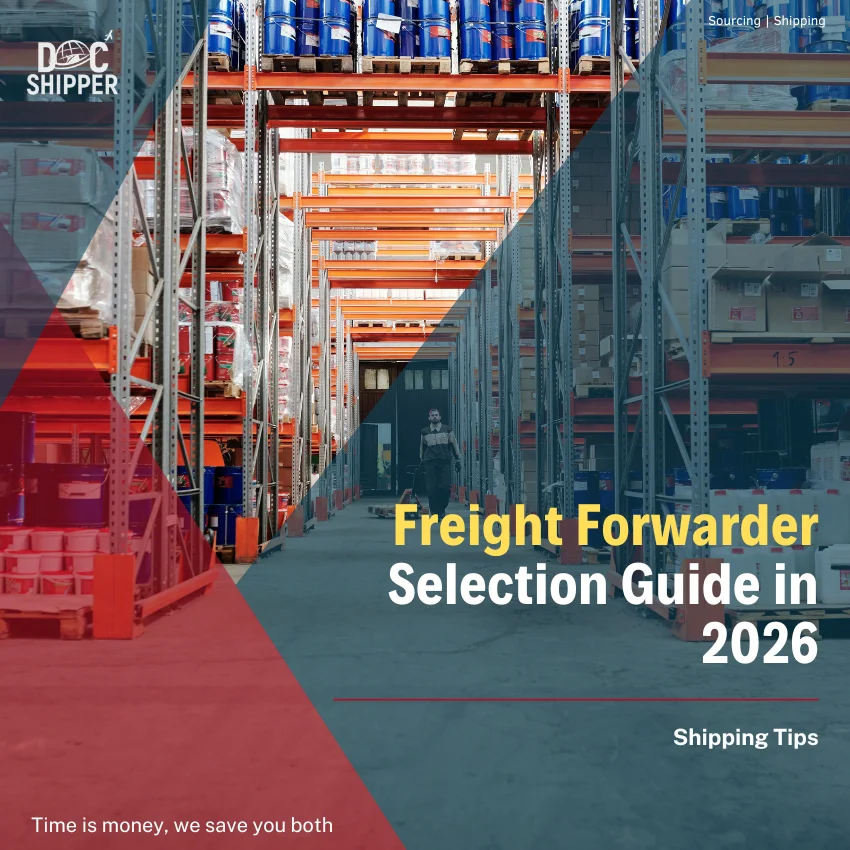


Freight Forwarder Selection Guide in 2026

  • admin 15 Min
  • Published on May 25, 2023 Updated on May 12, 2026
img

In short ⚡

Reliable freight forwarders are logistics partners that keep your cargo safe, documents accurate, costs transparent, and lead times predictable, even when shipments face issues like customs holds, rolled sailings, or trucking no‑shows. They combine end‑to‑end transport coordination, strong customs and documentation control, clear pricing, technology‑driven visibility, and proven processes for exception handling and claims.

In this article, you will find concrete selection criteria, comparison workflows, legal and insurance checks, technology and visibility requirements, and practical tips to match freight forwarders with your cargo, trade lanes, and service scope.

We hope you’ll find this article genuinely useful, but remember, if you ever feel lost at any step, whether it’s finding a supplier, validating quality, managing international shipping or customs,  DocShipper can handle it all for you!

Free shipping quote 24h      I want to talk to a sourcing expert

Key differences between freight forwarding companies, NVOCCs, and carriers

When you’re choosing a freight forwarder, you’ll notice fast that not all “freight forwarding companies” play the same role, even if their quotes look similar.

This distinction matters because it affects contracts, liability, and how problems get solved when your cargo is already in motion.

We’ve seen a classic scenario, a buyer thinks they hired a carrier, but they actually hired an NVOCC, then a schedule slip happens and nobody knows who can approve rebooking without extra charges.

That’s the moment where reliable freight forwarders stand out, they explain their role upfront and put the right terms in writing.

Role What they do in practice What you should watch
Freight forwarder Organizes transport end to end, trucking, ocean freight or air freight, customs brokerage coordination, sometimes warehousing and distribution, acting like a 3PL or even a light 4PL for specific lanes. Who issues documents, who manages exceptions, and whether they control origin pickup and destination delivery, not just the main leg.
NVOCC Acts like a carrier for ocean freight without owning vessels, consolidates cargo, issues its own house bill of lading, buys space from vessel operators. House B/L vs master B/L clarity, claims process, and whether their network supports your ports and transshipment needs.
Carrier Owns or operates the vessel, aircraft, or trucking assets, moves the shipment on its network under its own contract. You still need coordination for customs clearance, documentation, and inland legs, unless you have a separate partner managing it.

One practical tip, ask “Who will be the contracting party on the bill of lading?” and “Who do you call at 6 pm when trucking misses the pickup?”.

If you get vague answers, you’re not looking at a best freight forwarder candidate, you’re looking at a quote generator.

To keep yourself protected, you also want to see whether the operator aligns with recognized standards like FIATA practices, because it usually signals structured documentation and clearer operating rules.

Freight Forwarder Selection

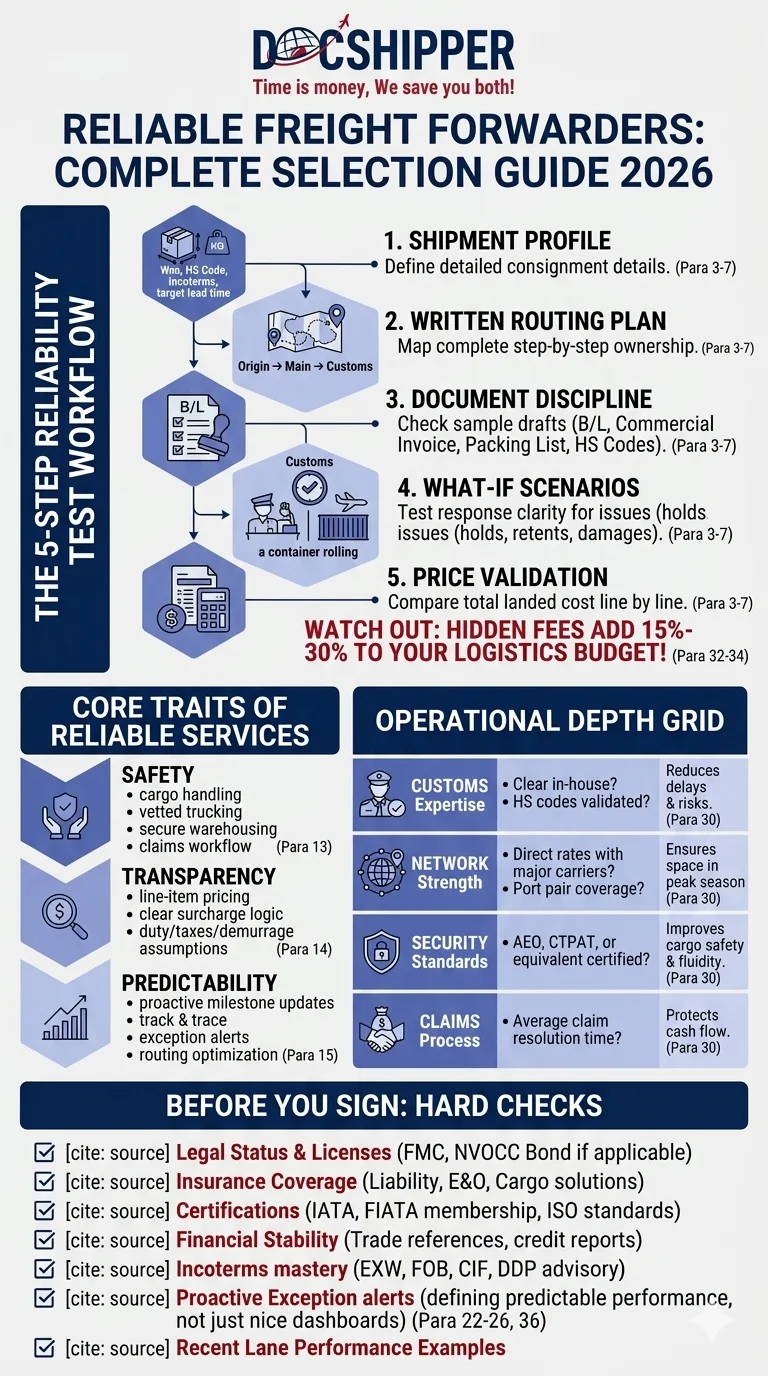
Core traits of reliable freight services: safety, transparency, and predictability

Reliable freight services aren’t magical, they’re built on repeatable controls that keep your shipment safe, your costs explainable, and your lead time stable.

In real operations, predictability beats “cheap”, especially when you run just in time inventory management and a delay triggers stockouts.

We once handled an import export flow where the supplier rushed cartons to meet a sailing, but the packing list didn’t match the final pallet count.

Customs flagged it, and because the forwarder had no pre-check process on HS code mapping and document consistency, the container sat, and detention started ticking like a taxi meter.

  • Safety: cargo handling standards, vetted trucking, secure warehousing options, and clear claims workflow when damage happens.
  • Transparency: line-item pricing, clear surcharge logic, and documented assumptions for duties and taxes, demurrage, and customs exams.
  • Predictability: proactive milestone updates, track and trace, exception alerts, and routing optimization when a lane gets congested.

Look for forwarders who can talk comfortably about incoterms and risk transfer, because that’s where many “hidden” costs are born.

If you buy FOB but act like it’s DDP, you’ll pay for it, usually in surprise destination charges and messy accountability.

Siam Shipping Advice

Turn criteria into a scoring system, not intuition.
Request a pilot shipment with clear KPIs before committing volumes.
Data driven selection protects margins and service stability.

Looking for a Reliable Shipping & Sourcing Partner?

We handle the entire sourcing process, supplier research, negotiation, production, and inspections, so you can focus on what matters most: growing your business.

Clear criteria to choose the best freight forwarder for your shipments

The best freight forwarder for you isn’t the biggest name, it’s the one whose operating model matches your cargo, lanes, and service scope, with the controls to keep your supply chain steady.

Choosing a freight forwarder gets easier when you convert “reliable” into measurable freight forwarder selection criteria, and you test each one before you scale volumes.

At DocShipper, we structure this like procurement and tendering, you define constraints, run a small pilot, then expand once the process proves itself.

Checklist, use these criteria to shortlist providers:

  • Lane fit, proven performance on your origin and destination pair, including cross-border trucking if needed.
  • Cargo fit, experience with your product constraints, fragile, hazardous, oversized, temperature sensitive, or high value.
  • Service scope, customs clearance, warehousing, cross docking, distribution, and proof of delivery coverage.
  • Commercial clarity, contract logistics terms, payment terms, and how freight rates change between contract and spot rate.
  • Operational maturity, documentation QA, escalation paths, and measurable KPIs for on-time delivery.

Step-by-step workflow to run a clean comparison:

1) Build a shipment profile, volumes, seasonality, target lead time, and service level, door-to-door or port-to-port.

2) Request like-for-like quotes with the same incoterms and the same routing assumptions.

3) Ask for a process map, booking, export docs, customs brokerage, main transport, delivery, POD, and exception handling.

4) Run a pilot shipment, then score results against delays, document errors, and cost drift.

5) Negotiate a simple SOP and KPI pack, then scale.

Match your cargo, trade lanes, and service scope with the right providerMatch your cargo, trade lanes, and service scope with the right provider
To apply freight forwarder selection criteria properly, start with fit, because a forwarder great at air freight for electronics might be average at ocean freight for bulky retail, and you’ll pay the difference in congestion, damages, or dead-slow updates.

If you’re shipping multiple SKUs, you also want someone comfortable with inventory management implications, split shipments, partial deliveries, and distribution scheduling.

Here’s a situation we see often, you source from two factories, one finishes early, one is late, and your supplier pushes you to consolidate anyway “to save freight”.

A reliable partner will challenge that, propose an intermodal transport or split move, and protect your launch date instead of blindly optimizing cost.

  • Cargo requirements: packaging specs, palletization rules, stacking limits, and labeling for warehouse management system intake.
  • Lane reality: port congestion patterns, feeder reliance, customs risk profile, and local trucking reliability.
  • Service scope clarity: do you need a 3PL-style door delivery, warehousing, cross docking, and last mile delivery, or only main carriage?
  • Customs depth: HS code review, tariff classification logic, and how they handle queries on duties and taxes.

If you want a practical test, ask them to explain, in writing, how they’d ship your exact product under two incoterms, like EXW vs FOB, and what changes in cost and control.

The best answers read like an operations plan, not a marketing brochure.
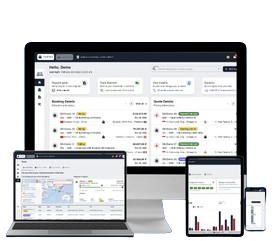
Technology, visibility, and documentation: non‑negotiables in freight forwarder selection

In modern logistics, reliable freight forwarders win on execution, and execution depends on visibility, clean documents, and systems that don’t collapse when you scale.

Freight forwarding companies that still run on spreadsheets alone will eventually lose a document version, miss a cutoff, or send you a status update after the container already rolled.

We remember a consignment where the shipper changed carton count at the last minute, the forwarder updated the commercial invoice but forgot the packing list.

Customs clearance stalled, and the buyer had to pay storage while their retail distribution plan fell apart.

  • Track and trace: milestone updates you can trust, booking confirmed, gate-in, onboard, arrival, out-gate, POD.
  • Document control: versioning for bill of lading, manifest, packing list, and import entries, with pre-alert discipline.
  • Compliance support: HS code logic, restricted party screening awareness, and clear escalation for customs inspections.
  • Data readiness: export packing data structured for routing optimization, warehouse receiving, and exception handling.

If you’re evaluating technology, don’t get distracted by flashy dashboards, ask how exceptions are logged, who is accountable, and how fast you get a corrective action.

That’s how you separate “nice visibility” from reliable freight services that actually protect your budget and lead time.

Siam Shipping Alert

Signing without verification exposes you to delays and cash flow risk.
Ask for licenses, insurance proof, and recent lane examples before approval.
Control the contract, protect operational continuity.

DocShipper Platform

One platform. Your entire supply chain

Sourcing, freight, customs & documents, all centralised, all visible, 24/7.

Freight forwarder selection criteria you should verify before signing a contractFreight forwarder selection criteria you should verify before signing a contract
Before you sign anything, you need to validate hard facts, not marketing promises. A reliable freight partner proves compliance, capacity, and control with documents and processes.

  • Legal status and licenses: Business registration, freight forwarding license, NVOCC bond if applicable, FMC registration for US trades.
  • Insurance coverage: Freight forwarder liability insurance, errors and omissions insurance, and access to cargo insurance solutions.
  • Certifications: IATA for air freight, FIATA membership, ISO standards if relevant.
  • Financial stability: Trade references, years in operation, credit reports if volumes are significant.
  • Incoterms mastery: Clear advisory capability on EXW, FOB, CIF, DDP and risk transfer points.

You should also test their operational depth on your specific trade lane. Ask for recent shipment examples similar to yours, including transit time performance and exception management.

CriteriaWhat You Should AskWhy It Matters
Customs expertiseDo you handle clearance in-house or via agents?Reduces delays and compliance risks
Network strengthDo you have contracted rates with major carriers?Ensures space even in peak season
Security standardsAre you AEO, CTPAT, or equivalent certified?Improves cargo safety and border fluidity
Claims processWhat is your average claim resolution time?Protects your cash flow in case of damage

Technology is not optional anymore. You need shipment tracking, document management, and proactive alerts in one interface.

  • Real-time milestone tracking
  • Digital document repository, BL, AWB, commercial invoices
  • Automated pre-alerts and delay notifications
  • Data export for your ERP or supply chain system

At DocShipper, we integrate sourcing, quality control, customs, and transport under one coordination team. You gain end-to-end visibility instead of fragmented communication.

How to compare reliable freight services and avoid costly mistakes

Price alone is a dangerous benchmark. You must compare total landed cost, risk exposure, and service consistency.

Comparison Factor Forwarder A Forwarder B
Freight rate Low base rate Slightly higher
Local charges Unclear, variable Pre-detailed and fixed
Free time at destination 3 days 7 days
Demurrage support No negotiation Active carrier negotiation
Customer support Generic inbox Dedicated account manager

A low quote can hide destination fees, documentation surcharges, or peak season premiums. Those hidden costs can inflate your logistics budget by 15% to 30% in volatile markets.

You should run a structured comparison workflow before onboarding any forwarder. Keep it simple and repeatable.

  • Step 1: Share identical shipment details with at least three providers.
  • Step 2: Request a full door-to-door breakdown including origin and destination charges.
  • Step 3: Clarify Incoterms responsibilities and risk transfer points.
  • Step 4: Evaluate response time and clarity of communication.
  • Step 5: Test them with a pilot shipment before scaling.

Another common mistake is ignoring operational culture. If your forwarder reacts only after a delay happens, you will constantly manage crises.

You want proactive updates, escalation procedures, and contingency plans. That is what defines predictable logistics performance.

Conclusion

Choosing among reliable freight forwarders is a strategic decision, not a tactical purchase. You are protecting your cargo, margins, and brand reputation.

  • Verify licenses, insurance, certifications, and financial stability.
  • Match the forwarder’s expertise with your cargo type and trade lanes.
  • Demand transparent pricing with detailed origin and destination charges.
  • Assess technology, visibility tools, and reporting capabilities.
  • Test responsiveness and problem-solving through a pilot shipment.
  • Prioritize partners who offer integrated supply chain support, not just freight booking.

If you want to secure your international flows with a single accountable partner, you can rely on DocShipper’s freight forwarding services. We help you structure, control, and optimize every shipment with operational discipline and full transparency.

FAQ | Reliable freight forwarders: how to choose partners that protect your cargo, budget, and supply chain

When quotes and services look similar, the differences usually hide in execution. Ask each forwarder for a concrete example of a recent shipment similar to yours, including transit time, issues encountered, and how they were handled. Then request to speak with the operations person who would actually manage your file and see how clearly they explain their process. The forwarder who can walk you through specific past cases with numbers, timings, and decisions is usually the one with more reliable internal control, not just good sales talk.

Ask us anything!

Need Help with
Logistics or Sourcing ?

First, we secure the right products from the right suppliers at the right price by managing the sourcing process from start to finish. Then, we simplify your shipping experience - from pickup to final delivery - ensuring any product, anywhere, is delivered at highly competitive prices.

Component-15.png

Live Chat

Get instant assistance from our team - just click and start chatting!

Chat now
image

Fill the Form

Prefer email? Send us your inquiry, and we’ll get back to you as soon as possible.

Contact Us
image

Call us

Reach out to us on WhatsApp for a quck and personal support.

Call us
image