In short ⚡
Digitization of logistics is the shift from manual, shipment-by-shipment management to a unified, data-driven flow that connects freight forwarding, warehousing, inventory, customs, and transportation so every routing change, freight rate update, or lead-time variation is reflected end to end, reducing surprises, manual handoffs, and avoidable costs.In this article, you will find key concepts of digital transformation, core logistics technologies, competitive advantages, a step-by-step digitization roadmap, and the digital tools that unlock end-to-end supply chain visibility.
We hope you’ll find this article genuinely useful, but remember, if you ever feel lost at any step, whether it’s finding a supplier, validating quality, managing international shipping or customs, DocShipper can handle it all for you!
What digitization of logistics really means for your business
The digitization of logistics is what happens when you stop “managing shipments” and start running a data-driven flow, from procurement to order fulfillment, with tracking and tracing that actually matches reality.
In practice, you’re turning freight forwarding, warehousing, inventory management, customs clearance, and transportation into connected processes, so one change in routing, freight rates, or lead time updates everywhere, fast.
Here’s the thing, the goal isn’t shiny software.
The goal is fewer surprises, fewer manual handoffs, and decisions you can defend when a carrier misses a cut-off or a supplier ships the wrong consignment terms under the wrong Incoterms.
Quick checklist, you’re really digitizing when you can:
- Quote and compare freight rates using consistent lane data, surcharges, and service levels.
- Generate shipment documents, including commercial invoice data, packing lists, and bill of lading references, from one source of truth.
- Track multimodal transport milestones and exceptions, not just “departed” and “arrived”.
- Link customs brokerage inputs, tariff classification, import duties, and export compliance checks to the same shipment record.
- See warehouse operations, cross-docking, palletization, and load planning reflected in live inventory availability.
Workflow, what “digitized” looks like end to end:
1) You capture order and Incoterms, then validate supplier readiness and pickup window.
2) You run digital quoting, book the carrier or freight brokerage option, then confirm routing and cut-offs.
3) You sync cargo handling events, warehouse scans, and consolidation into one timeline.
4) You push customs clearance data early, confirm duties, then release on arrival with fewer holds.
5) You close the loop with a freight invoice match, cargo insurance evidence, and performance KPIs.
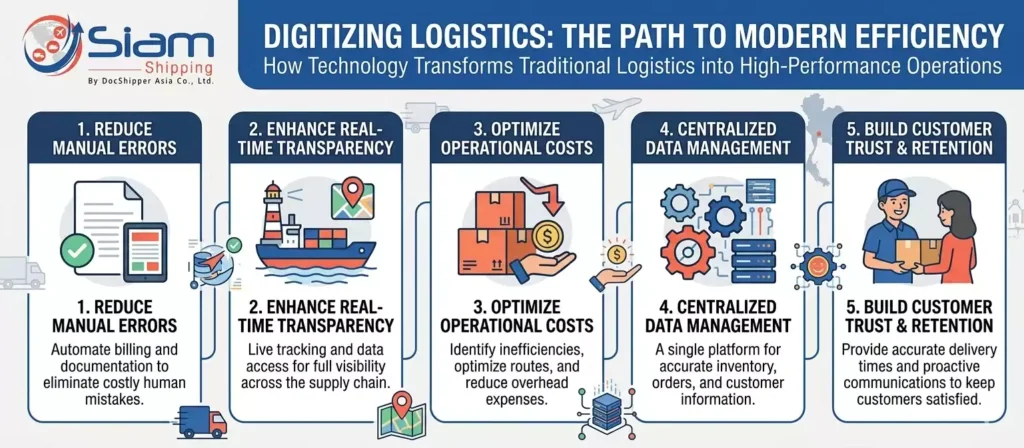
Siam Shipping Info
DocShipper helps you structure, standardize, and digitize freight, customs, and warehousing with measurable KPIs from day one.
From analog to digital: key concepts in the digital transformation of logistics
The digital transformation of logistics starts by replacing “tribal knowledge” with structured data, and you’ll notice fast how many decisions currently live in email threads.
From experience, one of the most expensive “analog habits” is letting the forwarder, the warehouse, and the customs broker each maintain their own version of the truth.
A real scenario we see all the time at DocShipper, a buyer agrees FOB, but the supplier books local trucking anyway, then the freight invoice arrives with unexpected origin charges and a missed consolidation window.
With digitized workflows, your Incoterms, booking status, and pickup responsibilities stay visible, so the mistake gets caught before cargo hits the distribution center.
In practical terms, digitization means you standardize:
- Data: SKUs, weights, dimensions, HS codes, service levels, carrier cut-offs, bonded warehouse status.
- Events: pickup, gate-in, cargo receipt, customs entry, release, last-mile delivery attempt, reverse logistics return.
- Rules: who pays what under Incoterms, when to insure, when to consolidate, when to switch modes.
Analog vs digital, what changes for you:
| Topic | Analog operations | Digitized logistics |
| Shipment visibility | Status updates by email, often delayed | Milestone-driven tracking and tracing with exceptions |
| Freight forwarding execution | Booking in spreadsheets, manual confirmations | Centralized booking, documents, and SLA checks |
| Customs clearance | Docs sent late, higher risk of holds | Pre-alerts, shared data, faster release readiness |
| Warehouse and inventory | Stock mismatches, slow cycle counts | Scan-based inventory management tied to orders |
Mini-checklist, before you “buy tools”, make sure you can answer:
- Where does your shipment master data live, and who owns it?
- Which milestones define your lead time, per mode and lane?
- How do you prevent duplicate bookings and document version chaos?
- What triggers escalation, demurrage risk, or re-routing?
Core technologies behind digitized logistics and freight forwarding
Digitized logistics runs on a small set of technologies, but the magic is in how you connect them across freight forwarding, warehousing, and customs brokerage.
You don’t need every tool on the market, you need the right stack that supports shipment execution, compliance, and billing without manual retyping.
We once handled a multimodal transport file where the ocean bill of lading data didn’t match the booking, the customs entry used an older packing list, and the warehouse received pallets under the wrong reference.
The fix wasn’t “work harder”, it was one data model feeding the forwarder workflow, document control, and warehouse receiving scans.
Core building blocks you’ll see in the digitalization of the logistics industry:
- TMS: routing, load planning, carrier selection, tendering, freight consolidation, performance tracking.
- WMS: receiving, put-away, picking, cross-docking, palletization, cycle counts, order fulfillment.
- Freight forwarding operating system: booking, documents, milestones, customs clearance coordination, exception handling.
- Visibility layer: tracking and tracing via carrier APIs, EDI, IoT events, and port/terminal milestones.
- Finance layer: freight invoice audit, accruals, duty and tax estimation, and chargeback rules.
Where “digitization of freight forwarding” usually starts paying off:
- Automated document generation, fewer bill of lading and commercial invoice errors.
- Earlier customs data submission, better export compliance and fewer clearance delays.
- Cleaner handoffs between 3PL, 4PL, carrier, and distribution center teams.
Tech checklist, keep it simple but strict:
- One shipment ID across booking, warehouse receipts, customs entries, and invoicing.
- Role-based access for your supplier, forwarder, and customs broker.
- Audit trail for document revisions and milestone changes.
- API or EDI connectivity with carriers and key partners.
Siam Shipping Advice
We audit your current stack and design a lean architecture that eliminates retyping and version conflicts.
Looking for a Reliable Shipping & Sourcing Partner?
Why the digitalization of the logistics industry is accelerating now
The digitalization of the logistics industry is accelerating because volatility stopped being “exceptional”, and you can’t manage exceptions at scale with spreadsheets.
Freight rates swing, ports congest, last-mile delivery capacity tightens, and suddenly your just-in-time delivery plan becomes a daily negotiation.
You’ve probably lived the frustration, you ask for an ETA, and you get three different answers from the carrier, the forwarder, and the warehouse.
That gap between “what’s planned” and “what’s happening” is exactly what digitization closes.
In fact, standard-setting bodies like the International Air Transport Association (IATA) have pushed e-freight and structured messaging for years, and that momentum is now showing up in day-to-day operations.
Checklist, signs you’re feeling the pressure right now:
- You re-route shipments weekly and still miss customer delivery windows.
- You pay demurrage, detention, or storage because clearance documents land too late.
- You struggle to reconcile freight invoices against quotes and actual service.
- You can’t confidently promise lead time because exceptions aren’t tracked consistently.
Siam Shipping Alert
Get real-time visibility and exception control across carriers, ports, and warehouses.
Competitive advantages you gain from digitization of freight forwarding
Digitization of freight forwarding gives you speed and leverage, not just nicer dashboards.
When your forwarder process is digital, you quote faster, book faster, and escalate exceptions with evidence, not gut feeling.
A common case, you’re consolidating LCL for two suppliers, but one ships late and blows the cut-off, then you either airfreight at premium freight rates or accept a sales stockout.
With a digitized forwarder workflow, you see supplier readiness, pickup status, and consolidation deadlines early enough to split the plan, protect margin, and keep service level.
What you gain operationally:
- Faster quoting: lane history, carrier options, and surcharge logic in one place.
- Better booking discipline: fewer double bookings, clearer carrier acceptance, cleaner milestones.
- Stronger compliance: export compliance checks and document completeness before cargo moves.
- More predictable execution: proactive alerts on delays that impact lead time.
Quick workflow, how to use digitization to negotiate better:
1) Benchmark freight rates per lane and seasonality.
2) Define service tiers, transit time, and exception handling in your SLA.
3) Tender with comparable data, then lock surcharges and accessorial rules.
4) Track performance and use it in quarterly carrier reviews.
How digitized logistics improves cost, service quality, and resilience
Digitized logistics improves cost because you stop paying for blind spots, and you stop expediting everything at the last minute.
It improves service quality because customers and internal teams see the same truth, the same milestones, the same risks.
We’ve seen importers lose days because a single wrong tariff classification triggered a customs query, while the warehouse kept planning labor for a delivery that couldn’t be released.
When customs clearance, bonded warehouse status, and distribution center appointments sit in one timeline, you re-plan labor, routing, and last-mile delivery before the delay becomes expensive.
Cost, quality, resilience, what changes tangibly:
- Lower total logistics cost: fewer detention charges, fewer premium shipments, fewer document rework cycles.
- Higher OTIF: better coordination between procurement, carriers, 3PL teams, and order fulfillment.
- Stronger resilience: faster mode shifts, smarter re-routing, clearer inventory allocation during disruptions.
- Cleaner financial control: freight invoice matching against quotes, accessorial rules, and proof of delivery.
Mini-checklist, if you want resilience, don’t skip these foundations:
- Exception codes and escalation paths, not free-text chaos.
- Inventory visibility tied to inbound ETA, not yesterday’s spreadsheet.
- Defined reverse logistics process, including return routing and disposition rules.
- Document governance for bills of lading, certificates, and insurance records.
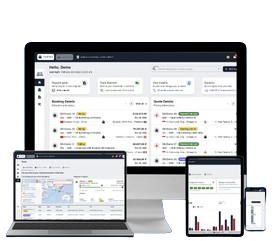
DocShipper Platform
One platform. Your entire supply chain
Sourcing, freight, customs & documents, all centralised, all visible, 24/7.
Step-by-step roadmap to digitize your logistics operations

You cannot switch from traditional freight forwarding to an app-based model overnight. You need a structured transformation roadmap that aligns operations, technology, and revenue logic.
Below is the practical framework we use at DocShipper when supporting companies moving toward a fully digital model.
- Step 1: Audit your current processesMap booking, documentation, customs, billing, tracking, and customer service workflows.
- Step 2: Define your digital value propositionDecide whether you offer instant quotes, on-demand booking, real-time tracking, or full supply chain orchestration.
- Step 3: Choose your business modelMarketplace, digital freight forwarder, hybrid 3PL, or SaaS-enabled logistics.
- Step 4: Build or integrate core systemsImplement TMS, WMS, CRM, API connectivity, and customer portals.
- Step 5: Digitize documentation and complianceAutomate invoices, bills of lading, customs entries, and POD collection.
- Step 6: Launch MVP and iterateStart with one lane, one trade route, or one service segment.
- Step 7: Scale with automation and dataUse analytics to optimize pricing, routing, and capacity allocation.
You should treat this transformation as a product launch, not an IT upgrade. Your logistics company becomes a digital service platform.
| Phase | Traditional Model | Digitized Model |
| Booking | Email and phone | Online portal and API |
| Pricing | Manual quotation | Dynamic rate engine |
| Tracking | Reactive updates | Real-time dashboard |
| Documentation | Paper-based | Digital document workflow |
| Customer Support | Account manager dependent | Self-service + automated alerts |
If you aim to build an on-demand logistics app, you must also redesign your revenue structure. Technology without a monetization strategy will drain your margins.
- Transaction fee per shipment
- Subscription model for frequent shippers
- Margin-based resale of freight capacity
- Premium visibility or analytics features
- Integrated customs and compliance services
When we support digital transformation projects, we focus heavily on process standardization first. Automation only works when your operations are predictable and measurable.

Siam Shipping Info
We build step-by-step transformation roadmaps aligned with your revenue model and service positioning.
Digital tools and platforms that unlock end-to-end logistics visibility
To build a scalable digital logistics model, you need interconnected systems. Visibility is not a dashboard, it is a synchronized data ecosystem.
- Transportation Management System (TMS) for booking, routing, and rate management
- Warehouse Management System (WMS) for inventory control and fulfillment
- Customer portal or mobile app for real-time booking and tracking
- API integrations with carriers, customs brokers, and last-mile providers
- Data analytics layer for forecasting and performance optimization
- Digital payment gateway for seamless financial processing
You must ensure interoperability between these tools. Disconnected systems create digital silos instead of true end-to-end visibility.
| Technology | Main Function | Business Impact |
| TMS | Shipment planning and execution | Lower freight costs |
| Real-time tracking API | Live shipment status | Improved customer satisfaction |
| AI pricing engine | Dynamic quotation | Higher margin control |
| Digital document management | Paperless compliance | Faster customs clearance |
| Analytics dashboard | KPI monitoring | Data-driven decisions |
You also need strong cybersecurity and data governance policies. Digitization increases exposure to operational and regulatory risks.
- Role-based access control
- Encrypted data transmission
- Backup and disaster recovery systems
- Compliance with international trade regulations
- Audit trail for documentation and approvals
At DocShipper, we combine digital freight management with sourcing, inspection, customs clearance, and international transport. This integrated approach ensures that your digital transformation translates into measurable operational performance.
Siam Shipping Advice
We connect TMS, WMS, APIs, and analytics into one synchronized ecosystem with secure governance.
Conclusion
The digitization of logistics is not a trend, it is a structural shift in how global trade operates. You either build digital capabilities or you compete against companies that already have them.
- You must audit and standardize your current logistics workflows.
- You need a clear digital business and revenue model.
- You should implement interconnected systems, not isolated tools.
- You must prioritize real-time visibility and automation.
- You should launch small, test fast, and scale with data.
- You can accelerate transformation by partnering with experts like DocShipper.
If you are ready to transform your traditional freight or sourcing business into an on-demand digital platform, we can design and deploy a solution aligned with your operational reality and growth objectives.
FAQ | Digitization of logistics: how to transform your supply chain for speed, visibility, and lower costs
Start with the area where errors and delays are most frequent, not the one that looks the most “innovative”. For many shippers this is documentation and booking: if quotes, bookings, and customs data still live in email threads and spreadsheets, digitizing that workflow will remove a big source of disputes, missed cut-offs, and demurrage. Then expand to tracking and warehouse integration once you have a clean, digital shipment record as a foundation.
A frequent mistake is buying tools before defining processes. Teams plug in a TMS or visibility platform but keep old habits: free‑text status updates, inconsistent shipment IDs, and undocumented rules around Incoterms and responsibilities. Another pitfall is trying to digitize every lane and partner at once; this usually leads to partial adoption and users reverting to email and Excel. A focused pilot with strict data standards works far better.
You don’t need to build your own platform. Choose partners and tools that come pre-integrated: a digital freight forwarder, a cloud TMS with built-in carrier APIs, and simple web portals for suppliers. Most modern systems offer configuration instead of custom development, so your job is to standardize how you name shipments, share documents, and capture events. A lean internal “process owner” is often enough to coordinate this.
Yes, as long as you define a single digital entry point for shipment data. Even if some partners send PDFs or emails, you can centralize them through a portal, EDI/API for larger providers, and manual upload for smaller ones. The key is that once data enters your system, it follows structured events and IDs, so the lack of sophistication on the partner side doesn’t recreate chaos inside your own operation.
Before starting, pick a handful of concrete KPIs and track them by lane or customer: demurrage and detention costs, rate of documentation errors, clearance delay days, on‑time in‑full delivery, and the share of shipments needing premium freight. If, after a few months, these indicators aren’t trending in the right direction, you likely digitized “around” the problem (dashboards and reports) rather than fixing core execution workflows.
Training has to be operational, not just tool demos. Show planners and customer service reps how each click in the system replaces a specific email, spreadsheet, or phone call they used to make. Walk through real past shipments that went wrong and replay them in the new workflow. Emphasize one or two non‑negotiable habits—for example, always using the shipment ID in all communication—so adoption sticks.
Yes, but you’ll likely use a “layered” approach. Many companies keep their legacy ERP for financials and master data while adding a specialized logistics layer (TMS/forwarder OS + visibility + document management) on top. You can start with light integration: export/import CSV files or limited APIs for orders and invoices, while letting the logistics platform handle tracking, events, and documents. Over time, you can deepen integrations as needed without a full ERP replacement.
Read more
Looking for more? Check out these articles.
Need Help with
Logistics or Sourcing ?
First, we secure the right products from the right suppliers at the right price by managing the sourcing process from start to finish. Then, we simplify your shipping experience - from pickup to final delivery - ensuring any product, anywhere, is delivered at highly competitive prices.
Fill the Form
Prefer email? Send us your inquiry, and we’ll get back to you as soon as possible.
Contact Us