Shipping trends in 2025 and beyond: how to cut risk, control costs, and stay competitive

  • admin 19 Min
  • Published on October 20, 2022 Updated on May 11, 2026
img

In short ⚡

Shipping trends in 2025 are driven by volatility on trade lanes, stricter customs controls, fast-moving freight rates, and a shift toward resilience over pure cost optimization. Companies are rethinking mode choice, embracing digital freight tools and data, integrating carbon costs, nearshoring supply networks, and tightening risk, visibility, and cyber security across their end-to-end logistics.

In this article, you will find an overview of macro forces, mode-specific freight trends, digital procurement and rate management, decarbonization and green corridors, network redesign strategies, and the growing importance of risk, transparency, and cyber security in shipping.

We hope you’ll find this article genuinely useful, but remember, if you ever feel lost at any step, whether it’s finding a supplier, validating quality, managing international shipping or customs,  DocShipper can handle it all for you!

Free shipping quote 24h      I want to talk to a sourcing expert

What are the key shipping trends reshaping global freight right now?

If you’re trying to make sense of shipping trends in 2025, you’ll notice fast that “normal” doesn’t exist anymore.

Between trade compliance shifts, capacity swings, and carrier contract renegotiations, your supply chain management playbook needs constant updates, not yearly reviews.

We see it every week at DocShipper, you can have a perfect packing list, clean commercial invoice, correct HS code, and still lose days on lead time because the lane itself changed.

  • More volatility on trade lanes, which impacts multimodal transport planning and consolidation decisions.
  • Stricter controls and documentation checks, making customs clearance and customs brokerage harder to “rush.”
  • Faster shifts in freight rate levels, pushing you to re-think freight quote timing and shipment booking strategy.
  • Pressure to redesign networks, from warehousing and cross docking to last mile delivery and reverse logistics.

Here’s the thing, the current trends in freight and shipping industry aren’t separate waves, they stack up.

So you’re not just choosing ocean freight vs air freight vs road freight vs rail freight, you’re managing risk across the full transportation system, including cargo handling, inventory management, and tracking and tracing.

Quick checklist, are you reading the market correctly?

  • You’ve mapped your top 5 trade lanes with backup routings and realistic transit buffers.
  • You’ve validated Incoterms against who really controls the bill of lading and freight insurance.
  • You’ve updated SOPs for customs duty and value added tax exposure by destination.
  • You’ve reviewed carrier contracts and surcharge clauses, not just base freight rate.
  • You’ve set a weekly cadence to monitor disruptions, not “when something goes wrong.”

Simple workflow you can apply this week

Step 1, classify each SKU correctly with HS code, then confirm documentation rules per country.

Step 2, choose routing and mode with a buffer for port, terminal, and inspection delays.

Step 3, lock Incoterms and responsibility split, then align freight forwarding and customs brokerage.

Step 4, request parallel freight quotes, then book with your risk tolerance, not your hope.

Step 5, track and trace milestones, then escalate exceptions before they hit your warehouse ETA.

Macro forces you must watch: geopolitics, inflation, capacity, and trade lanes

The most disruptive shipping trends don’t start in your warehouse, they start with geopolitics, inflation, and where capacity gets redeployed.

From experience, one rerouted service loop can cascade into missed cut-offs, rolled containers, and a scramble for air freight.

Here’s a scenario we’ve handled: you negotiate a decent freight rate, confirm the booking, and your supplier ships on time.

Then the vessel schedule slips, your container misses transshipment, and suddenly your distribution plan collapses, you pay for emergency deconsolidation, and your inventory management team is firefighting stockouts.

You’ll want to monitor signals that often predict the next move in freight trends:

  • Capacity discipline, fewer sailings can lift spot rates even when demand feels flat.
  • Inflation and interest rates, they change purchasing cycles and therefore demand forecasting.
  • Lane risk and compliance checks, which can slow customs clearance and raise demurrage exposure.
  • Tariff uncertainty, impacting total landed cost, customs duty, and VAT planning.

The World Trade Organization often flags trade lane pressure points early, and you can use that to stress-test your import export assumptions.

When you pair those signals with your own shipment booking data, you stop reacting late.

Macro forceWhat you’ll see operationallyWhat you should adjust
Geopolitical disruptionsRerouting, longer lead time, port congestionRebuild safety stock, diversify carriers, add alternate ports
Inflation and demand swingsOrder batching, unstable volume forecastsUse rolling forecasts, split POs, plan consolidation windows
Capacity shiftsBlank sailings, tighter equipment availabilityEarlier booking, dual-carrier strategy, flexible cut-offs
Tariffs and controlsMore exams, document scrutiny, delaysImprove commercial invoice accuracy, pre-check HS code and Incoterms

Segment-specific shifts in freight trends: ocean, air, road, and international shipping lines

Zoom in and you’ll see freight trends diverge by mode, which is why one “global strategy” usually fails in execution.

Ocean freight punishes slow decisions, air freight punishes sloppy documentation, and road freight punishes poor appointment discipline at your 3PL.

We’ve seen importers win on price and lose on reality, a supplier quotes EXW, you accept to “save money,” then you discover too late that cargo handling at origin is chaotic.

Your truck misses the terminal cut-off, your bill of lading gets issued late, and your customs clearance clock starts with the wrong dates, that’s how small details become big costs.

  • Ocean freight, expect tougher schedule reliability, more focus on consolidation, and sharper carrier contract terms.
  • Air freight, speed is great, but trade compliance errors on packing list or commercial invoice will still stop you cold.
  • Road freight, capacity is local, so warehousing location and cross docking discipline matter more than ever.
  • Rail freight, useful for specific corridors, but you need tight tracking and tracing and realistic transshipment buffers.

On top of that, international shipping lines keep optimizing networks around yield, not your production calendar.

That’s why we often recommend you treat ocean, air, and road as a multimodal transport portfolio, then attach clear rules for when to switch modes.

ModeBest use case in 2025Operational trap to avoid
Ocean freightCost-efficient replenishment, stable SKUsLate booking and weak consolidation planning
Air freightLaunches, urgent replenishment, high valueIncorrect HS code or invoice data triggering holds
Road freightRegional distribution and last mile deliveryIgnoring appointment systems at warehouses and hubs
Rail freightSpecific long corridors with predictable nodesUnderestimating transshipment timing and damage risk

Checklist, pick the right mode without guessing

  • You’ve defined a “mode switch” rule based on margin, stockout cost, and lead time risk.
  • You’ve aligned Incoterms with who controls pickup, export docs, and the bill of lading.
  • You’ve confirmed packaging standards for cargo handling to reduce claims under freight insurance.
  • You’ve validated destination customs clearance requirements before you ship, not after.
  • You’ve built a carrier and 3PL bench, not a single-point dependency.

Step-by-step workflow for mode selection

Step 1, calculate total landed cost, including tariff, customs duty, VAT, and last mile delivery.

Step 2, map lead time end-to-end, including warehousing, cross docking, and terminal dwell time.

Step 3, choose ocean, air, road, or rail, then decide on consolidation or direct shipment.

Step 4, validate documents, commercial invoice, packing list, and compliance data, before cargo handover.

Step 5, book, track, and trigger exception management with your freight forwarder early.

How digital freight shipping and data change the way you buy and sell transport

Digital Freight

One of the biggest shipping trends in 2025 is that transport procurement is turning into a data game, whether you like it or not.

When you shift from emails and spreadsheets to digital workflows, you don’t just “save time,” you reduce costly ambiguity in freight forwarding, customs brokerage, and carrier coordination.

We’ve watched teams lose money simply because nobody had the same version of the truth.

The purchase order says one thing, the booking request says another, and the warehouse receives a different SKU mix, that’s how inventory management drifts into chaos.

  • Digital documentation, fewer errors on bill of lading, packing list, and commercial invoice versions.
  • Faster freight quote comparisons, so you can react to market shifts without rushing blind.
  • Better tracking and tracing, which improves exception management and customer communication.
  • Cleaner collaboration, between your supplier, 3PL, 4PL, warehouse, and customs clearance teams.

Checklist, are you ready for digital freight shipping?

  • You can centralize bookings, documents, and milestones in one system.
  • You’ve standardized SKU, HS code, and Incoterms data across teams.
  • You have a clear approval flow for freight quotes and carrier selection.
  • You track cost per shipment, per lane, and per supplier, not just “monthly spend.”
  • You’ve defined who owns exceptions, delays, damage, and customs holds.

Workflow, turning operations into a repeatable process

Step 1, standardize master data, SKUs, HS code, supplier addresses, and Incoterms.

Step 2, run shipment booking through a single channel, then attach documents immediately.

Step 3, set milestone alerts for pickup, gate-in, departure, arrival, and customs clearance.

Step 4, reconcile invoices against contracted freight rate and accessorial rules.

Step 5, feed results back into lane strategy and supplier performance reviews.

Looking for a Reliable Shipping & Sourcing Partner?

We handle the entire sourcing process, supplier research, negotiation, production, and inspections, so you can focus on what matters most: growing your business.

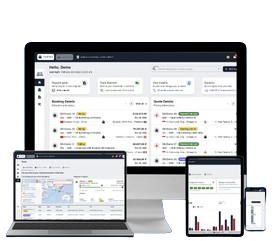
DocShipper Platform

One platform. Your entire supply chain

Sourcing, freight, customs & documents, all centralised, all visible, 24/7.

From manual brokers to digital freight marketplaces and TMS platforms

With digital freight shipping, you stop negotiating in the dark and start buying transportation with context.

You still need relationships, but now you can compare service levels, accessorial policies, and transit time promises without chasing 40 email threads.

We once took over a lane where the client relied on a single broker who “handled everything.”

When a customs hold hit, nobody could find the right commercial invoice version, and the demurrage clock kept running, a basic TMS-style document hub would’ve avoided it.

  • Digital freight marketplaces help you benchmark pricing and find capacity fast.
  • TMS platforms give you governance, approvals, and audit trails for compliance.
  • Hybrid models let you keep a freight forwarder for complex import export moves, while digitizing routine shipments.
Option What you gain Where it can fail
Traditional broker only Human problem-solving, ad hoc flexibility Low visibility, inconsistent documentation, weak benchmarking
Digital marketplace only Speed, price comparison, quick booking Less support on exceptions, complex customs clearance gaps
TMS plus freight forwarder Control plus execution, strong governance Needs clean master data and disciplined user adoption

For many shippers, the winning move is “digitize the workflow, keep expert execution,” and that’s exactly where we position DocShipper.

We handle freight forwarding end-to-end, from consolidation to customs clearance, while keeping your operation visible and auditable.

Turning data into decisions: forecasting demand, tracking shipments, and managing shipping rate trends

If you want to stay ahead of shipping rate trends, you can’t rely on gut feeling, you need structured data and a routine.

That means blending demand forecasting, tracking and tracing, and invoice auditing into one operating rhythm.

We’ve seen a classic trap: a buyer locks a “good” rate, then volumes shift, and the carrier applies minimum quantity commitments or surcharges.

Suddenly your freight rate per unit jumps, not because the market moved, but because your data and procurement didn’t talk to each other.

  • Forecast demand by lane, so you can plan consolidation and avoid last-minute air freight.
  • Track milestones, to protect warehousing schedules and reduce detention and demurrage.
  • Audit invoices, to catch accessorials that quietly break your budget.
  • Score carrier and supplier reliability, to reduce lead time variability.

Data also changes how you interpret the current trends in freight and shipping industry, because you can separate “headline volatility” from your real, lane-specific costs.

Industry signals from bodies like the International Maritime Organization help, but your own shipment history is what turns strategy into execution.

Data signalWhat it tells youOperational decision you can take
Quote to booking spreadHow fast the market is movingShorten quote validity, book earlier, diversify carriers
On-time pickup and gate-inOrigin control qualityChange Incoterms, add origin QA, tighten supplier SLAs
Customs clearance durationCompliance frictionFix HS code mapping, improve invoice data, pre-alert broker
Accessorial frequencyHidden cost driversRenegotiate carrier contract clauses, adjust packaging and appointments

Checklist, build a rate and performance cockpit

  • You track spot vs contract freight rate per lane, weekly.
  • You log exceptions with root causes, supplier, carrier, warehouse, or customs.
  • You reconcile freight invoices against quotes, tariffs, and accessorial rules.
  • You maintain a rolling 8 to 12 week forecast tied to purchase orders.
  • You review KPIs with your freight forwarder and 3PL on a fixed cadence.

Step-by-step workflow for managing shipping rate trends

Step 1, collect lane quotes in a consistent format, with surcharge assumptions stated.

Step 2, compare against your contracted carrier terms, then select the service level you actually need.

Step 3, book early enough to protect capacity, then confirm cut-offs and documentation deadlines.

Step 4, monitor tracking and tracing milestones, then escalate exceptions before they hit delivery.

Step 5, close the loop with invoice audits and KPI reviews, then adjust your next forecast and procurement plan.

“`html

Freight Shipping Trends for currentyear_ 7 Key Shifts

Green corridors, fuel choices, and regulatory pressure on freight emissions

You can no longer treat decarbonization as a branding exercise, it is now a core cost driver. Regulators, carriers, and shippers are reshaping contracts around carbon intensity.

In 2025, shipping trends are heavily influenced by IMO targets, the EU ETS extension to maritime, and stricter fuel reporting rules. If you ship into Europe, you are already paying for emissions whether you see it or not.

DriverWhat is changingOperational impact for you
EU ETSCarbon pricing on maritime emissionsHigher ocean freight invoices, new surcharge lines
IMO decarbonization targetsGradual reduction of GHG intensityShift toward alternative fuels and slower steaming
Fuel transitionLNG, methanol, biofuels gaining shareDifferent vessel availability and route planning
Customer pressureScope 3 reporting requirementsNeed for emissions data per shipment

Green corridors are emerging between major ports, concentrating low-emission vessels on specific trade lanes. You should align your volumes with these corridors to secure capacity and better ESG reporting.

  • Request carbon emission reports per BL or AWB
  • Compare fuel surcharges versus carbon surcharges
  • Negotiate long-term contracts including sustainability clauses
  • Evaluate modal shift from air to ocean where feasible

At DocShipper, we integrate emissions visibility into your routing strategy so you reduce both CO2 and volatility. You stay compliant while protecting your margins.

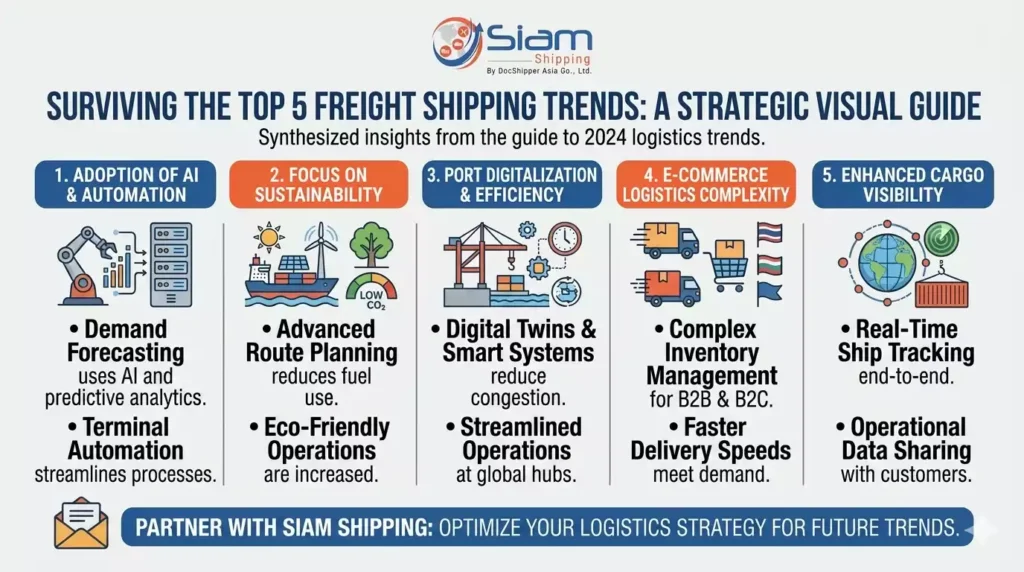
Siam Shipping Info

Emissions are now a line item, not a slogan.
Request shipment-level carbon data and optimize routes before surcharges erode margins.
We help align green corridors with cost control and compliance.

Network strategy trends: nearshoring, Arctic routes, and diversified sourcing

network strategy

Your network design is now a strategic weapon, not just a cost calculation. The biggest shipping trends in 2025 revolve around resilience over optimization.

Nearshoring is accelerating as companies rebalance exposure to Asia. Mexico, Eastern Europe, and Southeast Asia are absorbing volumes from China-centric models.

StrategyWhy companies adopt itWhat you must adjust
NearshoringShorter lead times, lower geopolitical riskReconfigure trucking and cross-border flows
China+1 sourcingDiversify supplier baseMulti-origin consolidation planning
Arctic route trialsShorter Asia-Europe transit timeSeasonal planning and insurance review
Regional fulfillment hubsFaster last-mile deliveryInventory repositioning strategy

The Arctic route remains seasonal and politically sensitive, but it signals how carriers search for time savings. You should monitor it without overcommitting critical cargo.

  • Map your supplier concentration risk by country
  • Simulate lead time scenarios by region
  • Split production across at least two trade lanes
  • Align Incoterms with your risk appetite

We help you redesign sourcing flows, consolidate multi-country shipments, and choose the right Incoterm for control. This is how you transform shipping trends into competitive advantage.

Siam Shipping Advice

Resilience beats single-source optimization.
Redesign your sourcing and routing mix with multi-country consolidation and Incoterm control.
Turn network shifts into measurable lead time and cost advantages.

Risk, transparency, and cyber security across modern shipping networks

Disruption is no longer an exception, it is your operating environment. Cyber attacks, port congestion, and political shocks directly affect your freight KPIs.

Digitalization improves visibility but increases exposure to cyber threats. You must treat logistics IT systems as critical infrastructure.

Risk type Example Mitigation action
Cyber attack Ransomware on carrier systems Audit partners’ IT security standards
Port congestion Labor strikes or rerouting Pre-book alternative gateways
Geopolitical tension Sanctions or route closures Dual routing strategy
Data opacity No real-time milestone updates Integrate TMS with live tracking APIs

Transparency is becoming a contractual requirement in many tenders. If you cannot provide milestone-level visibility, you will lose bids.

  • Implement shipment-level tracking dashboards
  • Standardize communication with carriers and forwarders
  • Audit compliance with international sanctions
  • Secure EDI and API connections

At DocShipper, we centralize your freight data, secure communication flows, and create contingency routing plans. You gain control before disruption hits.

Siam Shipping Alert

Visibility without protection is a liability.
Secure your logistics data and diversify gateways before disruption hits your KPIs.
We build contingency routing and protected communication flows.

Conclusion

Shipping trends in 2025 are reshaping how you design, buy, and manage transport. You must align sustainability, network design, and risk management into one coherent strategy.

  • Integrate carbon cost and compliance into freight budgeting
  • Diversify sourcing and transport corridors to reduce dependency
  • Leverage data tools for predictive and real-time decisions
  • Strengthen cyber security across all logistics partners
  • Work with a partner who understands end-to-end supply chains

When you proactively adapt to these shipping trends, you protect margins and service levels at the same time. That is exactly where we position DocShipper, as your strategic freight and sourcing partner.

“`

FAQ | Shipping trends in 2025 and beyond: how to cut risk, control costs, and stay competitive

The biggest shift is that security is no longer just about guards and seals, it’s about data and systems. You’re seeing ransomware on carriers and terminals, phishing targeting shipping documents, fake freight marketplaces, and GPS spoofing on high‑value lanes. At the same time, regulators and big buyers are asking for proof of cyber resilience in tenders. Practically, this means you need to screen partners for IT security, protect your own access to booking and tracking tools, and treat shipment data as an asset that can be stolen or manipulated.

Ask us anything!

Need Help with
Logistics or Sourcing ?

First, we secure the right products from the right suppliers at the right price by managing the sourcing process from start to finish. Then, we simplify your shipping experience - from pickup to final delivery - ensuring any product, anywhere, is delivered at highly competitive prices.

Component-15.png

Live Chat

Get instant assistance from our team - just click and start chatting!

Chat now
image

Fill the Form

Prefer email? Send us your inquiry, and we’ll get back to you as soon as possible.

Contact Us
image

Call us

Reach out to us on WhatsApp for a quck and personal support.

Call us
image