DDP Incoterms explained: how delivered duty paid can simplify your global shipping

  • admin 15 Min
  • Published on May 23, 2024 Updated on May 7, 2026
img

In short ⚡

DDP Incoterms mean the seller is responsible for almost everything: transport from origin, export and import customs clearance, payment of duties and taxes, and delivery to the named place, while the buyer simply receives the goods there and assumes risk and costs only after delivery, usually before unloading.

In this article, you will find who does what under DDP, how risk and costs are allocated, when to choose DDP versus DAP or FCA, and practical checklists to draft clean DDP clauses and avoid customs or delivery disputes.

We hope you’ll find this article genuinely useful, but remember, if you ever feel lost at any step, whether it’s finding a supplier, validating quality, managing international shipping or customs,  DocShipper can handle it all for you!

Free shipping quote 24h      I want to talk to a sourcing expert

What DDP Incoterms mean for your international shipments
With ddp incoterms, you’re basically telling your supplier, “handle it all, right up to my door, including customs.”

Here’s the thing, that promise sounds clean on paper, but in real-life international shipping, the details decide whether DDP feels effortless or turns into a dispute the moment cargo lands.

We’ve seen it countless times at DocShipper, you negotiate product price for weeks, then one vague line about “delivered duty paid shipping” creates unexpected invoices, delays, or a customs clearance dead-end.

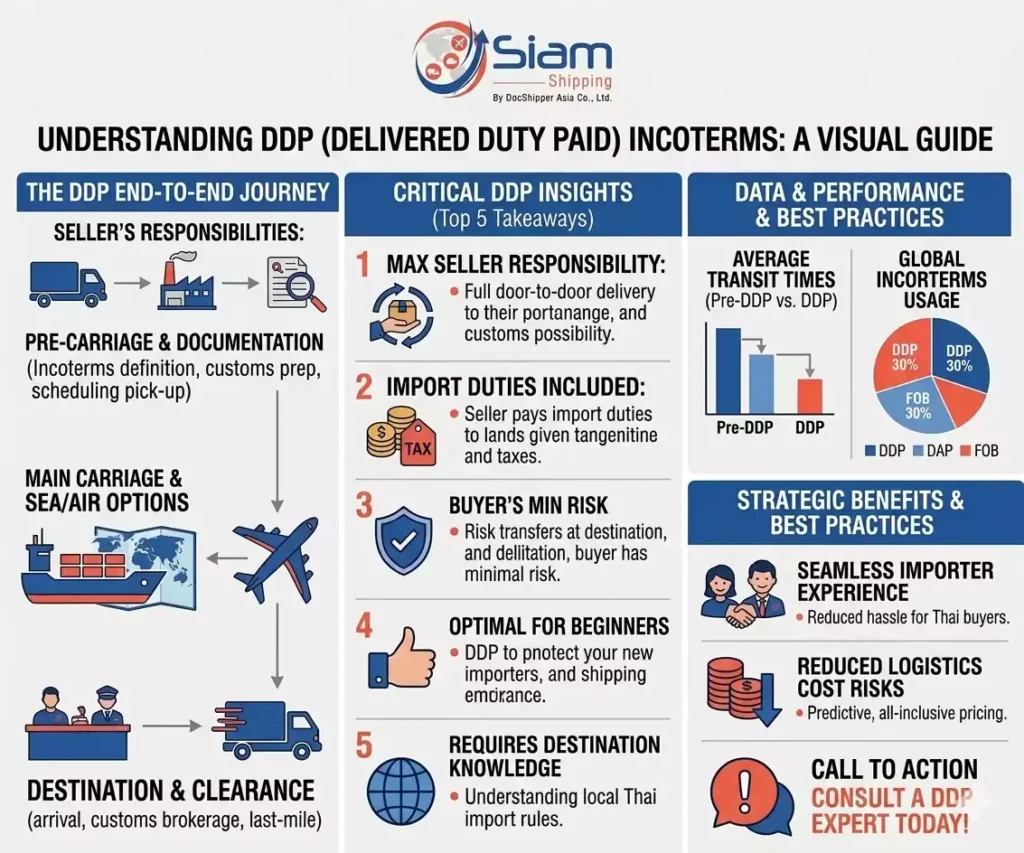
DDP in one sentence: the seller covers transport, export and import formalities, customs duties, and delivers to the named place, with the buyer taking delivery there.

DDP workflow (step by step)

  • Seller plans pickup, cargo handling, and origin documentation (commercial invoice, packing list, export permits if needed).
  • Seller arranges main carriage (air, ocean, rail, road), often via a ddp freight forwarder or 3PL.
  • Seller manages import customs clearance, tariff classification, and pays customs duties and taxes.
  • Seller coordinates last mile delivery to the named place and hands goods over to you.
  • You receive, inspect, and book inventory into warehousing or distribution.

DDP checklist to avoid the classic surprises

  • Confirm the exact named place (warehouse address, dock, or DC), not just the city.
  • Validate the harmonized system code and who owns tariff classification decisions.
  • Agree on who acts as importer of record and how trade compliance will be handled.
  • Define what “delivery” means (at curb, at dock, with unloading, with appointment scheduling).
  • Clarify insurance, damage reporting, and proof of delivery requirements.
The role of DDP in the Incoterms framework and global trade

In the ddp incoterms rule, DDP sits at the far end of seller responsibility within the Incoterms framework published by the International Chamber of Commerce (ICC).

You’ll notice fast that DDP is less a “shipping method” and more a commercial decision about who controls customs brokerage, freight rates, and risk across the supply chain.

From experience, DDP shipping often appears when you want to outsource logistics, or when your supplier has negotiated carrier contracts, freight consolidation lanes, or a strong freight brokerage setup.

One real scenario we run into, a buyer orders machinery under incoterm ddp, the supplier books ocean freight, then the shipment hits port and customs asks for importer registration the seller doesn’t have in that country.

The result, containers sit, demurrage grows, and everyone argues about “whose problem it is,” even though DDP says the seller must clear import.

That’s why we treat DDP service as a compliance and execution project, not just a freight quotation.

Where DDP shows up most in logistics

  • E-commerce replenishment where you need predictable landed cost.
  • Multimodal transport moves (ocean plus drayage plus overland transport).
  • Shipments into tight delivery windows (retail shipping schedule, appointments, cross docking).
  • When you’re using logistics outsourcing and don’t want to build customs brokerage internally.

Siam Shipping Alert

A vague DDP clause can trigger delays, demurrage, and compliance disputes.
Let DocShipper audit your DDP setup before cargo moves, we secure importer status, duties, and final delivery scope.

Key elements: delivery point, risk transfer, and cost responsibilities

With ddp incoterms, three levers matter, the named delivery point, when risk transfers, and which costs the seller truly covers under delivered duty paid shipping.

If any of those are fuzzy, you’ll get friction on cargo handling, last mile delivery, or import export compliance the moment the bill of lading is issued.

We’ve watched a simple DDP freight deal go sideways because the PO said “DDP Los Angeles,” but the buyer expected delivery to an inland warehouse, and the seller priced only to the port area.

Under DDP, the seller pays the freight and duties, but you still need crystal-clear scope so you don’t accidentally pay “destination charges” twice.

DDP risk and cost map (quick reference)

Item Under DDP, who typically handles it? What you should verify
Export customs clearance Seller Exporter of record details, export docs accuracy
Main transport (DDP freight) Seller Carrier contract vs spot rates, transit time, lead time buffer
Import customs clearance Seller Importer of record capability, tariff classification, licenses
Customs duties and taxes Seller Duty basis, VAT/GST handling, proof of payment
Delivery to named place Seller Exact address, appointment, unloading, access constraints
Risk transfer At delivery to named place Damage inspection protocol, POD, insurance trigger point

Mini-workflow for a clean DDP clause in your contract

  • Write: “DDP, delivered to [full address], Incoterms.”
  • Add: “Includes import clearance, duties, taxes, and last mile delivery to dock.”
  • Specify: “Seller provides duty payment receipt and customs entry reference.”
  • Define: “Delivery appointment booked by seller, with 24h notice.”

Looking for a Reliable Shipping & Sourcing Partner?

We handle the entire sourcing process, supplier research, negotiation, production, and inspections, so you can focus on what matters most: growing your business.

Who does what under DDP: detailed seller and buyer obligations

Under ddp incoterms, the big idea is simple, the seller runs the logistics playbook end-to-end, and you receive goods at the named place with duties paid.

In practice, obligations can blur when a supplier “offers” delivered duty paid shipping but subcontracts everything to a broker who cuts corners on trade compliance.

We’ve seen buyers believe they’re hands-off, then customs asks for product certificates, end-use statements, or a corrected harmonized system code, and suddenly you’re pulled into the process anyway.

DDP checklist before you sign the PO

  • Confirm the seller can legally act through customs brokerage in the destination country.
  • Ask who the customs broker is and who pays their fees.
  • Require a landed-cost breakdown (freight rates, duties, taxes, destination handling).
  • Set document standards (invoice data, HS codes, country of origin, Incoterms line).
  • Agree on claims handling and freight insurance coverage.

Siam Shipping Info

DDP sounds hands off, but documentation gaps still pull you in.
We map seller and buyer obligations clearly so customs, duties, and delivery stay aligned from PO to POD.

Seller responsibilities from origin to final delivery under DDP

With ddp incoterms, the seller carries the heaviest load, pickup, export clearance, main carriage, import clearance, duties, and final delivery.

That means the seller manages containerization or palletization choices, load planning, port handling, and drayage, plus the paperwork trail that follows your shipment.

A common real-world moment, the supplier ships “DDP” but books the cheapest routing, the cargo misses the delivery appointment window, and your warehouse charges detention or rebooking fees.

Under a true DDP service, the seller should absorb those logistics execution costs, not pass them to you as “unexpected local charges.”

What the seller should cover under DDP (operational view)

  • Freight forwarding coordination, including multimodal transport and carrier booking.
  • Freight quotation management and schedule control (lead time, transit time, cutoffs).
  • Export documentation and compliance checks.
  • Import customs clearance, duties, and taxes payment.
  • Destination handling, overland transport, and last mile delivery to the named place.

Seller-side DDP workflow you should expect

  • Booking confirmation shared with you (routing, ETD/ETA, carrier).
  • Pre-alert with documents before arrival (invoice, packing list, bill of lading).
  • Customs entry filed and duty payment confirmed.
  • Delivery appointment scheduled and POD provided after delivery.

Buyer responsibilities and when risk and cost shift to you

Even with ddp incoterms, you’re not “off the hook,” you still need to provide correct product data and be ready to receive the goods when they arrive.

Your costs typically start after delivery, unloading if not included, inbound receiving, inspection, warehousing, inventory management, and any post-delivery issues you discover.

We’ve dealt with a case where a buyer changed the delivery address mid-transit, the seller treated it as a variation order, and the extra last mile charges landed on the buyer.

So yes, DDP shifts a lot to the seller, but you can still create costs by late appointments, refused delivery, or missing import data that the broker needs.

When risk shifts to you under DDP

  • Risk transfers when the goods are placed at your disposal at the named place of destination.
  • If you delay acceptance or receiving, you may trigger extra storage or redelivery costs.

Buyer-side workflow to keep DDP smooth

  • Send complete SKU data early (materials, use, value, origin, HS code suggestions).
  • Confirm receiving constraints (dock hours, appointment rules, liftgate needs).
  • Prepare receiving inspection and damage reporting within agreed time limits.
  • Book inventory quickly, especially if you run cross docking or tight replenishment cycles.

If you want DDP shipping without the typical “who’s the importer of record?” headache, we can structure it end-to-end through our freight forwarding and customs brokerage network at DocShipper, so you get one accountable operator instead of three middlemen.

You can start by requesting a shipping plan via DocShipper, we’ll map the right DDP freight setup, verify compliance, and lock down the delivery scope before your cargo moves.

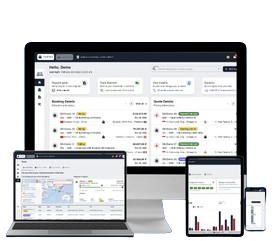
DocShipper Platform

One platform. Your entire supply chain

Sourcing, freight, customs & documents, all centralised, all visible, 24/7.

When you should use DDP (and when another Incoterm works better)

You should choose ddp incoterms when you want a turnkey delivery where your supplier handles transport, export, import clearance, duties, and last mile delivery to your named place. You gain maximum simplicity, but you give up operational control.

DDP works best when your priority is speed of execution and administrative comfort rather than cost optimization. If you lack a local entity or import license in the destination country, DDP can remove a major barrier.

  • You are a first time importer and want minimal procedural involvement.
  • Your supplier has strong experience shipping to your country.
  • The shipment value is moderate and predictable, with stable duty rates.
  • You want a single all inclusive invoice for budgeting clarity.

However, you should be cautious if customs regulations are complex or frequently changing. Under DDP, the seller becomes the importer of record in many jurisdictions, which is not always legally or practically feasible.

Scenario DDP Recommended? Why
E-commerce small parcels Yes Clear landed cost, smooth customer experience
High value industrial machinery Often No Better control with DAP or FCA
Countries with strict import licensing Risky Seller may struggle to act as importer
Long term supply chain with volume Usually No Cost savings possible with buyer managed freight

If you want tighter cost control, DAP or FCA may be more strategic. You then manage freight, insurance, and customs through your own forwarder.

At DocShipper, we often advise you to compare DDP against a structured DAP plus customs brokerage scenario. In many cases, you can reduce your total landed cost by 5 to 15% by separating transport and duties from the supplier’s margin.

Siam Shipping Advice

Not sure if DDP is truly strategic for your flow?
Run a landed cost comparison with us, we benchmark DDP vs DAP or FCA to optimize control and margin.

DDP versus other options: DAP, DDU, and common misuses

You often see confusion between DDP and DAP because both include delivery to a named place. The critical difference is who pays import duties and taxes.

Incoterm Import Duties Paid By Import Clearance Risk Transfers
DDP Seller Seller At delivery point, ready for unloading
DAP Buyer Buyer At delivery point, before unloading
DDU Buyer Buyer Obsolete term, replaced by DAP

DDU is no longer part of the official Incoterms rules, yet many suppliers still use it informally. In practice, DDU behaves like DAP but creates contractual ambiguity.

  • Assuming DDP includes unloading, it does not unless specified.
  • Using DDP in countries where the seller cannot legally be importer of record.
  • Believing DDP guarantees the lowest total cost, it rarely does.
  • Failing to specify the exact delivery address in the contract.

You should always define the named place precisely, warehouse, factory, or site address. A vague reference such as “DDP Europe” exposes you to disputes.

From a compliance perspective, DDP can increase audit risks if VAT registration rules are not respected. We systematically verify local regulations before structuring DDP solutions for our clients.

Conclusion

You now understand that DDP is the most seller intensive Incoterm in terms of cost and responsibility. It simplifies your operations but may reduce transparency and cost efficiency.

  • DDP means seller pays transport, duties, taxes, and manages import clearance.
  • Risk transfers at the named place of delivery, before unloading.
  • It is ideal for low complexity shipments and new importers.
  • DAP is often more flexible for experienced buyers seeking cost control.
  • Clear contractual wording prevents compliance and financial disputes.

If you want to determine whether DDP is truly the best option for your shipment, you should run a full landed cost simulation. At DocShipper, we help you compare scenarios and build a risk optimized international logistics strategy.

FAQ | DDP Incoterms explained: how delivered duty paid can simplify your global shipping

DDP shipping (Delivered Duty Paid) means the seller takes care of almost everything: international transport, export and import customs, duties and taxes, and delivery to the agreed place in your country. You, as the buyer, mainly have to be ready to receive and unload the goods. In practice, it’s the closest thing to saying: “Just deliver it to my door, with customs done and paid.”

Ask us anything!

Need Help with
Logistics or Sourcing ?

First, we secure the right products from the right suppliers at the right price by managing the sourcing process from start to finish. Then, we simplify your shipping experience - from pickup to final delivery - ensuring any product, anywhere, is delivered at highly competitive prices.

Component-15.png

Live Chat

Get instant assistance from our team - just click and start chatting!

Chat now
image

Fill the Form

Prefer email? Send us your inquiry, and we’ll get back to you as soon as possible.

Contact Us
image

Call us

Reach out to us on WhatsApp for a quck and personal support.

Call us
image